Black Blade Budd recommends: Piratey Reads for “Talk Like a Pirate Day”

I was just about to compose a new post for the Pegasus Pulp blog, when a strange fellow with a peg leg and a parrot on his shoulder suddenly appeared in my office. His name, he announced in a strange accent, was Black Blade Budd and he was taking over my blog in the name of International Talk Like a Pirate Day. And since he had a cutlass and a flintlock pistol and looked as if he knew how to use them, I wasn’t inclined to argue with him.

Once Black Blade Budd learned that I have more than one blog, he insisted on capering my personal blog as well. So here is Black Blade Budd’s message:

Avast, ye landlubbers! My name be Black Blade Budd and today be International Talk Like a Pirate Day, so take a gander at these piratey offerings from Pegasus Pulp.

Old Mommark's TaleFirst of all, there be Old Mommark’s Tale. Now Old Mommark, he be a legend, a true pirate’s pirate. Nowadays, he be spending all his days in a tavern on Tortuga, but in his youth… oh, he had adventures. Trust me, my luvvies, none can spin a yarn quite like Old Mommark. And if ye buy him a tankard of grog or a bottle of rum, Old Mommark be telling you some of his tales.
Read it for the low price of 99 cents or pence at Amazon US, Amazon UK, Amazon Germany, Amazon France, Amazon Spain, Amazon Italy, Amazon Canada, Amazon Brazil, Amazon Japan, Amazon India, Amazon Mexico, Kobo, Barnes & Noble, Apple iTunes, W.H. Smith, Nook UK, DriveThruFiction, OmniLit/AllRomance e-books and XinXii.

Hostage to PassionThen, there be Hostage to Passion, the story of Sir Nicholas Harcourt who be known in piratey circles as the Black Falcon. Don’t be fooled by the title, for Sir Nicholas be no aristocratic toff. No, he be a pirate like ourselves, a pirate so dashing and daring that he be knighted by the Queen of England herself for fighting the Spanish, plundering their ships and ravaging their maidens. Maidens like Doña Rosaria, a fiery Spanish lass, if there ever was one. Sir Nicholas took her hostage and swore to hang her, if her uncle did not pay up. But in the end, the fiery Doña Rosaria captured his heart.
Ye want to read the story. Ye can, for the low price of 2.99 dollars or Euros or 1.99 pound sterling at Amazon.com, Amazon UK, Amazon Germany, Amazon France, Amazon Spain, Amazon Italy, Amazon Canada, Amazon Brazil, Amazon Japan, Amazon India, Kobo, Barnes & Noble, Apple iTunes, Casa del Libro, W.H. Smith, Nook UK, DriveThruFiction, OmniLit/AllRomance ebooks and XinXii.

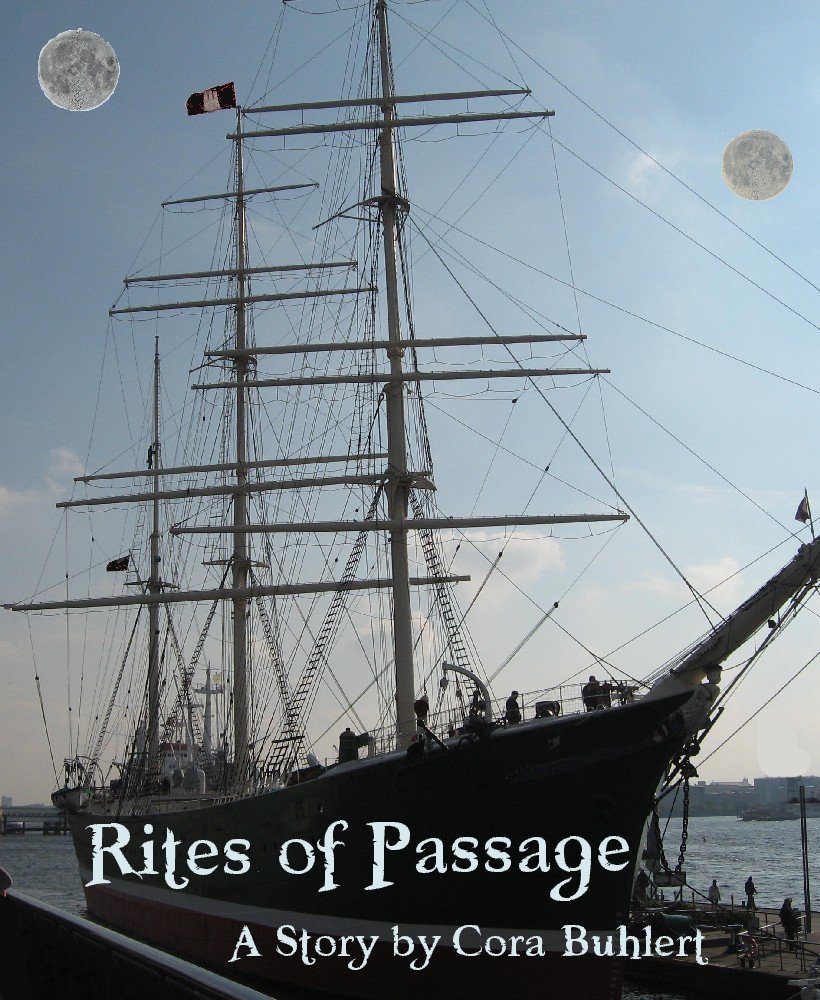
Rites of Passage Finally, there be Rites of Passage, a tale of pirates from beyond our world. And I be telling ye, the world of those pirates be real weird. They be having two moons, if ye can believe it. Just imagine trying to navigate with two moons in the sky. And imagine what the tides must be like!
But two moon or not, the pirates of that world still be our brothers. Pirates like Philon, a young whippersnapper still, but a Captain’s son and heir. Now Philon, he be an adventurous lad and he be having cats his eye on Ariana Delora, a spirited lass who’s quick with a sword and her tongue and who just happens to be the daughter of the sworn enemy of Philon’s father. I be telling ye, me luvvies, those two be the Romeo and Juliet of piratedom.
And if ye want to read their story, ye only need to pay 99 cents or pence at Amazon.com, Amazon UK, Amazon Germany, Amazon France, Amazon Spain, Amazon Italy, Amazon Canada, Amazon Brazil, Amazon Japan, Amazon India, Kobo, Barnes & Noble, Apple iTunes, Casa del Libro, W.H. Smith, DriveThruFiction, OmniLit/AllRomance ebooks or XinXii.

So what are ye waiting for, ye landlubbers? Get thee over to them stores and download them tales to your fancy e-reader thing!

And if ye want to be trying all three of them piratey tales, the fine trading post of DriveThruFiction be offering a bundle of all three for only 3.50 dollars.

Posted in Books | Tagged , , | 2 Comments

In Memoriam Marcel Reich-Ranicki

One of my personal literary heroes, Polish-German literary critic Marcel Reich-Ranicki, died today aged 93. Here is a wonderful tribute from Kulturzeit with plenty of Reich-Ranicki clips and here are two more obituaries from the New York Times and the Frankfurter Allgemeine Zeitung, the paper where Marcel Reich-Ranicki worked as a literary critic for more than fifty years.

Now literary critics are dime a dozen, but Marcel Reich-Ranicki was unique. His literary taste was pretty much diametrically opposed to mine, I hardly ever agreed with his verdicts and I suspect that he would have hated my books, if he had ever read them. Nonetheless, Marcel Reich-Ranicki’s TV show Das Literarische Quartett (The Literary Quartet) was one of the most entertaining programs on German TV. And considering that it was a 75 minute program of four literary critics sitting around a table and discussing the sort of heavy literary tome I rarely read, that is saying something. And what made Das Literarische Quartett so bloody entertaining was Marcel Reich-Ranicki’s sharp tongue, his bluntness and his utter lack of embarrassment. In fact, the show was so entertaining that I was shocked when Sigrid Löffler, one of Reich-Ranicki’s fellow critics, walked out in 2000 after a disagreement over a Haruki Murakami novel. I’d always assumed that the animosity between the critics was just part of the performance and was stunned to learn that Sigrid Löffler really hated Marcel Reich-Ranicki’s guts.

She wasn’t the only one, for Marcel Reich-Ranicki told it as he saw it. He eviscerated books and was hated by the elite of German postwar literature to the point that in 2002 two different novels murdered a thinly disguised Reich-Ranicki stand-in. Marcel Reich-Ranicki was the man who conjugated the F-word live on German television (warning: clip is totally not safe for work). He was the man who declined the German TV Award live during the awards ceremony, because he did not want to be honoured alongside stupid reality and talent shows and was subsequently given half an hour to expound on his views on television in an interview with the very awards show host he had snubbed.

All those angry young and not so young men* critics who expound their views about the current state of the SFF genre with lots of swearing and rude words? They’re just pale imitations with not a tenth of the acrid wit and sheer bloody entertainment value of a single episode of Das Literarische Quartett.

Marcel Reich-Ranicki was the real deal and he will be missed.

*And they usually are men. And I’m not supplying names, since I’m sure you can supply your own.

Posted in Books | Tagged , , , | 6 Comments

Time Travel and Gender

Back in July, Anna Smith asked at The Guardian “Why can’t women time travel?” and laments that mainstream time travel movies almost always feature male protagonists.

My initial reaction to that article was: But women do time travel. There are plenty of female time travelers. There’s Claire Randall from Diana Gabaldon’s Outlander series, Grace St. John from Linda Howard’s Son of the Morning, Mendoza from Kage Baker’s Company novels (sort of), Verity Kindle from Connie Willis’ To Say Nothing of the Dog, Dana from Octavia Butler’s Kindred, the eponymous heroine of Susan Grant’s The Legend of Banzai Maguire and its sequel The Scarlet Empress (again sort of, cause Banzai Maguire is more a female Buck Rogers type character, who wakes up in the future), the time-cop heroine of Kay Austin’s Time Transit, the heroines of Teresa Medeiros’ Breath of Magic and Touch of Enchantment, the heroine of Robin Schone’s Awaken, My Love, who infamously masturbates her way back in time (really!) and many others. Writer Gwyn Cready has built a whole career out of writing time travel romances about women traveling through time to find love in the arms of a hunky hero from the past. On the TV front we have Alex Drake from Ashes to Ashes, Kiera from Continuum, Amanda from Lost in Austen and the overwhelming majority of Doctor Who companions. Torchwood‘s resident time traveler was male, but the show had a bunch of time travel episodes, which involved female time travelers, both guest characters and a female member of the regular cast. So women clearly do time travel. Anna Smith simply hasn’t read the right books or watched the right TV shows.

Meanwhile, Charles Stross responds to Anna Smith and attempts to analyse why time travelers are overwhelmingly male. Unlike Anna Smith, Charles Stross is aware that there are female time travelers in what he calls “fantasy and paranormal romance” (though time travel romance is usually considered its own subgenre apart from paranormal or futuristic romance), but claims that there are none in SF. Now he is wrong on that account, because IMO Kage Baker’s Company novels, Connie Willis’ To Say Nothing of the Dog, Kay Austin’s Time Transit and the TV show Continuum clearly count as SF. There’s also Noÿs Lambent from Isaac Asimov’s The End of Eternity, an SF novel if there ever was one. To be fair, Noÿs is not the protagonist of The End of Eternity, but she is female and a time traveler and indeed the catalyst who makes the whole plot possible.

But even if Charles Stross missed a few female SF time travelers, he nonetheless makes some interesting points:

The time travel story is a tale of tourism in the classical sense: an activity of the privileged, making spectacle of the past (and, occasionally, the Wellsian future). And women make poor time travelers because in the foreign countries of the past they lack the agency conferred by privilege.

Now plenty of the examples of stories about female time travelers I listed above gain a lot of mileage precisely out of the power imbalance between the genders in the past. Issues of privilege and power imbalance (not just gender issues either, but also ethnic and religious issues) drive ninety percent of the plot of Outlander. Octavia Butler’s Kindred is basically a novel about slavery and racism. Arian Whitewood from Teresa Medeiros’ Breath of Magic is persecuted as a witch in Puritan times, a fate that befell far more women than men, and time travels into the future when the spell she casts misfires. The masturbating heroine in Robin Schone’s Awaken, My Love finds that her liberated sexuality clashes with the stifling conventions of Victorian times. Amanda from Lost in Austen comes up against the strictures of Regency era England far more often than one would expect from a devoted Jane Austen fan. The Torchwood episode “Captain Jack Harkness” addresses both the racism facing Toshiko and the difficulties of living as a gay man at a time when homosexuality was criminalized. Doctor Who, usually the epitome of escapist time travel yarns, had Martha Jones, a black medical student, forced to work as a maid during an extended stop in 1914 in the two-part episode Human Nature/Family of Blood and dealing with the everyday racism of the time, while the Doctor was blissfully unaware that there was anything wrong. And even Alex Drake, who only traveled from 2008 to 1980, finds herself dealing with the inherent sexism, let alone racism and homophobia, in the Metropolitan Police in the early 1980s. Without the imbalance of power and privilege, many of those books/TV series wouldn’t have a plot.

Charles Stross writes:

A young and intrepid male time traveler might experience a tour of the Great Times as an educational adventure; an equally young and intrepid female time traveler could count herself lucky if she merely ended up in a Magdalene Laundry. (There were plenty of worse places to land, horrifying though this might seem.)

I don’t recall any time travel tale where a time traveler ended up in a Magdalene Laundry. However, there are plenty where female time travelers find themselves threatened with workhouses, rape, forced marriage or find themselves nearly burned at the stake as witches. Claire Randall from Outlander experiences all of these except for the workhouse. And yet such books are not considered “grim reading”, even if they are halfway realistic (and most aren’t), but enjoyable escapism. So Charles Stross is obviously mistaken that readers of time travel tales want to identify only with the privileged, even though most time traveling women do end up among the privileged, i.e. the aristocracy, of the respective time.

Charles Stross continues:

For a female protagonist to successfully enjoy time travel as a form of tourism implies either that she has defensive resources that render her invulnerable to the depredations of the locals (a Culture knife missile up her sleeve should do the trick), or that she has acquired a privilege power-up—probably by way of cross-dressing, which shows up depressingly often as a get-out-of-time-jail-free card. (It’s so common in the literature, in fact, that it’s somewhere between a cliche and a full-blown sub-genre convention.) But in neither of these circumstances is she able to engage with the alien society from within: She remains an outsider. Her privilege delivers alienation, not engagement.

I don’t really know how he comes to this conclusion, because the many tales of female time travelers I listed do not support this at all. For example, Claire Randall of Outlander ends up under the protection of a Scottish clan via making herself indispensible because of her nursing skills. She lives with these people and eventually even marries one of them (not entirely voluntarily). Alex Drake of Ashes to Ashes works as a police officer in the past (okay, so it’s not really the past, but neither Alex nor the viewer knows until the very end), solves cases and befriends her colleagues. She also attempts to meddle in her personal history. And Susan Grant’s Banzai Maguire gets involved in a rebellion in the future. It would be difficult to engage more with the “alien society” from within than these women do.

To be fair, there is a difference between male tourist time travelers and the various female time travelers I listed. For while male time travelers can fall in love on their travel (and often do, all the way back to H.G. Wells’ The Time Machine), female time travelers inevitably fall in love, even if the story in question is not an explicit genre romance such as Kage Baker’s Company series, Isaac Asimov’s End of Eternity or Ashes to Ashes. Contary to what Charles Stross says about women remaining detached from the alien society of the future and/or past, the detached time traveler who is merely an observer is a purely male figure. Female time travelers usually throw themselves head on into the new, alien world they find themselves in, often via throwing themselves into the arms of a hunky man from the past or the future.

There is another factor that separates male and female time travelers. For female time travelers rarely hop into their time machine and dial up 1812 or whatever. Instead, female time travel is almost always accidental and achieved via walking into the wrong stone circle, stumbling upon a time portal, touching the wrong magical artefact, getting shot and waking up in the past, vigorous masturbation, etc… Partly this is due to the demands of the time travel romance subgenre, where time machines are frowned upon. Indeed, the submission guidelines of the new defunct Dorchester Publishing, which used to specialize in this sort of thing, explicitly used to state “No time machines”, which always confused me to no end, because how else are you going to travel into the past or future?

I was so curious about the supposed aversion of romance readers to time machines that I once asked a bunch of them about this on a forum. The responses I got ranged from “Time machines are unromantic” to “It takes all of the urgency and tension out of the story, if the hero or heroine can just hop into their machine and return tp their own time.” Apparently, that reader was unaware that time machines can malfunction or otherwise fail to work as advertised as well. Just ask the Doctor.

SL Huang also responds to and disagrees with Charles Stross and points out that time travel stories are rarely historically accurate anyway, that male time travelers would be just as likely to run into trouble and find themselves imprisoned or executed as women and the modern view of the past as one big monolythic misogynist dystopia as wrong and coloured by our own inherent sexism.

Here is a quote:

The escapist time-travel sub-genre is not inherently sexist in the least—there is not the slightest logical reason we shouldn’t have just as many female protagonists zipping through time as male ones. Authors and other creators have not been somehow forced into male protagonists because “the story wouldn’t work otherwise,” and I object to giving them even the hint of that excuse. The reason we have an overabundance of male protagonists compared to female ones is not that the Doctor or Marty McFly or the Time Traveler’s Wife’s Husband couldn’t be written as women; instead, it is a far more simple reason, and the same reason we have an overabundance of male protagonists in so much of the rest of the SFF genre: simple, ingrained institutional bias. Not the inherent sexism of the material, but the unconscious sexism of its creators.
[…]
Let’s write more female-led escapist time travel, everyone.

This is a very important point SL Huang makes here. SF-nal time travel narratives tend to have male protagonists, because for way too many writers, white straight men are still the default.

But I’d even go one step further and point out that we already have plenty of escapist time travel adventure with female leads. And if you take another look at the many examples I listed above, you’ll note that almost all of them were written by women. The TV show Ashes to Ashes was created by two men and I have no idea who is behind Continuum. But everything else I listed was written by women. In fact, the whole subgenre of time travel romance is basically escapist fun by women for women with female leads.

So yes, we have plenty of escapist, female led time travel adventure. However, marketing forces as well as the SFF community have decided to engage in a bit of false categorization and classify these books as something other than SFF.

Posted in Books, TV | Tagged , , , , , , , , , | 11 Comments

Vechta Photos and the Best Bakeries in Northwest Germany

I’ve been keeping this under wraps until all the papers have been signed, but in the fall semester I will be teaching English at the University of Vechta again. I already taught English at Vechta a couple of years ago. This time around, I will teach a class to prepare aspiring English teachers for their teaching internships.

The University of Vechta is Germany’s smallest university with some 3500 students, mostly aspiring teachers as well as social workers, gerontologists and agronomists. It started out in 1830 as a teacher training college operated by the Catholic church.

Vechta itself as a town of 32000 people approx. sixty-five kilometers south of Bremen. It’s a typical North German small town, a bit more diverse with regard to population and culture than similar small towns due to the many students. Vechta is also a bit of a regional oddity, since it’s a very Catholic town in traditionally Lutheran Protestant Northwest Germany, part of a Catholic enclave that stretches from approx. thirty kilometers south of Bremen all the way to the Dutch border.

I was at the university yesterday to sign some papers and get some books from the university library. Afterwards, I went into the city, because Vechta still has a Leffers store, a largely defunct chain of clothing stores with an excellent selection of sensible high quality underwear and nightwear. And since I neglected taking photos the last time I worked there, I decided to remedy that and took my camera along.

So here are some photos of Vechta, where I’ll be teaching soon, along with two of the best bakeries in the region: Continue reading

Posted in General, Work | Tagged , , , , , , | 46 Comments

Yet more Worldcon and Hugo Reactions

The discussion about Paul Cook’s attempts to define SF for the rest of us seems to have died down, but it seems we’re still talking about Worldcon and the Hugos and if/how they should change. My last round-up of Hugo and Worldcon reactions is here BTW.

First of all, Paul Cornell apparently referred to the SMOFs, an acronym that stands for Secret Masters of Fandom (i.e. the people who organize and run cons), as “Smurfs” in reference to this photo of overwhelmingly male and white Worldcon chairs posted by Jim Hines and plenty of others. Personally, my reaction to the photo was “Wow, there are are more women than I would have expected.” I don’t really think Smurf is an insult either. After all, Smurfs are clever, brave, industrious, kind and regularly beat Gargamel at his own game. Nonetheless, some people were upset, so Paul Cornell apologized to all offended SMOFs. File 770 and Cheryl Morgan have more. Continue reading

Posted in Books, Links | Tagged , , , , , , , | 21 Comments

Bremerhaven Photos, Part II: Ships

Somewhat delayed by the recent WorldCon, Hugo and “what is SF” discussions, here is the second part of my post featuring photos taken during a recent trip to Bremerhaven. Part I with some information about the city in general is here BTW.

This post will focus on photos of ships. Since Bremerhaven is the fourth busiest port in Europe, there are rather a lot of them. Most of the historical ships seen in these photos are courtesy of the German Maritime Museum and the extensive exhibits in the so-called museum harbour. Continue reading

Posted in General | Tagged , , , , , | 8 Comments

New Post-Apocalyptic Novelette: The Hybrids

As I’ve hinted at before, I have a story to announce. It’s another foray into science fiction, the genre that still owns my heart. However, instead of the next Shattered Empire story (coming later in 2013), this novelette tackles a different subgenre, namely post-apocalyptic SF.

Though this is the first time that it’s been released, The Hybrids is actually one of my oldest surviving stories, scribbled by hand twenty years ago during a particularly boring lecture. However, the current edition of The Hybrids is an almost complete rewrite. Only the plot and a couple of dialogue lines remain of the original.

Looking back, I wonder why I never did anything with the original version of The Hybrids beyond typing it up. I had already gotten my first rejection letter by the time I wrote The Hybrids and it’s certainly one of the better stories I wrote during that time (and some of the other, better stories of that period eventually did sell after a couple of rewrites), yet I never submitted it anywhere. Instead, it just lingered on my harddrive until I went through all of my old work to see if any of it was salvagable.

So what happened? Shortly after finishing The Hybrids, I read somewhere post-apocalyptic Adam and Eve stories were so cliched that they shouldn’t be written at all. Now The Hybrids is is clearly post-apocalyptic. And while it never was an Adam and Eve story, not even in its original form, it was still close enough that I felt very embarrassed about conforming a cliché I didn’t even know existed and promptly trunked the story without ever doing anything with it.

So here it is, finally in (electronic) print after twenty years: The Hybrids

The HybridsGordon Havers thought that he was the last man on Earth – after a virus killed off everybody else. So he lived on much as he had before the pandemic that wiped out humanity, eeking out a living as a trapper in the Canadian Rockies.
But one day, there is a knock on the door of Gordon’s log cabin. And when he opens the door, he finds an attractive young woman on his doorstep to his infinite surprise. So perhaps Gordon isn’t the last living human being after all? And maybe there is still a future for the human race.
There’s only one problem. Joanna Creed isn’t human…

.
For more information visit the dedicated The Hybrids page.

Buy it for the low price of 2.99 USD, EUR or GBP at Amazon US, Amazon UK, Amazon Germany, Amazon France, Amazon Spain, Amazon Italy, Amazon Canada, Amazon Brazil, Amazon Japan, Amazon India, Amazon Mexico, Kobo, Barnes & Noble, Apple iTunes, Casa del Libro, W.H. Smith, Nook UK, DriveThruFiction, OmniLit/AllRomance e-books and XinXii.

Posted in Books | Tagged , , , , , , | Leave a comment

Yet more responses to Paul Cook

We’re still talking about Paul Cook’s ill thought out post about what does and does not constitute SF, so here are the latest responses:

At Teleread, Chris Meadows cames to the conclusion that Paul Cook was deliberately trolling for outraged reactions and that we are obliging him by providing those reactions. He (apologies if I got the gender wrong, but the Twitter pic suggest male) also has a great response to Paul Cook’s preemptive, “Wah, you all hate me, just cause I dare to have an opinion” whine:

No, you twerp, you’ve offended people by expressing that opinion offensively. Lots of people somehow manage to have opinions without offending people. Thousands of them, every day!

Chris Meadows also links to this wonderful tweet by Patrick Nielsen Hayden in response to Paul Cook. And in the comments to his post, someone also points out that if Paul Cook was really so concerned about the purity of the SF genre, he would also have to summarily evict Isaac Asimov, because Asimov’s Elijah Bailey and Daneel R. Olivaw novels are unambiguous murder mysteries in an SF setting (and they even have romantic subplots, though relationships were not Asimov’s strong point). However, The Caves of Steel and The Naked Sun are apparently okay, because Elijah Bailey and Daneel R. Olivaw at least don’t discuss fashion and don’t engage in hot robot human sex (now that’s a fanfic I’d love to see).

Angela Highland a.k.a. Angela Korra’ti finds Paul Cook’s rant simply facepalm worthy, a sentiment that I share. And for those wondering why so many people are upset about and arguing with a guy who isn’t all that important in the great scheme of things, Angela Highland answers as follows:

But on the other hand, women in SF/F don’t really have the luxury of not paying attention to this. We have to keep talking about it until it stops.

At The Other Side of the Rain, Alix Heintzman is wondering why we are still having this conversation, considering we’ve been having it for decades now.

At The Owl Underground, someone named WOL (who is very likely not really an owl) also comments on Paul Cook’s rant and offers the following quote:

After reading the article in question, it seems to me that Mr. Cook suffers from severe genre dysphoria. Maybe Mr. Cook would be happier, or at least less strident, if we created a new niche genre: “old school hard core escapist science fiction” with the target audience of middle-aged white cis male readers who objectify women and who identify as 100% red blooded manly men. We could call it “Mitty-gritty SciFi”

Though to be fair to Paul Cook, he does not blanket dislike all female SF writers. Indeed, he mentions in the comments to the original post that he does like Pamela Sargeant and Kij Johnson. And while he could be confused about Kij Johnson’s gender because of her ambiguous name, Pamela Sargeant’s name is pretty unambiguous. On the other hand, Paul Cook also dislikes a bunch of authors who are unambiguously male, namely Gene Wolfe, Steve Miller and Alexandre Dumas.

Steven Brust offers a a few points in response to Paul Cook and follows it up with this hilarious post about how women are ruining SF.

At Nighthawk Postcards (love the header image BTW), J.B. Whelan offers not just his response to Paul Cook, but also that of his wife Stephanie in the form of a hilarious short story called The Harshest Mistress.

Not a response to Paul Cook, but pertinent nonetheless, is this interview with YA author Rainbow Rowell at XOJane. It’s a great interview and you should read it all (and then go out and order Ms. Rowell’s books – I know I did), but I found this quote particularly striking with regard to the current discussion:

The thing that really enrages me is when women and girls are demeaned for wanting romance. Like there’s something weak and dumb about wanting characters to fall in love, or wanting love for yourself. THIS IS SO WRONG. Love is the finest thing. It’s the thing everyone wants and needs and searches for. We might not all yearn for romantic love, but most of us do. Men and women.

I need to see love in a story for it to feel complete to me; it’s Han and Leia that make “The Empire Strikes Back” my favorite Star Wars movie. And if I love something that’s missing romance or endlessly teasing it (*clears throat, hums Sherlock theme song, doodles picture of Mulder and Scully*), I want to read and write fic that completes the picture.

Yes, this. A thousand times this. On a related note, Apex Magazine has a great article by Deborah Stanish about how young female fans, the so-called “fangirls” are often derided for doing fandom wrong, simply because they express their fandom in a different way than older fans.

Finally, Lois McMaster Bujold, one of the authors who don’t write what Paul Cook deems “proper SF”, responds at Goodreads and points out that debates about what is and isn’t “proper SF” has been raging for longer than most of us have been alive. She also points out that the tropes, motifs and styles that annoy defenders of “real SF” tend to change with the times and that the New Wave and Cyberpunk were once as controversial as Steampunk, zombies and crossgenre elements (and fantasy, if you are Paul Cook) are now.

Here is a quote:

Each decade seems to have had its own version of the barbarians at the gates – the New Wave in the late 60s and early 70s, Cyberpunk in the 80s, the rise of fantasy since Tolkien, and so on. (Some reader older than me will have to tell us what the 50s and 40s and 30s were kvetching about, but I guarantee there was something.) Boiled down, it was as if each camp in the arguments believed that there existed some Platonic Ideal of SF (suspiciously matching the promoter’s own tastes), toward which all works and all authors ought convergently to aspire.

And another:

What I think is actually happening is that each writer (and reader and critic) is supplying their own bright thread to a growing tapestry that we shorthand “the SF field”, and when people squint at it as a whole, they see some picture emerge. No single thread is the picture, though it could not exist without all of its threads, any more than a painting is some measured amount of canvas and pigment and glue; if you reduced a painting to its elements, the image would disappear. That image is an emergent property, no less real for not being material. (Some people think human consciousness itself is something like this.)

People being what they are, I think it is also probable that everyone perceives a different picture from this tapestry (thank you, Dr. Rorschach), just the way every person reading the same book constructs a different reading experience in their head.

Lois McMaster Bujold makes some very important points here, namely that attempts to define the genre are as old as SF itself and indeed one of those debates that resurge every other year or so (along ironically with the “women in SFF” debate) and that all too often those debates take a turn towards excluding that sort of SFF that the debater doesn’t personally like.

The other important point is that SF is a big genre (and itself part of the even bigger umbrella genre of speculative fiction) made up of dozens of different subgenres and trends. And while we personally may not enjoy every single subgenre or trend out there and usually have our very own ideas of what the perfect SF novel looks like (I post a bit about my personal criterias for the ideal SF novel here and how “fighting against tyranny and oppression” has always been a crucial element of the genre for me, even if it doesn’t show up in any of the official definitions), that doesn’t mean that those works that are not to our tastes are not part of the genre. Cause the genre is big enough for all of us.

BTW, those of you who wonder just what Paul Cook considers “real” SF, here is a list of his published novels at Fantastic Fiction.

Posted in Books, Links | Tagged , , , , , , | 6 Comments

The Pegasus Pulp Catalogue

Among all the other stuff, I almost forgot to mention that Pegasus Pulp now has a catalogue. And unlike most other publisher catalogues, the Pegasus Pulp will be continuously updated, as new titles become available (because I can). Sharp eyes may also notice a new story, which will be announced in the next few days, as soon as it’s live everywhere.

You can flip through the catalogue below or download a PDF version (Warning: Big file).

Posted in Books, Writing | Tagged , , , | 1 Comment

Hugos and Worldcon Redux

While some of us are debating about Paul Cook’s rather clueless attempt to define what is and isn’t SF (read the previous two posts for more), the discussion about the Hugos and the future of WorldCon is still happily chugging along.

The given the amount of discussion that the announcement of the Hugo nominees has caused earlier this year, post Hugo reactions have been remarkably quiet. So far, the only negative reaction has been on Facebook, where military SF author John Ringo rants about how John Scalzi’s pandering to what passes for leftwing in the US may have won him a Hugo (or three), but pisses off what Ringo views as Scalzi’s core readership and may cost him sales. He also complains about Scalzi’s tenure as SFWA president, during which Scalzi apparently bothered too much with “trivial” issues such as harrassment at conventions. Oh yes, and he attacks the straw communists of New York publishing as well. Never mind that John Ringo no more defines the readership of military SF than anybody else does, the passive aggressive threats of “We won’t buy your books anymore” (Doesn’t Nick Mamatas have an icon for this?) don’t really make him come across all that well. Too bad, because John Ringo actually won my respect for his classy response to the “Oh, John Ringo, no” thing a few years back, though I don’t read his books, cause they’re not my cup of tea. The rant was pointed out by Andrew Trembley in the comments to my previous Hugo post BTW. Continue reading

Posted in Books, TV, Writing | Tagged , , , , , , , , | 11 Comments