On June 3, 2026, I attended a preview showing of Masters of the Universe at the Savoy Movie Theater in the Hamburg St. Georg.
As for why I chose this particular theatre rather than one closer to home, for starters, it has one of the largest screens in North Germany. But the main reason was that the Savoy specialises in showing international movies in their original version rather than dubbed, as is the norm in Germany. And since I have only ever watched Masters of the Universe in English – West German audio dramas of the 1980s notwithstanding and they were occasionally marred by mispronunciations – the German dub would have irritated me to no end and pulled me out of the film. So the Savoy it was.
My mostly spoiler-free review is here at File 770 and I was also on the MarkWho42 podcast, where I discussed the movie (with some spoilers) with Juan Sanmiguel and Vicky Jakubowski. There will also be a more detailed, spoilerish dissection of the movie on this blog later on, when more people had the chance to watch the movie.
I did want to get this post finished, before leaving for the 2026 Los Amigos Masters of the Universe convention in Heidelberg. However, because of circumstances beyond my control, I didn’t get it done on time, so it goes up now. Stay tuned for my adventures at Los Amigos and the long trip to Heidelberg. And yes, I will eventually blog about something other than Masters of the Universe again, too.
However, I also wanted to talk about my trip to get to Hamburg and the theater, since Hamburg is located about 100 kilometers from where I live. Normally, driving 100 kilometers isn’t much of an issue. However, Hamburg is an absolutely traffic nightmare and has been for as long as I remember. My Dad, who actually worked in Hamburg for almost twenty years or so, hated the traffic so much that he actually paid for a more expensive plane ticket, so I could fly from Bremen rather than Hamburg. He also ironically hated Hamburg so much that when the company he was working for at the time moved their headquarters from Bremen to Hamburg in 1982, he quit and instead went to work in Singapore in a move that must have made sense to him at the time, though I can’t for the life of me imagine how. Okay, I also think that he expected a promotion he didn’t get or something like that, but going to work in Singapore was still a weird and impulsive decision. But that’s a story for another day.
Unlike my Dad, I actually like Hamburg. It’s a lovely and lively city and I have probably visited Hamburg more often in the past two years than in the ten years before that. That said, getting there is still a pain.
Now the Savoy Theater is located only five minutes from Hamburg Central Station, which is a nightmare all of its own. These days, Hamburg Central Station is the busiest railway station in Germany (yes, busier than Berlin Central) and the second busiest in all of Europe after Gare du Nord in Paris and the 120-year-old station and particularly the platforms are simply too small for the amount of traffic they get. There have been times when the platforms at Hamburg Central Station were so overcrowded that I genuinely feared someone would be knocked onto the tracks. There have also been times where the police had to clear the platforms of passengers to prevent accidents.
However, in this case, driving to Bremen Central Station, hopping onto the train to Hamburg, going to the theater and taking the train back actually seemed like a good idea. There was only one problem. The last train from Hamburg to Bremen left at 11:20 PM, around the time the movie finished. And if I missed that train, there wouldn’t be another until five AM or so. Now Hamburg is one of those cities that never sleeps and you can actually spend the night wandering around St. Pauli and then head to the fishing market at dawn. However, I wasn’t really looking for the “Auf der Reeperbahn nachts um halb eins” (On Reeperbahn at half past twelve by night) experience. Though honestly, if the Reeperbahn still looked like it does in that clip from the 1943 movie Große Freiheit No. 7, I totally would have done it. But that St. Pauli is gone, destroyed by bombing raids shortly after those scenes were filmed.
So I instead decided to follow my usual modus operandi when going to Hamburg, namely driving to Hamburg-Harburg, parking my car at a commuter car park and then taking the S-Bahn light rail in to the city proper. Cause the main reason Hamburg is a traffic nightmare is that there simply aren’t enough places to cross the river Elbe and that most of the traffic has to squeeze across the same few bridges that are more than a hundred years old by now. Okay, there is also two tunnels under the river Elbe, one of which is strictly for bike and foot traffic these days (and while you could drive through it in the past, it was an adventure, since cars were hoisted up and down by a freight elevator) and the other is chronically congested.
Since I was going to watch a Masters of the Universe movie, I of course took some action figures along. More precisely, I took He-Man and Teela along, so they could have a movie date. Though this time around, I took the small and cheap movie figures from the Core line along, because losing a 12 Euro Core figure at the cinema or on the S-Bahn wouldn’t be as much of a loss as losing a 30 Euro Masterverse figure, let alone a Classics figure that might go for 80 or 100 Euros these days.
Autobahn A1 and the first traffic jam
I set off at about three PM and immediately hit the first problem when I drove onto Autobahn A1 at Bremen-Brinkum, because the Autobahn bridge across the river Weser is currently undergoing much needed renovations, which causes nigh constant traffic jams for up to ten kilometers in both directions. It’s a nightmare for everybody living in the Bremen region, especially since the traffic also tends to spill out into adjacent towns. In the middle of the day, the constant traffic jam is usually tolerable and the exit Bremen-Brinkum is only about five kilometers from the construction zone. So I did decide to drive onto the A1 rather than around the construction zone and join the Autobahn later. That said, it still took me about twenty minutes to get through the construction zone.
Once I’d made it through the traffic jam, the road was mostly free all the way to Hamburg, though there was a the usual truck traffic (the A1 is one of the main North-South routes for all of Europe together with Autobahn A7) as well as a quite a bit of holiday traffic. Thursday is Corpus Christi Day and a public holiday in Catholic parts of Germany, so you had people using the long weekend for a short holiday. I also suspect that the Netherlands may have some kind of school holiday based on the number of Dutch cars I saw.
Now the Bremen-Hamburg leg of Autobahn A1 is pretty boring. There’s lots of fields and trees and very little else, except that you suddenly start getting hills from the exit Heidenau onwards. These hills are called the Black Mountains or Harburg Mountains and they are a terminal moraine from the last ice age. I always find them irritating, because why on Earth does Hamburg have hills, when there aren’t supposed to be any hills this far north. Though there is one spot near the parking lot Stillheide between exits Heidenau and Hollenstedt, where you reach the summit of a hill and suddenly have a lovely view of the Harburg Mountains stretching out in front of you. Here is a photo (not mine).
Afternoon Coffee in Sittensen
Unfortunately, I had run out of milk earlier that day, which meant that I needed to get milk and possibly some other groceries. However, I couldn’t get groceries on the way home, because by that time, all the supermarkets would be closed. So I had to go grocery shopping on the way to Hamburg.
Now as i said above, the area between Bremen and Hamburg consists of thinly populated heath and geest. There are some towns here, but most of them are quite a bit away from the Autobahn. The only things that are directly adjacent to the Autobahn are Autohöfe, which don’t have grocery stores, only convenience stores catering to truckers, and a few tiny villages that don’t even have a bakery. The only exception is Sittensen, a large village/small town halfway between Hamburg and Bremen that is directly adjacent to the A1. I occasionally stop there on the way back from Hamburg, because Sittensen has several grocery stores and also gas stations with reasonable prices as well as some dining options.
So I left the Autobahn A1 at Sittensen and went grocery shopping at a local Edeka store. I got milk, found the first Federweißer (partially fermented grape juice, i.e. very young wine) of the year to my delight and also picked up a bowl of fresh strawberries from a farm stall in front of the Edeka store. The strawberries in the store were probably cheaper, but fresh strawberries from a farm stall are much better.
By this time, it was half past four. The movie didn’t start until half past eight, so I had plenty of time. So I decided to stop for the some coffee and cake at Bakery Freitag. And the café part of the bakery was completely empty, I could even snap a photo of He-Man and Teela starting off their movie date with coffee and poppyseed crumble cake:

He-Man and Teela start off their movie date with latte and poppyseed crumble cake at Bakery Freitag in Sittensen.
Autobahn A261 and the second traffic jam
After finishing my cake and coffee, I drove back onto Autobahn A1 and left it again about twenty kilometers later to change onto Autobahn A261 at junction Buchholz.
Autobahn A261 is only nine kilometers long and serves as a shortcut to connect the A1 to Autobahn A7, i.e. the other main North-South route for all of Europe. The A1 and A7 do intersect directly at the Horster junction and intersection Maschen (a Cthulhuesque mess of a highway junction), but both are chronically congested and the A261 was built to relieve that congestion as well as the small towns of Tötensen and Rosengarten, who suffered from traffic trying to circumvent the chronically congested Horster junction and intersection Maschen.
After leaving Sittensen, I heard on the radio that there was a traffic jam on Autobahn A7 before the Elbtunnel. This isn’t overly unusual. As I said, Hamburg is a traffic nightmare and the Elbtunnel is the best way to across the river – better than the ancient Elbe bridges in the city – but it is still prone to congestion, especially since pretty much all the North South truck traffic for all of Europe has to go through this one tunnel. Besides, that traffic jam didn’t affect me in the slightest, because I wasn’t even going onto the A7, let alone through the Elbtunnel. Instead, I would leave the A261 one exit before it meets the A7. Not to mention that there are four exits and at least ten kilometers of Autobahn between junction Hamburg Southwest, where the A261 meets the A7, and the Elbtunnel.
However, it turned out that the traffic jam at the Elbtunnel was massive – ten kilometers long – and that it had spilled out onto the A261. And because the A7 was blocked, lots of drivers left the A261 at the exit Hamburg Marmstorf-Lürade to make their way across the Elbe bridges in the city. Yes, Hamburg actually has signposts that say “Elbe Bridges”, because those bridges are so important to the traffic through the city. Unfortunately, Hamburg Marmstorf-Lürade was the same exit I had to take to get onto Bundesstraße B75 for the last seven kilometers to Hamburg-Harburg. Even worse, there is a traffic light and a construction zone on the B75 almost directly behind the Autobahn exit, which further slows down traffic.
As a result, I hit the next traffic jam before I even got to the actual exit ramp. And the progress was glacial, especially on the exit ramp. Even worse, I got a cramp in my foot, while I was on the ramp and couldn’t even take my foot off the brake, lest my car roll down the ramp and into the car behind mine.
At this point, I was about seven kilometers from my destination, the Harburg commuter car park. And it literally took me twenty minutes or so for the 600 meters up the exit ramp and past the traffic light. Even worse, the B75 also passes the Hamburg-Marmstorf exit of Autobahn A7 shortly after, which brought in another flood of cars and trucks trying to escape the traffic jam on the A7. In short, this final part of the trip was absolutely painful and I was glad that I had left so early with plenty of time to spare.
Once I got past the construction zone on the B75 and the crossed the A7, the going got a little better. The traffic still piled up in front of traffic lights on occasion, but most of the time, traffic was moving. I finally made it to the commuter car park in Hamburg-Harburg, though it took me more than two hours altogether – not counting the pit stop in Sittensen – to drive 106 kilometers.
Hamburg Harburg and Hamburg Central Station
At Harburg, I parked my car at the commuter car park, which was pretty full, since it turns out lots of people are leaving their car there for a night on the town. I actually had to drive all the way up to the roof to find a spot.
As for what the view from the roof is like, here are two photos I took earlier this year during another trip to Hamburg:

The view from the roof of the Hamburg-Harburg commuter car park at the former Phoenix tire factory, now a shopping mall. Note the ICE high speed train on the railroad tracks. ICE trains regularly stop at Hamburg-Harburg.

Hamburg-Harburg railway station as seen from the roof of the commuter car park. The station was built in 1897.
The commuter car park has a direct connection to the Harburg S-Bahn light rail station, so I bought a ticket – letting two women who were also headed to a theater, but to a performance that started earlier, go ahead – and took the next train to Hamburg Central Station.

Hamburg Central Station, built in 1906.
I arrived at Hamburg Central Station at seven PM. The movie would begin at eight thirty, so I still had sufficient time for dinner.
Dim Sum in Hamburg
One of the great appeals of Hamburg for me is that it is a great foodie city and that you can find cuisines here that you don’t normally see in Germany. For example, Hamburg is one of the few places in Germany, where you can find authentic Mexican food.
However, I wanted to stay close to the station and the movie theater and I had dinner at Dim Sum Haus, a Cantonese Chinese restaurant that has been around since 1964 and used to be the only place where you could eat dim sum in North Germany, though Bremen also has a few dim sum places by now.
Due to the harbour, Hamburg actually had a Chinatown in the St. Pauli neighbourhood in the early twentieth century. You can catch glimpses of it in the 1944 movie Große Freiheit No. 7, a romantic melodrama which is set in Hamburg St. Pauli and is worth watching for a glimpse at the long lost world of St. Pauli in the 1940s alone. As for Hamburg’s Chinatown, in 1944 the Nazis rounded up and arrested the Chinese nationals living in Hamburg as well as their German wives/lovers and the children resulting from those relationships, while many of the buildings that housed Chinese restaurants, shops, laundries and boarding houses were destroyed by bombing, though at least one Chinese bar/boarding house operated until 2021, when the daughter of the original operator died.
I don’t know if the Dim Sum Haus has any connection to the pre-WWII Chinatown in St. Pauli, though it is an institution in the city (even former chancellor Olf Scholz visited at some point) and it’s also directly opposite Hamburg Central Station.
Since I didn’t really have time for an extended dinner, I opted for two different types of dim sum and a pot of tea. No He-Man and Teela romantic dinner photo, because the restaurant was pretty full, but I did snap a photo of my dim sum:

Shrimp Shumai

Buddha rolls, i.e. tofu skin filled with vegetables
Views of Hamburg St. Georg and an Digression on German Theater
After dinner, I made my way to the theater. It was still light outside – this close to the summer solstice, the sun sets at nine forty-five PM – so I also took some photos of the St. Georg neighbourhood.
Just outside Hamburg Central Station, I stumbled upon the famous Ohnsorg Theater, which was a surprise, because I didn’t remember the Ohnsorg Theater being located directly next to the Central Station. Which is no surprise, because the theater only moved to this location in 2011.

The entrance of the famous Ohnsorg Theater in Hamburg with Heidi Kabel statue
Founded in 1902, the Ohnsorg Theater is a boulevard theater, playing mostly comedies in Low German. Thankfully, boulevard theater still is a thing in Germany and theaters specialising in performing plays in Low German are not exactly rare in North Germany and are doing a lot to keep the language (Low German is a separate language that was traditionally spoken in North Germany) alive. Bremen had its own version once upon a time, the late lamented Ernst Waldau Theater. My grandmother was an eager visitor and even had season tickets, even though she didn’t hail from North Germany and thus didn’t grow up with Low German. However, Grandma had a knack for languages and spoke Hungarian and Polish. However, since she was a woman born in rural Saxony in 1919, this talent was never really nurtured or even recognised. It wasn’t until I was an adult and Grandma long dead that I realised that “Hey, my Grandma spoke Hungarian and Polish, which she apparently picked up just by living there, and she had no problem following theater plays in Low German, which is actually awesome.”
However, among the Low German theaters of North Germany, the Ohnsorg Theater is special. If you grew up in (West) Germany in the 1960s, 1970s or 1980s, I guarantee that you’ve heard of the Ohnsorg Theater and maybe even seen some of their productions, because many productions were broadcast on German TV to great success, though usually not in full Low German, but in High German with a Hamburg/North German dialect. The Ohnsorg Theater wasn’t the only boulevard theater whose productions were shown on TV. There also were similar broadcasts from the Willi Millowitsch Theater in Cologne in Cologne dialect and from Peter Steiners Theaterstadl in Munich in Bavarian dialect. My parents didn’t watch Willi Millowitsch or Peter Steiner, but they did watch Ohnsorg Theater and so did I. And to be honest, 1970s and 1980s Ohnsorg Theater productions were often hilarious.
The star of the Ohnsorg Theater during its golden years was Heidi Kabel. Born in 1914, she was a key member of the Ohnsorg Theater ensemble from 1932 to 1998, though she kept acting sporadically well into her nineties. She was also active in a lot of charities and supported homeless people, refugees and people with HIV/AIDS among others. There is a statue of her outside the new Ohnsorg Theater and the square where the theater is located is named Heidi-Kabel-Platz in her honour.

The Heidi Kabel statue outside the Ohnsorg Theater in Hamburg
I would have liked to introduce He-Man and Teela to Heidi Kabel, especially since I remember Ohnsorg Theater productions playing on the TV in the background, while I was playing with my action figures on the floor. Besides, Heidi Kabel was cool and would have taken no shit from Skeletor. But the area was busy and people were giving me weird looks as it was, because apparently younger people no longer care about Heidi Kabel.
Coincidentally, that evening the Ohnsorg Theater was playing Veer Lüüd in´n Nevel (Four People in the Fog) by Tim Firth, Low German by Frank Grube. It’s the story about four people on a team building exercise in the wilds of Schleswig-Holstein getting lost in the fog and stranded on a small island. I now imagine this happening to Adam and his dorky co-workers, though likely not in Low German.
Come to think of it, I should probably go to the Ohnsorg Theater sometime to brush up on my Low German (I can read and understand it, but don’t really speak it, since I went to school before the revival attempts really took off), since it’s so conveniently located.
The current home of the Ohnsorg Theater is the so-called Bieber House, a beautiful art noveau office building completed in 1909. The Bieber House has some lovely architectural details, some of which you can see below:

The main entrance of the Bieber House, flanked by two musclular atlantes with very strategically placed loin cloths.

The corner of the Bieber House in Hamburg with two statues above the entrance to the Café Junge on the ground floor.
The Ohnsorg Theater is not the only theater located next to Hamburg Central Station. There is also the Deutsches Schauspielhaus, built in 1900, which is Germany’s biggest spoken word theater (there are some opera houses that are bigger) with a whopping 1831 seats in the house.

The Deutsches Schauspielhaus in Hamburg, built in 1900, all decked out for pride month.
The large poster is for a series of debates on “The Future of Democracy”, hosted by writer Lukas Bärfuss. Though that evening, the Deutsches Schauspielhaus was playing McNeal by Ayad Akhtar, translated into German by Daniel Kehlmann.
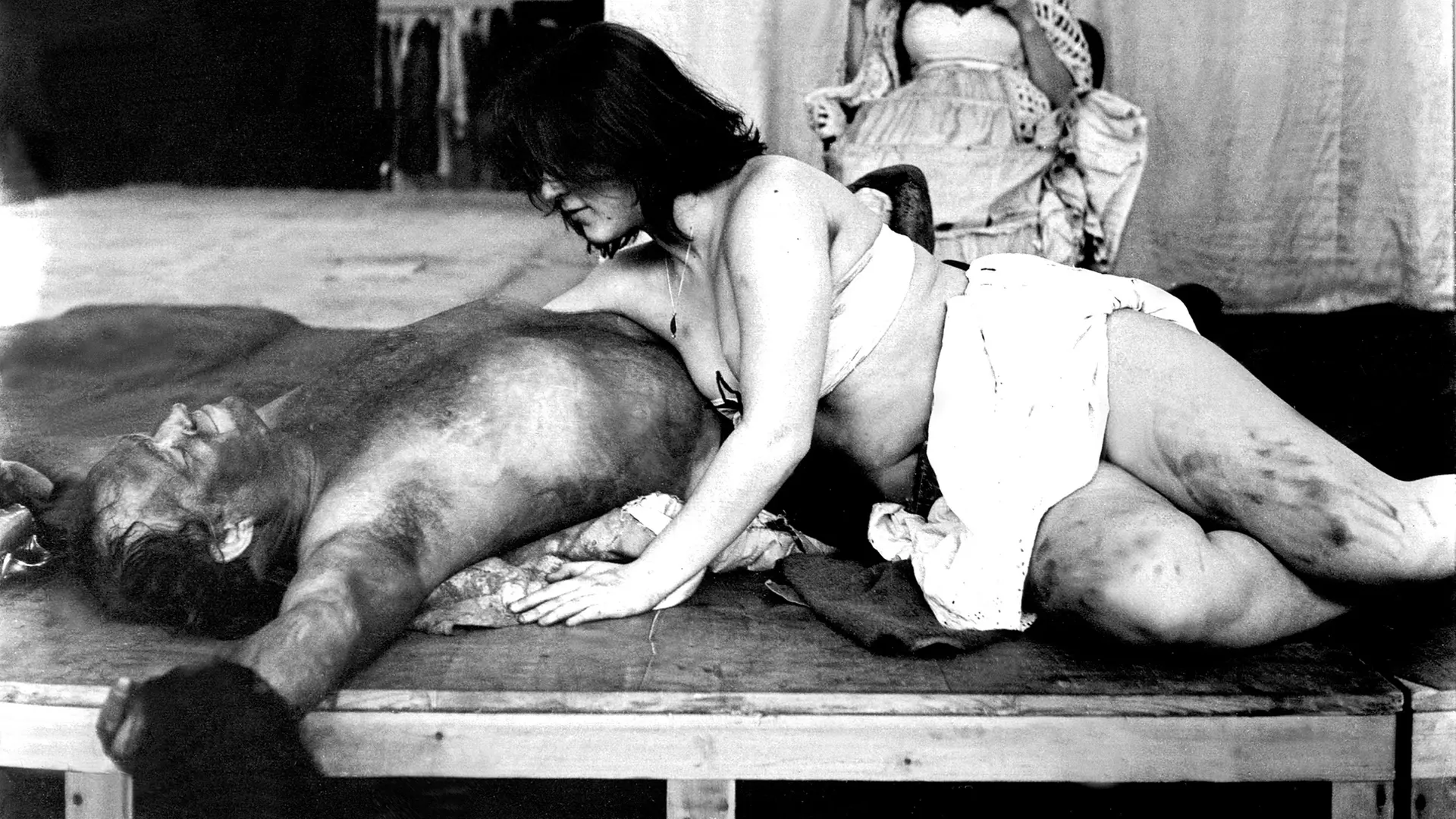
After a period of decline in the 1960s, the Deutsches Schauspielhaus became one of the spearheads of the Regietheater movement in the 1970s under director/manager Peter Zadek (who had gotten his start at the Bremen Goethe Theater, cause Bremen did Regietheater first – see my review of Zadek’s 1966 production of The Robbers by Friedrich Schiller at Galactic Journey). Coincidentally, the same Peter Zadek whose production of The Robbers in 1966 caused Bremen’s greatest theater scandal caused Hamburg’s greatest theater scandal ten years later in 1976 with a production of William Shakespeare’s Othello. At the time, it was still common in Germany to use dark make-up for white actors playing black characters on stage and so actor Ulrich Wildgruber who played Othello was covered in dark body make-up, which came off under the hot stagelights of the Deutsches Schaupielhaus and smeared all over Eva Mattes who played Desdemona, when they were frolicking about near naked on stage. Director Peter Zadek claimed he was trying to make a point about racism, while the good citizens of Hamburg who had season tickets for the Deutsches Schauspielhaus were utterly outraged at a make-up dysfunction. Looking back, it all seems so very silly, plus it’s almost endearing that people once cared enough about Shakespeare and Schiller to be outraged about supposedly unfaithful stage productions. If the same Othello production were to be performed today, the fact that they used blackface at all would be the scandal and not the fact that actors were near naked on stage and that the make-up came off. And yes, I’ve actually seen younger people assuming that the 1976 Othello scandal was about the blackface, when it definitely wasn’t. Blackface was still common and uncontroversial in Germany at the time – the issue was the nudity and simulated sex and the fact that the make-up came off.
The rise of the Regietheater in the 1960s and 1970s annoyed many long time stage actors, who weren’t keen on running around nude on stage and on younger directors trying to shoehorn some kind of point into classical plays. And so they went looking for greener pastures, which did not require them to be naked on stage. A lot of the established actors of Hamburg’s Thalia Theater and Deutsches Schauspielhaus found those greener pastures with Europa, a recording company that produces audio dramas on cassette tapes aimed at kids. Europa director Heikedine Körting and her husband hobnobbed a lot with Hamburg’s intellectual elite and so she was able to recruit top notch veteran stage actors to record audio dramas at kids and damn it, they gave their all. One of Europa‘s most popular audio drama series in the 1980s was Masters of the Universe BTW and many of the beloved characters were voiced by top notch stage actors.
As for why the Hamburg neighbourhood clustered around Hamburg Central Station is called St. Georg, it’s named after the parish church for this neighbourhood, the Church of the Holy Trinity a.k.a. St. Georg.

The tower of the Church of the Holy Trinity a.k.a. St. Georg in Hamburg. There has been a church here since the 13th century, but the tower was built in 1747 and is the only part of the church that survived the WWII bombing attacks. The nave of the church is a postwar building.
In order to get to the theater, I had to cross Hansaplatz, an open square at the heart of St. Georg. The Hansaplatz was originally just an open meadow where the locals could graze their cows. As the city grew, it was redeveloped into a large, representative city square in 1878, complete with a beautiful fountain at the center of the sqeare.

The Hansaplatz in Hamburg St. Georg with the Hansa fountain surrounded by linden trees.

A closer look at the Hansa fountain on Hansaplatz in Hamburg St. Georg, designed by Engelbert Peiffer in 1878. The statue on top is Hansa, a female representation of the Hanseatic League. The male statue on the front of the fountain is Emperor Constantin the Great.
Hansaplatz and the Hansa fountain are both lovely. However, while St. Georg is gentrifying, it has also long been a “problem neighbourhood” plagued by crime, drugs, homelessness and prostitution (which is ironic, because St. Pauli, Hamburg’s traditional red light district, is not far away). St. Georg is close to Hamburg Central Station, after all, and the neighbourhoods surrounding the central stations of German cities are often “problem neighbourhoods”.
And so the steps of the Hansa fountain have become a hangout for the local homeless population and drunks. I interacted with them for a bit when I took the photo above and they were friendly enough and besides, homeless people have to go somewhere, if you can’t or won’t provide housing for them. That said, St. Georg is still a dodgy neighbourhood, even if it is gentrifying. And while it was still light at this point, I would have to go across Hansaplatz to get to the Central Station after dark.
Now my Dad was the sort of girl dad who was always super worried about me and didn’t like me being out after dark, particularly in somewhat dodgy neighbourhoods. So he usually made a point to pick me up when I was out and about. If he were still around, he absolutely wouldn’t have liked me walking alone through St. Georg after dark at all and he probably would have insisted on going to the cinema with me, even if that meant braving Hamburg and its traffic hell. Not sure what he would have made of the movie, though he probably would have known a way around that terrible traffic jam on the B75, since he knew Hamburg a lot better than I do.
The Savoy Movie Theater
Directly behind Hansaplatz is Steindamm, a busy street lined with kebap shops as well as Middle Eastern restaurants and supermarkets. Steindamm is in a part of St. Georg that was badly bombed in WWII, so most of the buildings here are postwar buildings.
In the late 1960s, there were plans to completely flatten St. Georg to build a Brutalist nightmare called Alsterzentrum – after all, it was a dodgy neighbourhood and there were only poor people living there anyway. Understandably there were massive protests and the Alsterzentrum was never built to everybody’s relief. Surviving renderings show something that looks like the domed city from Logan’s Run. Alsterzentrum was one of the many projects by the fucking Neue Heimat (new homeland), a real estate company owned by the Council of German Trade Unions, who plastered West Germany with brutalist housing estates before going bankrupt due to corruption in 1982. The entire company with its more than 400000 apartments all over Germany was sold for a symbolic price of one Deutschmark in 1982, which made nine-year-old Cora very angry, because if they were going to sell the entire Neue Heimat for so cheap, why they didn’t they advertise it publicly? Because if you could buy the entire Neue Heimat for just one Deutschmark, I would have totally bought it. Hell, I would even have emptied my entire wallet, which probably contained around ten Deutschmarks. Cause my aunt and uncle lived on a Neue Heimat estate here in Bremen and I thought of their apartment, the other apartments in their high rise building, the adjacent high rise buildings full of similar apartments and all that repeated in every major city in West Germany. And all the people in all of those apartments were paying rent every single month. If I could buy all that for one Deutschmark, I would be fucking rich. So rich that I could even let me permanently cash-strapped aunt and uncle live in their apartment rent-free (and note that I didn’t actually like them) and there would probably be enough money left over to paint those ugly housing estates in nicer colours. Alas, the Neue Heimat never advertised that they were for sale and so my career as a nine-year-old real estate magnate/slumlord never got off the ground.
Thankfully, St. Georg remained the old motley mix of Victorian and postwar buildings of reasonable size. The Savoy Movie Theater is one of those postwar buildings, built in 1957 to house a cinema as well as a cheap hotel. It has had a varied history from West Germany’s most modern cinema upon opening to its decline in the 1980s and 1990s. For a while, the Savoy specialised in Bollywood and Turkish movies and for a few years, it was closed altogether and turned into a Middle Eastern supermarket, before it was restored to its former glory in 2013. The upper floors still houses a hotel and the exterior is largely unchanged from its glory days. See this photo for what the Savoy looked like in 1959. I really miss those huge handpainted posters by the way. Berlin and Bremen still have them to some degree, but the last movie poster painters are working for arthouses, so we will never see them paint He-Man or Spider-Man or Din Djarin and Grogu, more the pity.

The Savoy Movie Theater on Steindamm in Hamburg St. Georg, flanked by Middle Eastern restaurants and cafés.
The Batman Cafè next to the Savoy is named for the Turkish city Batman and not for the caped crusader BTW. Though a Batman Café named and themed after the DC superhero would be cool.

The entrance of the Savoy Theater in Hamburg St. Georg

A closer look at the neon sign of the Savoy Theater in Hamburg.
The Savoy actually has one of Hamburg’s largest screens, but since it is an old style 1950s movie theater rather than a modern multiplex, the lobby isn’t all that big. Nor were there any massive cardboard standees or statues or Skeletor’s bone throne in the lobby. Instead, we got movie posters behind glass as in the olden days. In many ways, the Savoy reminded me of the movie theaters of my childhood, where I went to see Disney movies and The Goonies and Star Wars and Indiana Jones with my Mom, before multiplexes and rising rents drove them out of business in the 1990s and early 2000s.

Posters for Masters of the Universe and The Mandalorian and Grogu along with show times and some toys on display at the Savoy.
There’s a bar in the lobby of the Savoy where you can have a pre or post-movie drink and also grab some snacks. Though sadly popcorn has replaced the classic ice cream chocolate of old here as well.

The bar of the Savoy
I don’t like popcorn and also didn’t want any messy snacks and since I still had to drive, alcohol was out, so I just got a bottle of water. I also snapped a quick picture of He-Man and Teela. I wish I could have given them snacks and drinks, but while I have snacks and drinks in my collection of miniature food for toy photos, I didn’t want to take it along, because small parts are easily lost.

He-Man and Teela are chilling in the lobby of the Savoy.
Meanwhile, the lobby of the Savoy was filling up with moviegoers. The Masters of the Universe fans were clearly recognisable by the fact that they were weaing Masters of the Universe t-shirts. But there were also a lot of casual walk-ins. The gender breakdown of the audience was roughly the same sixty percent men and forty percent women that Mattel found back in the 1980s. There were no children in the audience, because it was an eight thirty PM English language showing on a school night.

Moviegoers queuing for tickets at the Savoy
Now it must be noted that the Savoy is not your usual movie theater. Since it specialises in showing movies in the original language, it attracts students, immigrants and even the occasional sailor who wants something different than what St. Pauli has to offer. And since the Savoy only has a single auditorium, if you walked into the Savoy that night and bought a ticket, Masters of the Universe is what you’re watching rather than Scary Movie or Obsession or Backrooms or whatever.
The Savoy wasn’t completely full, but I’d estimate that it was about eighty percent full. Interestingly enough, there were two free seats on one side of me, even though the seating chart on the website showed that the entire row was sold out. I guess someone bought tickets, but then didn’t show up.
As movie theaters go, the Savoy is really nice. It’s clean, it has comfortable reclining seats and state of the art projection and sound technology. I had a very pleasant theater experience, especially compared to the Bremen theaters, where the experience is so terrible that I almost never go there anymore. The CinemaxX in the city center is the worst of the bunch. When it opened in 1996, it was a sensation – Bremen’s first true multiplex. There even was a whale skeleton from the local museum on display in the lobby. However, once the CinemaxX had driven all the other city center theaters out of business, the quality started to decline badly. Seats and carpets were dity and disgusting, half the concession stands weren’t open, lightbulbs were not replaced and the working conditions were so bad that the staff went on strike several times. The other two multiplexes, Cinestar and Cinespace are better, but both are outside the city center and not as easy to reach. And while the arthouse theaters are nice, they also don’t usually show movies I actually want to watch.
But while the Savoy is great, getting there is something of a hassle that it’s a venue where I will go for special movies – and Masters of the Universe definitely was special for me – but not for regular “This movie looks good and I’ve heard positive things” films.
Meanwhile, He-Man and Teela were enjoying themselves as well. And yes, the theater had a place to put them, though I suspect it’s intended for snacks rather than action figures.

He-Man and Teela are getting cozy in the cinema
After the usual trailers – including trailers for Supergirl, The Odyssey, Disclosure Day, Toy Story 5, Spider-Man: Brand New Day and The Amazing Digital Circus as well as a special pride month showing of Portrait of a Lady on Fire – and ads and just before the movie was about to start, there was a brief break. No, not for the elderly ice cream lady who haunted the theaters of my youth and always showed up just before the actual movie to ask if anybody wanted ice cream, but for the owner of Comic Cave, a Hamburg comics and collectibles store that has gotten a lot of my money over the years. Comic Cave has got a partnership with the Savoy and they were giving away a Funko Pop Skeletor figure to a moviegoer. No, I didn’t win, but then I don’t really need a Funko Skeletor.
As for the movie itself, I once more refer you to my review at File 770 and my discussion with Juan Sanmiguel and Vicky Jakubowski at MarkWho42.
I had heard about the three post-credits scenes in advance – and the theater erupted into spontaneous applause at the second one – so I knew to stay seated till the end. Of course, I always do this anyway and have done this since long before post-credits scenes were a regular thing (and coincidentally, the 1987 Masters of the Universe had one of the earliest post-credit scenes). However, some folks did get up and I even told a few people who were seated close to me to stay put, because there was more coming. And thankfully, the theater did not turn up the lights or send in the cleaners until the last post-credits scene, cause this is often an issue.

The Savoy Movie Theater after dark.
St. Georg After Dark
I left the theater happy and elated and made my way back to Hamburg Central Station. Initially, I considered going the long way along Steindamm and Kreuzweg, larger roads with lots of traffic, including patrolling police cars. But then I decided to go back the way I’d come, cutting across Hansaplatz and walking down the small side streets behind the Deutsches Schauspielhaus towards Hamburg Central Station.
It was half past eleven by now and completely dark. The restaurants and bars on Hansaplatz were still open, though the drunks I’d encountered earlier had apparently gone to sleep. And though I was aware that Dad would not like me walking around St. Georg at half past eleven at all, no one bothered or accosted me. In one of the streets behind the Deutsches Schauspielhaus, passed a bar called Zar & Zimmermann (Czar and Carpenter), named after the 1837 opera by Albert Lortzing. The high-brow name did not match the actual bar at all, since Zar & Zimmermann is the sort of dive bar that could once be found on every corner in every working class neighbourhood. Most of these bars are gone now, though a handful still survive, including in Hamburg. Though the traditional Hamburg dive bars I know about are found in St. Pauli, particularly on the street Hamburger Berg. Though I’m always happy to see places like this surviving St. Georg. Here is a brief article about the bar and the current owner, daughter of the original owners.
I probably should have just gone into the Zar & Zimmermann, because I would have liked a coffee and I suspect I would have gotten one there, since bars like those are usually welcoming, unless you’re a jerk. Because one huge issue in Germany is that the bakeries and cafés where you can get a coffee usually close by seven PM at the latest. Later at night, e.g. when you’re coming out of a movie theater, the only places that are still open are restaurants, who often don’t like people just dropping in for a coffee, and bars, which are focussed on alcohol and can also be unpleasant environments particularly for women. Though to be honest, these days I feel safer at dive bars like the Zar & Zimmermann than at hipper more upscale cocktail bars.
However, I walked on to Hamburg Central Station, because I assumed I could get a coffee there. Alas, all the shops at Hamburg Central Station were already closed, which is a shame for Germany’s busiest railway station. As long as there are trains going, at least some shops should be open. However, Germany all too often operates under the assumption that nobody has any business being outside after eight or nine PM and therefore cannot expect any shops to be open.
On the way to the theater, the S-Bahn train stopped at a separate subterranean platform at Hamburg Central. But for the way back, I had to go into the main hall onto one of the regular platforms that are also used by mainline trains. However, because it was so late, the platform was not very crowded.
On the S-Bahn, I wound up chatting with a rather talkative young man (I suspect he may have been high), who basically chatted with everybody in the vicinity. He told me his cousin was working at the theater in Bremen and asked me what I was doing in Hamburg. I told him I’d been to the cinema and saw Masters of the Universe, whereupon he told me his Dad was a huge fan. I told him to go see the movie and take his Dad.
I had been a bit apprehensive about wandering around the Harburg commuter car park by night, but I needn’t have worried, because I wasn’t the only person who’d come back from a night on the town. So I never felt unsafe, as I made my way up to the roof top to my car. The midnight news had just begun, when I started the engine.
Driving Home by Night
The various traffic jams that had plagued me on the way to the cinema had all dissipated by now and so the roads were clear. I was still elated from the movie and not even slightly tired. Though I’d drunk the last of my water, when I returned to the car, and I always like to have some water with me on longer drives. So I decided to stop at gas station or Autobahn service station that was still open on the way home.
I did pass a gas station on my way through the Hamburg suburbs of Harburg, Marmstorf and Lürade, but it was already closed for the night. So I drove onwards, back onto Autobahn A261 and from there onto Autobahn A1. The next exit after Junction Buchholz, where the A261 meets the A1, is Rade, where I once spent two hours with my Dad stuck in a broken down rental car.
Dad had been on the trial run of the research vessel Maria S. Merian out of Rendsburg. He returned by plane, but his car was still in Rendsburg, so he rented a car and we drove to Rendsburg about halfway between Hamburg and the Danish border. Then Dad picked up his car, while I was supposed to drive the rental car back. The rental car was a brand-new Mercedes A-class – I think the kilometer counter said 60 kilometers when we got it that morning – and it was giving me trouble from the start. I initially thought the problem was that the Mercedes has a manual shift and my own car had an automatic shift, so I was not longer used to driving with a manual shift. But the problems with the car never got better, not even once we reached the Autobahn, where I didn’t have to change gears so often. And then, literally in the middle of the Elbtunnel, i.e. the worst possible place, the engine began to stall and no matter how hard I pressed onto the accelerator, the car just wouldn’t pick up speed but crawled along at 60 kilometers per hour on the Autobahn. I was panicking by now, because the Elbtunnel is pretty narrow and there is no shoulder to stop, should the car break down. Besides, I was terrified that I had somehow wrecked a brand-new car and would have to pay for it. I barely made it out of the Elbtunnel and stopped the car literally at the possible spot where there was an actual shoulder and frantically called my Dad that the car just wouldn’t accelerate. Dad said that he had noticed issues with the car on the way out as well and that I should try to drive on to service station Hollenstedt and then we would call the rental company.
So I drove on at 60 kilometers per hour on the bloody Autobahn. Even the trucks overtook me and honked for good measure, too. In my memory, I only made it a few kilometers to the next exit, before the car broke down for good, but in reality I must have driven almost 20 kilometers with a broken car and passed six exits, two junctions and an Autobahn parking lot. However, I never made it to service station Hollenstedt, since the car absolutely refused to go any further at exit Rade. So I pulled into exit Rade and barely made it up the exit ramp before the car broke down for good and refused to drive even a meter further. Dad called the rental company, who were surprisingly cool about the whole thing and promised to send a tow truck. However, the rental company was in Bremen and we were just south of Hamburg, so we had to wait for two hours until the tow truck could pick up the car. And this was the era before smartphones, so all we could do was listen to the car radio and play the snake game on the phone. We also couldn’t just abandon the car and have a coffee – if there even was a place to have a coffee in Rade. Nowadays, Rade has an Autohof, but I have no idea if that Autohof already existed twenty years ago. Not mention that it is one the other side of the Autobahn and the car barely made it up the exit ramp. The tow truck eventually arrived and picked up not just our car, but another Mercedes A-class that had also broken down on the Autobahn and had literally stopped on the exit ramp. Much as I loved the Mercedes A-class I drove from 2008 to 2017, that model always was prone to issues, which is probably why Mercedes completely redesigned it.
Once the car was taken care of, we climbed into my Dad’s car and stopped at service station Hollenstedt to use the bathroom and have a much deserved coffee. And yes, I have to think of that story, whenever I drive past exit Rade or service station Hollenstedt.
This night, however, I made it past Rade without any issues and pulled into service station Hollenstedt to buy some water. Alas, the service station, which is supposedly open 24 hours, was closed and completely dark. Even the gas station was closed and the motel – Hollenstedt is one of those service stations which have a motel attached – was only accessible via keycard or code. Personally, I think that at least the gas station and shop of an Autobahn service station should be open 24 hours, because by night, these service stations literally are the only place you can stop to refuel your car or yourself.
Since Hollenstedt was closed, I drove onwards to the next service station, Ostetal near Sittensen. And while the cafè and restaurant part of service station Ostetal was closed, the gas station and shop were still open. So I got a bottle of water and a large chocolate chip cookie. There even were some sandwiches on offer, but I wasn’t that hungry. Though I did chat a bit with the guy behind the counter. He was an recent immigrant from Kosovo and didn’t speak German very well, so we talked in English. These days, the staff at German Autobahn service stations are almost all immigrants.
I drank some water and munched down my cookie at the service station and drove onwards, towards home. The radio had already switched to nighttime programming – these days many stations shift to nighttime programming as early as ten PM, when several used to run all through the night – so I was stuck with gentle, soothing easy listening type music, when I wanted something rousing, preferably “Eternia” or “Princes of the Universe”.
It was half past midnight by now and at that hour, the Autobahn belongs to the oversize load transports, which aren’t allowed to drive by day, lest they impede traffic. And indeed I saw several oversize load trucks and their escorts going in the opposite direction, most likely headed for Hamburg harbour. As for what travelling with an oversize load transport is like, I actually blogged about that back in 2012. Other oversize load transports were waiting for their police escorts at the Autobahn parking lots. At one point, a cloud of smoke drifted across the Autobahn and I wondered if a truck was on fire or if they were transporting something that generated smoke.
I made it through the construction zone on the Weser Bridge without any problems. There were no oversize load trucks here, the construction zone is too narrow and the crumbling bridge probably couldn’t handle overweight load trucks anyway. I left the Autobahn at the exit Bremen-Brinkum and made one more stop at a gas station to fill up my tank, while gas was comparatively cheap. Then I went home and since I was still too wound up by the movie to sleep, I started writing my review for File 770.
And that was He-Man and Teela’s (and my) movie date.
 sending...