Indie Crime Fiction of the Month for February 2018

Welcome to the latest edition of “Indie Crime Fiction of the Month”.

So what is “Indie Crime Fiction of the Month”? It’s a round-up of speculative fiction by indie authors newly published this month, though some January books I missed the last time around snuck in as well. The books are arranged in alphabetical order by author. So far, most links only go to Amazon.com, though I may add other retailers for future editions.

Our new releases cover the broad spectrum of crime fiction. We have cozy mysteries, small town mysteries, paranormal mysteries, historical mysteries, police procedurals, legal thrillers, crime thrillers, psychological thrillers, domestic thrillers, men’s adventure, missing girls, stolen women, lost memories, serial killers, vigilantes, lawyers, innocents on death row and much more.

Don’t forget that Indie Crime Fiction of the Month is also crossposted to the Indie Crime Scene, a group blog which features new release spotlights, guest posts, interviews and link round-ups regarding all things crime fiction several times per week.

As always, I know the authors at least vaguely, but I haven’t read all of the books, so Caveat emptor.

And now on to the books without further ado:

Treachery on Tap by Constance BarkerTreachery on Tap by Constance Barker:

Ghost Hunters on the Loose

The Grumpy Chicken Pub is infiltrated by a famous Ghost Hunting television show and our ghost chicken is not amused. When one of the ghost hunting crew ends up on the opposite side of the living, Ginger and her ragtag of misfits leap into action. Will the Grumpy Chicken ghost help solve the crime like before, or are there more ghosts to contend with?

Find out in this next installment of The Grumpy Chicken Irish Pub Series.

An Occupied Grave by A.G. BarnettAn Occupied Grave by A.G. Barnett:

A village of secrets finds its past lies waiting…

When mourners gather in the village of Lower Gladdock, the grave is found to be already occupied. The victim is soon linked to a tragedy that tore the village apart five years ago and is handed over to the Bexford police to solve.

Detective-sergeant Guy Poole is hoping to put his traumatic past behind him and settle into his new station at Bexford. Now history is threatening to raise its head again, and he has a murder case to contend with.

Detective Inspector Sam Brock has a new recruit to take under his wing, and he’s determined this one isn’t going to die. As if that wasn’t enough of a headache, his wife is coming home and may be on the verge of discovering the lie he’s been telling her.

Newly paired duo Brock & Poole must track down the killer before more lives are lost.

The Starlet and the Dead Duke by Bianca BlytheThe Starlet and the Dead Duke by Bianca Blythe:

Murder. Manor homes. Malfunctioning chandeliers.

Hollywood starlets are supposed to be happily on set in sunny California, and not trapped in drafty manor houses during ferocious snowstorms.

But after Cora Clarke’s best friend and fellow actress elopes with an English earl, Cora visits England to help her friend brave the aristocratic disapproval of her new husband’s family.

Unfortunately the holiday turns nightmarish when a chandelier crashes down and kills somebody. When suspicion falls on her friend, Cora vows to figure out the identity of the murderer. After all, blizzards have a habit of preventing the police from arriving, and body counts have a dreadful habit of growing.

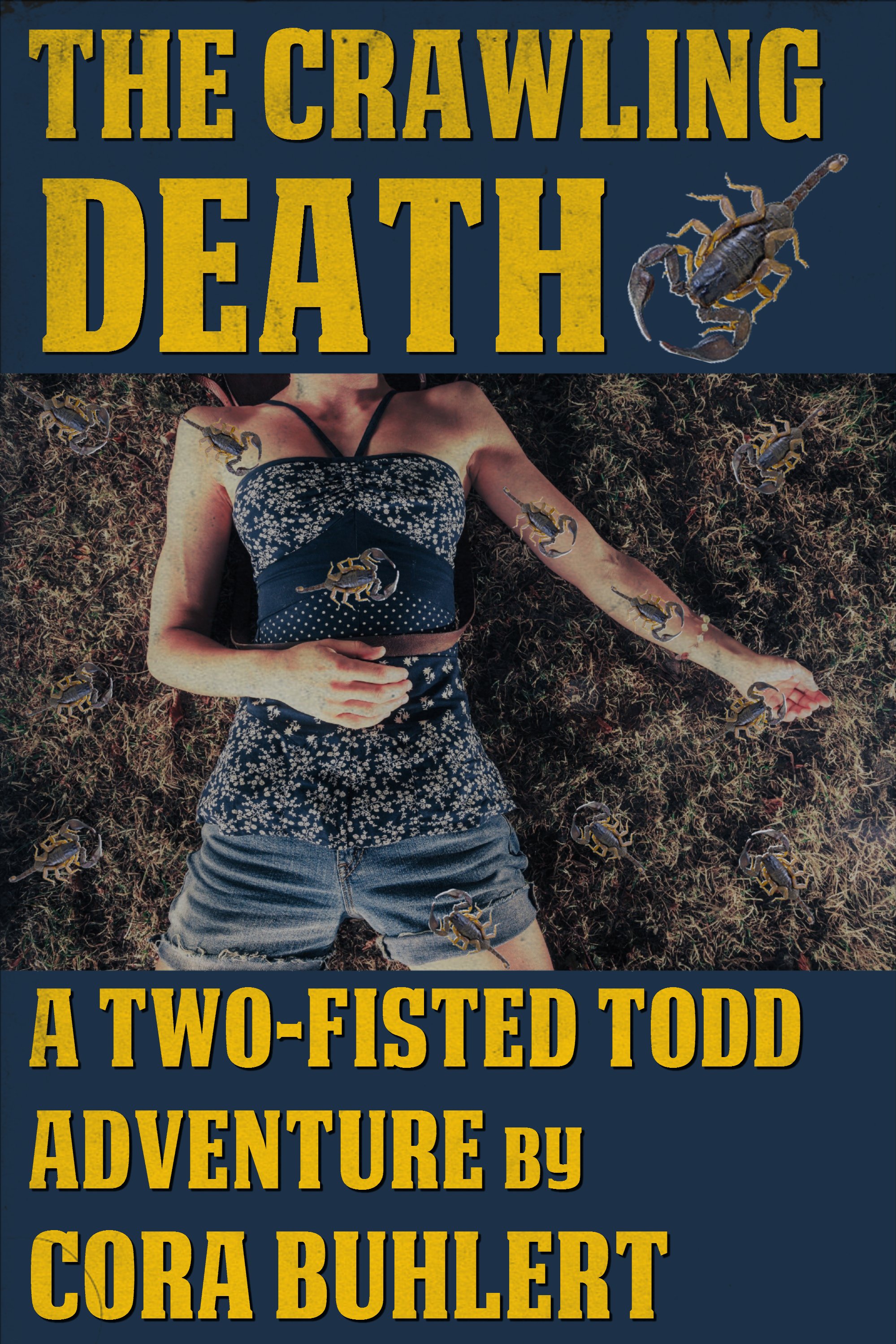
Flesh Trade by Cora BuhlertFlesh Trade by Cora Buhlert:

1966: Freelance troubleshooter Todd Donovan is hired to locate four American college students who have gone missing while doing humanitarian work on the Caribbean island of San Ezequiel.

While punching suspects and taking names, Todd learns that the college students as well as a young nun were kidnapped by a local crime boss named Cabeza.

So now Todd is engaged in a desperate race against time to rescue the kidnapped women before they can be sold to the highest bidder.

This is an adventure novelette of approx. 9800 words or 35 pages in the style of the men’s adventure pulps of the 1960s.

Tell Me I'm Wrong by Adam CroftTell Me I’m Wrong by Adam Croft:

What if you discovered your husband was a serial killer?

Megan Miller is an ordinary woman with a young family — until a shocking discovery shatters her perfect world.

When two young boys are brutally murdered in their tight-knit village community, Megan slowly begins to realise the signs all point to the lovable local primary school teacher — her husband.

But when she begins to delve deeper into her husband’s secret life, she makes discoveries that will make her question everything she knows — and make her fear for her young daughter’s life.

Facing an impossible decision, she is desperate to uncover the truth. But once you know something, it can’t be unknown. And the more she learns, the more she wishes she never knew anything at all…

Change of Fortune by Jana DeLeonChange of Fortune by Jana DeLeon:

Sinful, Louisiana, is always a hotbed of activity, and despite the steamy heat, August is no exception. Godzilla is terrorizing the town, looking for a home-cooked meal, and Gertie is worried someone will take the gator out before she can get him under control. Francine has a situation of her own at the café, where food is missing from inventory. And Celia is always up to no good.

But summer is almost over, which could mean huge changes for Fortune Redding. Her undercover time in Sinful has always been limited to three months, and that time is almost up. With Ahmad still on the loose, Fortune is forced to remain in hiding, but soon she’ll have to move to another town and start all over with a new identity. And that’s the last thing she wants to do. Determined to get her life back, Fortune decides to draw Ahmad out and end this once and for all.

Can Fortune take down one of the most dangerous men in the world? And if she can, does she have a future in Sinful?

30 Days of Justis by John Ellsworth30 Days of Justis by John Ellsworth

She’s a daughter he didn’t know he had. Until she calls him…from death row.

From USA Today bestselling author John Ellsworth comes another book so thrilling the pages all but turn themselves. Written as a standalone novel.

Michael Gresham meets his lost daughter, Cache, in her prison cell. She is scheduled for execution in 30 days. Her other lawyers have given up; there is nothing left to do. On a hunch, Michael reviews ancient records. He is astonished at what he finds. He goes before the appeals court. The lawyers at the other table hammer him; the judges pursue him. He leaves with a heavy heart. With gathering speed, the days tick past.

30 Days of Justis is the story of a frantic father who happens to be a lawyer–but is he lawyer enough to save his child? Will there be a last minute call? Or is he in Cache’s life only as the last face she sees before it goes dark? A psychological thriller? Yes, definitely. A legal thriller? Yes, definitely. And so much more.

Murder at Macbeth in Susan HarperMurder at Macbeth by Susan Harper:

There’s nothing more relaxing than a day at the theater…until Macbeth is actually murdered

Kendell, a fiery flight attendant, and Pauline, a globe-trotting retiree, get stuck in London. Determined to make the best of their layover, they decide to take in a play at the Globe Theater. When the lead actor is murdered on stage, the new friends are thrust into a murder investigation. Can the new friends work together to clear their names and catch the real killer of Macbeth?

Murder at Macbeth is part of the Flight Risk Cozy Mystery series. If you like fast paced mysteries with interesting characters and unexpected twists, you’re going to love the Flight Risk Cozy Mystery series.

A Stolen Woman by Catherine LeaA Stolen Woman by Catherine Lea:

“Find Me!”

Those are the words on the note crumpled in Laney Donohue’s disabled sister’s hand. All Laney knows is that the young nurse aid who wrote them was taken by a man, and no one stopped him. Laney owes this young woman. She cared for Laney’s sister when Laney couldn’t. Now she’s disappeared without trace. Laney intends to find out why.

Meanwhile, it’s Elizabeth McClaine’s birthday. Or it would be if her PA had gotten the date right. So what better time to leave her unwanted party than when the call comes telling her a client of her charitable foundation has been found beaten and left cowering in a closet, her nurse aid missing.

But from the moment Elizabeth asks the first question, it’s obvious someone out there is hell-bent on stopping her. And when the trail left by Laney Donohue leads to the brothels and casinos of an organized crime syndicate two states away, Elizabeth must pit her wits against the brilliant and ruthless crime boss to save her. The problem is…

…he already knows she’s coming.

Freaky Places by Amanda M. LeeFreaky Places by Amanda M. Lee:

Mystic Caravan Circus is heading to the West Coast, and while everyone is happy for the change of scenery there’s a pall settling over the group.
Poet and Kade are in a good place and planning for a change, but it’s something Poet can’t focus on because she feels as if someone is watching … and whoever it is has evil in his or her heart.
The festival location is different, and instead of space, the circus denizens have festival workers and artisans on every side. They’re open and exposed, and hiding their secret has never been more important.
When one of their own goes missing, Poet is determined to figure out exactly what’s going on. The answers won’t be easy, though, and there are all different types of evil.
A fight is coming, and the enemy is different from anything they’ve ever faced. They’re outnumbered and might find themselves outmaneuvered.
Who will survive? More importantly, who will be lost to something even worse than death? Sometimes death really is better.

Take Five by Vishal ReddyTake Five by Vishal Reddy:

Every death starts with a life…

The first 48 hours of a murder investigation are critical… but what about the last 48 hours of the victim’s life?

TAKE FIVE (Book 2 in the Equinox Mystery Series) turns the classic police procedural on its head by alternating between the first 48 hours of the murder investigation and the last 48 hours of the murder victim’s life, told from her point of view.

THE VICTIM

In Sunnyvale, California, — the heart of Silicon Valley – Daisy Hale is a 24-year-old coder for MagnaSwift, one of the tech industry’s fastest-growing companies. Despite experiencing tragedy as a child and homelessness as a young adult, Daisy has overcome numerous obstacles to create a life of her own.

But MagnaSwift is a misogynistic hotbed of mistreatment and harassment, and Daisy’s furious that her impressive skills aren’t helping her advance within the company. So she comes up with a plan that will not only destroy MagnaSwift… but will also make her $10 million richer.

But Daisy’s fate is sealed, because she’s also dealing with a toxic boyfriend, a violent loan shark, a creepy stalker, and others who would rather kill her than see her succeed in life.

THE DETECTIVE

Meanwhile, Detective Stellan Coleman of the Sunnyvale Homicide Department needs to find out who murdered Daisy, the brilliant young woman cut down in the prime of her life. And like Daisy, Stellan has dealt with his share of tragedy too. Recently widowed and taking care of his young and tech-obsessed daughter, Stellan — together with his volatile partner, Detective Enrique Montoya — will stop at nothing to find justice for Daisy.

As Daisy and Stellan’s timelines alternate back and forth, the line between lies and the truth becomes blurred beyond recognition. Because in this fast-paced mystery full of heart-stopping twists, everybody’s a suspect… and nobody’s confessing.

Vanishing Girls by Lisa ReganVanishing Girls by Lisa Regan:

When Isabelle Coleman, a blonde, beautiful young girl goes missing, everyone from the small town of Denton joins the search. They can find no trace of the town’s darling, but Detective Josie Quinn finds another girl they didn’t even know was missing.

Mute and unresponsive, it’s clear this mysterious girl has been damaged beyond repair. All Josie can get from her is the name of a third girl and a flash of a neon tongue piercing that matches Isabelle’s.

The race is on to find Isabelle alive, and Josie fears there may be other girls in terrible danger. When the trail leads her to a cold case labelled a hoax by authorities, Josie begins to wonder is there anyone left she can trust?

Someone in this close-knit town is committing unspeakable crimes. Can Josie catch the killer before another victim loses their life?

13th Avenue by Thomas Shark13th Avenue by Thomas Shark

HOW FAR WOULD YOU GO TO SAVE YOUR OWN SKIN?

Detective Nicholas Graves never wanted to be a murderer, but during one long Sunday afternoon on 13th Avenue, he became exactly that. With his secret safe and buried for three whole years, it comes as a shock when he receives an anonymous email, threatening to expose his secret.

Over the next 12 hours, Detective Graves finds himself in a game with a killer who is smarter, more cunning and deranged than he could ever be. His only hope is his rookie partner, Detective Stasia Rhine, who becomes the final wall between Graves and his demise.

There’s only one problem.

The killer has a game for Stasia too…

The Hate Crime by Rachel SinclairThe Hate Crime by Rachel Sinclair:

Heather’s back!

Heather Morrison is back in Damien’s office, but this time, she’s not just there to work. Her boyfriend, Beck Harrison, is accused of killing a transgendered friend of Heather’s. The prosecutors are charging the murder as a hate crime. Beck insists that he’s innocent. After investigating Beck’s background, Damien’s not so sure. Beck has a dark past of involvement with the Aryan Brotherhood. But Damien soon finds out that this case is nothing like it seems. The victim’s past soon becomes the target of the investigation, as Damien finds the one key that will break this case wide open.

Did Damien solve the crime or was there somebody else that he never even thought of who might have been the culprit? A surprise witness at the 11th hour provides the clue.

Meanwhile, Connor has his own case for Damien. He’s been working with underprivileged youth, trying to steer them straight and not walk the same path that he has. He presses Damien to represent Tina, who is charged with drug distribution. Damien sees many parallels between Tina’s life and his own, and he can’t help wanting to save her.

But can he?

Imperfect Memories by Jody WennerImperfect Memories by Jody Wenner:

After losing her husband and daughter in an all-too-common act of senseless terror, Nina Rogers thinks she might also be losing her mind. Is she slipping because of the tragedy, or is her memory actually failing her? Is she experiencing the same thing her mother did, or is this something different? It might be easy to figure out in a normal person, but Nina is anything but normal. She has hyperthymesia: the ability to recall every minute of every day of her life.

As the days go on, she sinks even deeper into madness and knows that she needs to find some answers to what is happening to her before it’s too late. Tragically, the one person who may be able to help is also the man who killed her family.

Posted in Books | Tagged , , , , , , , , , , , , , , , , , , , , , , , | Leave a comment

Some Thoughts on the 2017 Nebula Award Nominees

The nominees for the 2017 Nebula Awards have been announced today. At Barnes & Noble, Joel Cunningham offers an overview of the nominees and shares his thoughts on the nominated novels and at File 770, JJ shares some links to those of the Nebula nominated novels and stories that are available for free online. Meanwhile, as is sort of traditional by now, here are my thoughts and reactions to the nominated works.

As in previous years, the 2017 Nebula shortlist is an overall good and diverse shortlist, featuring plenty of women, writers of colour, LGBT writers, etc… There also are a couple of headscratchers and works I’ve never heard of among the nominees, but then again this is something that I find on almost every Nebula shortlist, far more so than on the Hugo shortlists, puppy nominees which usually aren’t that well known among wider fandom excepted.

Let’s start with the nominees in the best novel category, where we have a mix of obvious choices and “Huh?” moments. The Stone Sky by N.K. Jemisin as the conclusion of a critically acclaimed and highly popular trilogy, clearly falls in the first category as do Six Wakes by Mur Lafferty, Jade City by Fonda Lee and Autonomous by Annalee Newitz, all of which got a lot of buzz. But while the reviews I saw for Amberlough by Lara Elena Donnelly and The Strange Case of the Alchemist’s Daughter by Theodora Goss were generally positive, the reaction to both books was a lot more lowkey. Spoonbenders by Daryl Gregory, finally, complete passed under my radar. It’s notable that four of the seven nominees (Amberlough, The Strange Case of the Alchemist’s Daughter, Spoonbenders, Jade City) in this category feature historical/quasi-historical settings. Two nominees (Six Wakes and Autonomous) are unambiguously science fiction, while The Stone Sky sits on the borderline between fantasy and science fiction.

Diversity count: Six women, one man, two writers of colour. Three of the nominees are published by Orbit (plus one more is published by Orbit in the UK), two by Tor, one by Saga Press and one by Knopf. So the Tor dominance that certain elements in fandom are always complaining about is actually more of an Orbit dominance, at least in the novel category.

However, the Tor dominance actually does apply to the best novella category, which – as in previous years – is absolutely dominated by Tor.com’s novella line. Four of six nominees are Tor.com novellas, one was published in Uncanny and another by a small press/writers and artists collective called Noble Fusion Press. But then, Tor has revitalized the novella and its novella line is generally of very high quality. As for the nominees, River of Teeth by Sarah Gailey, All Systems Red by Martha Wells, The Black Tides of Heaven by J.Y. Yang and “And Then There Were (N-One)” by Sarah Pinsker all got a lot of positive buzz. Passing Strange by Ellen Klages seems to have generated somewhat less buzz, though I like the novella very much. I have to admit that I have never heard of Barry’s Deal by Lawrence M. Schoen, though I have enjoyed other works by the author. Again, it is notable that we have two nominees (Passing Strange and River of Teeth), which are set in the past. Coincidentally, this is also the category where there is the highest degree of overlap with my personal Hugo shortlist. Three of the Nebula nominees in this category are also on my personal Hugo shortlist, another is a definite possibility.

Diversity count: Four women, one man, one non-binary, one writer of colour, one international writer.

The novelette category is the one which contains the highest number of headscratchers. Vina Jie-Min Prasad is shaping up to be one of the breakout SFF writers of 2017, since I have seen a lot of positive buzz for her stories. She also has another story nominated in the best short story category. Kelly Robson is a writer whose stories I enjoy quite a bit, though I preferred her 2017 novelette “We Who Live In the Heart” to “The Human Stain”, for which she was nominated. Sarah Pinsker’s name frequently shows up on awards shortlists in recent years and indeed she also has another story nominated in the best novella category. I also generally enjoy her fiction, though I haven’t read this particular story. Meanwhile, Richard Bowes, Jonathan P. Brazee and K.M. Szapara are completely unknown to me. A quick Google reveals that Richard Bowes is a World fantasy Award winner and that Jonathan P. Brazee seems to write mainly military science fiction, which is not normally a subgenre that is well represented on awards shortlists. It’s notable that the best novelette nominees are drawn from a wide variety of sources and first appeared in F&SF, Asimov’s, Tor.com, Uncanny, Clarkesworld and an anthology. I don’t read F&SF or Asimov’s, since they very hard to come by where I live and I haven’t read the anthology in question either, which is probably why so many of the nominees in this category are unknown to me. Interestingly, one of the stories, “Weaponized Math” by Jonathan P. Brazee, was published in the self-published anthology The Expanding Universe, Vol. 3, which makes it the only self-published work among the nominees.

Diversity count: Three women, three men, one writer of colour, one international writer.

The nominees in the short story category are a mix between stories that got a lot of buzz and more obscure choices. “Welcome to Your Authentic Indian Experience TM” by Rebecca Roanhorse got a lot of positive attention and a very good story it is, too. “Carnival Nine” by Caroline M. Yoachim is another story that got a lot of attention this year and the woldbuilding is great, though the story itself didn’t work for me. “Clearly Lettered in a Mostly Steady Hand” by Fran Wilde is another story that got quite a bit of positive attention, as is “Fandom for Robots” by Vina Jie-Min Prasad. I usually read Tor.com’s short fiction offerings, but I must have missed “The Last Novelist (or A Dead Lizard in the Yard)” by Matthew Kressel. I haven’t read “Utopia, LOL?” by Jamie Wahls.

Diversity count: Four women, two men, two writers of colour, one international writer.
Publisher count: Two Uncanny stories as well as one each from Tor.com, Apex, Beneath Ceaseless Skies and Strange Horizons.

The Andre Norton Award for Outstanding Young Adult SF or Fantasy only has four nominees this year, namely Exo by Fonda Lee, Weave a Circle Round by Kari Maaren, The Art of Starving by Sam J. Miller and Want by Cindy Pon. Unlike some previous years, this year’s Andre Norton Award nominees largely seem to be the sort of book that actual teenagers read rather than the YA excursions by established adult SFF writers. Sam J. Miller is the only author who is better known for his adult SFF and a lot of the stories I have read by him feature teen characters, so he seems like a natural fit for YA. It will be interesting to compare this shortlist to the new YA Not-a-Hugo which is awarded for the first time this year.

Diversity count: Three women, one man, two writers of colour.
Publisher count: Scholastic, Tor, HarperTeen and Simon Pulse are represented with one nominee each.

In general, what’s notable about the adult fiction categories is that Uncanny dominates the short fiction categories, followed by Tor.com and Clarkesworld. Tor.com absolutely dominates the novella category, while Orbit dominates best novel. The decline of the big three print magazines continues. F&SF and Asimov’s managed to garner one nomination each, while Analog didn’t get any at all. Only a single nominee in the fiction categories is self-published. Thematically, I don’t see a clear trend beyond a preferences for works with historical settings.

So let’s take a look at the Ray Bradbury Award for Outstanding Dramatic Presentation: The Last Jedi, Wonder Woman, The Shape of Water and Logan are all obvious nominees and fine movies in their very different ways. Coincidentally, we have two more films with historical settings here, Wonder Woman and The Shape of Water. I’m a bit surprised that there is no love for any of the Marvel movies this year, especially since Guardians of the Galaxy Vol. 2, Spider-Man: Homecoming and particularly Thor: Ragnarok are among the better Marvel movies of recent years. I have to admit that the nomination for Get Out was something of a surprise for me, since it’s a horror movie and those don’t normally do well at the Hugos and Nebulas. However, Get Out is also a multiple Oscar nominee this year (and how cool is it that we have two SFF films competing in the major Oscar categories this year?) and generally very well received, though it seems to have passed under the radar here in Germany, probably because of cultural differences.

But for me, the really big headscratcher in this category is the nomination for “Michael’s Gambit”, an episode of the TV series The Good Place, because this show wasn’t really on my radar at all. Now I am aware that The Good Place has received some very positive reception after a somewhat lowkey start and that it apparently ends with a massive twist, but this is a show I have zero interest in, even though I like Ted Danson. For starters, it’s a sitcom and I don’t like US-style sitcoms. It’s also set in the afterlife and I don’t like stories set in the afterlife. And the one trailer I saw, mainly because I linked it at the Speculative Fiction Showcase, did absolutely nothing for me. I’m also surprised that of all the high quality SFF offerings on TV – The Handmaid’s Tale, Westworld, Game of Thrones, American Gods, Outlander, The Expanse, Preacher, The Defenders, Black Mirror, Stranger Things, not to mention highly debated shows like Star Trek Discovery and The Orville, interesting lowkey series like Killjoys and Dark Matter or even the various DC superhero shows – the lone TV episode to make the Nebula shortlist is an episode of a sitcom set in the afterlife. The Good Place may be a fine show, but better than The Handmaid’s Tale? Honestly?

So those are my initial thoughts and reactions on the 2017 Nebula nominees. I will probably make a follow-up post in the next few days with links to reactions from around the web, once they come in.

Posted in Books, Film, TV | Tagged , , , , , , , , , | 10 Comments

The Star Trek Discovery Season Finale or “Hey, we finally remembered we’re making Star Trek and not Game of Thrones in Space.”

Star Trek Discovery has finally reached the end of its highly uneven first season (for my episode by episode musing, go here). The season finale was not as bad as I feared – no one died, for starters, which is a good thing – but it still offered a wildly uneven conclusion to a messy and uneven season.

Warning! Spoilers underneath the cut! Continue reading

Posted in TV | Tagged , , , , , , , , | 1 Comment

In Defence of Wallpaper Science Fiction

A few days ago, Paul Weimer pointed me on Twitter to this post by Charles Stross in which Stross laments the current state of the science fiction genre, because a lot of SF writers these days focus more on plot, action, characters and their relationships than on worldbuilding, particularly on economics, which is the aspect of worldbuilding that is closest to Stross’ heart. It’s clearly an issues that he feels strongly about, since Charles Stross writes variations of this post nearly every year, such as this three part rumination on space opera and its clichés from 2016 or this post on why he prefers urban fantasy to science fiction from 2014.

Here is a quote from the most recent post:

Unfortunately, we get this regurgitated in one goddamned space opera after another: spectacle in place of insight, decolorized and pixellated by authors who haven’t bothered to re-think their assumptions and instead simply cut and paste Lucas’s cinematic vision. Let me say it here: when you fuck with the underlying consistency of your universe, you are cheating your readers. You may think that this isn’t actually central to your work: you’re trying to tell a story about human relationships, why get worked up about the average spacing of asteroids when the real purpose of the asteroid belt is to give your protagonists a tense situation to survive and a shared experience to bond over? But the effects of internal inconsistency are insidious. If you play fast and loose with distance and time scale factors, then you undermine travel times. If your travel times are rubberized, you implicitly kneecapped the economics of trade in your futurescape. Which in turn affects your protagonist’s lifestyle, caste, trade, job, and social context. And, thereby, their human, emotional relationships.

Whenever Stross posts a variation of this “other people are doing science fiction wrong” rant, it inevitably gets my hackles up and also reminds me why I have bounced hard off every Charles Stross novel I tried to read. By now I have accepted that Charles Stross and his work simply are not for me, to the point that I only check out new work by him, when it finds its way to the Hugo shortlist and I am eligible to vote. Where I inevitably bounce off his work yet again. Because the things he values in science fiction are very different from the things I value.

For starters, an overexplanation of any aspect of worldbuilding at all will quickly land you in Alfred and Bertha territory and that way lies madness. After all, there is a reason why the Alfred and Bertha stories are parodies of a certain kind of overly infodumpy hard science fiction (though military SF can be just as infodumpy – it merely infodumps in other areas). And indeed, in The Three Quarters Eaten Dessert, I spent a full paragraph explaining the concept of VAT/sales tax and another explaining the concept of paper money in response to one of Stross’ rants that science fiction writers care too little about economics and never talk about VAT/sales tax.

That doesn’t mean that there isn’t a kernel of truth in Stross’ post. Because all too often, things show up in science fiction, just because “that’s the way things are”, whether in genre or life, regardless if this makes sense in this particular setting. The prevalence of Galactic Empires vaguely modeled on the Roman or British Empire in science fiction is a result of tropes being imported from other genre works unexamined, as is the fact that every future military ever is either modelled on the US Marine Corps of the 20th/21st centuries or the British Royal Navy of the 18th and 19th centuries and that every starship is modelled on a modern aircraft carrier. Not that there cannot be very good narrative reasons for choosing these particular models over any others that are available, but all too often the answer to the question “Why is there a Galactic Empire rather than any other form of government?” or “Why is the future military modelled after the US Marine Corps or the British Royal Navy?” or “Why does this future starship function like a 20th century aircraft carrier?” is, “Because that’s the way things are done in this genre and besides, franchise X does it that way.” Hell, I’ve even seen writing advice explicitly stating, “Pick an existing SF franchise and use that as a baseline for how things work in your universe.”

But unexamined assumptions also creep into SF worldbuilding in other ways. For example, Star Trek Discovery (and Voyager, for that matter) assume that of course prisoners will be used for forced labour, because that’s the way things are and have been since the late 19th century at least in the US, whence the writers hail. Never mind that using prisoners for forced labour makes no sense in a post-scarcity quasi-utopian system like the Federation, where replicators are common and manufacturing is largely automatised. But prisoners have to do slave labour, because that is just the way things are. Just as prisoners wear overalls in garish colours, a convention that shows up a lot in filmic science fiction (also see the bright yellow prison uniforms in Guardians of the Galaxy), even though garishly coloured prison uniforms are a purely US thing and something that came in only in the last twenty to thirty years. Before that, prisoners wore denim shirts and pants or the traditional striped prisoner garb or the broad arrow on British prison uniforms or the plain white sarees (for women) or pants and shirt combinations (for men) worn by prisoners in India. And indeed, many countries have abolished distinctive prisoner uniforms altogether. But while many readers, viewers and writers would roll their eyes at prisoners dressed in outfits bearing the broad arrow in the far future, the garish yellow prisoner uniforms in Guardians of the Galaxy and Star Trek Discovery pass unremarked, because that is just the way things are and will always be. Just as it is totally normal that there will be such a thing as prisons and prisoners at all, that there is such a thing as a life sentence (common in the US and UK, but abolished or about to be abolished in many European countries) and that life sentences are handed out for crimes such as mutiny (which is of course a very serious crime – another unexamined assumption) rather than that they are reserved for serial killers and rapists, i.e. people who pose a huge danger for society. But while I and other continental European viewers point out that Michael Burnham’s fate in Star Trek Discovery is excessive and grossly unfair, most American viewers just accept it with a shrug. Because that is just the way how things are and always will be.

Coincidentally, Star Trek used to be much better at imagining the future of crime and punishment. The brainwashing shown in the original series episode “Dagger in the Mind” may seem incredibly creepy these days, but it was actually forward thinking at the time and indeed goes back all the way to Doc Savage and his crime college, if not further. Not to mention that the focus of the prison colony in “Dagger of the Mind” is on reform and not punishment or exploitation. But the writers of Star Trek Discovery simply cannot imagine a world where prisoners are not exploited as cheap labour. Just as the writers of the original Star Trek couldn’t imagine a future, even a highly utopian one, without the death penalty, as “The Menagerie” shows, though at the time the series was made in the real world most western countries already had or were in the process of abolishing the death penalty and both executions and support for the death penalty had dropped to an all-time low in the US.

And for that matter, why are Federation citizens so keen to join Starfleet anyway, when the death rate is extremely high and there is no financial incentive to join up, since the Federation’s post-scarcity future has abolished money? And why is Starfleet organised along military lines with a military rank structure and hierarchy, when their main mission is exploration? Why do Starfleet ships have huge crews with hundreds of people, when modern research vessels, the closest real world equivalents to either the Enterprise or the Discovery or the Voyager, have much smaller crews? The answer is probably because the original Star Trek writers and the writers of the works they borrowed from were far more familiar with Navy vessels (there have always a lot of military veterans among SF writers) than commercial or research vessels. And after a while, it simply became the way things have always been done in the genre.

This doesn’t mean that you can’t have aircraft carriers in space (for example, it made sense for either version of the Battlestar Galactica to be based on an aircraft carrier, because the Galactica was an explicitly military vessel in a way the Enterprise wasn’t) or forced prison labour or even chain gangs in space, if you want to. You absolutely can and indeed, an upcoming In Love and War story will be set in a hellish prison camp where the prisoners are basically worked to death. However, if you want to have such a setting, you have to first answer the question “Why is this system in place and why does it make sense?” My answer was that the world in question has a lot of natural resources and exports agricultural products as well as minerals and resources. However, they have little to no manufacturing, so the machinery and software required for automation have to be purchased for foreign currency and the exchange rate is shit, making this extremely expensive. Human labour, however, is cheap and if you can get away with not even paying the humans for their labour, since they are convicts, you can cheaply harvest/extract natural resources and agricultural products and export them for valuable foreign currency. And since violent criminals are not all that good at following orders and complying, you will want mostly non-violent prisoners and you’ll need a way to keep them in line, too. Hence, even small infractions (in one case a parking meter violation, which is borrowed from Cool Hand Luke, the movie where the punishment for demolishing parking meters is death) are turned into crimes that result in lengthy prison sentences. And whole families are locked up, so prisoners can be kept in line via threats to their loved ones. Of course, once I had come up with a reason why there was something very much like a late 19th/early 20th century American chain gang on a planet in the far future, it completely derailed what was supposed to be a simple prison break story, because the system I had come up with was so evil that merely escaping wouldn’t do. The system had to be dismantled as whole. And indeed, Anjali and Mikhail insisted that “we have to stop this, because it is evil.” Which posed all sorts of new storytelling challenges.

So if all that Stross’ post did was implore science fiction writers to interrogate their worldbuilding choices and ask themselves “Why did I choose this?” and “Does this even make sense for the world that I built and if not, how can I make it fit?”, I would probably have heartily applauded. However, that’s not all he does. Because Stross does not just ask science fiction writers to make sure their worldbuilding is makes sense and is internally consistent. No, he also insists that all science fiction, at least the science fiction he is willing to consume, adhere to his personal worldbuilding standards and preferences and dismisses works that fail to match his particular standards. And this is problematic.

For starters, different writers focus on different aspects of worldbuilding. Charles Stross seems to focus on economics. J.R.R. Tolkien focussed on language and linguistics. Hard SF writers like Greg Egan or Stephen Baxter focus on physics. Ada Palmer focusses on philosophy. Brandon Sanderson focusses on magic systems. Military SF writers focus on military equipment and tactics. As for myself, I am interested in food and fashion and culture and architecture and will of course focus more on those aspects than e.g. on economics or physics, both of which I don’t particularly care about. This doesn’t mean that a writer shouldn’t at least have a vague working knowledge of other aspects (or be able to research whatever they need to know to tell the story they want to tell), just that writers will focus more on areas and aspects that interest them than on those that don’t. And if Charles Stross dismisses Ada Palmer’s Terra Ignota quartet in the comments to the post with “It didn’t work for me, because the flying cars were not plausible”, he misunderstands the series, because the flying cars in Terra Ignota are just a tool and plot convenience to quickly move characters from one place to another. Flying cars not what those books are about and in fact, you could replace them with a Star Trek transporter, mini-wormholes or even magic pixie dust and still have the same story.

If a work focusses too much on an aspect of worldbuilding (or indeed any aspect) that you don’t care about, it’s perfectly normal to bounce off the work in question. I tend to have this reactions to certain types of military SF and also some thrillers, which make me think, “Enough with the weapons porn. Could we maybe get back to the plot?” Meanwhile, the steamier sorts of science fiction romance or paranormal romance occasionally make me go, “Okay, I get that the sex is great. But could we maybe get back to winning the galactic civil war now? And while we’re at it, could you explain this cool worldbuilding aspect a bit more?” Finally, I once said about Tom Clancy, “I will only read submarine tech specs, when I’m paid to translate them. I certainly don’t want this stuff in my leisure time reading.” Not that it isn’t possible to enjoy a work, even if it focusses a lot on aspects of worldbuilding you normally don’t particularly care for. For example, I’m not overly interested in the philosophy of the Enlightenment, but I nonetheless enjoyed the Terra Ignota books a whole lot, even though the characters spend a lot of time talking about philosophy. Finally, even if I don’t particularly care about a book and find the endless discussion of some worldbuilding aspect I’m not interested in duller than watching paint dry, that still doesn’t make it a bad book or mean that nobody else will like it. It merely means that this book is not for me. And that’s okay, because not every book has to be for me.

But Stross doesn’t merely complain that people are writing books he doesn’t care for, he also pulls out science fiction’s biggest cudgel, namely “This is not scientifically accurate.” And it is a big cudgel, so big that fear of getting hit with it stopped me from writing SF for years (which, to be fair, has nothing to do with Mr. Stross, but was my own reaction to years and decades of similar articles and essays). For as a young person who loved science fiction and desperately wanted to write it and who was scientifically literate enough to realise that movies like The Black Hole or Armageddon were complete and utter bunk and that nuclear reactors don’t require slaves to shovel radium into the atomic furnace (looking at you, Flash Gordon), I was utterly paralysed by the fear of getting the science wrong. Never mind that the sort of SF universe I wanted to create – a big universe with lots of inhabitable planets, alien races and regular FTL travel between them – was scientifically impossible.

It didn’t help either that I read about other science fiction writers who would calculate and plot out the orbits of their fictional planets or who regularly mined science magazines for story ideas. Still, this was the way “real SF writers” did things, so I forced myself to read science articles that often bored me to death, hoping for a nugget of SF inspiration to fall out. And when no nuggets of inspiration appeared, I sadly concluded that I was simply not meant to be an SF writer and focussed on other genres.

Meanwhile, the truth is that I’m simply not that sort of writer. My stories usually start with a character, a situation or a scene, not with a big idea, scientific or otherwise. Nor do I create the story to fit the science, but I research the science to fit the story. It’s a different approach to writing SF (or any other genre), but it’s just as valid as calculating and plotting orbits and drawing GA-plans of spaceships before even writing a single word.

To be fair to Stephen Baxter, he gets this. Take this quote from the article I linked to above about his collaboration with Terry Pratchett on the Long Earth series:

“It was a great idea but Terry’s strength did not lie in landscapes and things,” Baxter says. “He’d get a story by having a basic idea, get two people in a room talking and see where it went from there.”

This is not how Baxter works. His fiction, whether about the colonising mission sent to a planet orbiting a nearby red dwarf star, in Proxima, or the exploration of different evolutions of humanity in the Destiny’s Children series, is meticulously planned and pinned down, rooted in the scientific background from which he comes.

My own way of writing is a lot closer to Pratchett’s than to Baxter’s. I start with characters, too, and not with the science and the worldbuilding. Nonetheless, I found myself paralysed and unable to write in the genre I loved most for years, simply because I was a character-driven and not a big idea writer.

Meanwhile, I was well aware that a lot of the SF I read (or watched) and enjoyed was far from scientifically accurate. A lot of the time I made excuses along the lines of “It’s an old book/movie. They just didn’t know any better back then”, though even I knew that the radium shovelling slaves in Flash Gordon (around the 6 minute mark) made no more sense back in 1936 than when I first saw the serial in 1989. And there was absolutely no excuse for The Black Hole, since everybody should have known about vacuum and decompression by 1979. As for Armageddon, I simply decided to view it as a comedy set in space, much to the consternation of the other cinemagoers, who seemed to take it seriously and were mightily irritated by me laughing out loud during various tense moments.

Even so-called hard science fiction contains mistakes all the time. Here, James Nicoll finds scientific, anthropological and other flaws aplenty in two recent hard SF darlings: Seveneves by Neal Stephenson and Aurora by Kim Stanley Robinson. And don’t even get me started on novels which get all the science right or at least not glaringly wrong, but still manage to be set in utterly implausible futures entirely populated by straight white American men who never ever seem to eat, fall in love, have sex or indeed experience any human emotions at all.

But even though I saw plenty of other SF works get away scientifically impossible nonsense and had absolutely no problem with lightsabres, aliens crossbreeding with humans, Star Trek transporters and other tech I knew could not exist, I still would not give myself permission do the same and just write the SF I wanted to write. Because I never wanted to be the person who committed the idiocy of the radium shovelling slaves of Flash Gordon or The Black Hole or Armageddon.

Nor am I the only SF writer who ever felt paralysed by the fear of writing something that contradicts currently accepted scientific fact and getting laughed out of the room. In fact, this creative paralysis seems to be quite a common phenomenon, particularly among women and writers of colour who already have a harder time gaining a foothold in the genre and who are more frequently given the message that people like them just don’t get science and so of course cannot write SF. Nor does it help when works by women and writers of colour are disproportionately accused of being “not real science fiction”, when there is a great hue and cry from certain quarters that science fiction is dominated by English majors and MFAs now rather than by the scientists and engineers who used to write it and that those nasty English majors and MFAs are too stupid to understand either science nor what proper science fiction is and want to ruin the genre because they suffer from literary status envy and that any awards won by women, writers of colour and LGBT writers are due to affirmative action rather than merit. In an atmosphere like this, it’s no wonder that budding writers, particularly women and minority writers, are terrified of writing something labeled “not proper science fiction”.

Take for example this post by Catherynne M. Valente, in which she discusses the intense pressure on science fiction writers to keep their work realistic and scientifically accurate and how it paralysed her, wondering whether she was allowed to write something set in a universe that we know does not exist that way. Never mind that anybody who reads as much as the blurb of Radiance, the novel in question, should be able to tell that Radiance is not set in the solar system as it is, but in an alternate solar system as early 20th century pulp science fiction imagined it to be. And you know what? That’s perfectly okay.

Now don’t get me wrong. If you write something billed as hard science fiction, you’d better get the science right. If you write something that is set in our solar system in the fairly near future, then the solar system should look and behave as it does in reality. But hard SF is not the only mode of science fiction out there. And if you want to have steampowered spacecraft, vampires and werewolves in outer space, swordfights on the decks of spaceships, thrilling chases through the asteroid belt, a Mars, Venus or whole solar system straight out of early 20th century pulp science fiction, a planet full of homicidal toys (looking at you, Simon R. Green) or even slaves shovelling radium into atomic furnaces, then yes, you can do that, too. You’ll just have to have find a way to explain it and make it internally consistent with the world you’ve built.

There is also another cudgel hidden in that post, namely the “This story isn’t science fiction, it’s just an adventure story/romance/western/mystery set in space/in the future”. This accusation has always baffled me, because how on Earth is a love story or a murder mystery set in the future or in outer space not science fiction? Sure, if you took away the science fiction trappings, you’d still have a murder mystery or a romance, but it wouldn’t be the same story and this goes even for something like the near future Eve Dallas mysteries by J.D. Robb a.k.a. Nora Roberts.

Nonetheless, the accusation that a given story isn’t science fiction enough, because it uses the SF elements as furniture, is surprisingly common and resilient, from Bat Durston, whose adventures would never see print in Galaxy via Ian Sales’ Ruritanian science fiction to accusations that latter day Cyberpunk tales such as Sam J. Miller’s (lovely) novelette “We Are the Cloud” or the recent streaming video series Altered Carbon, based on Richard Morgan’s eponymous novel, are just a gay love story (“We Are The Cloud”) or a standard noir detective story (Altered Carbon) set in a shopworn and exhausted Cyberpunk future that is in itself a nostalgic retro setting.

My reactions to such criticisms is always “So what?” There is no reason that every work of science fiction always has to focus on new ideas and new technologies and a new, never before seen vision of the future. Sometimes, it is perfectly okay to use science fiction elements merely as furniture or wallpaper to tell a story that focusses on some other aspect of the human experience. Not to mention that saying that “We Are the Cloud” isn’t doing anything new with the genre is wrong (I haven’t seen Altered Carbon and barely remember the novel, so I can’t comment), because what “We Are the Cloud” or other SF stories by Sam J. Miller such as “Things with Beards” do is inject LGBT characters into stories that normally had no space for such characters. And that definitely brings something new to the shopworn urban dystopias of Cyberpunk or the claustrophobic SF horror of Who Goes There?/The Thing. It might not be a new aspect that the critics of these stories care about or even recognise, but it definitely does something new with old tropes.

And indeed, whenever I hear a “my science fiction is purer than thine” critic ask why an author didn’t just write a contemporary or historical novel, if all they do with the science fiction elements is use them as furniture, I always think, “But it’s not possible to move that story to a different time period and/or setting and still tell the same story.” Because if you move a work of wallpaper science fiction (an analogue to wallpaper historical romance) to a different time period, the social and political conditions of that period may well render that story impossible to tell or at least irrevocably alter it. A gay romance between two fighter pilots cannot simply be moved to a WWII setting, because the vicious homophobia of the time would make the story impossible. A tale about a pirate captain who happens to be a lesbian of colour wouldn’t be entirely impossible during the age of sail (there were pirates of colour as well as female and LGBT pirates), but it would still be a very different story and its protagonist would face very different challenges. Or maybe, you simply want to set your story in a world with indoor plumbing, in a world where travelling long distances without grinding the plot to a halt for days, weeks or months is possible (see Ada Palmer and the flying cars of Terra Ignota), where your protagonists don’t have to worry about dying of infectious diseases or other treatable conditions or – if they have wombs and ovaries – dying in childbirth. There are all very good sorts of reasons to set a story in a science fiction world, even if the story itself is a romance or murder mystery or adventure story and the SF elements are merely furniture and background details. Though you should still take some time to consider if you are using these particular SF elements, because your story requires them or just because that’s the way things are done in this genre and whether the elements in question even make sense in the world that you built.

More than other genres, science fiction is always concerned with defining itself and also with policing its borders. Quite often, this involves embracing and absorbing works that use science fiction elements, whether they want to be embraced or not. This is why Nineteen Eighty-Four, The Handmaid’s Tale, The Road, Never Let Me Go, The Plot Against America, The Yiddish Policeman’s Union, The Underground Railroad or The Power all came to be considered science fiction, even if their authors occasionally had other ideas. However, this boundary policing is also directed at excluding works for not being science fictional or innovative enough. Even though quite often, the ones attempting to eject a work from the genre cannot even see what is innovative about it (same old cyberpunk, only that the protagonist is gay; same old space opera, except that everybody uses female pronouns, etc…). And you’ll find these boundary policing attempts both on the right (I don’t have to link to that Nutty Nuggets post again, do I?) and the left (many of the links in this post). But whatever direction it comes from, it’s problematic.

If the author considers their work science fiction and if it includes elements generally considered science fictional, then it is science fiction. It may not be the sort of science fiction you like, but that doesn’t make it any less science fiction.

Posted in Books, Writing | Tagged , , , , , , , , , , , , , , , , , , | 4 Comments

Star Trek Discovery and the American Cult of Guilt and Redemption

Yes, there apparently was a new episode of Star Trek Discovery last Sunday, though it was easy to forget with the Superbowl and the most important thing about it, the ads and trailers. For previous posts on Star Trek Discovery, see here, by the way.

Though frankly, this episode of Star Trek Discovery also was rather forgettable. It didn’t even have shocking twists (TM), no matter how non-sensical, to keep us on the edges of our seats. Instead, all this episode of Star Trek Discovery dished up was unlikeable people (and aliens) being unlikeable and treating each other like shit. It did feel a bit more like Star Trek – moral dilemmas and people talking a lot – but unfortunately it only seemed to take all the bad aspects of Star Trek – the heavy-handed moralizing of episodes like “Let That Be Your Last Battlefield” and the fact that occasionally the solution to the moral dilemma du jour was “Be an arsehole, as long as you don’t violate the prime directive or maybe even if you do” – with none of the good. Camestros Felapton says in his review that it felt a little like an episode of Deep Space Nine, which may be why I didn’t like it, since I never cared for Deep Space Nine at all. Except for Tilly, pretty much everybody behaved like an arsehole in this episode and this includes Michael Burnham.

Yes, this is the episode that made me openly dislike Michael. Though I have to admit I didn’t like her all that much, since Michael was much too passive about accepting what happened to her. I merely sided with Michael almost reflexively, because she had been wronged and treated abominably and I tend to side with characters put in such a situation, even if they are not particularly likeable otherwise. But now it turns out that everybody in this version of Starfleet is an arsehole, including their scapegoat for everything bad that ever happened.

Warning! Spoilers beneath the cut! Continue reading

Posted in TV | Tagged , , , , , , , , , , , , , | 1 Comment

Star Trek Discovery – Still dishing out Shocking Twists (TM), but at least no one has eaten Saru this week

Yes, it’s the obligatory Star Trek Discovery review cum angry rambling (previous editions may be found here). Though at this point, we should probably call the show Star Trek: What the Fuck?! or maybe Star Trek Rollercoaster. Cause Discovery is increasingly fealing like a funfair ride that was kind of fun at the beginning, but then just keeps on going long after you wish it would stop.

Warning! Spoilers below the cut: Continue reading

Posted in TV | Tagged , , , , , , , , , | Leave a comment

Indie Speculative Fiction of the Month for January 2018

Indie Speculative Fiction of the MonthIt’s that time of the month again, time for “Indie Speculative Fiction of the Month”.

So what is “Indie Speculative Fiction of the Month”? It’s a round-up of speculative fiction by indie authors newly published this month, though some December books I missed the last time around snuck in as well. The books are arranged in alphabetical order by author. So far, most links only go to Amazon.com, though I may add other retailers for future editions.

Once again, we have new releases covering the whole broad spectrum of speculative fiction. This month, we have epic fantasy, urban fantasy, dark fantasy, historical fantasy, sword and sorcery, paranormal mystery, paranormal romance, science fiction romance, space opera, military science fiction, dystopian fiction, post-apocalyptic fiction, post-apocalyptic romance, horror, Steampunk, weird western, reluctant witches, space vampires, dragons, djinns, crime-solving ghosts, aliens, rogue AIs, murderous androids, dead women revived, reincarnation, zombie-fighting sheriffs, imperiled hostages, remorseful executioners, Lovecraftian monsters, Frankenstein’s Bride, sentient office equipment and much more.

Don’t forget that Indie Speculative Fiction of the Month is also crossposted to the Speculative Fiction Showcase, a group blog run by Jessica Rydill and myself, which features new release spotlights, guest posts, interviews and link round-ups regarding all things speculative fiction several times per week.

As always, I know the authors at least vaguely, but I haven’t read all of the books, so Caveat emptor.

And now on to the books without further ado:

The Legion and the Lioness by Robert D. ArmstrongThe Legion and the Lioness by Robert D. Armstrong:

They said I would never finish flight school. Never rank at the top of my class. Never fly with the top aces. Never return from combat against the Kelton androids. Never survive emergency surgery.

Here I am.

The year is 2151, Earth is gone. A hellscape. I’ve been unfrozen after 72 years of cryosleep on a medical facility on Saturn’s moon, Titan. I have nothing, no home, no friends, no concept of this new world, these Titans.

All that remains is the old conflict that has blackened my veins and memories of the ones I loved still fresh in my heart. Forgotten for decades.

But it seems war hasn’t forgotten me, no, even in my slumber. My name is Captain Victoria Ann Belic, I was a wife and an ace fighter pilot, and have been revived for one reason–to die again.

Zombie Wild West: Death Wals In by Eric BakerZombie Wild West: Death Walks In by Eric Baker:

“Is this the end? The apocalypse?”

The dead are coming back to life, and there’s going to be a showdown in the sleepy town of Dire.

Sheriff Eli Roberts has had more hardship in his life than one man should ever have. Now he’s started over: a new town, a new life, and as of this morning, new problems. A stranger has walked into town and fallen dead in the middle of the main street. Once again the wild west has earned its name.

As if zombies in town weren’t enough, the Sheriff also has to deal with an ornery Doctor, a saloon girl, and a corrupt Mayor. To make it even worse, they’ll have to work together if they want to make it through the night.

Sawyer by Theresa BeachmanSawyer by Theresa Beachman:

Surviving the invasion was only the beginning.

Ben Sawyer is a man of morals, driven by conflict and haunted by a dark past, where doing the right thing came at high personal cost.

Following an attack on her lab, he helps weapons engineer Julia Simmons across the alien infested landscape of London to the safety of the underground Command Base. Safe for the moment, Sawyer falls hard for her brilliant mind and dangerous curves.

Struggling to come to terms with Earth’s devastation, completing her newest weapon gives Julia hope and purpose. But, her decision leaves her no time for a relationship. She makes Sawyer promise they will not fall in love, because there’s no time for love in the apocalypse, right?

Still fighting his own demons and believing himself beyond redemption, Sawyer agrees to Julia’s terms–comfort without emotional entanglement.

But events escalate and an unexpected alien mutation threatens the very heart of the previously impenetrable base. Even if they can survive the dangers closing in on them, Julia and Sawyer may not survive each other’s dark secrets.

The question then becomes, who will be the first to admit to love?

Life Under the Noose by James BeeLife Under the Noose by James Bee:

Fifteen years ago, Rivers was stolen from his village, under the orders of a King. Forced to serve, Rivers’ life was safe as long as his village stayed loyal. Only now it seems that they have broken faith with the King, and the noose around his neck grows tight. His life is forfeit, unless he travels back to his home, and delivers the punishment himself. Now Rivers is faced with an impossible choice. If the life he has carved out for himself is to survive, he must destroy his old world. How far will he go to save his own life? How far can one man be pushed before he breaks?

Life Under the Noose is a fast paced, character driven novel for readers who love gritty action, and high stakes.

Vengeance by S.M. Schmidt and Lisa BlackwoodVengeance by Lisa Blackwood and S.M. Schmitz:

When rogue AIs steal everything that matters most, the only thing left is vengeance.

As the flagship of the Spire Empire, Vengeance is a legendary AI whose broken heart has proven his greatest battle yet. But his new telepathic link, a little girl named Hayley, finally teaches him to love again—until rogue AIs attack her planet and level her home in a storm of fire and destruction. Vengeance is left with only one hope in his potentially immortal existence: the chance to avenge his innocent link.

Twenty years later, a young engineer joins his crew, and he’s inextricably drawn to her. But the closer he tries to get to her, the harder she pushes him away. Olivia Hawthorne risks everything—her friendship with her telepathic sisters and even her life—to assume a new identity so she can serve aboard Vengeance. After suffering at the hands of rogue AIs, she should be wary of trusting one again, even her old friend. And yet, she can’t seem to stay away from him. But when rogues raid Spire colonies, Vengeance and Liv must learn to overcome the fears shackling them to the past. Because if they want to survive, they’ll have to seek vengeance together.

Beyond Night by Eric S. Brown and Steven L. ShrewsburyBeyond Night by Eric S. Brown and Steven L. Shrewsbury:

An Epic Fantasy tale of action, adventure, heroism, horror and sorcery…

Beyond Night is a Dark Fantasy Horror novel that pulls back the veil of nearly two thousand years of jaded history. Come trod in the bloody footprints left by monsters, soldiers and wizards and behold what lies hidden Beyond Night itself.

It’s Bigfoot War mixed with Lovecraftian horror on the edge of the Roman Empire.

How could Rome lose a Legion? What could’ve happened to blot out the existence of over five thousand men not only from history but the Earth itself?

As the Legion moves north to engage the forces of Pictdom, a dark horror emerges from the bowels of the Earth. Thought to be random attacks by hulking monsters, Decurion August soon learns a dire truth, that these bloody events are directed by opposing the wizards of the Picts. While one side assembles all tribes in a confederated army to battle the Legion, the other pulls these Greyman beasts from the depths of the Earth.

August fights not only these creatures and workers of magicks, but internal passions in the Legion itself.

Can he discover a way to survive the enormous bloodletting about to take place that will only serve to satisfy the wizards of Pictdom?

Origins by Lindsay BurokerOrigins by Lindsay Buroker:

Are you still human if your father was a dragon?

Even though Captain Trip always knew he was a little odd, he’s still shocked by the revelation that the elder gold dragon, Agarrenon Shivar, sired him. It’s time, however, to accept reality and learn to use his power, even if it alienates him from his magic-fearing friends—and the woman he’s come to care about. With enemy dragons threatening to kill or enslave everyone in his homeland, he has no choice.

But even if he becomes a great sorcerer, it won’t be enough to fight off all the dragons threatening Iskandia, so Trip suggests a mission to General Zirkander. He wants to lead a team, with the scholarly Lieutenant Ravenwood’s help, to locate his sire. Agarrenon Shivar, once respected and feared by his own kind, may be the perfect ally for Iskandia—if Trip can talk him into siding with humanity.

Just one problem: the ancient dragon hasn’t been seen for thousands of years, and Trip has no idea how his long-dead mother found him.

Banished by Cynthia Joyce ClayBanished by Cynthia Joyce Clay:

n this third book of The Saga of the Dragon Born, Tristabé-airta, banished from her father’s kingdom of Allsongs, must find a mentor so that she can advance in her training in magic. But no one wants to teach a miscreant, especially one who pulled from the ocean ten waterspouts and destroyed a village with them. On the road alone and prey to griffons, ruffians, and a frightening god who lusts for her, Tristabé-airta must find a way to improve her control over her magic.

And Allsongs? Allsongs must prepare for a truly terrible winter, having banished the one person with the magical ability to right the weather–Tristabé-airta. The poets have always said Tristabé-airta is Allsongs’s best defense, so having her driven her out, the new heirs of Allsongs must protect Allsongs from enemy kings and their own dragon natures on their own. Despite the king’s decree, Tristabé-airta’s milk sister Em keeps in touch with Tristabé-airta and gives her what help her magic can provide.

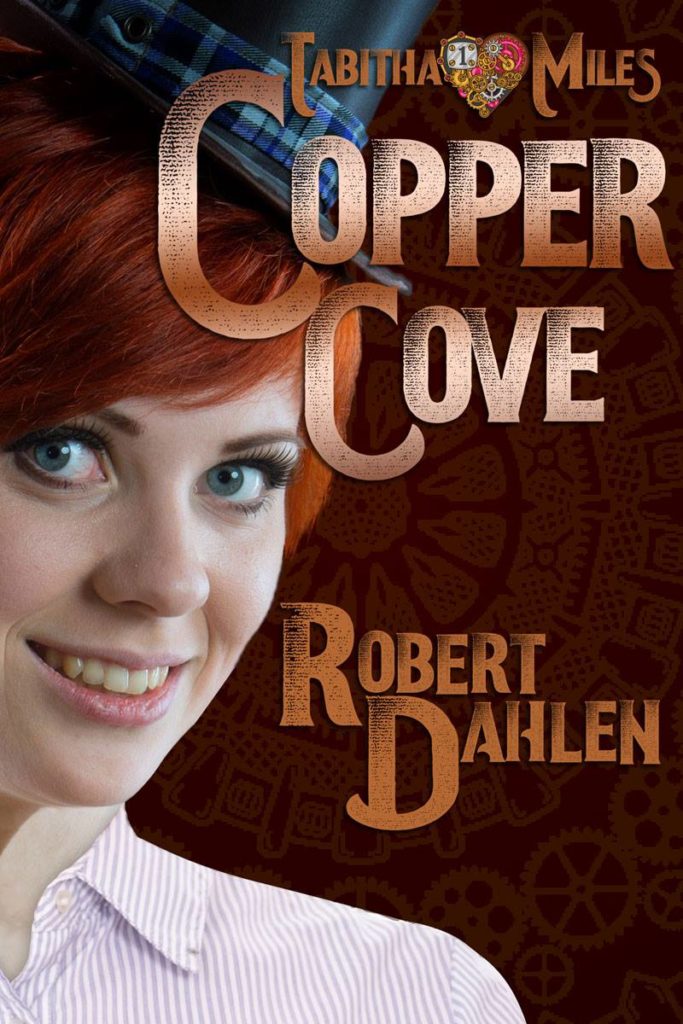
Copper Cove by Robert DahlenCopper Cove by Robert Dahlen:

Copper Cove, city of marvels powered by magic and steam, is abuzz over the coming of the new rail line. Crafter Tabitha Miles would love to be on the first trip of the Velessan Express, but there’s work to be done. Staying awake past midnight to make ends meet, difficult clients, runaway automatons, guild enforcers, all just another typical day for her.

Tabitha’s latest commission seems like just another job at first but then she meets newspaper reporter Sophie Haverford and falls into a web of conspiracy and murder. Can Tabitha unravel the mystery, prevent a disaster, and win Sophie’s heart in time for tea?

Rain Dance by D.N. EriksonRain Dance by D.N. Erikson:

Eden Hunter has a little secret that could get her killed. Again.

Paradise isn’t all it’s cracked up to be. Reaper Eden Hunter would know: she spends her days working for a local vampire warlord, harvesting the souls of the recently departed. But even bad situations can get worse. And when a body washes up on shore near Eden’s secluded beachfront villa, the former con artist finds herself under investigation by the FBI.

But Eden’s not concerned about being charged with murder. She’s got a bigger secret she needs to keep quiet. It’s why she’s living miles from anyone else, even on an island that appears on no map. If that secret gets out, the fate awaiting her is far worse than life in prison. Too bad the FBI won’t stop digging until it might be too late…

Rain Dance is the first book in the all-new Sunshine & Scythes urban fantasy series starring (semi) reformed con artist turned Reaper (and occasional FBI consultant) Eden Hunter. Each novel can be enjoyed on its own without reading the others, but there is an ongoing series arc.

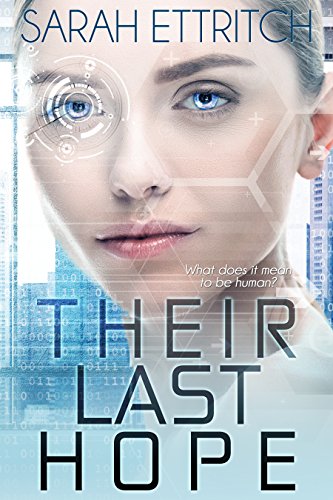
Their Last Hope by Sarah EttrichTheir Last Hope by Sarah Ettrich:

AI specialist Liz Price is determined to see sentient androids in her lifetime, but then she’s diagnosed with terminal cancer. Hoping that her dream will be realized in the future, she arranges to be cryogenically frozen upon her death.

When Liz is revived years later, she expects to be cured. But sentient androids are taking humans and killing them for some unknown reason. They control the medical system, and they don’t treat serious illnesses.

A resistance group wants Liz to turn the androids back into mindless machines. They tell her that’s the only way to stop the androids, and the only way she’ll be cured.

Liz wants to live, so she agrees to work with the resistance. She secretly hopes she can reason with the androids, but then she finds out why they’re taking humans.

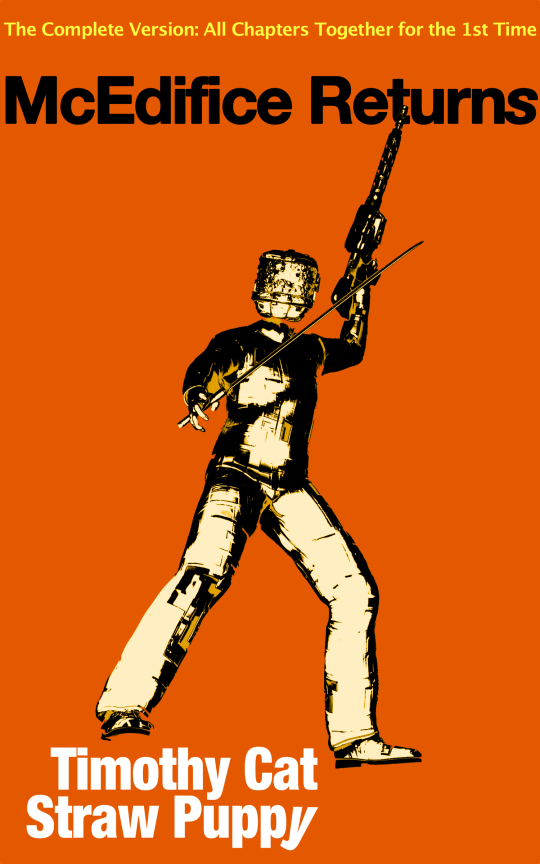
McEdifice Returns by Camestros FelaptonMcEdifice Returns by Timothy T. Cat and Straw Puppy with a little help by Camestros Felapton:

Veteran space marine Chiseled McEdifice wanted a peaceful life after decades of fighting evil but a cowardly attack sets him off on a bicycle ride of revenge and into an adventure across space and time.

From the pen of Timothy the Talking Cat and his surprisingly loud imaginary friend Straw Puppy, comes a space adventure like no other (except ones a bit like it). Featuring a chapter full of the word ‘I’, a dancing photocopier and guest appearances galore.

The City of Ashes by Robert I. KatzThe City of Ashes by Robert I. Katz:

Douglas survived the siege.

But will he survive the tournament?

The contest takes place every five years. The best and brightest fight for riches and glory. But the hidden battle isn’t with fists or weapons, it’s a game of words and diplomacy. Behind the scenes deals are being struck. Sides are being chosen. And betrayal is in the air.

Does this mean war?

Can Douglas uncover the truth?

And if he wins, can he survive long enough to enjoy his victory?

As the game unfolds, the Grand Tournament is just the opening gambit. What comes next will blow you away.

The Empire's Orphans by Robin KristoffThe Empire’s Orphans by Robin Kristoff:

In the space of three days, Rogan loses his royal privilege, his country, and his mother. Now knowing that his father, the King of Kanrine, orchestrated his mother’s execution, Rogan is left stranded in his mother’s homeland. Sickened by the idea of returning home, Rogan lowers himself to washing and sweeping for a local healer to survive. He’s now a drudge, a mongrel, a nobody with airs. His one friend is Bryna, the poverty-stricken daughter of the city’s former baron, who has her own reasons for skirting the notice of the city’s occupying soldiers.

Before Rogan can decide his next move, the mysterious death of a soldier pulls him and Bryna into a web of politics, murder, and magic. The two of them must race to separate truth from lies as the authorities’ investigations quickly turn personal…and deadly.

Told from the alternating perspectives of a conqueror’s son and a conquered lord’s daughter, THE EMPIRE’S ORPHANS follows two twelve-year-olds in a country simmering with national, racial, and class.

Witchin' USA by Amanda M. LeeWitchin’ USA by Amanda M. Lee:

Hadley Hunter has lived a normal life, in a normal suburb, with a normal job and a normal father. All that changes when a grandmother she didn’t even know existed dies and leaves her a fabulous lighthouse on Moonstone Bay Island.

Hadley, ready for an adventure, decides to check things out and finds herself plunged into a world she never envisioned.
From the naked woman swimming in the ocean outside her back door, to the hot sheriff who seems to be hiding a secret, Hadley is intrigued from the start. That’s before magical things start happening – including to Hadley – and a body washes up on the beach.

It seems Moonstone Bay has a killer on the loose … and he may be stalking Hadley, although no one can figure out why.

Things are about to spiral for Moonstone Bay’s newest reluctant – and baffled – witch. She has to learn about the past, investigate the present and hold on to her future for dear life. Along the way she will meet a bevy of new friends who have a few particular abilities … and a lot of really odd quirks.

Set sail for adventure, because once you visit Moonstone Bay, you’ll never be the same again.

Three Wishes by Lisa ManifoldThree Wishes by Lisa Manifold:

To find out what might have been, she has to give up control over what will be.

After a long night of eating too much ice cream and lamenting her less than wise choices, Tibby Holloway wakes up to find a freelancing djinn sitting on her bed. He makes her the offer of a lifetime: three wishes – three chances to go back and change her life.

She can choose a different career, find the man she loved and lost – in short, she can go back and do everything right this time.

But there’s a catch.

Once she’s gone back three times, once she’s created three new—and hopefully better—realities, the djinn will decide where she ends up.

Maybe it would be better not to even know … but that’s a chance Tibby will have to take if she wants to have her THREE WISHES.

Gone with the Ghost by Erin McCarthyGone with the Ghost by Erin McCarthy:

Bailey Burke has had a rough six months—it’s not easy thinking your romantic overtures toward your best friend caused him to kill himself. Except that’s exactly what happened. Ryan is very much dead, having shot himself with his own police-issued gun. Guilt and grief shouldn’t cause hallucinations though, but six months after Ryan went into the ground, Bailey is freaking out and swearing his ghost is standing in her kitchen. Which he is…

Ryan claims he didn’t commit suicide, but was murdered, and he needs Bailey to help him find his killer so he can earn his ticket out of purgatory. Ryan’s counting on a stairway to heaven, as opposed to wings, since that might be a little unmanly for a cop, even a dead one.

An expert in home design, with her own staging business, Bailey can tell you where to place a couch to improve flow and comfort, but solving a crime? Not her area of expertise. But with help from Ryan’s former partner, Marner, she is unraveling the mystery of what happened to Ryan that day… and unwittingly putting herself in grave danger.

Bride by Kyle Alexander RominesBride by Kyle Alexander Romines:

The year is 1795. Frankenstein’s monster has given his creator an ultimatum: Victor must build the creature a mate, or watch as the monster destroys everything and everyone he has ever loved.

You know their story.

You don’t know hers.

She is born into darkness, her destiny entwined with an unspeakable evil. Her sole companion is her creator, the inscrutable Victor Frankenstein, gatekeeper to a life she has never experienced. As her understanding of humanity takes shape, she must contend with the horrific nature of her intended mate and conflicting feelings for her creator.

She wants more from life than to be the bride of Frankenstein’s monster, but will she seek freedom, vengeance, or something else entirely?

Smoke City by Keith RossonSmoke City by Keith Rosson

Marvin Deitz has some serious problems. His mob-connected landlord is strong-arming him out of his storefront. His therapist has concerns about his stability. He’s compelled to volunteer at the local Children’s Hospital even though it breaks his heart every week.

Oh, and he’s also the guilt-ridden reincarnation of Geoffroy Thérage, the French executioner who lit Joan of Arc’s pyre in 1431. He’s just seen a woman on a Los Angeles talk show claiming to be Joan, and absolution seems closer than it’s ever been . . . but how will he find her?

When Marvin heads to Los Angeles to locate the woman who may or may not be Joan, he’s picked up hitchhiking by Mike Vale, a self-destructive alcoholic painter traveling to his ex-wife’s funeral. As they move through a California landscape populated with “smokes” (ghostly apparitions that’ve inexplicably begun appearing throughout the southwestern US), each seeks absolution in his own way.

In Smoke City, Keith Rosson continues to blur genre and literary fiction in a way that is in turns surprising, heartfelt, brutal, relentlessly inventive, and entirely his own.

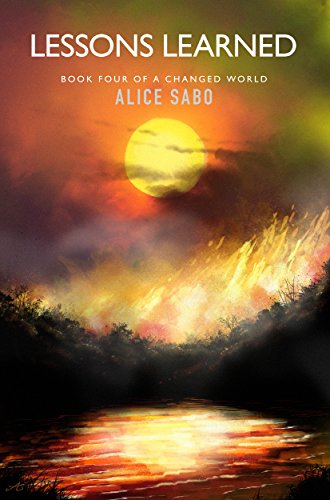
Lessons Learned by Alice SaboLessons Learned by Alice Sabo:

While a wildfire threatens High Meadow, an uninvited guest sows seeds of dissent.

The president arrives at High Meadow with his entourage of bureaucrats and faux-military. Tillie and Angus don’t have time for any distractions as a massive wildfire bears down on their settlement. It will take more than hard work and good intentions to get them through this catastrophe.

Martin is leery about sending all of his men to aid those in the path of the fire thereby leaving their borders unprotected. They are most vulnerable in their commitment to help others.

Wisp and Nick work the fire lines seeking out people fleeing the raging flames. Only Wisp can find those lost in the heavy smoke, risking his life to bring them to safety.

Behind their backs, certain people are questioning every decision. At a time when they most need to work together, the outsiders are creating divisiveness.

Ghosts of the Sea Moon by A.F. StewartGhosts of the Sea Moon by A.F. Stewart:

In the Outer Islands, gods and magic rule the ocean.
Under the command of Captain Rafe Morrow, the crew of the Celestial Jewel ferry souls to the After World and defend the seas from monsters. Rafe has dedicated his life to protecting the lost, but the tides have shifted and times have changed.
His sister, the Goddess of the Moon, is on a rampage and her creatures are terrorizing the islands. The survival of the living and dead hinge on the courage and cunning of a beleaguered captain and his motley crew of men and ghosts.
What he doesn’t know is that her threat is part of a larger game. That an ancient, black-winged malevolence is using them all as pawns…

Come set sail with ghosts, gods and sea monsters.

ONSET: Stay of Execution by Glynn StewartONSET: Stay of Execution by Glynn Stewart:

The Vampire War is over.
The United States is reeling.
The Masquerade is fragmenting.
The Apocalypse is here…

The long and bloody war with the vampires in the United States has finally ended, thanks to the efforts of the vampire Arbiter and ONSET Commander David White—and a nuclear explosion on American soil.
The final battle proves harder to conceal than hoped, however, and a series of high profile incidents end any chance of hiding the supernatural. Suddenly the world is faced with the fact that it is both more wonderful and more terrible than humanity ever realized.
But as the US Government struggles to adapt to this new reality, old enemies have set into motion plans that could render humanity’s struggles irrelevant. There are those beyond the Seal who were once Gods…and they want their planet back!

Fire Fight by Chris WardFire Fight by Chris Ward:

A gripping new space opera saga from acclaimed author Chris Ward …

On the fire planet of Abalon 3, an evil warlord threatens to unleash a wave of destruction in order to take control of the planet’s valuable source of trioxyglobin, a dangerous but valuable liquid used for starship fuel. The only person capable of stopping him is Lianetta Jansen, a disgraced former Galactic Military Policewoman now turned smuggler, who is haunted by a terrible tragedy in her past. Along with her ragtag, wisecracking crew—the one-armed pilot Caladan, and the malfunctioning droid, Harlan5—Lia must confront her own demons, while trying to stop another.

Posted in Books | Tagged , , , , , , , , , , , , , , , , , , , , , , , , , , , , , , , , , , | Leave a comment

Indie Crime Fiction of the Month for January 2018

Welcome to the latest edition of “Indie Crime Fiction of the Month”.

So what is “Indie Crime Fiction of the Month”? It’s a round-up of speculative fiction by indie authors newly published this month, though some December books I missed the last time around snuck in as well. The books are arranged in alphabetical order by author. So far, most links only go to Amazon.com, though I may add other retailers for future editions.

Our new releases cover the broad spectrum of crime fiction. We have cozy mysteries, small town mysteries, culinary mysteries, paranormal mysteries, hardboiled mysteries, historical mysteries, police procedurals, legal thrillers, crime thrillers, psychological thrillers, men’s adventure, private eyes, missing persons, prosecutors, reluctant witches, domestic violence, murdered grandmothers, the pit of crawling death and much more.

Don’t forget that Indie Crime Fiction of the Month is also crossposted to the Indie Crime Scene, a group blog which features new release spotlights, guest posts, interviews and link round-ups regarding all things crime fiction several times per week.

As always, I know the authors at least vaguely, but I haven’t read all of the books, so Caveat emptor.

And now on to the books without further ado:

A Frosty Mug of Murder by Constance BarkerA Frosty Mug of Murder by Constance Barker:

Who Killed the Black Widow?

The Grumpy Chicken Irish Pub is in full blast mode when proprietor Ginger O’Mallory discovers someone has offed the town’s Black Widow before the woman can take out another husband. Secrets swirl and the hooch flows in this brand new series centering around an Irish Pub with a crazy clucker name. And what is with all the spooky goings on with a ghost chicken attached? Find out in this hilarious romp filled with colorful and wisecracking characters.


The Crawling Death by Cora Buhlert
The Crawling Death by Cora Buhlert:

1966. Freelance troubleshooter Todd Donovan is hired to locate Dr. Pat Turner, a biologist who has gone missing in the South American jungle. It seems like an easy job at first, but then Todd finds himself staring into the barrel of a gun.

Captured and taken to the jungle compound of the drug lord Durango, Todd finally meets up with Dr. Turner, who turns out to be not just a beautiful woman, but also Durango’s prisoner.

Durango is not the sort of man to leave potential witnesses alive. And so Todd and Dr. Pat Turner are soon facing a painful end in Durango’s pit of crawling death…

This is a short adventure story of approx. 5500 words or 20 pages in the style of the men’s adventure pulps of the 1960s.

The Mystery of Ruby's Sugar by Rose DonovanThe Mystery of Ruby’s Sugar by Rose Donovan:

Christmas, 1934.

The snow lies heavy around Pauncefort Hall. Dress designers Ruby Dove and Fina Aubrey-Havelock leave behind their Oxford exams to rescue Lady Charlotte’s wardrobe. But what Lady Charlotte doesn’t know is that Ruby is on a mission—a mission to avenge her family and bring down an empire.

As the weather worsens, Ruby and Fina are drawn into the intrigues of Lady Charlotte’s other guests, who include a princess, a furiously left-wing don, a West End starlet—and, it seems, a murderer. After the two resident cads are poisoned, Ruby and Fina must find the culprit and still carry out their secret plans—all before the law arrives. But Pauncefort Hall can remain snowbound for only so long.

The Mystery of Ruby’s Sugar is the first book in the Ruby Dove historical cozy mystery series.

Bleeding Levee Blues by Nick DorseyBleeding Levee Blues by Nick Dorsey:

Tom Connelly left the New Orleans Police Department after the madness of Hurricane Katrina, and his life has gone downhill ever since. Shunned by his brothers in blue, he broke down and gave in to drink. He lost his friends. He lost his wife. And now his son barely knows his name.

But a figure from his past has asked Tom to help a wealthy politician find his missing daughter. If Tom keeps this quiet, the politician promises Tom the one thing he needs most: redemption. A name cleared from past controversy. A new life moving forward.

The search for the young woman leads Tom into the dark corners of the decaying New Orleans landscape and beyond, right into the heart of a deadly human trafficking organization and to the other side of the world. Now Tom isn’t just worried about redeeming himself, he’s hoping he can get out of this alive.

For Better or Worse by Donna Huston MurrayFor Better or Worse by Donna Huston Murray:

Finally back to her spunky self after the loss of her husband, men have once again become an issue for amateur sleuth Ginger Barnes—men who mistreat their wives, men accused of murder, and men who ask her out.

While working on a DIY project at her newlywed daughter’s house, a bag of bricks is thrown from the neighboring third-story window. Next, pops that sound like muffled gunshots have Gin racing for her phone. Eric, who lives in the house with his grandmother, claims she’s obsessed with mystery novels. Yet after the septuagenarian falls down a flight of stairs, she’s so frantic to keep Eric away that Gin must intervene. Was the fall actually attempted murder?In her husband’s eyes, Cissie Voight can’t do anything right. Gin occasionally helps the frazzled young mother, and when she needs a dresser carried upstairs, Gin brings Eric along. Bad move! The electricity between the two new acquaintances sparks a chilling premonition. This time Gin’s good intentions will produce grave consequences—for everyone involved.

Deep Zero by V.S. KemanisDeep Zero by V.S. Kemanis:

It’s one a.m. Do you know where your teenagers are? Prosecutor Dana Hargrove makes it a point to know. But one night, in the dead of winter, she should have known more.

In February 2009, Dana is the newly-elected district attorney of a suburban county north of Manhattan, where she lives with her husband, attorney Evan Goodhue, and their two teenage children. The Great Recession has seen a rise in substance abuse and domestic violence. It’s also the era of burgeoning social media, an intoxicating lure for wayward and disaffected teens who find new methods of victimization: a game to some, with no thought of the consequences.

During an arctic cold snap, the body of a high school student is discovered, lodged in the ice floes of the Hudson River. People are crying for justice, but there doesn’t seem to be a law that fits. Days later, in one hellish night, Dana’s children are sucked into a criminal investigation against several of their classmates, making her a convenient target for community outrage.

In Deep Zero, the fourth standalone legal mystery featuring the dynamic prosecutor, Dana walks the tightrope like never before in her tricky balance between professional ethics and family loyalties.

Witchin' USA by Amanda M. LeeWitchin’ USA by Amanda M. Lee:

Hadley Hunter has lived a normal life, in a normal suburb, with a normal job and a normal father. All that changes when a grandmother she didn’t even know existed dies and leaves her a fabulous lighthouse on Moonstone Bay Island.

Hadley, ready for an adventure, decides to check things out and finds herself plunged into a world she never envisioned.
From the naked woman swimming in the ocean outside her back door, to the hot sheriff who seems to be hiding a secret, Hadley is intrigued from the start. That’s before magical things start happening – including to Hadley – and a body washes up on the beach.

It seems Moonstone Bay has a killer on the loose … and he may be stalking Hadley, although no one can figure out why.

Things are about to spiral for Moonstone Bay’s newest reluctant – and baffled – witch. She has to learn about the past, investigate the present and hold on to her future for dear life. Along the way she will meet a bevy of new friends who have a few particular abilities … and a lot of really odd quirks.

Set sail for adventure, because once you visit Moonstone Bay, you’ll never be the same again.

Murder at Home by Faith MartinMurder at Home by Faith Martin:

Meet DI HILLARY GREENE, a policewoman struggling to save her career and catch criminals.

Flo Jenkins is found murdered in her armchair, a paperknife sticking out of her chest. The old woman was well liked and nothing seems to have been stolen from her home. And it was common knowledge that she only had weeks to live.

Why kill a dying woman? This is going to be one of the toughest cases yet for Hillary to solve.

Hillary also has to deal with a new colleague who has a terrible temper and a rocky past.

With no forensics, no leads, and only a drug-addict nephew as a suspect, will this be Hillary’s first failure to solve a murder case?

Gone with the Ghost by Erin McCarthyGone with the Ghost by Erin McCarthy:

Bailey Burke has had a rough six months—it’s not easy thinking your romantic overtures toward your best friend caused him to kill himself. Except that’s exactly what happened. Ryan is very much dead, having shot himself with his own police-issued gun. Guilt and grief shouldn’t cause hallucinations though, but six months after Ryan went into the ground, Bailey is freaking out and swearing his ghost is standing in her kitchen. Which he is…

Ryan claims he didn’t commit suicide, but was murdered, and he needs Bailey to help him find his killer so he can earn his ticket out of purgatory. Ryan’s counting on a stairway to heaven, as opposed to wings, since that might be a little unmanly for a cop, even a dead one.

An expert in home design, with her own staging business, Bailey can tell you where to place a couch to improve flow and comfort, but solving a crime? Not her area of expertise. But with help from Ryan’s former partner, Marner, she is unraveling the mystery of what happened to Ryan that day… and unwittingly putting herself in grave danger.

Chocolate Cake with a Side of Murder by Meredith PottsChocolate Cake with a Side of Murder by Meredith Potts:

Wedding season has come to Treasure Cove. But a shocking murder threatens to turn the entire town on its head.

Even worse, amateur sleuth Sabrina Daley and her detective fiancé are unable to uncover a single suspect.

Will Sabrina be able to track down the killer before they get away, or will this case go cold?


The Accused by Rachel SinclairThe Accused by Rachel Sinclair

Harper is back…and this time it’s personal.

Harper must defend Damien, who has been arrested for the murder of his birth father, Josh Roland. Harper knows that Damien didn’t do it. He couldn’t do it. Yet his past comes to haunt him, as Harper finds out things about Damien that she never knew.

The victim, Josh Roland, was, for many years, a bastard. He sexually harassed most of his female employees and was a serial rapist. He was also involved with many shady and crooked financial deals that broke the many contractors who had the misfortune of dealing with him. In short, there were many, many people who wanted this man dead. So why was Damien made the prime target of the investigation? The answer to this question stuns Harper and causes her to question everything about what she thought she knew about her law partner.

In the meantime, her tween daughters are giving her fits – even Abby has been acting out lately. They’re 13, at the most awkward age imaginable, and Harper is at the end of her rope with them. Throw in some romantic troubles with her longtime beau, Axel, and you have one seriously frazzled lawyer. She keeps it together, Harper-style, which means that her life is perpetually a mess, but she always fights her way out.

With the twists and turns that you’ve come to expect in a Harper Ross/Damien Harrington legal thriller, The Accused is not to be missed!

Who Killed Granny? by Stephanie VillegasWho Killed Granny? by Stephanie Villegas:

When Barbara Smythe finds her grandmother unconscious and sprawled out on the sofa, she suspects foul play. Worried the attacker will come after her next, Barbara rushes around Los Angeles in a desperate attempt to find and warn her twin sister of the peril they face. With the killer hot on her trail, she must race against the clock to discover who killed Granny and bring them to justice.

Posted in Books | Tagged , , , , , , , , , , , , , , , , , , , , , , , | Leave a comment

A New Release and a New Series – Introducing Two-Fisted Todd

Yes, this is another new release announcement and also the announcement of a new series. But first, let’s travel back in time.

About twelve years ago, I sold several short stories to a magazine that billed itself as a successor to the men’s adventure magazines of the 1960s. Most of those stories were historicals featuring more or less scantily clad damsels in distress, while one was a take on the spicy pulps of the 1930s featuring The Silencer. All but one of those stories have been republished in e-book form since then.

At the time, I didn’t know much about the actual men’s adventure mags of the 1950s and 1960s beyond having seen a few cover scans on the internet. The editor of the mag in question helpfully sent me some scans of the interiors of actual men’s adventure mags. What is more, I also came across this art book which collects hundreds of covers of vintage men’s adventure magazines and also offers an overview about the genre, it’s development, prominent themes and subjects and what sort of content might be found inside. So I promptly bought the book.

The art book also included some statements by artists, models and writers who had worked on these magazines. And one of the writers said that quite often, the covers were painted before there was even a single word of content. And afterwards, a writer would be commissioned to write a story to match the cover. And considering some of the really lurid illustrations on those covers – rugged men being attacked by all sorts of likely and unlikely wildlife, while buxom maidens were being tortured and menaced by evil Nazis, evil Communists, evil biker gangs and evil beatniks (the last one doesn’t quite fit) – coming up with a story to match must have been quite a challenge.

Now I have never been able to resist a writing challenge, so I decided to set myself the same challenge as those men’s adventure magazine writers of old, namely to write a story to match the cover of one of those magazines. So I opened the art book at random, picked one of the covers shown and decided to write a story based on it.

Of course, a men’s adventure tale also needed a suitably manly and rugged hero and so I came up with “Two-Fisted” Todd Donovan, a freelance troubleshooter who travels around the globe to solve other people’s problems, provided the price is right. That was a vague enough description to allow for pretty much any kind of adventure from dealing with lethal wildlife via rescuing young women from dastardly villains to tangling with biker gangs and those really, really dangerous beatniks. And of course, it also had series potential.

So now I had my hero and an image to serve as inspiration, so I started writing. The story stalled out at about three-quarters through. So I set it aside. Then life and work got in the way and the magazine changed direction to become a sexy horror mag, depriving Two-Fisted Todd of his intended market. Eventually, self-publishing became a thing, making previously unviable stories suddenly viable again. And through it all, Todd was biding his time in some tropical paradise, a cool drink in his hand, waiting for another job.

Eventually, I started doing the July short story challenges and one of the things I used for inspiration was the art book of men’s adventure magazine covers, because both the lurid covers and ridiculous headlines made for excellent inspiration. And so several of the stories in Bug-Eyed Monsters and the Women Who Love Them as well as the story “Mock Duck” in Operation: Rubber Ducky were inspired by either headlines or illustrations in vintage men’s adventure mags that I found in that book.

Because the art book was such a gold mine of inspiration, I used it again for the 2017 July short story challenge. Only that this time, I didn’t even open it. I looked at the cover – a lurid illustration of a man and a woman tied up with scorpions crawling all over them – and thought, “Actually, that’s a great image. Why don’t I write a story for that one?”

Of course, I still needed a plot – beyond two people getting tied up and menaced by scorpions – and a hero to go with it. And this is where Todd Donovan suddenly emerged from the depths of my subconscious, cleared his throat and said, “That looks like a job for me.”

And since one of my rules for the July short story challenge is “Go along with whatever pops up, no matter how weird” I sent Todd on a quest to locate a missing scientist (who of course turns out to be a very attractive woman who also isn’t willing to take any macho crap neither from Todd nor the villain) only to find trouble in the form of a murderous druglord and his pit full of scorpions. I also decided to keep the story a period piece set in the mid 1960s.

With the July challenge stories, I normally try to keep research to a minimum. However, this story required some research beyond googling what coca plants actually look like. For starters, a pit full of deadly scorpions required a sufficiently lethal species of scorpion that made sense in the context and setting, since lethal scorpions that live in African or Asian deserts are not really suitable for a story that is set in a Latin American jungle. Finally, I did find a suitable species of scorpion, namely Tityus serrulatus, the Brazilian yellow scorpion, which even looks a little bit like the scorpions on the cover I used as inspiration. And since I had a pit full of lethal scorpions, I also needed to research what happens and what to do when someone gets stung.

That’s one of the benefits of writing. You learn all sorts of obscure facts when researching stories, which is why it baffles me when certain authors, usually of the literary persuasion, insist that they never do research, such as this dude who portrayed cellphones and e-mail as common in a novel set in the early 1990s and also relocated a town from Serbia to Croatia, which is kind of a massive faux pas, especially when the Balkan wars are one of the subjects of the novel.

Te next challenge was finding the right kind of cover for the story. Now the striking cover art of vintage men’s adventure magazines is largely impossible to recreate in the modern era without access to custom illustration. The look of men’s adventure paperbacks such as The Executioner or The Destroyer is also difficult to recreate in the modern era.

In the end, I combined influences from vintage paperbacks and German pulp magazines and found a stock photo of a young lady lying in the grass in clothes that fit both the description in the story and that also looked suitably vintage (too modern clothing and make-up is a curse when browsing stock photos). Of course, there were no scorpions, so I had to photoshop some in. Next came the typography, inspired by looking at the kind of fonts used on actual vintage magazines and paperbacks of the era, and finally some photoshopped grit for that beat up paperback look.

I think the result is pretty good, at least unless I can somehow resurrect Norm Eastman or Rafael DeSoto and persuade them to make covers for me.

Finally, do you remember that first Two-Fisted Todd story, the one I started and never finished? Well, in the wake of editing, proofing and publishing, I dug up that story again as well and found that what I’d written way back when still held up pretty well. What is more, I finished the story. It’s currently going through editing, so there will be at least one more Two-Fisted Todd adventure in the very near future. And then, who knows? After all, I have a big book full of artwork to serve as a potential inspiration for more adventures for Todd Donovan, freelance troubleshooter.

And for those of you who are not into retro pulp stuff, I also have more In Love and War stories coming up very soon (again, currently in editing) as well as at least one more Helen Shepherd Mystery as well as Murder in the Family 2 and After the End 2: More Stories of Life After the Apocalypse.

But for now, buckle up and follow Two-Fisted Todd Donovan into the jungle, as he faces…

The Crawling Death
The Crawling Death by Cora Buhlert1966. Freelance troubleshooter Todd Donovan is hired to locate Dr. Pat Turner, a biologist who has gone missing in the South American jungle. It seems like an easy job at first, but then Todd finds himself staring into the barrel of a gun.

Captured and taken to the jungle compound of the drug lord Durango, Todd finally meets up with Dr. Turner, who turns out to be not just a beautiful woman, but also Durango’s prisoner.

Durango is not the sort of man to leave potential witnesses alive. And so Todd and Dr. Pat Turner are soon facing a painful end in Durango’s pit of crawling death…

This is a short adventure story of approx. 5500 words or 20 pages in the style of the men’s adventure pulps of the 1960s.

More information.
Length: 5500 words
List price: 0.99 USD, EUR or GBP
Buy it at Amazon US, Amazon UK, Amazon Germany, Amazon France, Amazon Netherlands, Amazon Spain, Amazon Italy, Amazon Canada, Amazon Australia, Amazon Brazil, Amazon Japan, Amazon India, Amazon Mexico, Kobo, Barnes & Noble, Apple iTunes, Google Play, Scribd, Smashwords, Inktera, Playster, Thalia, Weltbild, Hugendubel, Buecher.de, DriveThruFiction, Casa del Libro, e-Sentral, 24symbols and XinXii.

Posted in Books, Writing | Tagged , , , , , , , , , , | 1 Comment

Cora guestblogs elsewhere and remembers Ursula K. Le Guin

First of all, my pals at the great podcast The Skiffy and Fanty Show are holding a “Month of Joy” event to celebrate the launch of their new website and they invited plenty of folks they interviewed over the years, including me, to share what gives them joy.

When I got the invitation e-mail, I was massively stressed out and didn’t feel particularly joyful. So I wondered what I could possibly write about, especially since very little gave me joy at that time. However, I found that no matter how stressed I was, I inevitably felt calmer when I sat down to make myself something to eat. So I decided to write about cooking.

The resulting post can be seen here. And coincidentally, I finally managed to recreate the elusive Schillerlocken salad mentioned in that post and you can see the result here. But I don’t just talk about cooking, but also a bit about writing. What is more, I share a genuine family recipe and holiday classic, namely my grandma’s recipe for herring salad. I wondered for a moment whether to share that particular recipe – it is a family legacy, after all – but then I thought why not. My Mom and I and possibly my cousin are the only people still making that particular recipe, so why not spread the joy of the best recipe for herring salad ever further?

So head over to the Skiffy and Fanty website, check out my post and maybe try the recipe. And while you’re there, read some of the other “Month of Joy” posts as well such as this one about translating Italian science fiction by Rachel Cordasco.

In other news, this was a sad week for the science fiction and fantasy community, because Ursula K. Le Guin, genre matriarch and grande old dame of science fiction and fantasy, left us at the age of 88. Over at the Speculative Fiction Showcase, I have linked to a number of lovely tributes from many of the big and small names in our genre in the weekly link round-up.

Those posts and tributes say pretty much everything there is to say about Ursula K. Le Guin and also show how important she was for our genre. So this isn’t going to be a long tribute, just a short rememberance.

When I fired up the Internet on Tuesday and saw that Ursula K. Le Guin had died, I was stunned, almost petrified. It shouldn’t be shocking, if someone dies at the age of 88, but she still seemed so active, still writing, still blogging, still publishing (her last essay collection, fittingly entitled No Time To Spare, came out barely a month before her death) that it seemed as if she would be here forever.

As with many other writers, readers and fans of science fiction and fantasy, Ursula K. Le Guin and her work have meant very much to me. However, when I saw someone asking others on Twitter, which was the first Ursula K. Le Guin book they read, I initially drew a blank. Which is odd, because for most of the other great writers of the genre, I can usually tell you which work of theirs I found first. But for Ursula K. Le Guin I honestly wasn’t sure.

Unlike many others, I never read A Wizard of Earthsea and its sequels as a teenager. When I grew up, science fiction and fantasy in general were scarce in supply in my school library and the village newsagent cum tobacco store cum stationery store cum bookstore. And as a young reader, you are very much dependent on the books that are available to you, particularly in the pre-Internet era. And in the 1980s, that meant “realistic” books that reflected the lives and problems of young people (though hardly any of those books ever reflected mine), not fantasy and science fiction. And what fantasy and science fiction there was, was usually be German or European authors. Books by American authors were rare, probably because of the vicious Anti-Americanism at the time (from both the right and the left) that meant anything American was automatically dismissed as trash. So I never read the Earthsea books as a kid, just as I never read Narnia or the Prydain Chronicles or A Wrinkle in Time or The Dark is Rising or the Oz books or Doctor Suess or plenty of other cultural touchstones for people from the English speaking world.

And when I finally discovered written science fiction at the age of fifteen, I found Isaac Asimov and Arthur C. Clarke and Anne McCaffrey and Edgar Rice Burroughs and Poul Anderson and Robert A. Heinlein and C.J. Cherryh and many others, but I still did not find Ursula K. Le Guin. I knew that she existed, but for some reason – probably a lack of availability – I did not read anything by her until much later. Once I did, I read The Left Hand of Darkness and The Lathe of Heaven and The Dispossessed and enjoyed them all. I also finally read A Wizard of Earthsea and saw that I would have loved it, had I found it at the right time in my life. But most of all, I enjoyed her essays and her criticism. While I was working on my MA thesis, I thoroughly overdosed on science fiction criticism and could stomach neither science fiction criticism nor science fiction itself for a year or so. However, I still read any Ursula K. Le Guin essay or review I could find. Because unlike the preposterous blatherings of more or less preposterous men that I endured for my MA thesis, her work was always insightful and not preposterous at all.

So which was the first Ursula K. Le Guin work I read? Well, it turns out that there were two of her works that I read in my teens after all. One was “The Ones Who Walk Away From Omelas”, which I found in an anthology somewhere. But though it made an impact – well, is there anybody on whom that story doesn’t make an impact? – I did not recall the name of the author (it didn’t help that my teen self occasionally used what few bookstores carrying English language fiction there was as libraries, because I could not possibly afford to buy all the books that interested me) until I found it referenced in one of Ursula K. Le Guin’s essays much later. However, there is another work by Ursula K. Le Guin I encountered at around the same time, probably earlier, and that is The Word for World Is Forest. I suspect the reason I sought it out was because I saw it listed somewhere as an influence on the Endor scenes in Return of the Jedi. My teen self had made it her mission to track down each and everything that was supposed to have influenced the Star Wars trilogy. This quest led me to some strange places and to plenty of things where I could not see any connection at all, but it also introduced me to the films of Akira Kurosawa and the fiction of Ursula K. Le Guin.

So the first work by Ursula K Le Guin that I read was The Word for World Is Forest. I read it, because someone somewhere claimed it had influenced Return of the Jedi. I have no idea if it really did, though I can certainly see the parallels, but I’m still grateful to whatever critic drew that comparison, because they introduced me to one of the true greats of our genre.

Posted in Books, Links, Personal | Tagged , , , , , , , , | Leave a comment