The awards debate that won’t die

Yes, we’re still talking about the Hugo and Clarke Awards.

Let’s start with the Clarke Awards this time around. Regular commenter Estara points out this great post by another regular commenter, Australian SFF writer Andrea K. Höst who takes issue with the jury’s claim that a lot of the novels by women writers that were submitted to the Clarke Award this year are “technically fantasy” and points out that it’s perfectly possible for books to be both SF and fantasy or look like fantasy and actually be SF and that even some works by the award’s patron Arthur C. Clarke would fall into this category. And of course, Clarke’s Third Law states:

Any sufficiently advanced technology is indistinguishable from magic.

Andrea’s post also led me to writer Tom Pollock and his delightfully named blog Djinn & Tronic. Tom Pollock makes a similar point, namely that genres can coexist with each other and that it’s perfectly possible for a book to belong to more than one genre, an idea which will horrify genre purists everywhere.

And let’s not forget that some of the previous winners and nominees of the Clarke Award, such as the 2011 winner Zoo City by Lauren Beukes or the various China Miéville novels which have been nominated (and won) in the past or the Sherri Tepper novel whose nomination so enraged Christopher Priest (and others) last year or Time Powers’ Declare, which suffers from the same issue as G. Willow Wilson’s Alif the Unseen, that is the presence of Djinn*, were not exactly clear-cut SF either.

On to the Hugos: At The World in the Satin Bag, Shaun Duke points out that all of those who tell Hugo/Worldcon critics that they should attend the WSFS business meeting have missed the fact that attending Worldcon is prohibitively expensive for many of us. I’m not sure if I’ll attend next year’s Worldcon in London (or if I even want to), because even though Worldcon is on the same continent for once, getting to London still requires plane travel (and Ryanair is not a great option, if you want to buy something and have more than carry-on luggage) plus accomodation costs (and of course, the con is in the Docklands, where hotels are pricey and nowhere near any London friends where I could crash) plus the costs for the con itself, all of which adds up. Ditto for a possible Helsinki Worldcon the year after. And I’d still consider myself financially privileged. The situation looks much worse for fans from non-western countries.

The Skiffy and Fanty Show has invited Justin Landon and Jonathan McCalmont to expound on their isues with the Hugos in general and this year’s shortlist in particular. Once again, I haven’t listened to it, since I don’t do podcats.

*And other problems. I found Declare not just immensely disappointing, but also downright offensive – and I normally like Tim Powers a lot.

Posted in Books | 4 Comments

The latest state of this year’s awards debate

Apparently, we’re still talking about the Hugo and Clarke Awards, so here are the latest links:

At Tor.com, Niall Alexander offers a summary of the uproar surrounding this year’s all-male, all-white Clarke Award shortlist. There’s not a whole lot in this post that’s new, but it’s a nice round-up.

Kevin Standalee of the WSFS attempts to answer the question, “Who owns the Hugo Awards?” I think part of the problem here is that because the Hugos along with the Nebulas are the best known awards in the SFF genre, a lot of people feel a connection to the Hugos that they don’t feel to – say – the Clarke Award or the BSFA Award or indeed any other genre award, hence the upset when the nominations and winners don’t reflect their personal tastes.

Daveon offers a few proposals of how the WSFS business meeting could be made more inclusive towards those who are unable to attend Worldcon on a regular basis. This is a very good post and one of the few which offers concrete solutions and suggestions. Meanwhile, the comment thread at Ruthless Culture seems to have taken on the quality of a particularly nasty trainwreck.

Seanan McGuire whose name repeatedly came up during this year’s Hugo debate as that of a nominee many disagreed with wonders why she is being accused of excessive self-promotion, while male writers are not, and suspects her gender has something to do with it, because women are always judged much more harshly than men whenever they dare to open their mouths. I think she’s on to something here. Besides, it is notable that the Hugo nominees who received the most vitriol in this discussion, Seanan McGuire/Mira Grant and Lois McMaster Bujold, both happen to be women, while John Scalzi got off a lot lighter, even though the people who felt that Blackout and Captain Vorpatril’s Alliance shouldn’t be on the Hugo shortlist generally feel that Redshirts doesn’t belong there either. Never mind that John Scalzi does have a very popular blog and occasionally uses it to promote himself among many other things, whereas I don’t think I’ve ever seen Lois McMaster Bujold do any online self-promotion at all beyond the occasional interview.

Of course, those that disagree with Lois McMaster Bujold’s Hugo nomination tend to claim that she’s only on the shortlist, because fans keep nominating her out of habit. Again, no one is claiming that Kim Stanley Robinson only got nominated out of habit, even though he has been writing professionally for about as long as Lois McMaster Bujold and received a whole bunch of nominations over the course of his career as well. So yes, there is a definite gender bias in this discussion.

Talking of which, here are two posts by Larry Nolan at The OF Blog that I missed during my last round-ups: First, here is a post where he shares his opinions about the best novel nominees and then there is another post wherein he responds to the ongoing Hugo debate and says that he has largely stopped caring about the Hugo and Nebula Awards, since the winners and nominees rarely match his tastes.

What I find notable about most of the Hugo complaints this year is that they always center on the same three books, namely Mira Grant’s Blackout, John Scalzi’s Redshirts and Lois McMaster Bujold’s Captain Vorpatril’s Alliance, whereas hardly anyone has anything negative to say about Kim Stanley Robinson’s 2312 and Saladin Ahmed’s Throne of the Crescent Moon. Now in my initial Hugo post I wrote that I was quite satisfied with the nominations for Redshirts, Throne of the Crescent Moon and Captain Vorpatril’s Alliance, even if only one would have been on my personal list, but didn’t care for 2312, since Kim Stanley Robinson does nothing for me, and Blackout, since I don’t like zombie stories.

Now I can understand why some people might not like Redshirts, because it does play on nostalgia and sf fan culture insider jokes, i.e. it’s a book that’s deliberately self-referential and designed to appeal to geeks. But what I don’t understand is why the same people almost unanimously like Kim Stanley Robinson and dislike Lois McMaster Bujold (often without having read her), since both are writers that deliver the big ideas SF fans love so much. Now I personally think that Lois McMaster Bujold is more successful at mixing the big ideas with great characters and good stories than Kim Stanley Robinson. But nonetheless I wonder why there is such a vehement dislike directed at Lois McMaster Bujold. Is it because she’s published by Baen? Or because she’s a woman?

Larry Nolan also states that while this year’s list of Hugo nominee may be diverse with regards to gender, race and country of origin, the stories are still “too conventional and safe” for his tastes, since they don’t challenge today’s social conventions as much as (his examples) Joanna Russ and Samuel Delany. Now I believe that Lois McMaster Bujold’s works in general are quietly subversive, though a lot of people fail to notice this (and indeed the dismissal of Bujold in certain corners of the SFF community confirms one of the points Joanna Russ made in How to Suppress Women’s Writing). What is more, this year’s Hugo shortlist contains a classic of Chinese literature retold as an SF novella (Aliette de Bodard’s On a Red Station Drifting) and a short story that would have been right at home in the feminist SF of the 1970s (Kij Johnson’s Mantis Wives). Even John Scalzi’s Redshirts, while conventional in subject and theme, does have a rather unusual structure with its three codas. Indeed, Nolan’s first Hugo post illustrates an issue I briefly mentioned towards the end of my last post, namely that a lot of people want more diversity in the SFF genre and its awards, but then are annoyed when the diversity they get doesn’t match their ideal of what diversity should look like.

Meanwhile, the winners of the Romantic Times Awards (which are awarded for various genres, not just romance) have been announced as well. There are a lot of SFF nominees and winners (they even have a separate Steampunk category, though I would have picked Meljean Brook’s Riveted over Karina Cooper’s Tarnished) including John Scalzi’s much maligned Redshirts in the SF category and two books many would have liked to see on the Hugo shortlist, N.K. Jemisin’s The Shadowed Sun in the general fantasy and Elizabeth Bear’s Range of Ghosts in the epic fantasy category. They also have a bunch of categories for small-press/self-published works.

And just because the Hugo and Clarke Awards don’t have a monopoly on generating debate, I also have a round-up of the latest indie publishing controversies and discussions over at the Pegasus Pulp blog, including a slugfest of sorts between Hugh Howey and Chuck Wendig. And I didn’t even get into Scott Turow and his “Death of the American Author” op-ed in the New York Times, which sparked a whole new round of controversy.

Posted in Books | Tagged , , , , , , , , | 6 Comments

Mixed Links – mostly SFF but not necessarily Hugo related

First of all, here is a signal boost. Ben Wolverton, the 16-year-old son of writer and teacher Dave Farland/Dave Wolverton, has been critically injured in a longboarding accident and is currently in a coma. The treatment costs are enormous and like so many in the US, the family has no health insurance. If you want to help, you can donate for a fundraiser here and/or buy one of Dave Farland’s books, such as Nightingale, a YA paranormal from the man who was Stephenie Meyer’s teacher. If you’re a writer, Dave Farland also has two great books on writing, Million Dollar Outlines and Drawing on the Power of Resonance in Writing. If you manage to buy one of those books on Wednesday, you will contribute to the “book bomb” organised by friends of the Wolverton family to benefit Ben. But if you buy them later, you can still help.

I’m interviewed by fantasy writer Scott Marlowe at his blog. We talk about writing, inspiration, ideal readers, sockpuppets and whether the review system is broken. So come on over and say “hello”.

The Hugo/Worldcon debate seems to be winding down, though artist and Hugo winner John Picacio points out that Worldcon is open to everybody who is willing to pitch in and do the work and the the WSFS is actually pretty democratic. The delightfully named I’m wasted potential also shares his or her thoughts here.

Fantasy Book Café has honoured a lot of female fans, critics and writers during their “Women in SF&F” month. Today’s post is by Lois McMaster Bujold, who expresses her frustration that discussions about the death of science fiction and about women in genre not just reoccur every year, but that they are almost the same discussions every time as well. This is quite fitting, particularly in the light of the recent Hugo and Clarke award debate, which would probably have to be filed under “Discussions that reoccur every year” as well.

At Galaxy Express, Heather Massey comments on the prevalence of sexual violence committed against the heroine in science fiction romance and how annoying this trope can be, particularly en masse and done in a way that trivializes sexual violence. The discussion in the comments is interesting, particularly in the light of the recent grimdark debate. Word of warning though, a troll rears his ugly head in the comments as well.

Aliette de Bodard has a great post at her blog about how complaints that a certain work of fiction is overly political or preachy on the one hand and dismissing other works as escapist entertainment or “mindless fluff” on the other hand both miss the point, because all fiction is political. Even the so-called “escapist fluff” promotes some kind of message, usually one that reinforces the status quo.

In fact the reply that “It’s just entertainment. Don’t overanalyze it”, whenever I complain about sex scenes in supposedly contemporary romances and erotic fiction that don’t involve condoms, about stone age gender relations and men treating women like crap in certain popular romance novels, about the fact that any Asian or French person ever to show up in an episode of NCIS or NCIS: LA will inevitably turn out to be a villain* (Germans don’t necessarily fare any better, there just aren’t very many of them), about the fact that the otherwise enjoyable German crime show Der letzte Bulle (The last cop) had two episodes almost back to back, where a lesbian suddenly fell in love with a man and her female partner then proceeded to murder said man in a fit of jealousy. Because these things are not just entertainment, they also send a message, a message that can be actively harmful.

*In one case, this even included a recurrent character who had been on the show for several years before suddenly being revealed as a murderess and traitor and being “accidentally” shot by Leroy Jethro Gibbs in a scene that was cut in a way to make the shooting look anything but accidental.

Posted in Books, Links | Tagged , , , , , , , , , , | 3 Comments

Award me, baby, one more time

Yes, we’re still talking about the Hugos and awards in general, though by now the discussion seems to have moved on from general complaining and whining to constructive criticism of how the Hugos could be fixed, provided one agrees that they require fixing. One example is the post by Jonathan McCalmont to which I linked yesterday. Continue reading

Posted in Books, Links | Tagged , , , , , , , | 11 Comments

The Hugos, the Clarke Awards and what do you want, exactly?

We’re still talking about the Hugo awards and whether they are broken or not. Though as a bonus, we’re now talking about the Clarke awards and whether they are broken as well.

So here are links to the latest posts and some commentary under the cut: Continue reading

Posted in Books | Tagged , , , , , | 19 Comments

Linkdump – One hundred percent Hugo and Clarke Award free

The hits on my Hugo reaction link round-up have gone through the roof thanks to links from John Scalzi, James Nicholls, Liz Bourke, Jay Lake, Radish Reviews, SF Signal and others. I’ll do another link round-up about the reactions to the Hugo and Clarke awards shortlist (which has also been announced and goes in the complete opposite direction) over the weekend. However, my offline life has been very busy these past two days (plus school started up again), so reactions to Hugo reactions and the Clarke awards will have to wait. Plus, I think I accidentally deleted a comment that landed in my spam filter, so my apologies for that.

But for now, here are some non-Hugo/non-Clarke links that have piled up:

Chuck Wendig, who has just been nominated for the Campbell award, has a great illustrated post about plot and story structure. He is a bit harsh on Freytag’s triangle (What is it with American SFF writers and Freytag hate lately?), though he’s right that the basic Freytag triangle is not the only way to structure a story. Besides, if you’ve ever read Freytag (I have – slogged my way through six volumes of Die Ahnen at university), you’ll see that not even Freytag himself always adhered to the triangle that bears his name.

At Editor’s Opinions, William H. Coles attempts to answer the question why contemporary literary fiction is so often so dull and fails to achieve excellence. At the creative writing classes I attended at university, this problem manifested itself in a glut of stories about doomed exchange student romances.

In the New York Review of Books, British writer Tim Parks recounts his experiences with an intrusive American editor intent on americanizing one of his books. Found via Craig Morris, an American journalist living in Germany, who also offers some observations of his own. I’ve pointed out before that I find the American obsession with non-issues like split infinitives, passive voice, adverbs, “telling”, etc… flat-out weird, especially since e.g. split infinitives are often regarded as grammatical mistakes, when it’s merely a style issue. I guess we have to thank my old friends Strunk and White for that. Meanwhile, American editors seem to be far more intrusive regarding rewriting to fit house styles or telling writers to change the content of their works than German editors. Indeed, I try to imagine some twentysomething editor trying to tell Martin Walser or Günther Grass or Peter Handtke how to write and predict a bloodbath at Suhrkamp that makes the current troubles look like a minor skirmish.

One of the editors of Carina Press, Harlequin’s “digital first”, has come up with a new romance subgenre called “contemporary crack”, which apparently encompasses all the stuff that was bad about the romance genre twenty to thirty years ago such as domineering alpha heroes, over-the-top plots, extreme melodrama, etc… Now I like Carina Press for publishing romances with niche appeal. For example, a lot of the better recent SF romance hybrids originated at Carina. I also like the fact that they publish a lot of same sex romances and don’t necessarily separate them from the regular heterosexual romances, e.g. when you click on “science fiction” on the Carina website, you get both gay and straight stories. However, I really could do without devoting an extra subgenre 1980s retro style romances (never mind that this style never went away – Harlequin has whole lines devoted to publishing this sort of thing) and I no more want to see “contemporary crack” than real crack of the drug variety.

For that matter, what’s this thing with referring to books and TV shows of the overly melodramatic variety as “crack”, “crackalicious” and similar terms. As neologisms go, I find “crackalicious”, “contemporary crack” and similar terms nearly as annoying and problematic as “drinking the Kool Aid” or anything involving “Youg Turks”. Besides, what’s wrong with “addictive”?

The German media has just discovered online witchhunts, “fails”, as they’re called in the online fan community, or “shitstorms” as such phenomena are called in German speaking countries, which shows that the German language mainstream media is several years behind the times, as usual. I also strongly doubt that Sascha Lobo coined the term “shitstorm”, since I recall having seen it used in English language texts, though not with the exact same meaning. There’s probably a linguistic paper in this somewhere. Meanwhile, 3sat also offers an image gallery with several prominent example. I must confess that I missed most of those uproars, except for the Anne Hathaway hate (which I just plain don’t get). That is, I’d heard that German actress Katja Riemann was at the centre of an online controversy about an interview, though my initial reaction was “Wait a minute, you mean someone actually watches DAS!?”

Finally, here’s the sad news and sadly, there’s rather a lot of it:

Scottish SF writer Iain Banks has been diagnosed with advanced gall bladder cancer. Here is an appreciation by fellow Scottish writer Val McDermid.

Legendary American film critic and blogger Roger Ebert dies aged 70 after a lengthy battle with cancer. I had never heard of Roger Ebert before getting on the internet, but I have enjoyed several posts at his blog in recent times.

Spanish dirctor, fimmaker and composer Jess Franco died aged 82. I have never been a fan of Mr Franco’s works, largely due to what he did to the Dr. Mabuse franchise (For more details, see the article I wrote about the German master villain Dr. Mabuse). However, you can’t help but admire his prolificness.

DC Comics artist Carmine Infantino, who drew Batman and The Flash among others, died aged 87. He was one of the main forces in ushering in the silver age of comics at DC.

Posted in Books, Links, Writing | Tagged , , , , , , , , , , , , , , , | 2 Comments

Hugo Nomination Reactions or Why the Fuck is this Controversial?

Odd. I’d have thought that this year’s Hugo shortlist was pretty much uncontroversial. I mean, we have a healthy representation of women and writers of colour, most of the nominations went to works and writers that are popular or at least talked about, there are very few “What the Fuck?” nominees compared with other years (e.g. last year’s nominees included a filk CD and a Hugo acceptance speech from the previous year). Sure, there still are issues, particularly with certain categories, but there always are issues.

Which is why I was surprised to find that this year’s Hugo slate is apparently considered highly controversial in certain corners of the SFF community. Continue reading

Posted in Books | Tagged , , , , , | 61 Comments

A quick thought on Game of Thrones

Just watched the first episode of season three of Game of Thrones.

Tywin Lannister really is determined to win the unofficial Darth Vader Parenthood Award for the second year in a row, isn’t he?

Posted in TV | Tagged , | Leave a comment

Some Reflections on Recent Awards and Nominations

The past week has been a good one for awards and nominations, because the shortlists and winners for several more or less prestigious awards have been announced.

First of all, the nominations for the 2013 Hugo Awards have been announced. This is another good year for genre diversity, for there are several women writers and writers of colour among the nominees in the various fiction categories. There even is a women among the nominees in the best pro-artist category, which is a first as far as I know. The best fan writer category remains mainly male dominated, but at least we have one female nominee in Tansy Rayner Roberts.

The best novel category looks like a good selection. Captain Vorpatril’s Alliance by Lois McMaster Bujold is my personal favourite of the bunch (But oh, that cover! Not just awful, but whitewashed, too). I haven’t read Throne of the Crescent Moon by Saladin Ahmed yet, but I’ve heard many good things about it. Besides, here we have a muslim writer getting a Hugo nomination for an Arabian based fantasy novel, which is reason enough in itself to rejoice. John Scalzi is immensely popular, not least because of his massively popular blog, plus Redshirts is funny and plays on geek tropes. Come to think of it, both Captain Vorpatril’s Alliance and Redshirts are definitely on the lighter side of the genre spectrum, which is interesting given the current grimdark debate. 2312 by Kim Stanley Robinson strikes me as exactly the kind of book Hugo voters will like, though Robinson has never personally done it for me. For me, the only baffling choice is the Mira Grant novel. Now I like Seanan McGuire’s urban fantasy quite a bit, but her Mira Grant books strike me as exactly the sort of run-of-the-mill zombies/biohazard/killer virus technothriller I avoid in any incarnation.

I can’t really comment on the merit of the individual works in the three short fiction categories, since I haven’t read any of them. However, I’m pleased to see Jay Lake and Aliette de Bodard nominated. Seanan McGuire/Mira Grant is represented with another three stories, too. And while Catherynne Valente’s work is not my cup of tea at all, I know she’s popular. It’s also interesting that several of the nominated stories (Aliette de Bodard’s On a Red Station, Drifting and Immersion as well as Ken Liu’s Mono No Aware, maybe others as well) feature non-western settings and characters. Finally, we only have three nominated short stories, because no others managed to capture more than five percent of total nominations, which might indicate either a very weak year for short fiction or an extremely wide and varied field of nominations.

The short fiction categories also show how the publishing landscape is changing, because only one of the nominated works in the three short fiction categories was published in one of the established big three print SF magazines. Clarkesworld and Tachyon Publications have produced several nominees, a couple come from anthologies, while most of the nominees in the novella category are standalone publications, something that was extremely rare before e-books made standalone novellas feasible. Plus – drumroll – we finally have the first self-published Hugo nominee in Seanan McGuire’s In Sea-Salt Tears. Come to think of it, On a Red Station, Drifting might be indie published as well, even though there is a publisher imprint listed. Given the rules, it was always obvious that the Hugos would probably be the first major award to open towards indie published works, since indies have never been explicitly excluded, unlike with other major genre awards. Though I actually expected someone like Hugh Howey to kick open the doors of the Hugos for indiedom, it probably makes more sense that a hybrid author would be the first.

The related works category looks pretty good. My favourite would be The Cambridge Companion to Fantasy Literature, but then I’m biassed towards academic reflections on the genre. The Chicks Dig series is pretty popular and garners two nominations this year. I can’t comment on the Martin Greenberg book and the nomination of the Writing Excuses podcast in this category just baffles me, because shouldn’t it go in the podcast category.

The long form dramatic presentation category includes the usual blockbusters – Cabin in the Woods is the only surprise here. The domination of Doctor Who in the short form dramatic presentation category continues with three nominated Doctor Who episodes. There’s also one Game of Thrones episode and one Fringe episode nominated. I’ve hoped for years that something other than Doctor Who would finally be nominated in this category, especially since Doctor Who has declined pretty severely IMO. And I can’t argue with Game of Thrones, but Fringe? Honestly? Fringe is the best genre TV you could come up with? Though to be fair, there is very little good genre TV around these days. Being Human has shot past annoyance into “This crap is still on?” territory, Misfits is no longer as good as it used to be and Supernatural mainly seems to survive due to fanfic people. True Blood is still on, but no one is watching, ditto for Vampire Diaries. What is more, the UK – which in recent years has been the most reliable source of innovative genre TV – seems to be mainly focussing on nostalgia dripping period dramas designed to appeal to the Downton Abbey fan of late. So really, what is there to nominate aside from Doctor Who and Game of Thrones?

I can’t comment in the other categories, since I’m not familiar enough with them. The Campbell award shortlist just continues to baffle me, ditto for most of the best fan writer nominees.

The shortlist for another major genre award was announced this week as well, for the nominations for the 2013 Rita and Golden Heart awards have been announced. I have read only three of the nominated books, namely Lothaire by Kresley Cole, Rogue Rider by Larissa Ione as well as the annual J.D. Robb. Though it’s interesting to see several e-book first/only imprints like Carina Press or Loveswept represented as well as Amazon’s Montlake Romance imprint. No self-published nominees, but then the Ritas aren’t open to self-published works yet. And talking of which, it’s probably time to revamp the Golden Heart contest for the best unpublished books, because in the current publishing climate they’ll probably run out of nominees soon, because the sort of books that would once have been submitted for the Golden Heart are now increasingly being self-published.

More awards: The winners of the 2013 BSFA awards have been announced this weekend as well. The shortlist as well as the winners here are heavily male dominated. I can’t comment on the winning novel, Jack Glass by Adam Roberts, though the cover (also a winner) is great. The awards nod for the World SF Blog is well deserved, though.

Yet more awards: The winner(s) of the 2013 Philip K. Dick award was announced this weekend as well. I really can’t comment, since I have never even heard of either book.

Finally, the winners of the 2013 Adolf-Grimme Awards, supposedly the most renown German TV award, have been announced as well with predictably horrible results (The Grimme awards are mainly renown for rewarding bloody depressing TV). In the fiction category, the winners are a TV movie about a mother who commits suicide, another TV movie about a marital rape (or was it?), yet another TV movie about a real life kidnapping case that is mainly remembered because the police investigators in charge decided to ignore the inconvenient fact that Germany has a constitution and threatened to torture the suspect (didn’t help, the kidnapped child was dead anyway and very few people even dared to say that what the police did was wrong), a TV series on a tiny pay-TV cable channel that no one watches and a TV mini-series about annoying bourgeois people in Communist East Germany based on an equally annoying family saga which won the German book award (renown for rewarding family sagas with historical background) a few years ago. The non-fiction winners include documentaries about children dying of leukaemia, a black German boxer facing racism, a Stasi informer, the end of Communism and young people from an immigrant background in Germany. In the entertainment category, “entertainment” meaning “not bloody depressing” in this context, the winners are an episode of series about crime scene cleaners and a parody of the popular German game show Wetten Dass? (Wanna bet?). If I ever needed confirmation about the sorry state of German TV, the Grimme awards provide it in spades.

Posted in Books, TV | Tagged , , , , , , , , , , , | 5 Comments

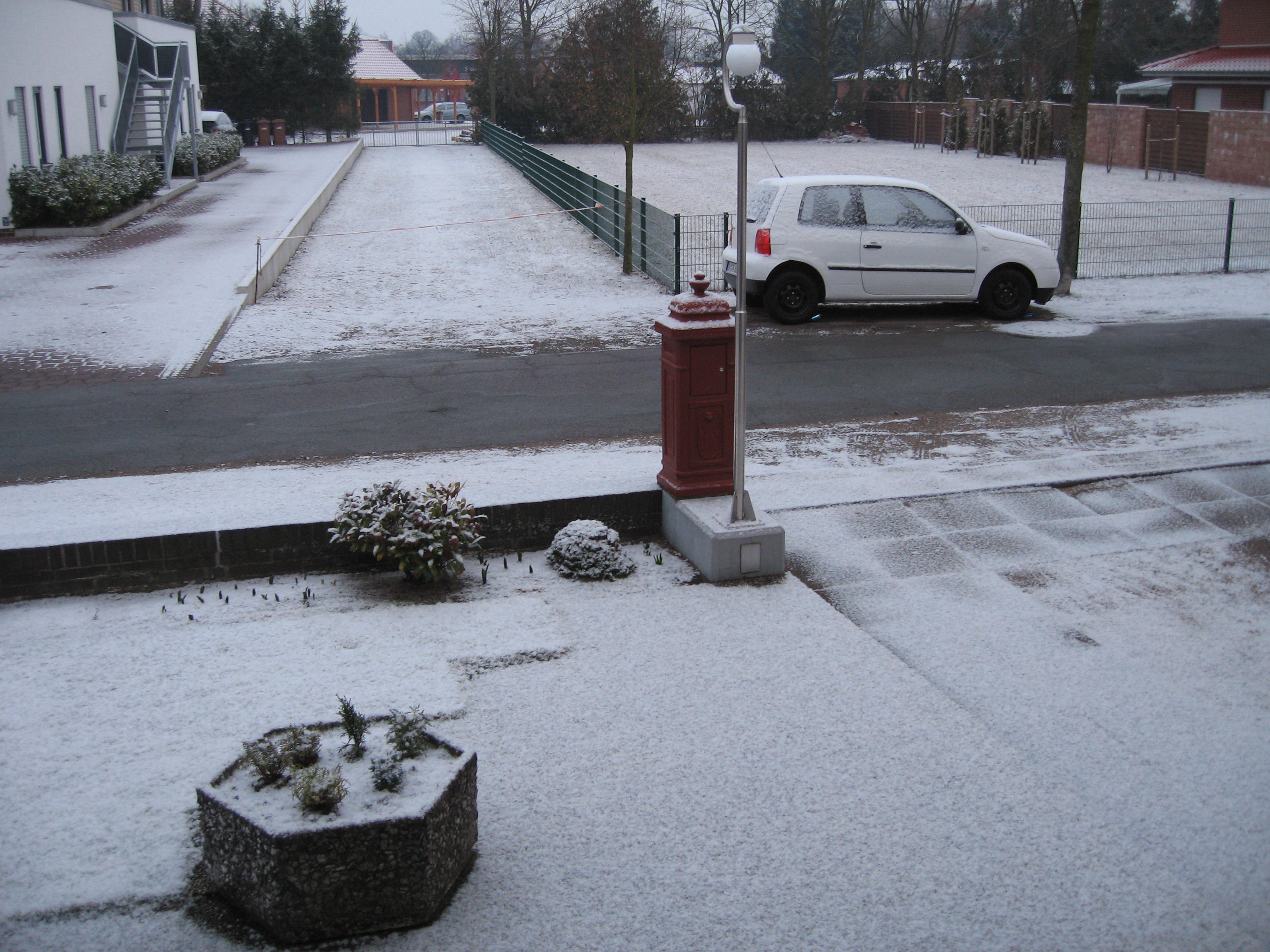
Happy Snowy Easter

This is the view from my front door at seven AM today. Now, it’s not Christmas but Easter morning. In fact, Christmas was warmer and much greener than this.

Snowy Easter 2013

Try finding some Easter eggs on the snowy meadow. Though given how cold it is, maybe the Easter bunny opted to stay home instead.

Snowy Easter

Pristine snow on an Easter Sunday morning. Not even the drunkards staggering home from last night’s Easter fire have marred it.

Posted in General | Tagged , , | Leave a comment