Photos: Wangerland in East Friesia

Easter Monday is a public holiday here in Germany. And since the weather was a bit cold, but otherwise nice, we decided to go on an outing to the East Friesian North Sea coast to visit the municipality of Wangerland.

I also took my camera – well, only my smartphone camera, since I forgot to charge my proper camera – along, so here are some photos. Ships, fish, random wood paths and windmills. East Friesia borders on the Netherlands, so you can find quite a few windmills here.

Stumpens windmill

The windmill in Stumpens near the village of Horumersiel. Originally built in 1816, it houses a café nowadays.

Stumpens windmill

Another look at the windmill in Stumpens near Horumersiel.

Stumpens windmill

A close-up look at the top of the windmill in Stumpens. Note the gallery, which was included to facilitate maintenance work.

Osternburg windmill

This windmill is not in East Friesia, but in Osternburg near Oldenburg. Unlike the Stumpens windmill, the Osternburg mill was reconstructued according to historical blueprints and is actually less than twenty years old. It houses a restaurant and boutique hotel.

Road through the forest

A country road passes through a forest near Kirchhatten near Oldenburg.

Wood path near Kirchhatten

A wood path near Kirchhatten near Oldenburg.

Wilhemshaven destroyer Möldens

The “Möldens”, a decommissioned destroyer of the West German navy that now serves as an exhibit of the navy museum in Wilhelmshaven. Wihelmshaven has been one of the main ports of the German navy since the days of the second German empire. Even today, half of the buildings in the harbour either belong to the navy or used to belong to it.

Here is the homepage of the German Navy Museum in Wilhelmshaven and here is the Wikipedia entry for the destroyer Mölders.

We also had lunch at favourite restaurant of ours, “Die Brücke” (The Bridge) in the village of Hooksiel, a seafood restaurant which also smokes its own fish.

"Die Brücke" in Hooksiel

The restaurant “Die Brücke” (The Bridge) in the village of Hooksiel.

Rosefish and zander with lobster sauce

Here’s my lunch: A so-called sluicegate keeper’s platter, consisting of filet of rosefish and filet of zander with lobster sauce and grey shrimp.

Matjes housewife style

Lunch (not mine): Matjes (Dutch salted herring) housewife style, which means served with a sour cream sauce with apples, onions and dill.

Here is the recipe for Matjes, housewife style, BTW.

Eggs Kejriwal

Finally, this is something I made for dinner yesterday: Eggs Kejriwal

I found the recipe for Eggs Kejriwal, an egg and cheese sandwich originally served at a country club in Mumbai, here. It sounded tasty, so I wanted to try it out and Easter was the perfect excuse. It doesn’t look as pretty as in the recipe, but it was very tasty.

Posted in General, Personal | Tagged , , , , , , , , , , , | Leave a comment

Of False Memories and Explosions

Yesterday, I came across this article by Kate Lunau on Motherboard, in which psychologist Julia Shaw explains false memories and how they form. It’s a fascinating article, which also struck a chord with me, because I have a very vivid memory of a traumatic event stuck in my head that happens to be false.

In 1979, a fire broke out at the Rolandmühle, a flour mill here in Bremen, which caused a devastating flour dust explosion that killed 14 people, injured a further 17 and caused a huge amount of damage. Here is an article about the explosion.

I was not quite six years old at the time of the disaster and I have an extremely vivid memory of watching the explosion happen: In my memory, I’m standing on the far side of the Nordstraße. The sun is shining, the wind is tugging at my dress and playing with my still short hair that has only begun to grow out, the daffodils on the dike are blooming and I’m looking over at the mill, when it suddenly explodes. As memories go, this one is absolutely crystal clear, as if it happened only yesterday. My mind can replay it at will. Worse, I sometimes get flashbacks, whenever I happen to be near the Rolandmühle. Once, when I had to drive directly past the flour silos, I got not just a flashback, but a full blown panic attack to and had to stop the car, which is not exactly ideal, because it’s an area where street prostitutes hang out and stopping your car there, even though you’re not a customer will only piss them off.

This memory, which is so absolutely clear and vivid, is also completely false. The explosion really did happen and I knew the Rolandmühle, because I often drove past it with my parents on our way to visit friends of theirs. However, I was nowhere near the mill, when it exploded. Instead, I was about twenty kilometres away, most likely in bed.

Replaying the memory – and remember that I can replay it at will – it’s notable that there are some things about it that are odd. For starters, the memory has no sound – the explosion happens in absolute silence, even though the real explosion was so loud it could heard as far as twenty-five kilometres away. I also don’t turn away or duck or scream, I just stand there calmly and watch it happen like in a movie, which isn’t particularly likely, especially not considering I was only six years old at the time. I can also read the signs on the mill and the other factory buildings in the area, even though I wasn’t in school yet and therefore couldn’t read. Finally, in the memory I’m all alone on a street, where I had no reason to be, since I only knew the area from driving past it.

Nonetheless, I assumed for many years that the memory was real and that we must have driven past the mill, when it exploded. Only that my parents had no memory at all of driving past the exploding Rolandmühle and that’s not something one is likely to forget. So eventually I assumed that I had simply seen a footage of the explosion on TV and mistook it for one of my memories.

However, there is no footage of the explosion, only of the aftermath. So how could I come to have a clear memory of watching footage that doesn’t exist.

Upon closer examination, a lot of the details of my memory are off: The explosion happened at half past nine at night, yet in my memory it is daylight. And in my memory, I clearly remember wearing a dress and seeing the daffodils on the dike, even though the explosion happened on a cold night in February. Plus, photos taken after the explosion show that the part of the mill where I remember seeing it happen is about the only part that remained undamaged.

So how can I so clearly remember an event I neither witnessed nor that ever happened that way? The Motherboard article explains that if you imagine something happening over and over again, it will eventually turn into a false memory. And this is precisely what happened here.

Now the explosion at the Rolandmühle was front page news in Bremen in February of 1979, so even at the age of not quite six, I would have heard about it on the radio and TV news. The event also clearly terrified me, because I knew the mill from driving past it with my parents every weekend and because that sort of thing wasn’t supposed to happen in places you knew. Buildings exploded in war zones far away, but not where I lived. And flour was not supposed to explode at all (in fact, dust explosions happen on occasion, but most people are completely unaware that flour can cause massive explosions).

So I must have become obsessed with the explosion and imagined it happening over and over again, until it turned into a memory. This also explains the discrepancies. I imagined the scene in daylight, because we’d only driven past the mill by day. I imagined the explosion seen from Nordstraße, because that was the street we always drove along (There are some photos of what the area looks like today here). And of course, I imagined the explosion in the front part of the mill that was actually visible from the street rather than where it really happened. The daffodils really do grow on the dike in front of the mill – you can see a photo here – so I incorporated them in my memory. My hair was really still short in February 1979 and I really had a dress like the one I remember wearing – though I have no idea why I incorporated this particular dress, since it wasn’t a favourite. So I recreated a scenario out of all of this bits of reality, the street, the mill, the daffodils, the dress, the short hair, and somehow managed to implant a false memory in my brain. Coincidentally, this memory feels as real, if not more so, as other memories from the same time, even though I know that it’s false.

When I first heard of false memories, e.g. of people recalling crimes that never happened (and of course, talk of false memories first surfaced in the context of allegedly false sexual abuse allegations supposedly planted by overzealous investigators), I viewed it as just another excuse to dismiss crimes and not believe the victims. Once I realised that I have a vivid false memory myself I became more open to the idea that false memories can and do exist, though that does not mean that sexual abuse and other allegations should be dismissed, but that they should be investigated thoroughly.

Posted in Personal, Research | Tagged , , , , | 1 Comment

Photos: Heiligenrode and Spring Flowers

Due to several warm and sunny days in March, spring is currently in full bloom here in North Germany, so it’s time for some spring flower pictures.

What is more, the long Easter weekend also caused massive traffic jams on all the highways in the area. Therefore, on Thursday afternoon, while I was on the way back from Oldenburg, I found myself forced to leave the highway and make my way home via smaller country roads. I chanced to come through the village of Heiligenrode and stopped for a cup of ice cream.

The village of Heiligenrode is more than 800 years old and was once home to a benedictine abbey, which was founded in 1182. The nuns are long gone, but the old abbey church is still there as is the so-called abbey mill, a restored water mill. I’ve been in Heiligenrode dozens of times, since I live only five kilometres away. But while I was enjoying my ice cream, I suddenly realised that I had never actually taken any photos of the village and promptly proceeded to remedy that.

So here are some photos of the Heiligenrode abbey mill, the Klosterbach a.k.a. the Varreler Bäke and the so-called Mühlteich (mill pond):

Timbered farm house

Traditional timbered farmhouse in Heiligenrode. Note the inscription above the door.

Heiligenrode water mill

The Heiligenrode water mill. This building houses the actual mill – the miller used to live next door – and was built in 1843. However, there has been a water mill at this spot since the 16th century.

Heiligenrode water mill

The water wheel of the Heiligenrode mill. The building across the road is the old bakery house.

Heiligenrode water mill wheel

Here is a closer look at the water wheel of the Heiligenrode abbey mill. It’s still functional, too.

Heiligenrode Klosterbach

A look down the Klosterbach, which is known as Varreler Bäke outside Heiligenrode, with the water wheel of the mill in the foreground.

The Klosterbach a.k.a. Varreler Bäke is mentioned in the song “Delmenhorst” by the German band Element of Crime, by the way, as the “brook behind Huchting, which goes into the Ochtum”, since the road B75 crosses it on the way from Bremen to Delmenhorst. It’s a delightful song in general and even better, when driving down B75 towards Delmenhorst (Element of Crime singer Sven Regener is originally from Bremen). Unfortunately, there is only a low quality live version on YouTube.

Heiligenrode Mühlteich

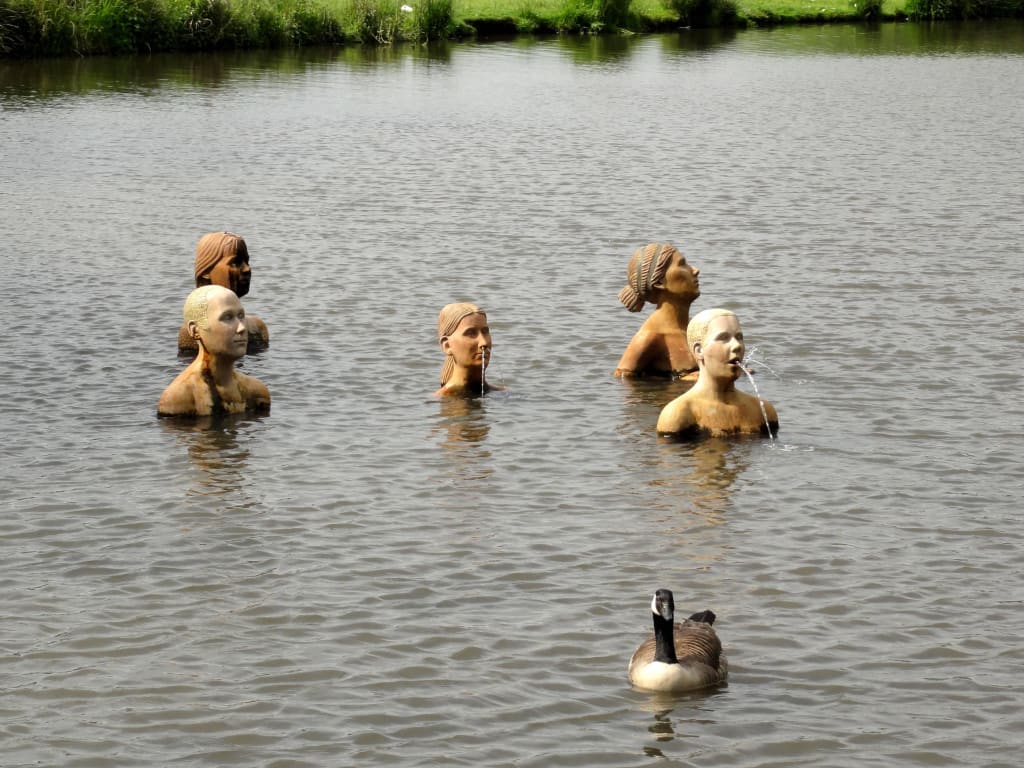
A look across the so-called Mühlteich a.k.a mill pond, which branches out from the Klosterbach. The people in the middle of the pond are not particularly hardy bathers, but an art installation.

Heiligenrode Mühlteich art

A closer look at the art installation “Der Mensch lebt nicht vom Brot allein” (Man does not live only of bread) by sculptor Petra Förster.

Heiligerode Mühlteich art

This was supposed to be an even closer look at the art installation in the Mühlteich. Unfortunately, the camera focussed on the leaves instead, but it’s still a great shot.

Here is a close-up photo (not mine) of the art installation and here is the website of artist Petra Förster. Coincidentally, I was present when one of the sculptures was cast as past of a local film group making a documentary about the artist.

Tulips in the garden

Here are some tulips in full bloom in my grden.

Tulips in my garden

A closer look at the tulips in my garden.

Tulips in the garden

More tulips in my garden, this time shot against a brick wall.

Purple flowers

I have no idea what these little purple flowers in my neighbour’s garden are called, but they sure are pretty.

Indian egg curry

Finally, here is today’s lunch, Indian egg curry.

Posted in General | Tagged , , , , , , , , | Leave a comment

And even more reactions to the 2017 Hugo Finalists

In general, the 2017 Hugo Awards shortlist is less contentious than those of previous years, but were still seeing reactions trickling in. I offered my own take on the 2017 shortlist and also did a round-up of reactions from around the web here and then another round-up a few days later.

However, since then a few more Hugo reaction and discussion posts have appeared, so here is round-up number 3. As always, thanks to Mike Glyer of File 770 for pointing out some of the links I missed. I already included some of these as ETAs to the previous post, but I’m including them again here. Continue reading

Posted in Books, Links | Tagged , , , , , , , , , , , | Leave a comment

Yet More Reactions to the 2017 Hugo Finalists

Thanks to Mike Glyer of File 770, the hits on my Hugo reaction post and the space opera post of the day before have gone through the roof. My first round-up of Hugo reactions from around the web got a lot of attention as well.

Meanwhile, more reactions are trickling in, so here are the latest links: Continue reading

Posted in Books | Tagged , , , , , , , , , , | Leave a comment

Reactions to the 2017 Hugo Finalists

Currently, the SFF world is all abuzz talking about the Hugos, but of course there are other awards announcing their shortlists at this time of the year as well. One of them is the Bailey’s Women’s Prize for Fiction and this year’s shortlist includes a science fiction novel, The Power by Naomi Alderman. This isn’t the first time the Bailey’s Prize has recognised speculative fiction – The Long Way to a Small, Angry Planet by Becky Chambers was one of last year’s nominees.

But now, let’s get back to the Hugos: My own take on the 2017 Hugo Awards shortlist is here (and hits are currently going through the roof thanks to Mike Glyer of File 770 linking to it), so let’s take a look at other reactions from around the web:

For starters, here is a short video where 2017 Hugo administrator Nicholas Whyte shares three things to know about the 2017 Hugo Awards.

At Forbes, Kevin Murname offers a list of the 2017 Hugo finalists as well as a brief summary of the whole puppy mess.

At the Barnes & Noble SFF blog, Joel Cunningham is very pleased by the scope and diversity of the 2017 Hugo nominees and declares that the future of science fiction is diverse. He also makes a crack about the Marvel Comics diversity uproar, but then it is low hanging fruit.

Case in point, at Fusion.net, Charles Pulliam-Moore focusses on the Hugo finalists in the graphic story category and points out that the nominations for Ms. Marvel and Black Panther (as well as for the Image comics Monstress and Saga) belie the claim by Marvel’s vice president of sales David Gabriel that diverse comics don’t sell.

At Bleeding Cool, Jude Terror focusses mainly on the comic related Hugo finalists, but then Bleeding Cool is a comics site. Of course, he also cannot resist making a crack about three of Marvel’s supposdly so unpopular diverse series getting Hugo nods.

David Gerrold is happy to see the Hugos return to their pre-2015 form, as the sad puppies fade into obscurity, and hopes to see the rabids fade away soon as well. He also points out that the attacks on the Hugos by the sad and rabid puppies caused the WorldCon community (and SFF fandom in general) to come together to repeal them.

At Dreaming About Other Worlds, Aaron Pound is happy to finally have a good Hugo shortlist full of fantastic nominees again. He also points out that the sad puppies faded away and that while the rabid puppies managed to get a few of their choices onto the shortlist, their impact has been much diluted by the 5/6 and EPH voting systems as well as by the rabids’ own incompetence in determining what is eligible.

At Bookriot, Alex Acks is also generally pleased by a very good Hugo shortlist before proceeding to measure the impact of the rabid puppies on the 2017 Hugo ballot. He comes to the conclusion that there is still puppy poo on the ballot, but it’s manageable. And since the 5/6 system has given us an extra nominee per category, we are basically getting a full category of five finalists plus an occasional additional serious finalists.

Camestros Felapton offers his comments on the 2017 Hugo ballot and is overall very pleased with the outcome. So far, nothing has been heard from Timothy, the talking cat.

In a follow-up post, Camestros Felapton also offers a guide how to evaluate the nominees in the best series category, since the reading load for a long and unfamiliar series can be heavy.

Ana Grilo and Thea James of The Book Smugglers are thrilled to be nominated for the Hugo in the best semiprozine category in a year with such a great shortlist.

Ana Grilo is also nominated in the fancast category along with Renay Williams for the Fangirl Happy Hour, which is one of my favourite SFF podcasts. They have now uploaded a special 2017 Hugo nomination edition of the Fangirl Happy Hour. Renay and Ana are also happy that the Hugos are finally back to normal and that people are back to agonising about how to rank the many good choices on the ballot rather then looking for something, anything at least halfway decent to vote for. They also have some strong words about the rabid puppies.

ETA: At Wired, Jason Kehe reports about the 2017 Hugo shortlist and particularly focusses on two nominees, Chuck Tingle for best fan writer and Stix Hiscock for best novelette. He also reads Alien Stripper Boned From Behind by The T-Rex, so you don’t have to.

At The Mary Sue, Kaila Hale-Stern is really happy about the 2017 Hugo ballot and particularly about the organic best fan writer nomination for Dr. Chuck Tingle.

Meanwhile, the estimable Dr. Chuck Tingle has responded to his second hugo nomination in his own unique way by writing and publishing Pounded In The Butt By My Second Hugo Nomination. Because love is real.

Abigail Nussbaum is happy about her well deserved Hugo nomination in the best fan writer category, but frustrated about the continued puppy poo presence on the shortlist. She also finds the finalists in several categories a bit predictable and middle of the road and would like to return to those pre-2014 of arguing about the Hugo shortlist and the various nominees and not about puppies.

Indeed, we are seeing some predictable grumblings about the quality of the shortlisted works from the anti-nostalgic part of the SFF spectrum (for my theory of the three fractions of speculative fiction, see this post).

On Twitter, Ian Sales had this to say about the 2017 Hugo finalists in the short fiction categories:

Also on Twitter, Jonathan McCalmont shares his thoughts about the 2017 Hugo finalists:

McCalmont’s issues with Campbell nominee Laurie Penny stem from the fact that Laurie Penny knows internet troll Milo Yiannopoulos from way back and uses those connections and the fact that Milo considers her a friend to get an inside look at the so-called alt-right movement and uses this access to write revealing articles about them. Here is an older article from The Guardian where she follows Milo and friends around the Republican National Convention in Cleveland, Ohio, during last year’s presidential campaign, and here is a more recent article from Pacific Standard Magazine written during Milo’s fall from grace.

Now I’ve been quite critical myself of the flood of “We must understand how the white rustbelt Trump voter thinks, so I visited Dogshit, Ohio*, to interview a few of them” thinkpieces or the German variant, “We must understand how the white East German AfD voter thinks, so I visited Klein Ostkotzski in Saxony** and interviewed a few them”, because a lot of those articles and thinkpieces can be reduced to “Wah, won’t someone think of the widdle white man” whining. However, Laurie Penny’s articles are not like that. For starters, the Milo and Trump supporters she looks at are not unemployed steelworkers in the rustbelt, but young white middle class men from a generally privileged background. And she reveals these characters for what they are, pathetic and whiny little boys. And unlike the many “Wah, won’t someone think of the poor widdle white man” articles, I don’t see those artices as an apologia, but rather as a scathing look at what those people are truly like. Because that’s what journalists do, go to dark places, so we don’t have to.

Besides, Laurie Penny is nominated for a Campbell Award not for her journalistic work, but for her fiction, i.e. the short story “You Orisons May Be Recorded” and the novella Everything Belongs to the Future. Besides, she is one of six nominees in a very strong category, so those who disagree with Laurie Penny’s nomination still have five other nominees (well, four organic nominees and one puppy) to vote for.

Others have issues with works that did not make the Hugo shortlist. Here is someone named Will Ellwood complaining that Dave Hutchinson’s Fractured Europe trilogy did not make the shortlist. Which I’m actually grateful for, because I do not like those novels. And besides, a lot of my favourites did not make the shortlist either.

I’ve also seen grumblings about the fact that the Fireside Fiction report on the state of black science fiction is missing from the best related work shortlist and indeed it would have been a most worthy nominee. Though I suspect that when the extended nomination lists come out in August, we’ll see that it narrowly missed the nomination threshold. And given the trashfire that the best related work category was these past two years, I guess we’re all just glad to have something decent to vote for.

But in general, the British contingent of the anti-nostalgic fraction seems to have decamped to the Clarke Award Shadow Jury project, which not just generates some interesting reviews, but is also a lot more productive than what the majority of puppies are doing.

And while we’re on the subject, let’s hear what the puppies, both sad and rabid, have to say (all links go to archive.is):

Vox Day lists all the rabid picks he managed to get onto the ballot, predictably chuckles a bit over Alien Stripper Boned from Behind by the T-Rex and grumbles about the best novel (unsurprisingly, he still hates N.K. Jemisin, though he urges his fans to vote for The Obelisk Gate, because… well, I guess it makes sense to him, if not to anybody else) and best series finalists (he hates everything except for the Vorkosigan saga). In short, nothing new or even overly shocking from the Supreme Lord of Darkness or however he refers to himself these days. He also seems to be a lot more interested in the latest US political scandal.

Declan Finn, an indie writer who attached himself to the puppies, is not at all happy about the 2017 Hugo ballot and declares that it has been swamped by crap. Besides, there are way too many women on the ballot for his tastes and that’s just not possible without interference by the shadowy SJW cabal that meets every Wednesday in the basement of the Flatiron building, cause women can’t possibly be any good, can they? Plus, the one woman he really wanted to see there, Toni Weisskopf of Baen, is missing from the ballot (good point, actually. I suspect her status as a puppy cause celebre cost her organic nominations). He also claims that he hasn’t heard of most of the nominees in the series and novel categories, though he knows they are inferior to his personal favourites, because those sell so much better. Coincidentally, I had to google what Black Tide Rising even was (a series by John Ringo, it turns out). Though I’m stunned that Finn missed The Expanse (written by two white men at that), even though everybody is talking about the TV series based on the books these days. Oh yes, and the Dragon Awards are much better, so would you please vote for him? In short, Finn manages to fill the whole puppy bingo card in one post (with bonus misgendering and transphobia in the comments), which takes some doing.

ETA: Declan Finn also chose to take issue with some commenters at File 700 picking apart his post, so he made a follow-up point declaring that he totally doesn’t care about the Hugos, and besides, Honor Harrington totally was eligible for best series (yes, it was. Hugo voters still chose not to nominate it. They also chose not to nominate four of my five best series nominees. It happens). Finn also can’t grasp that File 770 commenters make fun of Terry Goodkind. Now I’ve never read Goodkind, since extruded fantasy product is not my thing, but I’ve also never heard of anybody over the age of fourteen who genuinely liked his books. Finally, Finn still feels the need to whiteknight for Toni Weisskopf and is apparently really upset that last year’s all-female Ghostbusters film got a Hugo nod. Though I’m surprised he believes it will win, considering it’s up against the massively popular and critically acclaimed Arrival and Hidden Figures (but then, he’d probably hate Hidden Figures, too) as well as against the nostalgia appeal of Stranger Things.

Jon Del Arroz, a newish puppy recruit (he joined their ranks after complaining that a con was discriminating against him for voting for Donald Trump), insists on pointing out that the number of Hugo nominations in 2017 (coincidentally the second highest number of nominations ever after 2016) means that WorldCon is dying, because it discriminates against “real fans” (TM) who are conservative and Christian. The Superversive SF blog makes the same point, nominations are down from an all-time high in 2016, so that means the Hugos and WorldCon are dying. Aw, puppy math! I guess it makes sense in some parallel universe.

Meanwhile, the editor of Cirsova magazines is just happy to be nominated in the best semiprozine category and manages to express his joy without any swipes at Tor, social justice warriors and other nominees. He also offers some links to interviews about the magazine from around the web for those who are interested in learning more.

At Every Day Should be Tuesday, a Castalia House blogger named H.P. declares that the 2017 Hugo Award shortlist does not interest him enough to purchase a supporting membership for WorldCon 75, so he can vote. However, he does like some of the finalists and is looking forward to reading/watching some of the others and not just the rabid puppy picks, too. So it is possible for puppy sympathisers to write about the Hugos without getting rude about it.

Larry Correia, the man who started it all when he was angry about losing the Campbell Award to Lev Grossman back in 2011, has emerged from his mountain top retreat, where he paints miniatures and writes Monster Hunter books, to remind people to nominate and vote for the Dragon Awards where wrongfuns are still allowed to have wrongfun (and voting controls are non-existent), since the Hugos seem to have fallen back to the Tor SJW cabal. Aw, and I’d thought Larry Correia had gotten tired of the whole puppy thing and decided to focus on his career rather than piss off a whole genre.

John C. Wright is happy that his novel Iron Chamber of Memory placed third in the 2017 Conservative Libertarian Fiction Alliance Book of the Year Awards (the winner was Peter Grant – the writer, not the protagonist of Ben Aaronovitch’s Hugo-nominated series) and also notes that he was nominated for a best short story Hugo as the token white dude in that category. I guess he has finally realised that he can’t win that one and focusses on the awards he can win. Good for him.

Meanwhile, Brad Torgersen and the Mad Geniuses are conspicuously silent on the 2017 Hugos beyond some of the usual “Traditional publishing is dying and we are the future”.

Comments are still off – Puppies poop elsewhere.

*Town totally fictional

**Town totally fictional as well

Posted in Books, Comics | Tagged , , , , , , , , , , , | Leave a comment

The Obligatory Hugo Nominations Reaction Post 2017 – and the first ever Nommo Awards

So the finalists for the 2017 Hugo Awards were announced today. And since the good folks of WorldCon 75 in Helsinki were kind enough to warn us ahead of time that they were planning to announce the Hugo shortlist today, we even had time to prepare for the inevitable discussion and dissection. And so I finished the massive space opera post yesterday, so I could fully focus on the annual Hugo nomination commentary today.

Of course, the Hugos weren’t the only SFF award that announced its finalists today. The 2017 Nommo Awards for African speculative fiction also announced their finalists today and they certainly look worth checking out. Two nominees that will be familiar even beyond the circle of those interested in African speculative fiction are the novel Rosewater by Tade Thompson (who also has a story nominated in the novella category) and Nnedi Okorafor’s Hugo and Nebula Award winning novella Binti. This is the first year for the Nommo Awards, by the way, and I for one will be very interested to see how they develop in the future.

The Hugos, on the other hand, already have a sixty plus year history of recognising usually worthy works. So, without further ado, here are the Hugo finalists for 2017. The link goes to File 770, where there also is a lot of discussion going on in the comments.

At first, second and third glance, this looks like a very fine Hugo shortlist, especially given the shenanigans of the past three years. There is still a bit of residual puppy poo on the shortlist – once that stuff gets stuck under your shoes, it’s very difficult to get rid of it completely. But Vox Day is clearly suffering from Dead Elk attrition and besides, EPH and the six nominees per category rule dealt just fine with his manipulation attempts, so the occasional turd in a category is bearable. File 770 has attempted to measure the rabid puppy impact on the 2017 Hugo shortlist and found that 13 of the finalists were on Vox Day’s (much reduced) rabid puppies slate, while a further three were declared ineligible, the Supreme Dark Lord not being all that great at vetting his nominees. But then, several of the rabid puppy nominees are so-called hostages, works that are generally popular and would probably have made the ballot anyway. China Mieville, Neil Gaiman and Deadpool don’t need Vox Day’s help to make the Hugo ballot.

What is more, in spite of the puppies’ efforts, the diversity count is also great this year. The 2017 Hugo shortlist is full of women, people of colour, LGBT people, international writers and artists and yes, there are straight white men, too. I don’t think there is a single category that is entirely male. Compare that to the almost all male Hugo shortlists of the early to mid 2000s and the puppy-infested shortlists of the past three years.

So let’s take a look at the individual categories: Continue reading

Posted in Books, Comics, Film, TV | Tagged , , , , , , , , , , , , | Leave a comment

The Space Opera Resurgence

At Wired, Charlie Jane Anders talks about the current space opera resurgence and why the subgenre has become more diverse and better than it has been in a long time.

The article offers a nice overview of the current crop of space opera writers amd also highlights how diverse the subgenre has become. The authors and books mentioned – The Stars Are Legion by Kameron Hurley, The Long Way to a Small, Angry Planet and A Closed and Common Orbit by Becky Chambers, Binti and Binti: Home by Nnedi Okorafor, The Collapsing Empire by John Scalzi, Ninefox Gambit and The Raven Strategem by Yoon Ha Lee and of course the Imperial Radch trilogy by Ann Leckie (plus shout-outs to Guardians of the Galaxy and the TV series The Expanse) – will not exactly be news to SFF fans. After all, these aren’t undiscovered gems, but some of the most discussed, anticipated and award-winning works in the genre. You could also add other names to those mentioned in the article, e.g. Rachel Bach, Ann Aguirre, Elizabeth Bonesteel, K.B. Wagers, Aliette de Bodard, Emma Newman, Sara Creasy, S.K. Dunstall, Margaret Fortune, Rhonda Mason, James S.A. Corey (who is included – sort of – via a reference to The Expanse TV show based on their books), Tobias Buckell, Mike Brooks, Michael Cobley, Jay Allan (whom Charlie Jane Anders actually planned to include in her article according to this tweet), Charles Gannon, Marko Kloos, not to mentioned established space opera stalwarts like Lois McMaster Bujold, Catherine Asaro, Sharon Lee and Steve Miller, C.J. Cherryh, Melinda Snodgrass, Tanya Huff, Elizabeth Moon, Kristine Kathryn Rusch, David Weber, Mike Shepherd, Jack Campbell, Jack McDevitt, Kevin J. Anderson, etc… However, Wired is a tech magazine, not an SF magazine, and therefore aimed at a more general readership to whom the big names and seminal works of current space opera may well be new.

Charlie Jane Anders also points out that there is a lot more space opera to be found on both physical bookshelves and on the virtual shelves of Amazon, Kobo, B&N, Google Play, iTunes or Smashwords than there was only a few years ago. She writes:

Not long ago, a group of mostly British men dominated the field. Authors like Alastair Reynolds, Charles Stross, and Iain M. Banks wrote wild, sweeping tales, often about cyborgs and other post-human characters. You still see a lot of that in space operas, but the genre’s renewed popularity has introduced readers to a diverse array of writers, each of them bringing a new approach to tales of thrilling adventures in the cosmos.

I remember those days of the early 2000s well, when space opera was mainly written by a bunch of white, mostly British men. Occasionally, those books made it onto the shelves of the local Thalia store and I bought several of them, because hey, there was a spaceship and/or a planet in space on the cover, the blurb sounded kind of interesting and the authors were highly regarded and/or had won a bunch of awards. But time after time, when I actually cracked the book open, I found myself deeply disappointed, because there usually was a lot of technobabble about the singularity and highly advanced civilisations with a lot of quasi-magic tech and characters that were thin as cardboard and often behaved so unbelievably that the only likely explanation would be that those books were secretly authored by advanced AIs, since it certainly didn’t sound as if the authors had ever met an actual, living, breathing human being. What is more, those books also tended to sound kind of samey, the same highly advanced civilisation meddling in everybody else’s affairs with their quasi-magic tech in book after book. It wasn’t until several years later that I realised that many of those authors were more or less inspired by Iain M. Banks’ Culture novels (who is still considered the gold standard for space opera by many UK writers and critics).

Not that all British writers were writing what became known as New British Space Opera at the time. Simon R. Green’s Deathstalker series, for example, is space opera in the truest sense of the word, with a cast of thousands, a broad sweeping canvas that spans all space and (eventually) time and everything and the kitchen sink, too, thrown in. It’s also a lot of fun. However, Green’s space opera was never to be found on the bookstore shelves, at least not at the stores I patronised, so I didn’t discover his work until years later. And for a time in the early 2000s, New British Space Opera and singularity science fiction was all there was actually to be found on the shelves.

I didn’t like any of those books. But I was an SF fan and a space opera fan and this was all the space opera there was, with very few exceptions (mostly published by Baen Books, which are notoriously difficult to find in Europe). So I kept trying the highly regarded New Space Opera of the early 2000s, until I found myself standing in the local Thalia store, the latest offering of New British Space Opera subgenre in hand (it was this one – I remember the cover very clearly), when I suddenly dropped the book to the floor and exclaimed, “Why do I keep buying this shit? I don’t even like these books.” So I turned my back on New British Space Opera and on science fiction altogether (I did put the book back on the shelf first) and read other genres for a few years, until I came back in a roundabout way via urban fantasy and science fiction romance and found a whole universe of SFF books that weren’t on the radar of the official genre critics at all.

Now, some ten to fifteen years later, there is a lot more space opera on the shelves than back in the early 2000s. It’s also a lot more diverse the than just pale Banks clones. Nor is it just written by white, overwhelmingly British dudes – indeed, some of the best space opera of today is written by women and writers of colour. And even some of those authors whose novels almost put me off science fiction altogether some ten years ago are writing much more enjoyable works these days. For example, I heartily disliked Absolution Gap, but enjoyed some of Alastair Reynolds’ more recent works like Slow Bullets and Revenger.

So we’re definitely in the middle of a space opera resurgence at the moment, which is great news, as far as I’m concerned. However, not everybody is happy about the direction the subgenre has taken. Some of them make their views heard in the comments. Yes, I know one should never read the comments, but bear with me here. First, you get a few of the usual “You missed my favourite book/author/series” comments, which are actually constructive, since they help those interested in the subgenre to find more books they’ll like (someone even gave a shout-out to good old Perry Rhodan).

There also are two what I’d call puppyish comments, though I have no idea if the commenters are in any way affiliated with the sad or rabid puppies. One commenter declares that “this type of space opera sounds more like wet dreams for SJWs”, but that the real fans (TM) want to read nutty nuggets and nothing but nutty nuggets before launching into a list of sufficiently nutty nuggety space opera.

Another commenter has this to say:

“Girl going into space, expering [sic] things and going trhrough personal growth” is a different genre. Not worse or better than space opera, but not SO. Charles Stross have (among his huge output) written some books that could be classified as SO (Saturns Children and Escaton series) but isn’t among the biggest SO writers.

Regarding the articles conclusion I beg to differ. Space Opera have given us a lot of alien invasions, memetic viruses, antimatter terrorism, fractional C strikes, genetic modifications going haywire, AI takeover, awakening of the Great Old Ones, enviromental disasters or the (repeated) end of humanity. The “girl going into space” genre could fit the bill for safety and happy ending- but it is not SO.

So in short, boys going into space, having advantures and experiencing personal growth is totally space opera, but girls doing the same thing is not, because they pollute the genre with their feelings and romance and happy endings and general girl cooties. I wonder what this commenter makes of the Honor Harrington and Kris Longknife series, both of which are very nutty nuggetty, but have female protagonists.

Paul Watson, the commenter who stated that he wants nutty nuggets rather than SJW wet dreams, helpfully included a link to a roundtable discussion with several authors regarding what makes a good space opera. He obviously wants us to click on it, so I did.

The authors Watson interviewed for his roundtable are Dave Bara, Michael Cobley, S.K. Dunstall, H. Paul Hosinger and Jack McDevitt, i.e. four men and two women, since S.K. Dunstall is the pen name of two sisters from Australia. It’s actually a pretty good discussion and a lot more nuanced than I would have expected from Watson’s comment on Charlie Jane Anders’ Wired article. Coincidentally, Watson also wrote a really nice overview about the US publication history of Perry Rhodan.

Nonetheless, the selection of authors interviewed suggests that Paul Watson’s preferences tend more towards the military end of the spectrum (though to be fair, I’ve only read Michael Copley and S.K. Dunstall of the authors in question). He’s far from the only one, cause if you take a look at Amazon’s subgenre bestseller list for space opera or for sub-subcategories like Galactic Empire or Space Fleet, you’ll find that the category is heavily dominated by indie military science fiction with a few big name trade releases such as John Scalzi’s Collapsing Empire, the Expanse novels (since they’ve gotten a sales boost due to the TV series), media tie-ins and genre classics mixed in. It’s almost as if Baen’s slushpile came alive and took over Amazon’s space opera category.

Now space opera became an early casualty of the “write to market” strategy employed by many indie authors, because Chris Fox, the author credited with coining “write to market” (he outlines his strategy on his YouTube channel), chose space opera as his example for an underserved market (the relevant video is here) and thus opened the flood gates for indie space opera. The “write to market” philosophy is probably also the reason why a lot of the indie space opera dominating Amazon’s charts is so samey, a whole lot of spaceship in space covers, while the plots are a mix of Starship Troopers, the Lost Fleet series, Mass Effect and the new Battlestar Galactica with the occasional Honor Harrington or Kris Longknife clone thrown in for good measure. There are also a few urban fantasy/space opera hybrids featuring wizards and vampires in space, which at least try to do something original.

However, while a lot of Amazon’s indie space opera offerings aren’t to my taste (and note that there are indie space opera writers whose works I like, e.g. C. Gockel, Lindsay Buroker, Patty Jansen, Jennifer Foehner Wells, Krista D. Ball, K.S. Augustin, Sandy Williams, Jenna Bennett, Chris Reher, etc…), they clearly are to someone’s taste, because those books sell… a whole lot. There is a voracious readership for military flavoured space opera out there. And due to Amazon’s algorithms and because Amazon’s customer base is mostly concentrated in the rural, landlocked parts of the US, where that sort of thing is popular, Amazon’s space opera bestseller lists has been taken over by military science fiction. Which is great, if that’s what you like to read and/or write. However, space operas that don’t fit the fairly narrow scope of manly space marines doing manly things in space can easily become drowned out by the flood of military SF.

Now my personal tastes run in a very different direction. In spite of the broad canvas and larger than life plots, I prefer my space opera character-focussed. I like a bit of romance in my space opera and a focus on character relationships (both romantic as well as friendship and family relationships) in general. I really like characters struggling to overthrow an injust system or just trying to find a place where they can live without interference by the system. I actually like space politics – I’m probably the only person who enjoyed the Imperial senate scenes in the Star Wars prequels. I don’t mind military settings and themes, but I prefer my military science fiction more focussed on the characters and their individual conflicts than on space battles, weapons technology and vanquishing the enemy. And I really hate characters blindly following problematic or blatantly illegal orders. Alien races who are evil because they are evil and who want to conquer/subjugate/exterminate humanity because that’s what they do and who just happen to be insectoid or reptilian or Cthulhu with the serial numbers filed off (if people would at least make their evil alien race look like cuddly teddy bears for a change) bore me. Honestly, if I never see a plot along the lines of “humanity is locked in a deadly war of annihilation with an evil alien race and only Captain Manly McMannister and his ragtag crew can save the galaxy”, it will still be too soon.

My own two space operas, the Shattered Empire series and the In Love and War series, are both tailored to my personal preferences, high on all the elements I love about space opera and low on those I don’t like. I write a bit more about what I wanted to do with both series here and here. And yes, I initially began writing those stories, because I couldn’t find enough of the sort of space opera I liked to read out there.

And this is precisely why the current space opera boom is great for all of us who love the subgenre. Because today’s space opera is not just New British Space Opera or nutty nuggetty military SF or the Napoleonic Wars in space or the Roman Empire in space or science fiction romance or a picareqsue Bildungsroman in space or quenderqueer feminist space opera or magical mathematics in space – it’s all that and more. And that’s good for all of us.

Posted in Books | Tagged , , , , , , , , , | 5 Comments

Indie Speculative Fiction of the Month for March 2017

Indie Speculative Fiction of the MonthIt’s that time of the month again, time for “Indie Speculative Fiction of the Month”.

So what is “Indie Speculative Fiction of the Month”? It’s a round-up of speculative fiction by indie authors newly published this month, though some February books I missed the last time around snuck in as well. The books are arranged in alphabetical order by author. So far, most links only go to Amazon.com, though I may add other retailers for future editions.

Once again, we have new releases covering the whole broad spectrum of speculative fiction. This month, we have urban fantasy, epic fantasy, Asian fantasy, space opera, military science fiction, near future science fiction, post-apocalyptic science fiction, dystopian fiction, science fiction romance, time travel, horror, dragons, vampires, witches, ghosts, superheroes, aiens, robots, artificial intelligences, cyborg bounty hunters, supersoldiers, mutant assassins, galactic empires, Martian judgements, intergalactic prison breaks, radioactive wastelands, lake monsters, murder mysteries in space and much more.

Don’t forget that Indie Speculative Fiction of the Month is also crossposted to the Speculative Fiction Showcase, a group blog run by Jessica Rydill and myself, which features new release spotlights, guest posts, interviews and link round-ups regarding all things speculative fiction several times per week.

As always, I know the authors at least vaguely, but I haven’t read all of the books, so Caveat emptor.

And now on to the books without further ado:

Wisps of Spider Silk, First Thread by Athena AndreadisWisps of Spider Silk – First Thread by Athena Andreadis:

Wisps of Spider Silk, First Thread is a diptych of two interlinked space opera stories (“The Stone Lyre” and “The Wind Harp”) that tell of interplanetary cultures in conflict — and in perilous alliances — over psychic talents and the dominance they can confer.

These two stories are wisps of a vast nebula. In this universe the Minoan civilization partly recovered from the Thera explosion and some of its descendants eventually took to the stars, as did their adversaries. This is the universe of “Dry Rivers” and “Planetfall” which appeared in Crossed Genres in 2009.

Traitor by Krista D. BallTraitor by Krista D. Ball:

Seven years ago, Rebecca St. Martin took the coward’s path to save her skin. She has lived with that decision, eking out a life as an indentured servant on a space station far from home. Only now, fate has decided to give Rebecca another chance. A ghost from her past plans to execute a daring rescue from the prison bowels of the station Rebecca now works.

Rebecca has to face the same decision she made all those years ago. Could she watch her friends be murdered? Or could she, just for once, be a hero?

Aletheia by J.S. BreukelaarAletheia by J.S. Breukelaar:

Deep below the island, something monstrous lies waiting for Thettie, and it knows her name.

“Family and small town desires and secrets simmer in J. S. Breukelaar’s melancholy and affecting mix of literary, noir, and horror by the lake. ALETHEIA is a compelling 21st century ghost story. Don’t lose your Gila monster!” — Paul Tremblay, author of A Head Full of Ghosts and Disappearance at Devil’s Rock.

The remote lake town of Little Ridge has a memory problem. There is an island out on the lake somewhere, but no one can remember exactly where it is—and what it has to do with the disappearance of the eccentric Frankie Harpur or the seven-year-old son of a local artist, Lee Montour.

When Thettie Harpur brings her family home to find Frankie, she faces opposition from all sides—including from the clan leader himself, the psychotic Doc Murphy.

Lee, her one true ally in grief and love, might not be enough to help take on her worst nightmare. The lake itself.

A tale of that most human of monsters—memory—Aletheia is part ghost story, part love story, a novel about the damage done, and the damage yet to come. About terror itself. Not only for what lies ahead, but also for what we think we have left behind.

Dead World by Cora BuhlertDead World by Cora Buhlert:

Once, Anjali Patel and Mikhail Grikov were soldiers on opposing sides of an intergalactic war. They met, fell in love and decided to go on the run together.

Now Anjali and Mikhail are trying to eke out a living on the independent worlds of the galactic rim, while attempting to stay under the radar of those pursuing them.

When they are hired to retrieve a weapons prototype from an abandoned planet, it seems like a routine job. But it quickly turns out that the planet is not as empty as they had thought. And soon, Anjali and Mikhail find themselves caught in a deadly chase across a radioactive wasteland.

This is a novella of 27500 words or approx. 95 print pages in the “In Love and War” series, but may be read as a standalone.

The Bay of Sins by J.D. ByrneThe Bay of Sins by J.D. Byrne:

The war is over, but nothing is settled.

On the Neldathi side of the Water Road the clans are slowly pulling apart following a sudden murder. Hirrek is tasked with getting to the bottom of a mystery: was this killing the random act of a violent, unstable man? Or was it something more sinister, a hint of what the Neldathi thought they’d defeated during the war? The unity won in blood may be slipping away.

In the rebuilding city of Innisport, life is returning to something like normal. That’s largely due to Mida, given the task of rebuilding the city by Antrey Ranbren herself. After Mida hands power over to the Guild of Politicians, she finds herself on trial for her life, charged with treason and being a collaborator. Along the way she meets someone, a curious remnant of the war, who makes her rethink the way she sees those that destroyed her city.

In the meantime, Antrey returns from exile, escaping to the wilderness of Telebria. She gains new allies, including Rurek, and a new foe, the Sentinel Faerl. He’s best known among the other Sentinels as the man who let Antrey slip away once before, getting all his men killed in the process. Now he has a chance for redemption and revenge. But Antrey is willing to do anything to ensure that her legacy does not slip away.

The chase is on, as the saga of The Water Road barrels toward its explosive conclusion.

The Boy with the Blue Sky by N.C. DavisThe Boy With The Blue Sky by N.C. Davis:

How far would you go to bring back a loved one from the dead?

Theo returned her stare. ‘It’s not just a program.’
‘Then what the hell is it?’ she said.
‘It’s a digital reconstruction of our son.’

On the anniversary of their young son’s death, teacher Eury can only find peace by descending into an electronically-induced world of dreamless sleep.

Her husband Theo, a music lecturer, is at the end of his tether and has tried everything he can think of to drag Eury out of the darkness. So, in a final act of desperation he acquires software that can digitally resurrect their child.

Will it bring Eury back to him or will the shock drive her deeper into a world of endless slumber?

The Boy with the Blue Sky is a story that shines a light on the steady creep of technology, into the most intimate parts of our lives.

Starbound by J.J. GreenStarbound by J.J. Green:

Humanity has colonized Mars and invented interstellar travel—joining the thousands of alien races that explore the deepest reaches of the galaxy.

Jas Harrington is the sole survivor of a Martian colony disaster. After growing up in institutions on Mars and Earth, she travels to Antarctica to train as a deep space security operative. All she wants is to graduate college and escape her past, but it isn’t long before she faces familiar prejudice against returned colonists.

Jas must navigate aggression, bigotry, and the frozen Antarctic wastes if she’s to fulfil her dreams.

For once, fighting her way out of her problems isn’t an option, until it is.

Prequel to the 10-book space opera serial, Shadows of the Void.

Prominence by A.C. Hadfield and Colin F. BarnesProminence by A.C. Hadfield and Colin F. Barnes:

They tried to destroy our planets. Our way of life. They tried to send us into extinction. But we, the Coalition, fought them and won. That was a decade ago. We had assumed they were beaten for good.

We were wrong.

They’re known as the Host: a cabal of aliens seeking to dominate our sector of space. And they’re back—with help from a powerful new enemy.

Against their wrath, we must stand. We’re outnumbered and unprepared. If we lose, we lose everything.

But there is hope. An ancient race of long-dead but technologically advanced aliens called the Navigators have a ship called the Blackstar that could potentially turn the tide. That is if I, Kai Locke, a humble ship racer, can find it and learn how to harness its power in time.

If I fail, the Coalition will fall, and the Host will consign us to a distant memory. I refuse to let that happen. I will fight to my last breath for the Coalition’s survival.

Simon Rising by Brian D. HowardSimon Rising by Brian D. Howard:

Five years ago, an alien ship crashed into the bay. Since then, vigilantes and criminals with extraordinary powers increasingly dominate headlines.

A man wakes up in the hospital with no memory. He’s told he is Steve Ambrose, a serial bank robber who was shot while being arrested. Everything changes when he discovers he has telekinetic powers. Hunted by FBI Special Agent Rachel Moore, and with unknown enemies around every corner, can he change who he is, or is the dark criminal everyone accuses him of being too deeply a part of his nature to escape?

The Enemy Within by Patty JansenAmbassador 6: The Enemy Within by Patty Jansen:

Two men went on a surfing trip in a remote area. Only one came back, accused of murdering the other.

Sounds simple, right?

Not quite, because the alleged murder happened on another planet, the accused is a member of the secretive Pretoria Cartel of super-rich business tycoons–with illegal off-Earth ventures–and the only person who can remotely be called a witness is an alien, the elder Abri from the Pengali Thousand Islands tribe.
Diplomat Cory Wilson is asked to accompany Abri to the Nations of Earth court, but when he and his team arrive there, their contacts have been moved to different cases, their rooms are bugged and their movements restricted. No one is answering their questions, but it is when a lawyer is murdered and Cory’s team captures a mysterious stalker that things get interesting.

Just as well they are prepared in the usual way: alert and highly armed.

Dances of Deception by J.C. KangDances of Deception by J.C. Kang:

An invincible empire threatens to invade Cathay, and only a Dragon Song can ensure peace.

After vanquishing the Last Dragon with the power of her voice, all Kaiya wants is a quiet life of anonymity. Instead, the Emperor sends her to negotiate peace with the aggressive Teleri Empire.

The critical mission reunites her with her childhood friend Tian, now an assassin-spy who loathes killing. He is no longer the adorable, gullible boy from her memories, any more than she is the adventurous, sweet girl from his. Instead of rekindling nostalgia for a youthful innocence they both yearn for, their reunion ignites a mutual hatred.

When the Teleri Empire breaks off talks, Tian must help Kaiya escape. Orcs, Ogres, and enemy soldiers stand between them and home, and their volatile relationship could get them captured… or killed.

Chameleon Uncovered by B.R. KingsolverChameleon Uncovered by B.R. Kingsolver

The dark sequel to the best-selling Chameleon Assassin.

Libby has a chance to build a legitimate reputation when she’s hired by one of the world’s most prestigious museums to bolster their security. The gig is in Chicago, where her heartthrob lives, so she hopes for a little romance.

She’s on a first-name basis with larceny, mayhem, and death, but Libby’s not used to being on the receiving end. Chicago is far darker and more dangerous than her native Toronto. Amidst terrorist bombings, stolen treasure, and murder, a mutant prophet calls for revolution. Away from her family and friends, Libby has nowhere to turn as enemies assault her from all sides.

Their mistake. Libby is a dangerous enemy.

2184: Beneath the Steel City by Ben Lovejoy2184: Beneath the Steel City by Ben Lovejoy:

In London 2184, the government monitors every move its citizens make, logs every action, notes every visit, supervises every communication, penalises the slightest transgression with all the warmth and sympathy of a hungry piranha.

Computer tech David Lafferty has grown tired of living beneath the crushing weight of a billion petty rules, and decided it was time to create his own rules in an underground life beneath the steel city. Aided by Saira, a Self-propelled Artificially Intelligent Robot Assistant, and a small circuit board stolen from the government, all is going well until an unknown adversary appears to have learned his every secret …

The Cosmic City by Brian K. LoweThe Cosmic City by Brian K. Lowe:

In the conclusion to The Stolen Future trilogy, Keryl Clee finds himself at the center of a crisis which could mean the destruction not only on Earth, but of Time itself. Hostages of a time-traveling madman who is creating an army from the past to conquer the world of the future, before Clee and Lady Maire can defeat him they must come to grips with the shocking truth behind the 300-year-old Nuum invasion of Earth.

Beset by new and powerful enemies, betrayed by the Council of Nobles itself, Keryl Clee has one last chance to unite the peoples of Earth–Nuum and Thoran, human and non-human alike–because even he is powerless against those who are coming from beyond the stars to reach…The Cosmic City.

Insurgence by Lori Ann Ramsay:

Earth’s last hope relied on the mission to Xeoron, to save the captive from the horrid alien virus that claimed so many lives and plagued mankind for over three centuries. The mission would also set those bound on the alien planet free, even if it meant giving their own lives. The team had trained most of their lives for the mission, with many entering the Academy of Space Exploration as young as twelve years old. Now the launch propelled their starship into space at warp speed to a planetary system on the other side of the galaxy. The team sought to free the humans held captive there, whether dead or alive and to bring back a cure to save mankind and to save planet Earth from an alien invasion and annihilation. But the underlying possibility of captivity on Xeoron and failure to complete the mission hung in the air, would they succeed in saving Earth and mankind?

Insurgence is the first book of The Realm of Xeoron series. A space opera sci-fi series with genetic engineering, colonization on an alien planet, and contact with aliens.

Prison Break by Jim RudnickPrison Break by Jim Rudnick:

The Warlord Noriega, once captured is now being tried for the destruction of the Barony destroyer the Gibraltar with hundreds of casualties. But his lawyers are claiming that the Confederacy does not have jurisdiction and that is the court cases that begin with this tale. Added is the threat from the largest Warlord, Konoe, that if the Confederacy does sentence Noriega to life, then that constitutes a declaration of war with his realm.

The Barony is also now a part of the investigations over on Birdland, where the Duke and Duchess are discovering more about the mysterious ball-birds–and why they seem to be important even though the knowledge about them is scant. This however is also a factor in the new dissolution of the partnership between the Duke, the Baroness and the Caliph. With all the Xithricite that is currently known on the RIM, the Caliph and his new admiral are formidable powers on the RIM.

As the Warlord is sentenced to life on Halberd the lawyers file with the RIM Confederacy Supreme Court and yet the Warlord Konoe will not wait, and tries to break Noriega out of the prison planet–something that has never happened before. Ships clash and battles occur as the breakout rises to Pike Station up above the prison and threaten the security of the RIM Confederacy too…

Blood Hunt by Izzy ShowsBlood Hunt by Izzy Shows:

Wizard without a license. Defender of London.

The Hunter in the Darkness. Not a title I wanted, but that’s who I am now. Vampires are trying to destroy my city. We’re one mistake away from the world knowing about magic, but the vampires don’t care. They just crave their next fix. I have to stop them, but I can’t risk using the demonic powers I have. Whatever lurks inside me, it’s dark, and it’s hungry. I will find a way to fight on my own.

Vampires are not the only evil in this world.

Judgment of Mars by Glynn StewartJudgment of Mars by Glynn Stewart:

A war fought in the shadows
A conspiracy shattered in fire
A moment of weakness…
When politics are played for blood.

The destruction of the secret archive of the Royal Order of Keepers on Mars has left Damien Montgomery, Hand of the Mage-King, with his enemies defeated, his lover dead—and his questions unanswered.

When he seeks out the remaining Keepers for answers, he discovers only violence and death in their strongholds. Someone else is hunting down the survivors to make sure they never answer Damien’s questions—or anyone else’s.

As a wave of murder sweeps Mars and the consequences of the Keepers’ conspiracy sink home, Damien is summoned before the Council of the Protectorate to answer for the deaths of two other Hands. In the political heart of the Protectorate of Mars, he finds he may be forced to choose between honoring the oaths he swore and preserving the survival of the Protectorate itself!

Team Guardian by Naomi StoneTeam Guardian by Naomi Stone:

This collection includes the three Team Guardian adventures: Sweet Mercy, Safe Haven and Shining Hope.

When a probability bomb exploded in the heartlands of the US, no one couldhave predicted the results. Spreading chaos was the point of using a probability bomb. Thousands died. Others were gifted with strange powers. Ten years later the world had become a different place.

When Rachel Connolly — a Reverse Empath — and Franklin Luke Delano (Fluke) — a Probability Talent — meet in the course of capturing a would-be bomber, they have little time to explore their powerful connection before they must draw a mad Puppet Master into the open.

Beth Talbot’s psychometry Talent is a curse as well as a blessing, making Time for her less a smoothly-flowing river than a storm-tossed ocean. She sees David Connolly as a rock of stability in that maelstrom, with his Talent for neutralizing other Talents like hers. But how can she even try to turn his attention her way when everyone on Team Guardian needs him, especially with amad Talent out to take control of the entire world’s computing – and banking -systems.

Maybe Tom could have called on another Illusionist to help in the hunt, but Sophia Alvarez is the best, and she’s been on his mind since the last mission they worked together. Tom takes on the authority and responsibilities of leading the Team – in time to join the FBI in tracking down a rogue Talent behind a string of killings they believe the work of a vigilante Talent bent on destroying sexual predators.

The Piranha Solution by John TriptychThe Piranha Solution by John Triptych:

In the near future, a new space race begins. Private industry is now pushing the limits of human exploration and colonization. NASA has changed its mandate into a regulatory agency to oversee all US-based corporations and individuals involved in interplanetary expansion.

Stilicho Jones always has his hands full while working as a personal troubleshooter for eccentric trillionaire Errol Flux and his numerous cutting edge space projects. When a mysterious and potentially deadly situation threatens the colonies on Mars, Stilicho must team up with a feisty NASA special agent in a race against time to avert a looming catastrophe that could end any hope of inhabiting the Red Planet.

Check out The Piranha Solution. If you were ever inspired by the NASA Space Program, Elon Musk’s SpaceX, Kim Stanley Robinson’s Red Mars, Robert Zubrin’s The Case for Mars, or Andy Weir’s The Martian, then have a look at this newest, edge of your seat technothriller!

Posted in Books | Tagged , , , , , , , , , , , , , , , , , , , , , , , , , , | Leave a comment

Genre versus Literary – the Crime Fiction Edition

The old genre versus literary fiction debate has reared its ugly head again – and just when you thought that horse was well and truly dead.

This time around, the opening volley was fired by one William O’Rourke, emeritus professor of English at the University of Notre Dame. O’Rourke was actually trying to do a nice thing, namely praising his former student and protegé Michael Collins in the Irish Times.

The first half of the article is actually pretty good, a profile of Michael Collins, the multi-gifted student but perpetual outsider, written from the POV of his former professor. But then O’Roure goes off on a tangent or several, bemoaning the lack of literary culture in the US and what little there is of it is hopelessly fractured. He complains about Bookscan and how it can kill writing careers. O’Rourke even goes as far as to lament the sad fate of the straight white dude, because straight white dudes – a long as they’re still alive – are no longer fashionable.

To be fair, O’Rourke does have a point there, though putting it into blatantly offensive “Wah, won’t someone think of the poor widdle straight white dudes!” words doesn’t help him bring his point across at all. But the truth is that the US is focussed mainly on race, gender and sexual orientation (and to a lesser degree disability), but tends to ignore other axes of marginalisation such as ethnicity or socio-economic background. As a result, international writers are often lumped in with whatever their race happens to be in the US, which completely ignores the fact that their nationality will often act as a roadblock, even if they happen to be white. And though Michael Collins is white, he is not American but Irish (and was apparently rejected by the prestigious writing program of the University of Iowa for being “too Irish”) and of course writes from a different perspective than American-born writers. So yes, O’Rourke does have a point there, though he expresses it not just badly, but in a blatantly offensive way.

And of course, O’Rourke doesn’t do himself any favours either by comparing his own novel Notts to GB84 by David Peace, since both novels happens to be about the 1980s miners’ strike, and declaring GB84 inferior. Okay, so I understand that O’Rourke prefers his own interpretation of the events, but David Peace is pretty damn brilliant, so brilliant he made me read a novel about a miners’ strike of all things.*

But the kicker of O’Rourke’s article, the one bit everybody is talking about, is this one:

Very few non-commercial writers know how to successfully advance their careers. Michael was no exception. He changed agents, publishers, gave up writing short stories – a critical mistake in this country, if you want to continue to be noticed as a literary writer – and attempted to jump into the crime genre to entice the vagrant reader. If bestsellers were easy to write there would be more of them. Michael, unfortunately, had, has, too much talent to succeed as a crime writer. He doesn’t possess the fatal lack of talent required. He asks too much of a reader. America really doesn’t possess enough of a literary culture anymore to maintain a writer like Michael.

Ouch. That’s really nasty, especially since crime fiction is the most “respectable” of genre fiction. If O’Rourke accuses even crime writers of a having fatal lack of talent**, I don’t even want to imagine how he feels about science fiction and fantasy writers or – gasp – romance authors.

The response was swift, since plenty of primarily British and Irish crime writers felt compelled to call out William O’Rourke on his remarks. Also at the Irish Times (which seems to have a very good literature section), Martin Doyle collects responses by various Irish crime writers (including one authors I met years ago, before he was famous and before he wrote thrillers), which range from “We’re still having this discussion? Really?” via “If he thinks it’s so easy, then let’s see him try it” and “Talent is only a small part of it – perseverance is what matters” and “Hey, dude, look at the list of great classic writers you’re dismissing as untalented.” to “Duh, 90 percent of any genre is crud. Can we talk about specific books, please?” and “You’re just jealous, because crime writers have higher sales than you.”

Meg Gardiner has a lovely response:

I had a drop of talent once. I got rid of it. Sold it out of the boot of my car so I could write a crime novel.

As has Steve Cavanagh:

William O’Rourke’s comments that crime writers lack talent and that white males get a raw deal in publishing were a little surprising. I look forward to his next piece focusing on his experience being amongst the one-hundred-and-eleventy million people who attended Donald Trump’s inauguration.

I also liked this response by Barbara Nadel:

Until recently the only two types of literature in Turkey were known as fiction and non-fiction. Turkish friends in the business didn’t understand what was meant by “genre fiction” or why it was, in some quarters, considered a lesser art form. To them, it all seemed like a lot of unnecessary snobbery. Clearly they were right and maybe we should all consider going back to a simple fiction/non-fiction form of categorisation. Such spiteful ignorance is unworthy of the person who said it and the people it targets.

Now I’d have to talk to someone more familiar with Turkish bookstores than me to determine whether Turkish bookstores really recognised only two categories until fairly recently. Though in the many hours of my life I have spent browsing bookstores, I have seen all sorts of odd sorting systems. For example, well into the late 1990s, Foyle’s flagship store (then their only location) on London’s Charing Cross Road, categorised non-fiction by subject, but fiction by publisher, which made it nigh impossible to find anything. The many used book shops also found on Charing Cross Road back then (most of which are long gone now) generally consisted of a small street level shop and levels of mazelike catacombs accessed via a series of rickety stairs. Categorisation was extremely basic and the SF was usually located in the further corner of the deepest basement. How those places ever passed any fire inspection is still a mystery to me (not that my 23-year-old self would have cared). On the other hand, the crime fiction focussed bookstore Tatort Taraxacum in the East Friesian town of Leer divides up East Friesian set crime fiction (already a highly specialised category) according to whether the setting is an island or the mainland. Meanwhile, Bremen had (and still has, to my knowledge) an independent bookstore that basically consisted of stacks of books piled up everywhere with no apparent system. We have one bookstore located opposite the courthouse which specialises in law and tax books and has incredibly fine-grained categories for those books, but lumps all fiction together under a single header. The late lamented Wohlthat’s bookstore had huge tables full of discounted art and coffee table books in the centre and shelves full of fiction organised alphabetically along the walls. I bought a lot of art books there (and haven’t bought a single one, since Wohlthat’s closed), but no fiction at all. And of course, foreign language sections in German bookstores are usually divided only by language (with approx. 85% devoted to English language books, while the rest is a mix of French, Spanish and Turkish) and sorted into fiction and non-fiction. Only a handful of German bookstores divide their foreign language section by genre and even there, the categorisation can be messy or just plain wrong.

In general, I prefer bookstores to sort books by genre and/or subject, because otherwise browsing or just finding something becomes a chore. However, Barbara Nadel makes an important point, namely that genres, their definitions and the divisions between them are not fixed and may not even be the same from country to country. I have already touched on this regarding crime fiction, which is a far broader category in both Germany and the UK than the narrower mystery genre in the US (and indeed Michael Collins might well have fallen afoul of this). Subgenres are different as well and so US subgenres like “cozy mystery”, “hardboiled mystery”, “police procedural”, etc… don’t exist on our side of the pond, wheres both in Germany and the UK crime fiction is divided more according to the setting, though rarely with such fine-grained detail as at the Tatort Taraxacum store in Leer. Meanwhile, romance – if it has its own section at all, since many bookstores in both the UK and Germany don’t have a romance section and neither do Dutch bookstores – is combined with women’s fiction, chick lit and sometimes erotica. Historical fiction has its own section in Germany, but rarely in the US. Once solid genres such as the nurse novel or the gothic novel have been folded into romance, whereas men’s adventure fiction has been folded into the thriller genre.

But not just genre divisions are arbitrary, but the distinctions between literary fiction and genre fiction are arbitrary as well (and far more problematic than mere genre divisions). Never mind that a lot of what is found on the “literature” or “general fiction” shelves is not literary at all, since anything that cannot be sorted into a specific section tends to end up there. For example, if a bookstore doesn’t have a separate romance section (and many bookstores in Europe don’t), the “literature” or “general fiction” section is full of romance. William O’Rourke would probably spontaneously explode in horror.

Of course, the responses by the various crime and thriller writers have thoroughly debunked O’Rourke’s ridiculous claim about the fatal lack of talent writing crime fiction requires. However, the person I’m really feeling sorry for here is Michael Collins, because not only was the profile of him completely derailed by a debate that has very little to do with Michael Collins or his work – no, his name will no also always be linked to “that guy who thought all crime writers had no talent”. Now I haven’t read Michael Collins’ fiction, but I’m pretty sure he deserves better than this.

*My personal views on the 1980s British miners’ strike were strongly coloured by the fact that in 1980s West Germany, every coal mine or steelwork in the Ruhr area that was at risk of closing down was deemed a national tragedy, whereas the dying shipyards of North Germany were completely ignored, because our states were smaller and had fewer voters than North Rhine bloody Westfalia. As a result, I developed a vehement and completely misplaced dislike for miners and steelworkers, which of course influenced how I viewed the 1980s British miners’ strike. Adult me of course knows that miners and steelworkers were not to blame for dying shipyards and that British miners absolutely were not to blame, but for me to voluntarily read a novel about the British miners’ strike is still a minor miracle.

**Come to think of it, O’Rourke’s rival David Peace writes crime fiction such as the brilliant Red Riding Quartet, which impressed me so much that it enticed me to read everything Peace had ever written.

Posted in Books | Tagged , , , , , , | Leave a comment