Indie Crime Fiction of the Month for January 2020

Welcome to the latest edition of “Indie Crime Fiction of the Month”.

So what is “Indie Crime Fiction of the Month”? It’s a round-up of speculative fiction by indie authors newly published this month, though some December books I missed the last time around snuck in as well. The books are arranged in alphabetical order by author. So far, most links only go to Amazon.com, though I may add other retailers for future editions.

Our new releases cover the broad spectrum of crime fiction. We have cozy mysteries, small town mysteries, animal mysteries, hardboiled mysteries, historical mysteries, medieval mysteries, Victorian mysteries, Jazz Age mystries, paranormal mysteries, crime thrillers, legal thrillers, spy thriller, historical thrillers, pulp thrillers, police procedurals, romantic suspense, private investigators, amateur sleuths, judges, FBI agents, police officers, Pinkerton agents, spies, ex-cons, serial killers, kidnappers, missing children, heists, con artists, organised crime, crime-busting witches, crime-busting writers, crime-busting cats, crime-busting ghosts, pinched Pisarros, crime and murder in New York City, Denver, East Berlin, Scotland, Snowdonia, Miami and much more.

Don’t forget that Indie Crime Fiction of the Month is also crossposted to the Indie Crime Scene, a group blog which features new release spotlights, guest posts, interviews and link round-ups regarding all things crime fiction several times per week.

As always, I know the authors at least vaguely, but I haven’t read all of the books, so Caveat emptor.

And now on to the books without further ado:

Where Missing Boys Go by Parker AvrileWhere Missing Boys Go by Parker Avrile:

A missing ex. Two missing children. And the man caught in the middle of a cartel’s proposed hostage exchange.

When his boyfriend vanished with stolen millions, Darke went to prison for his part in the heist. Another man might want revenge. All he wants is the chance to rebuild his life with a new and better man, former FBI Special Agent Flare Greene.

But everybody else– including the FBI– still wants the millions.

When a faceless organization grabs two small hostages to force Darke to lead them to the missing money, he no longer has a choice. He must find his elusive ex or die trying.

And death is not an option as long as the two boys are in the hands of kidnappers.

Meanwhile, the FBI is dangling a mysterious new assignment in front of Flare? an assignment very far away from the rescue of two small hostages. What are the higher-ups in the bureau up to?

If they think they’re going to stop Darke Davis from finding the money first and saving those boys, they’ve got the wrong guy.

Nobody and nothing is stopping Darke from saving those boys.

Not his devious ex.

Not the FBI.

Not even Flare.

Magic Lies by Fatima BaderMagic Lies by Fatima Bader:

Hunting a serial killer can be hazardous to your health.

My name’s Selena Valeron, and I’m the Supernatural Bureau of Investigation’s best undercover witch. After three years, the bureau has just handed me my biggest case: hunting the magical community’s most prolific serial killer, Xavier.

Lately the dead women on the morgue table bear an eerie resemblance to me. A shocking revelation indicates the killer is someone from my past—if I can remember it. Years ago, an accident wiped out my memory and threatened to end my career. Now my magical powers seem to be manifesting into something stronger.

Was my memory loss really an accident, or a failed murder attempt?

Time’s ticking as I dig through my past to find the killer. I need answers. If I can’t get them in time, I’ll lose friends, family—even my own life.

MAGIC LIES is a fast-paced urban fantasy mystery with plenty of thrilling twists and turns that will keep you guessing. Agent Valeron may have lost her memory, but she hasn’t lost her snarky attitude and she’s still a badass witch. Jump into this magical world and start reading the Selena Valeron series today!

Murder by Midnight by Blythe BakerMurder by Midnight by Blythe Baker:

Murder and mystery in a Scottish castle…

When Alice Beckingham boards a train for Edinburgh in 1929, she begins a journey that will test everything she thinks she knows about her past and her family. From the moment of her arrival at the rugged and remote Druiminn Castle, something sinister haunts her steps.

With the murder of her host and the revelation that one of her fellow guests at the castle is an unscrupulous jewel thief, Alice resolves to uncover secrets that someone will stop at nothing to keep hidden.

Coercing the coolly unpredictable Sherborne Sharp into assisting her, Alice follows in the footsteps of her detective cousin Rose and pursues a heartless killer through glittering dining rooms, shadowed passages, and moonlit groves. A mysterious local legend may hold the key to unraveling everything, but will Alice survive long enough to decipher it?

The Pinched Pisarro by Will BriggsThe Pinched Pisarro by Will Briggs:

Sam Powell is a down on his luck con-man on the run from a vindictive ex-con whom he has double crossed.

His luck turns when he’s given one last shot at working for a criminal organization led by an enterprising Park Avenue butler. His mission: steal an invaluable Pissarro from one of Manhattan’s richest socialites.

However, Sam’s ex-partner (who happens to be his ex-girlfriend) doesn’t want anything to do with him so he’s forced to recruit his unwitting neighbor, a struggling piano tutor named Wendell Hoyt, to help.

Sam and Wendell find themselves pitted against a psychopathic hit-man, a criminal organization, and Wendell’s authoritative aunt.

Together they could end up millionaires…if they survive.

The Heavy Hand of the Editor by Cora BuhlertThe Heavy Hand of the Editor by Cora Buhlert:

New York City, 1938: Richard Blakemore, hardworking pulp writer by day and the masked vigilante only known as the Silencer by night, has faced many a horror in his day. But few of them can match the terror of the blank page. Especially since Donald A. Stuart, the upstart young editor of an upstart young magazine called Stunning Science Stories, has already rejected Richard’s story “The Icy Cold of Space” four times.

Stuart demands changes that Richard does not want to make. Worse, he also holds Richard’s story hostage. Unless Stuart permanently rejects the story, Richard cannot sell it elsewhere.

There are a lot of shady practices in the pulp business, but Stuart’s actions are beyond the pale even for the wild west of publishing. And so the Silencer decides to pay Stuart a visit to put the fear of God into an editor who believes himself to be one.

This is a novelettes of 10800 words or approx. 38 print pages in the Silencer series, but may be read as a standalone.

Any resemblances to editors, writers and magazines living, dead or undead are entirely not coincidental.

Hijinks and Murder by Beth ByersHijinks and Murder by Beth Byers:

January 1926

Violet has received an obscure note, a strange request, and the claim of a murder. She’d like to ignore it, but the writer knows too much about her.

Has someone died? Who is the author of the note and why are they dragging Violet into this crime? Just what is going on and will Violet be able to reach the bottom of this madness?


The Vault by Mark DawsonThe Vault by Mark Dawson:

A desperate agent. A petty criminal. An audacious plot.

When Harry Mackintosh is called upon to exfiltrate a valuable asset from East to West Berlin, what could have been an intelligence coup becomes an international embarrassment. Mackintosh’s men and his lover are killed by the East German secret police in a brutal crossfire and he barely escapes with his life. He flees to the West and promises himself that he will have vengeance.

Mackintosh is the head of Berlin Station but he doesn’t have the staff to compete with the Stasi. He returns to London to plead for the resources to fight back. But instead of the seasoned operatives that he needs, Mackintosh is given a single man: Jimmy Walker, a petty criminal with a record for robbing banks.

Mackintosh takes Walker to Berlin and sets in train an audacious plan that will see them both on the other side of the Wall. Mackintosh and Walker face off against Karl-Heinz Sommer, the Stasi general known as die Spinne – the Spider – a man known for his brutality and ruthlessness.

The plan is already a longshot, and then Walker learns of the riches that Sommer stole from displaced Berliners in the days after the Wall was constructed. Will Walker follow orders or will he find the prospect of the Stasi gold in Sommer’s secret vault too tempting to ignore? Will Mackintosh have his revenge or will he become another fly caught in the Spider’s web?

With ambiguous loyalties, clashing agendas and danger beyond measure, these two men will struggle to form a team. But in a battle as unequal as this, the unexpected might be the best strategy that they have.

Ghostly Charms by Lilly Harper HartGhostly Charms by Lilly Harper Hart:

Harper Harlow thought the only thing she was going to have to worry about in the shadow of spring was planning her wedding. She was wrong.A string of break-ins in Whisper Cove have caught the attention of the cops, including her fiancé Jared Monroe. Things take a turn for the worse when one of those break-ins results in the death of a local barber. It seems what was once written off as teenage hijinks is something else entirely. In addition to the break-ins, Harper finds herself distracted by a new resident. He’s bringing an art gallery to town … as well as his troubled sister. Rain Porter doesn’t want to be in Southeastern Michigan and she’s hiding a big secret. Harper is determined to help the girl until the young woman pushes the exact wrong buttons. Things aren’t what they seem and the deeper Harper digs the more she worries that she doesn’t really want to find an answer. When a ghost from the other side of the state shows up and starts invading her dreams, things go from bad to worse. Jared wants nothing more than to protect Harper, but there are some things he can’t fight … and a ghost is one of them. It’s going to take everyone working together to find a way out of this one and even then survival is not a given. Jump on the ghost train with Harper, Jared, and Zander … because this one is going to be a wild ride.

Die in the Wool by Katherine HaytonDie in the Wool by Katherine Hayton:

A sudden death has Tash Mallory all stitched up!

Tash Mallory’s future is in the balance when her employer “Auntie Fran” (no relation) fires her from the knitting shop job she’s held for twenty years. Even worse, when Tash returns to confront her, she finds Fran’s dead body in the back room.

Luckily, the doctor soon concludes the death is from natural causes. A decision cast into doubt when Tash finds out she’s inherited Fran’s store and home.

With an aggrieved nephew determined to fight the will in court and Fran’s despondent fiancé pointing the finger of blame, Tash battles to clear her name. The police mightn’t believe the death was murder, but the good folks of Patiti are quicker to rush to judgement.

If Tash can’t manoeuvre through the undercurrent of small town politics, winning the inheritance will be a Pyrrhic victory. Worse, the doctor’s assessment might be wrong, leaving a killer on the loose.

Murder Comes Home by K.R. HillMurder Comes Home by K.R. Hill:

The body was still warm. He’d never forget that touch.

Private investigator Connor Marin butts heads with the Russian mob as he investigates the murder of his best friend.

While working the case, he discovers that his own father, a police detective, had a bloody secret. To get to the bottom of his father’s story, Connor makes enemies of the police department.

With mob thugs threatening from one direction, and angry cops coming at him from the other, Connor is trapped.

How can he protect his beautiful fiancé, learn the truth about his father, and bring down a killer?

Mooved to Murder by CeeCee JamesMooved to Murder by CeeCee James:

Chelsea Lawson is a ride-or-die friend. When her best friend Tilly asked her to stay at her place to watch her six-year-old daughter and pets for a while, Chelsea didn’t hesitate to say yes. What she didn’t realize was that “Tilly’s place” was a micro-farm and “a few pets” included a cow and two goats as well as a child who was too smart for her own good.

Chelsea was already in over her head before the dead body turned up.

When the local community, instead of offering support, tries to run her out of town, Chelsea suspects something is going on. Something big and rotten. The mayor makes it clear she’s not wanted and the townspeople give her the cold shoulder, but that only makes Chelsea more determined to uncover their secrets.

But no one expected the repercussions those secrets would have, especially Chelsea. Now life on the farm is hanging in the balance. Will Chelsea ever be able to wake up from this nightmare?

Seven Shadows by V.S. KemanisSeven Shadows by V.S. Kemanis:

A criminal prosecutor is bound to make a few enemies over a decades-long career, and Dana Hargrove is no exception. Who has it in for her?

In 2015, the former prosecutor is in her second year as a trial judge in Manhattan. It’s a new world. Dana cut her baby teeth in the DA’s office during the crack epidemic, the ’80s and early ’90s. Now, the murder rate is a fraction of what it was, and public opinion about incarceration is softening. So is Dana. As a judge, she agonizes over every sentencing decision before her.

Midlife has also hit Dana hard on a personal level. She misses her children and adjusts to the empty nest by immersing herself in work. Instead of growing closer to her husband Evan, their relationship becomes strained. What is happening to them?

Tension builds as Judge Hargrove presides over two high-stakes media cases. The defendants: a glamorous dot-com millionaire who killed her business partner, and an orthopedist who runs a deadly pill mill. In the public mail bag, the judge receives a message from an anonymous crank. Then her family starts getting letters that sound all too personal. Someone with an agenda is harassing and shadowing Dana and her loved ones.

In Seven Shadows, the judge and her pursuer are on a collision course meant to teach Dana the meaning of empathy and the value of the people she cherishes most.

Hex Type Thing by Amanda M. LeeHex Type Thing by Amanda M. Lee:

Hadley Hunter is feeling on top of the world.

She’s embracing her new home on Moonstone Bay and coming into her own as a witch. Her boyfriend Galen Blackwood, who happens to be sheriff, is even involving her in his investigations.

Unfortunately, the peace on Moonstone Bay is about to be threatened.

A local millionaire and a one-hit-wonder songstress are hosting the Skyclad Festival, a paranormal beach extravaganza that features a bevy of famous faces in paranormal circles … and those who want to hobnob with them. There’s only one little problem ….

One of the local influencers, a woman whose only job is to rave about things on the internet, ends up dead. Then, in short order, the organizer himself goes missing. That means Galen is on the case … and Hadley insists on serving as his sidekick.

There are a lot of witches on the island. The question is: Is magic to blame for murder or is something more insidious happening?

It’s going to take everyone working together to find the correct answers – and keep each other safe – as the problem on the beach deteriorates.

Someone has murder on the mind and Hadley is determined to find the culprit. All she has to do is survive long enough to uncover a mystery that has roots in a past long since forgotten … well, and not step on the wrong witchy toes.

The odds of doing both seem long but where there’s a witch, there’s a way.

The Snowdoina Killings by Simon McCleaveThe Snowdonia Killings by Simon McCleave:

A small town murder. A big city detective.

DI Ruth Hunter’s dream of escaping the murderous streets of South London and settling in the rural peace of Snowdonia has come true – until a brutal killing turns it into her worst nightmare.

Detective Inspector Ruth Hunter lives with the pain of her partner’s mysterious and unsolved disappearance. About to hit fifty, the veteran police officer trades in the crime-ridden streets of London for a more peaceful life in rural North Wales. But Ruth has barely settled into her new position in North Wales Police, when the body of a brutally murdered woman is discovered…with strange symbols carved into her skin. Teaming up with an obstinate deputy, Ruth struggles to eliminate anyone from a long line of suspects. When another slain victim is discovered with the same cryptic markings, she’s forced to re-think the investigation.

Has Ruth got what it takes to solve the case before the murderer attacks again?

The Girl That Vanished by A.J. RiversThe Girl That Vanished by A.J. Rivers:

Ring…Ring…

One call from her past was all it took to change everything.

A ten-year-old girl has vanished on her way home from camp.

And things took a turn for the worse when another child, a child that Emma knows, goes missing.

Disappearances, death, and tragedies have followed Emma Griffin throughout her childhood.

Her obsession with finding out the truth behind her past was what led her to join the FBI.

It’s been months since the horror of Feather Nest.

After the shocking revelation of the last case, FBI agent Emma Griffin decides to take a much-needed vacation.

But a phone call from Sheriff Sam Johnson, a man from her past, completely derails her plans.

A young girl has disappeared, and another child has gone missing.

With the number count slowly climbing.

Emma must now put her plans on hold, go back to her hometown and face some ghosts from her past.

When a mysterious package appears on her birthday.

Emma can’t shake the feeling that someone is monitoring her every movement.

Someone is getting too close for comfort.

The question is who?

In the close-knit town of Sherwood, the truth is never as it seems.

All the Good Girls by Willow RoseAll the Good Girls by Willow Rose:

Detective Harry Hunter of Miami PD’s homicide squad throws himself into a case no one asked him to solve.

Four teenagers from one of Miami’s affluent neighborhoods are murdered on a boat. Another is found in a dumpster. All five of them go to the same school and are on a list of witnesses to another crime.

Because he’s in bad standing with his boss, Harry is given the task of protecting a possible future victim, but Harry isn’t always known to follow his boss’s orders.

Soon, he’ll risk everything while racing to stop a killer who has left everyone else in the homicide squad shaking in terror.

An Agent for Pearl by Christine SterlingAn Agent for Pearl by Christine Sterling:

A quiet woman with no desire to become an agent; an agent with no intention of ever having a partner, and the case that cooks up surprises.

Pearl Bolton has enough on her plate, she doesn’t want to add anything else. She loves her job as a cook for the Pinkerton’s Denver office. At night she rushes home to help take care of her invalid father. The last thing she needs is a husband, no matter how temporary. What she didn’t count on was a case that involved her two passions: baking and Pinkerton Agent Zeke Preston.

Zeke Preston has a crush on the shy cook, and he has the extra ten pounds to prove it! He wishes he could get her to open to him, but Pearl doesn’t appear to need anyone or anything. Every time Zeke comes around, it’s as though Pearl avoids him. He knows exactly what to do to get her attention. Someone has sabotaged a national baking competition and he needs her to help solve the case. The fact he must marry her is just a bonus!

Does Pearl assist Zeke in finding the saboteur? When Pearl is the victim of a crime, will Zeke be able to protect her and solve the case? Will their marriage end at the case’s conclusion, or will they bake up something new together?

The Burned Man by Jason VailThe Burned Man by Jason Vail:

One of medieval Ludlow’s mills burns to the ground during a cold November night. Former coroner Stephen Attebrook walks down to the site out of curiosity the following morning like many of the town’s residents, where he discovers the charred corpse of the miller in the smoldering ruins. It could have been an accident, but the evidence points to murder. Mysterious deaths are no longer Attebrook’s business — or so he mistakenly supposes. The constable of Ludlow Castle, anxious to ingratiate himself with the local lord who owns the mill, pushes Attebrook into pursuing the culprit, a move that pitches him into a tapestry of murder and robbery that reaches even into his own home — for a rampaging criminal gang steals all the money he has in the world, threatening him with poverty and ruin. Pulled two ways, Attebrook must decide whether to save his fortune or seek justice for the miller’s death.

Shifters and Sabotage by Lily WebbShifters and Sabotage by Lily Webb:

All’s fair in love and roar…

Zoe Clarke’s life is changing shape. After solving a litter of paranormal mysteries, Zoe’s ready to slow down and focus on domestics with her new live-in shifter boyfriend, Beau.

But someone in Moon Grove is eaten up with jealousy about their relationship — as Zoe learns from the series of disturbing anonymous letters addressed to Beau in their mailbox. So when Zoe finds Beau trapped in his golden retriever form, it’s up to her to sniff out what happened.

From his obsessive co-workers to the secretive community of shifters surrounding him, Zoe’s convinced the attacker is someone in Beau’s pack — until another prominent shifter is found locked in their animal form.

Can Zoe track down the culprit and reverse the shifter curse? Or will the attacker take a bite out of her too?

Shifters and Sabotage is the seventh book in the Magic and Mystery series of witch cozy mysteries. If you like shady shifters, raving reporters, and magical murder mysteries, then you’ll love this lighthearted seventh entry in Lily Webb’s spellbinding series.

Posted in Books, Indie Crime Fiction of the Month | Tagged , , , , , , , , , , , , , , , , , , , , , , , , , , , , , , , , , , | Leave a comment

Retro Review: “The Jewel of Bas” by Leigh Brackett

Planet Stories Spring 1944“The Jewel of Bas” by Leigh Brackett is a science fiction novella, which appeared in the spring 1944 issue of Planet Stories and is therefore eligible for the 1945 Retro Hugos. The magazine version may be found here. This review will also be crossposted to Retro Science Fiction Reviews.

Warning: There will be spoilers in the following!

The protagonists of “The Jewel of Bas” are two newlyweds, Ciaran (a name Brackett would reuse for the 1951 Eric John Stark story “Black Amazon of Mars”) and Mouse. Ciaran and Mouse are drifters. Ciaran is a wandering balladeer who carries a harp and sings songs about the old legends of his planet, while Mouse is primarily a pickpocket and petty thief. Both these skills will serve them well in the adventure to come. Ciaran and Mouse call themselves gypsies, a term which is considered offensive now, but was still in common use in 1944. Ciaran and Mouse are not even the only self-proclaimed Romani in Leigh Brackett’s planetary romances of the 1940s. “The Citadel of Lost Ships”, a finalist for the 1944 Retro Hugo, features an entire space station full of intergalactic drifters who refer to themselves by the g-word. Uncommon for the time, Leigh Brackett has a lot of sympathy for her Romani protagonists.

Unlike Isaac Asimov, Leigh Brackett does give us pretty detailed descriptions of her characters. And so we learn that both Ciaran and Mouse are fairly short and skinny, probably due to not always having had sufficient food, and Ciaran has bent legs, too. Ciaran has a scar on his lip and is missing a tooth, Mouse has curly dark hair and a brand between her eyes that marks her as a thief. Both Ciaran and Mouse have brown skin, so here we have a golden age story with two unambiguous protagonists of colour.

Ciaran and Mouse are more typical characters for a Leigh Brackett story than Lundy from “Terror Out of Space”. For most of Brackett’s protagonists are outsiders who live on the margins of their respective societies. Many are thieves or criminals of sorts and quite a few are people of colour, including what is probably Leigh Brackett’s most famous character, Eric John Stark. But unlike Eric John Stark and other Brackett protagonists, Ciaran and Mouse are not physically impressive. And though we are never given their age, but Ciaran and Mouse feel young, late teens or early twenties. Younger than most other Brackett protagonists, at any rate. Their relationship is volatile and they quarrel a lot, occasionally escalating into violence, even though they clearly love each other.

In fact, the story starts with Ciaran and Mouse quarrelling, as they are having dinner on a ledge overlooking an area called the Forbidden Plains. Mouse is scared, because she has never been outside the city before. And besides, there are rumours about people going missing near the Forbidden Plains. But Ciaran assures her that the shortcut they took is perfectly safe, even if it passes by the Forbidden Plains. While he’s at it, Ciaran also gives us a handy introduction to the old legends of his world, which he uses as fodder for his ballads, such as the story of Bas the Immortal who lives inside Ben Beatha, the Mountain of Life which overlooks the Forbidden Plains, with his android servants and a non-human slave race called the Kald. Bas the Immortal owns the Stone of Destiny, a powerful jewel that allows him to rule the world. Ciaran assures Mouse that those are just legends, stories to frighten children with, though he also dreams of climbing Ben Beatha and getting his hands on the jewel one day. He will get his wish.

Mouse and Ciaran’s dinner is interrupted by a shadow falling onto the ledge where they’re resting. They are frightened, for their world knows no night. By now, we are wondering just where exactly “The Jewel of Bas” is set. Leigh Brackett normally set her planetary romances in pre-spaceflight consensus version of our solar system that never was with Mars and Venus being particularly popular settings. However, the world of “The Jewel of Bas” with its sun balls and permanent daylight doesn’t match Brackett’s version of Mars or Venus or Mercury or indeed any other planet of the solar system. So did Leigh Brackett actually write a story set on an extrasolar world, thirty years before the Skaith trilogy? Or is something else going on here? It’s a mystery that will be resolved by the end of the story.

Soon after the incident with the shadow, Ciaran and Mouse find themselves in even worse trouble, when they are attacked and kidnapped by vaguely humanoid creatures with grey skin and pink eyes. Before he is knocked out, Ciaran recognises their attackers as Kalds, the non-human servants of Bas the Immortal. So if that part of the legend is true, maybe the rest is true as well?

When Ciaran comes to again, he and Mouse find themselves chained together with other people abducted by the Kalds and herded across the Forbidden Plains towards Ben Beatha. However, Mouse’s unconventional upbringing has also given her some mean lockpicking skills, which she uses to free herself, Ciaran and several other prisoners from their chains. The prisoners revolt and attack the Kalds, when another shadow falls onto a world that doesn’t know darkness. Ciaran and Mouse manage to escape in the ensuing chaos. The join forces with some of their fellow escapees, a big red-haired, nearly naked hunter, a wild-eyed hermit who appears to be insane and a dark-skinned trapper named Ram, whose wife and son were also abducted by the Kalds.

Because the Kalds have closed off all other escape routes, Ciaran, Mouse and their comrades have no choice but to head further towards Ben Beatha. Ram is killed in a fight with the Kalds, though not before finding his wife and son dead by the wayside. Meanwhile, Ciaran, Mouse, the hunter and the hermit sneak into a cave at the foot of Ben Beatha and find themselves staring into a pit, wherein a huge machine is being built. The human prisoners are used as slave labour to build the machine. They also seem to be drugged or hypnotised, not caring whether they live or die. And in fact, several slaves drop dead from exhaustion right in front of the eyes of Ciaran and his companions.

Ciaran and friends make it to the bottom of the pit undetected. Here, Ciaran finds proof that yet more of the old legends he used to sing about are true, for they witness one of the androids of Bas the Immortal hypnotising the new prisoners via some kind of mesmerising light. Mouse and the hermit are also affected by the light – only Ciaran and the hunter manage to escape, though not before overhearing that the androids are worried about something failing and that the machine will not be finished in time. They also overhear that the androids are planning to overthrow Bas the Immortal and rule the world themselves.

During their escape, Ciaran and the hunter are separated. Ciaran knows that the slaves are being worked to death and that things will only get worse with the androids in charge. Desperate to save Mouse from that fate, he decides to climb Ben Beatha to find Bas the Immortal and enlist his help against the androids. While he is climbing, Ciaran also notes that the sunballs which provide his world with light and warmth are dimmer than they used to be.

Ciaran eventually reaches an outcropping near the top of the mountain, which turns out to be a balcony leading to the quarters of Bas. He ventures inside and gets the surprise of his life, when he finally finds Bas, asleep on a bed which is shaped like an ankh, the Egyptian symbol of life (though Brackett uses the Latin term “crux ansata” for the symbol). For Bas is not the ancient and godlike immortal Ciaran has envisioned. Instead, he is a teenaged boy, perpetually young due to his immortality. At this point, Ciaran also remembers another legend, older than most, about the Shining Youth from Beyond, a boy who never grows old. So that legend is true as well.

Ciaran tries to wake Bas, only to be thwarted by the curtain of light that surrounds Bas and his ankh-shaped bed. When the curtain of light flickers out due to a convenient power failure (The frequent power failures in the story are timed very conveniently, even though there is an in-story reason for them), Ciaran still cannot get Bas to wake up. Desperate, Ciaran finally sits down on Bas’ bed and begins to play sad songs on his harp, which does the trick. Bas is awake at last, though not exactly happy about it.

We now get a brief rundown of the long history of Bas the Immortal. Bas, we learn, was a fisherman’s son from Atlantis. He gained his immortality as well as the Stone of Destiny from a meteor strike. Now Bas had eternal life and the powers of a god, but because of his youth he was never respected, only hated. Eventually, he left Earth with his androids and the Stone of Destiny and settled on the tenth planet of the solar system. Inside the hollow tenth planet, Bas built a world of his own, lit by sunballs and powered by the Stone of Destiny, and populated it with humans imported from Earth as well as the alien Kalds. But the people of this world also quickly came to hate Bas and so he went to sleep to live in his own dream world and left the androids in charge of the world he had created.

This conversation occurs in the penultimate chapter of the novella and finally clarifies where exactly the story is set, namely on or rather inside a hypothetical tenth planet of our solar system (Pluto was still considered the ninth planet back then). In fact, I wonder why Leigh Brackett didn’t simply use Pluto instead, especially since hardly anything was known about Pluto a mere fourteen years after its discovery. But then, hypothetical trans-Neptunian planets are very common in science fiction well into the twenty-first century, almost as common as real trans-Neptunian objects.

But though the revelation of where exactly the story is set only happens towards the end, Brackett weaves in hints regarding the nature of this world throughout the story such as the sunballs or the fact that neither Ciaran nor Mouse have ever experienced darkness before and are terrified by it as well as a moment early on where Ciaran recalls one of the legends surrounding Bas the Immortal, according to which Bas was born on a world with only one big sunball, where the sky changes from light to dark “like a woman’s fancy” and where the horizon curves down. So yes, the clues to the nature of this world are there from the beginning, even though I completely managed to miss them upon first reading.

The world of Ciaran, Mouse and Bas is also highly reminiscent of Edgar Rice Burroughs’ Pellucidar (which is eligible for the 1945 Best Series Retro Hugo), for Pellucidar also has a horizon that curves upwards, is also lit by a sunball and also knows no night. And considering Leigh Brackett has stated that she was a fan of Edgar Rice Burroughs and that Burroughs’ Tarzan was a big influence on Eric John Stark, it’s very likely that she read the Pellucidar novels. However, Burroughs places his Pellucidar “At the Earth’s Core”, whereas Brackett places her world on a planet beyond Neptune. It’s certainly a fascinating world and I wonder why Leigh Brackett never revisited it in future stories like she kept revisiting her versions of Mars and Venus.

However, Ciaran and Bas don’t have much time to dwell on the exact nature of their world. For the Stone of Destiny, which powers the sunballs and keeps the world habitable, is failing. Once it does fail, everybody in this world except for Bas and his androids will die. And life won’t exactly be pleasant for Bas and the androids either, considering they will be trapped on a frozen rock in space. Ciaran also deduces that this is why the androids are using the human slaves to build the gigantic machine he saw earlier, as a replacement power source for the failing Stone of Destiny.

Ciaran has the hardest time convincing Bas, the solar system’s oldest emo teenager, to help, since the fatalistic Bas declares that thousands of people dying is no big deal, since human lifespans are so short anyway. And besides, he’d much rather sleep. It’s only when Bas realises that the androids plan to do away with him as well that he agrees to help.

Together, Bas and Ciaran set out to confront the androids, just as the machine the slaves built starts up. The androids try to hold Ciaran and Bas back by siccing the Kalds on them. But the Kalds succumb to Bas’ telepathy, so the androids have the hypnotised human slaves block the way. Bas cannot see a way past the slaves without hurting or killing anybody. So Ciaran draws the human slaves away with his harp, pied piper style, while Bas turns the last bits of power in the Stone of Destiny against the androids, destroying them. The slaves are freed and the world is saved.

Ciaran and Mouse try to persuade Bas to stay with the people he saved, but Bas won’t hear anything about that. Sooner or later, in a couple of generations, they’ll only hate him again, he says fatalistically and goes back to sleep to live in his dream world with his perfect dream girl. Ciaran and Mouse bid him good-bye and realise that even if their lives are limited, they are much happier than Bas the Immortal will ever be.

The Best of Leigh Brackett“The Jewel of Bas” is a glorious pulpy adventure story that manages to offer up plenty of twists and turns, whether it’s the revelation where the story is set or Bas the legendary Immortal turning out to be a sullen emo teenager whose initial response to the impending end of his world is a shrug and “Whatever”. Bas only appears in the final three chapters of the novella, but he is certainly a memorable character, both a tragic figure and an annoying brat.

Dying worlds, mysterious relics and ancient legends that turn out to contain considerably more than a kernel of truth are common themes in Leigh Brackett’s work and “The Jewel of Bas” has all of them in spades. Leigh Brackett’s stories often inhabit the borderland between science fiction and fantasy. “The Jewel of Bas” tilts further towards fantasy than most. Yes, the story is set on another planet, there is a mysterious machine and there are androids, but Leigh Brackett isn’t particularly concerned about how any of this works. If this novella had been published in Astounding, we would have been treated to pages of technobabble about how the machine powering the planet works and how the androids were built. Leigh Brackett, however, isn’t interested in the details of her wholly imaginary technology. We get a few lines that the machine is powered by the rotation of the planet and by vibration, before we get back to the adventure and the crisis at hand. And the androids are no Asimovian robots with positronic brains and careful programming, they’re just a monster to fight and an obstacle to be overcome. Indeed, the story would have worked just as well, if Leigh Brackett had simply waved her hand and said “magic”, when asked how exactly the imaginary technology works. And indeed, the Stone of Destiny is pretty much magic. “The Jewel of Bas” is wallpaper science fiction, but it is also an excellent example why wallpaper science fiction often endures long after harder science fiction has become hopelessly dated.

Leigh Brackett’s planetary romances are exactly what the term “sword and planet” as an analogue to sword and sorcery was invented to describe. In fact, Adventures Fantastic notes in their review of “The Jewel of Bas” that the story not only feels like a sword and sorcery tale, but that it also pays homage to several popular sword and sorcery works. And so Ciaran plays a tune played at the funerals of Cimmerian chieftains at one point and mentions an ancient legend from the forests of Hyperborea at another, paying homage to both Robert E. Howard’s Conan (who hails from Cimmeria and visits Hyperborea) and Clark Ashton Smith’s Hyperborean Cycle. And we know that Leigh Brackett was a fan of Robert E. Howard’s work and even named a character in “Lorelei of the Red Mist”, her 1946 collaboration with Ray Bradbury, Conan after Howard’s barbarian, a decision she later regretted when the Conan stories were reprinted to huge success in the 1960s and the name became forever associated with the Cimmerian barbarian.

Adventures Fantastic also points out that the red-headed hunter who aids Ciaran and Mouse during their escape is reminiscent of Fritz Leiber’s red-headed barbarian Fafhrd. In this case, the link is more tenuous than in the previous example, but the interactions between Ciaran and the hunter are a little reminiscent of Fafhrd and the Gray Mouser down to the hunter calling Ciaran “little man”, which is how Fafhrd often refers to the Mouser. Though Fafhrd is the bard in that legendary partnership. Furthermore, it’s also notable that there is a character, albeit a female one, called Mouse in “The Jewel of Bas”, considering that Mouse was the Gray Mouser’s original name, before he decided to rebrand himself. Though this little tidbit would not be revealed until the novelette “The Unholy Grail” in 1962, i.e. eighteen years after “The Jewel of Bas”. Though it is pretty obvious that the various SFF authors of the golden age were all reading each other’s work, even if they didn’t know each other personally, and so occasionally dropped little Easter eggs into their stories.

Sea Kings of Mars by Leigh Brackett

I first encountered the story in this Gollancz Fantasy Masterworks collection.

The stereotypical protagonist of golden age science fiction is the competent man (and it is almost always a man, the occasional Susan Calvin notwithstanding) who uses his brains and his specialist knowledge to solve the problem at hand. Astounding was the realm of that particular breed of competent man, even though there were many stories published in Astounding that don’t match that stereotype at all. Leigh Brackett’s protagonists are certainly all competent, though they couldn’t be any more different from the heroic engineers and scientists found in the pages of Astounding. Instead, Leigh Brackett’s protagonists are usually outsiders living on the margins of their respective societies. Many are borderline or outright criminals. And while these marginalised outsiders do apply their specialist skills to the problem at hand, these specialist skills usually have very little to do with superior scientific knowledge.

Instead, Eric John Stark survives thanks to the instincts he acquired as a child growing up with a tribe of semi-primitive aliens on Mercury. Matt Carse from the 1949 novel The Sword of Rhiannon uses his knowledge of Martian history and legends to save the day, as does Carey from the 1963 story “The Road to Sinharat”. Meanwhile, Ciaran uses both his knowledge of the old legends of his world and his skills as a musician to save himself, his beloved Mouse and his world. SFF does have its share of heroic bards and balladeers from Fritz Leiber’s Fafhrd via Tom Bombadil and Manly Wade Wellman’s Silver John to Jaskier/Dandelion/insert flower name here from Andrzej Sapkowski’s The Witcher and the eponymous TV series. Ciaran, however, is one of the earliest examples of this character type – only Fafhrd (and if one counts his first appearance in a poem, Tom Bombadil) predates him.

As for Mouse, all of Leigh Brackett’s female characters are as competent as their male counterparts. Scrappy little Mouse, though far from a typical female Leigh Brackett character (Brackett tended to go for femme fatales rather than tomboys), is no exception. After all, the initial escape wouldn’t even have been possible without the lockpicking skills she acquired in her past as a thief.

“The Jewel of Bas” is a great example of the kind of grand planetary adventure that Leigh Brackett specialised in and just as exciting and enjoyable as it was seventy-five years ago.

Posted in Books, Retro Reviews | Tagged , , , , , , , , , , , , , | 1 Comment

A “Rememberance” of The Next Generation: Some Thoughts on Star Trek: Picard

I’m not sure, if I’m going to do episode by episode reviews of Star Trek: Picard like I did for Discovery, but the first episode of Picard, which became available on Thursday, certainly does deserve some discussion.

Now Star Trek is notorious for weak first episodes and entire seasons. It’s a tradition that Discovery proudly upheld with its very muddled first season. So it’s something of a surprise that Picard, a show that was born out of nostalgia for Star Trek: The Next Generation, manages to break with that particular tradition and gives us a first episode that is remarkably good.

Warning: Spoilers behind the cut! Continue reading

Posted in TV | Tagged , , , , , , , , , , , , , , | 2 Comments

Retro Review: “The Lake” by Ray Bradbury

Weird Tales May 1944“The Lake” is a short story by Ray Bradbury, which was first published in the May 1944 issue of Weird Tales and is therefore eligible for the 1945 Retro Hugos. The story may be found online here. This review is also crossposted to Retro Science Fiction Reviews.

Warning: There will be spoilers in the following.

“The Lake” is narrated by Harold, who as a twelve-year-old is spending one last day by the shores of Lake Michigan, the titular lake, with his mother. The next day, Harold will get on a train to move to California. It’s September, the beach is largely deserted and the hot dog stalls and merry-go-rounds on the boardwalk have already closed down.

The melancholy of the setting echoes Harold’s mood. For Harold is not just sad because he is moving away, but also because he lost something or rather someone important here at the shores of Lake Michigan. His classmate Tally, a girl Harold has been in love with since forever, drowned in the lake earlier that year and her body was never found.

Harold disentangles himself from his mother and ventures into the water, calling for Tally to come back. Finally, he builds half a sandcastle on the beach and calls out to Tally to come and build the other half, just like they used to do. But of course, Tally doesn’t come. Instead, the sandcastle is washed away by the waves.

The story now skips ahead ten years in two paragraphs, as Harold takes the train to California, grows up, goes to law school and marries a woman from Sacramento called Margaret. For their honeymoon, Margaret suggests visiting Harold’s old stomping grounds in Illinois.

By now, Harold has happily settled down in California and largely forgotten Illinois, but the train ride east brings back memories. Walking through his old hometown, he finds that he doesn’t recognise anybody, though some faces seem vaguely familiar, carrying echoes of old classmates.

Of course, Harold and Margaret also find themselves down by shores of Lake Michigan, walking along the beach on a September day much like the one when Harold left Illinois forever. Harold watches a life-guard boat moor at the quay, watches a life-guard carry out a bag containing a body. Full of foreboding, he tells Margaret to stay behind and walks over to the life-guard to ask what happened.

The life-guard tells him that they found the body of a little girl who has been dead a long time. The only reason the life-guard knows the dead body is a girl is because of the locket she had been wearing. The life-guard also says that no child drowned in the lake recently and that only one of the twelve children who drowned there since 1933 was never recovered. Harold already knows that the body has to be Tally, but asks to see it anyway. He also asks the life-guard where the body was found. “In the shallow water”, the life-guard says.

Harold walks over to the spot where the body was found and sees half a sandcastle on the beach, footprints leading to the castle and then back into the water. Harold finishes the sandcastle and realises that he will love Tally forever, even though he grew up and she will forever remain a child. He also wonders what to do about this woman called Margaret who’s waiting for him on the boardwalk. Though I do feel sorry for Margaret who after all didn’t know that she was marrying a man who was still in love with his dead childhood sweetheart.

The October Country by Ray Bradbury“The Lake” is a famous story that has been reprinted dozens of times. And rightfully so, because the story is utterly beautiful. I knew that I had read the story before, but I had forgotten how short it is, a mere four pages long. But Bradbury packs a lot into those four pages. You can almost see the beach, you can hear the seagulls, smell the hot dogs, feel the sand between your toes and the water lapping up to your legs. And you also feel the overwhelming sense of melancholy and loss that permeates this story.

Stylistically, Ray Bradbury was one of the best writers of the golden age and “The Lake” is a perfect example of his trademark poetic style. Much of the story consists of evocative descriptions of the shores of Lake Michigan. And it is certainly no coincidence that Bradbury was born in the town of Waukegan, Illinois, which lies on the shores of Lake Michigan, and later moved to California, just like his protagonist. A lot of Ray Bradbury’s stories feel autobiographical and “The Lake” is one of them. And if you do the math, you’ll notice that Bradbury was about the same age as his protagonist and first-person narrator Harold, when he wrote “The Lake”. Was there ever a childhood friend who drowned in Lake Michigan? I don’t know. But the evocative descriptions make the story feel very real.

Considering how description heavy this story is, it is interesting what Bradbury does not describe. For we do not get a single description of the dead body in the bag – Bradbury only tells us that Harold looked into the bag and looked away, for one look was enough. Harold also remarks upon how small Tally’s body, for while he grew up, she never did. Considering that Weird Tales was a horror magazine, Bradbury’s restraint in not giving us a description of the dead body is notable. But then stories in Weird Tales often kept their various horrors vague, the writers well aware that imagination can generate horrors worse than anything a writer can describe. And I guess we can all imagine what a body looks like after ten years in the water. Bradbury doesn’t need to tell us.

In one of my posts about last year’s Retro Hugo finalists, I noted that Ray Bradbury’s 1944 Retro Hugo finalist and eventual winner “R Is For Rocket” was the story which felt most timeless among the finalists, even though it included such vintage science fiction tropes as food pills and rockets with mighty fins. “The Lake” feels even more timeless than “R Is For Rocket”, simply because it doesn’t contain any overt science fiction tropes. Instead, it is a story about loss, grief and a September day on the shores of Lake Michigan. “The Lake” wouldn’t feel out of place in the (virtual) pages of a contemporary issue of Uncanny or Fireside or Tor.com, though instead of a train, Harold would probably take a plane these days.

A wonderful and haunting story.

Posted in Books, Retro Reviews | Tagged , , , , , , , , | 3 Comments

Toss a Coin to Your Witcher: Some Thoughts on The Witcher

I have to admit that initially, I wasn’t even going to watch The Witcher. For while I am cursorily familiar with the books, I have never played the videogames nor watched the Polish TV series from the early 2000s. And the trailers made the Netflix series look like a cheap Game of Thrones wannabe, even though the source material is something quite different.

I’m not the only one to make the Game of Thrones comparison. Indeed, most reviews in mainstream outlets compare The Witcher to Game of Thrones and declare that it falls flat. The overwhelmingly negative reviews only served to confirm my decision to skip The Witcher, considering that I hadn’t been particularly interested in the show in the first place.

However, then something strange happened. For while mainstreams reviews of The Witcher were overwhelmingly negative, I started seeing more and more positive comments about the show on Twitter and various blogs. Again, I wasn’t the only one who noticed this. In The Guardian, Edward Helmore comments on the discrepancy between professional and fan reviews to The Witcher with a condescending, “Well, I guess these fantasy fans will watch any old tosh to fill the Game of Thrones gap in their lives.”

The last time I came across a film/TV show that critics hated but fans loved, I came down hard on the side of the fans. And so, when I found myself looking for a new SFF show to watch after I’d finished The Mandalorian, I decided to give The Witcher a try. I’m glad I did, because I came to enjoy The Witcher quite a bit.

It’s no surprise that mainstream critics are comparing The Witcher to Game of Thrones, because people, particular if they’re not familiar with a genre, tend to draw comparisons to something they already know. And considering what a cultural phenomenon Game of Thrones was, it’s inevitable that any new epic fantasy series is going to be compared to Game of Thrones, just as Game of Thrones was compared to Lord of the Rings, when it first started, because at the time Peter Jackson’s Lord of the Rings adaptation was the most recognisable example of filmic epic fantasy out there. And just as Game of Thrones likely would never have existed, if Lord of the Rings hadn’t first demonstrated that yes, there is a huge audience for epic fantasy out there, The Witcher TV-show would probably never have existed without the success of Game of Thrones.

And there certainly are some similarities between The Witcher and Game of Thrones. Both are set in a vaguely medieval European secondary world with kings and queens, monsters, magic and dragons. Both shows share the same muted colour palette with lots of greys, browns and blacks that is apparently de rigeur for filmic fantasy these days and actually predates Game of Thrones, going back to the Lord of the Rings movies and the non-fantasy epic Gladiator at the turn of the millennium. The Witcher also occasionally indulges in gratuitous nudity and violence, though not nearly as much as Game of Thrones did. However, these similarities are superficial and largely due to basic genre tropes and general aesthetics of what the audience expects from filmic fantasy these days. But if you look underneath the surface, The Witcher and Game of Thrones tell two very different stories.

Game of Thrones was an epic in the most literal sense of the word, a giant tapestry with dozens of individual plot strands, umpteen POV characters and a cast of thousands. But while The Witcher is set in a world that is as big as that of Game of Thrones, the series tells a much smaller story. For while there are the requisite epic battles and clashes of kingdoms going on in the background, the TV series tells the story of three people: Geralt of Rivia, the titular Witcher, a freelance monster hunter, Yennefer of Vengerberg, an abused hunchbacked girl turned powerful sorceress, and Cirilla “Ciri”, the teenaged crown princess of the kingdom of Cintra who is on the run, after the evil empire of Nilfgaard conquered Cintra and killed her grandmother, the queen. Initially, the stories of these three people seem to be independent of each other, but eventually they intersect and intertwine. All three storylines also happen at different times, though this does not fully become apparent until episode 3 of the series. Geralt’s storyline intertwines with Yennefer’s in episode 5. Geralt’s storyline also touches upon Ciri’s in episode 4, though the two will not meet in person until the very last scene of the final episode of the first season. The structure with the three different timelines is not an artefact of the books, BTW, but a decision made by the showrunners. For while the books do jump around in time quite a bit – partly, because the first two books are fix-ups and partly because Andrzej Sapkowski is fond of having characters narrate events in flashbacks – they don’t do it like the series. The books are also far more focussed on Geralt and later Ciri, whereas the series gives equal weight to Geralt’s, Yennefer’s and Ciri’s storylines.

In fact, I would say that the books are often closer to sword and sorcery than to epic fantasy. And Geralt, the wandering loner and freelance monster hunter, is a classic sword and sorcery protagonist. He’s no chosen one on a quest, he’s just a guy doing a job he didn’t exactly choose, while trying and usually failing to keep out of trouble. Geralt has a lot more in common with Conan or Fafhrd and the Gray Mouser (and while we’re adapting classic fantasy, can someone please make a Fafhrd and the Gray Mouser series?) than with Aragorn or Frodo, including a taste for beautiful and dangerous women. And since The Witcher started out as a series of short stories published in Polish fantasy magazines in the 1980s and 1990s, the sword and sorcery vibes make sense, because sword and sorcery is a subgenre that works well as short fiction. Epic fantasy requires longer lengths. I have no idea whether Andrzej Sapkowski was influenced by classic sword and sorcery fiction – with authors from non-anglophone countries, availability is always an issue, even more so for authors from beyond the former Iron Curtain – but Geralt is basically a sword and sorcery protagonist in an epic fantasy world.

Talking of influences, The Witcher, both books and series, have a hodgepodge of influences. However, contrary to what the critics claim, Game of Thrones is not one of them, if only because The Witcher actually predates A Song of Ice and Fire by a decade. The first Witcher story, entitled simply “Witcher”, was published in 1986 (and all Witcher stories and novels except for one were published before 2000), while A Game of Thrones came out in 1996 and the TV series did not start airing until 2011. And while some critics point out that one episode of The Witcher features brother-sister incest as a plot point, that episode is based on the very first Witcher story, which came out ten years before the first Game of Thrones book. Never mind that Game of Thrones certainly did not invent sibling incest.

Instead, The Witcher is influenced by a mix of Western and East European fantasy and folklore. Tolkien clearly was an influence and indeed I found the very Tolkienesque elves jarring, because such elves come from celtic rather than continental European folklore. But then Tolkien’s work were available beyond the Iron Curtain – my own copy of The Hobbit is an old East German edition with woodcut illustrations. Andrzej Sapkowski himself has named Roger Zelazny as an influence (which means that Zelazny’s work must have been available in Poland in the 1980s/90s) and quite a few people have noted the similarities between the first Witcher story (adapted for the third episode of the series) and Nicolai Gogol’s novella Viy, which I read many years ago in – yes, a volume of ghost stories I had been given by an aunt from East Germany. Finally, The Witcher is influenced a lot by fairytales and folklore from both Eastern and Western Europe and beyond. For example, the story on which the first episode of the series is based was intended to be a subversion of the Snow White fairytale with Renfry, the princess turned brigand, basically Snow White gone bad.

Eastern Europe had a strong tradition of fairytales and children’s fantasy throughout the Communist era. At first glance, you would think that Communist countries had little use for fairytales with their old-fashioned plots and their kings and queens, princes and princesses, wizards and witches. However, Eastern Europe also published a lot of fairy- and folktale collections as well as new fairytale inspired stories, mostly aimed at children. Pretty much all of the fairytale books I had as a kid were East German editions that had arrived in parcels from my two East German aunts for Christmas and my birthday (meanwhile, my Mom sent a parcel containing such Western goodies as chocolate, coffee, nylons, canned fruit, etc… to my aunt every month). It wasn’t just East European fairytales either, but Grimm’s Fairytales, Hans Christian Andersen’s, Nicolai Gogol’s ghost stories, Tolkien, an absolutely beautifully illustrated picture book featuring what appears to be a Russian take on Little Red Riding Hood, etc… Furthermore, Eastern Europe produced a steady stream of lavishly produced fairytale films and TV series (mainly Czechoslovakia, but East Germany, Poland and the Soviet Union all produced fairytale and fantasy films as well), which were widely watched and enjoyed throughout Eastern Europe and also spilled out across the Iron Curtain, winding up as cheap and wholesome afternoon programming for children in West Germany and elsewhere. Those movies were extremely well made, often played fast and loose with the source material. Some like the 1979 Czech TV series Arabela were even remarakbly subversive. I and many other children lapped this stuff, because they were often the only fantasy we could find among dreary realism of the 1970s and 1980s. As a result, I had quite a lot of exposure to East European fantasy as a kid, both via fairytale movies and TV shows and via the books I got from my aunts in East Germany (thank you, Aunt Metel and Aunt Erika). And I recognise the influence of East European fantasy in The Witcher, mixed with the grime and dirt of Anglo-American grimdark fantasy.

And indeed one of the things I loved about The Witcher was how very much the series subverts Anglo-American storytelling expectations. After all, here we have a series about a monster hunter who tries to avoid killing monsters as far as possible and instead tries to either save the monsters, if they were innocent victims of circumstance (the striga, Duny, the dragon and its egg) or persuade them to go away (Renfry, the elves at the edge of the world, the djinn). Furthermore, we hardly ever actually see Geralt fight monsters. There is the spidery creature at the very beginning (a scene which put some folks off the entire series, which is a pity, because they’re missing out), two monster kills that take place off-stage and the fight against the ghouls in the very last episode. Compare that to US fantasy, whether it’s Supernatural or Larry Correia’s Monster Hunter books. In fact, I now wonder how the Witcher videogames handle the material, considering that gamers usually place a high emphasis on fighting and killing monsters. And a monster hunter who doesn’t kill monsters unless he has no other choice is not really a typical videogame character.

The very first episode puts Geralt in a situation where he has no choice but to kill someone he doesn’t want to kill, when he finds himself caught up in a conflict between the sorcerer Stregabor and a princess turned brigand named Renfry. Stregabor tries to enlist Geralt’s help in killing Renfry whom he insists is dangerous, because she is one of sixty girls born during an eclipse and the only one who survived, after Stregabor imprisoned and killed all the others. Renfry in turn tries to enlist Geralt’s help to kill Stregabor, who destroyed her life after all. Geralt tries to stay out of the conflict and persuade Renfry to leave town, but she refuses. And so Geralt is forced to fight and make a choice. Reluctantly, he kills Renfry. It is pretty obvious – both to Geralt and the viewer – that this was the wrong choice. Yes, the first episode has our hero fail utterly. Worse, the events will continue to haunt Geralt throughout the series, as he is constantly called “the Butcher of Blaviken” after killing Renfry and the men in her thrall.

One thing that surprised me was how likeable Geralt was, considering that he is a perpetually glum, emotionally challenged outcast who communicates in grunts and the occasional “fuck” and who no more gets along with people than with the monsters he tries not to kill. However, Henry Cavill manages to imbue what could have been a one-note character with a lot of charm, which surprised me even more, considering that my main exposure to Henry Cavill so far was his utterly awful take on Superman (which, to be fair, is more Zack Snyder’s fault than Cavill’s). Apart from that, the only other things I’ve ever seen him in were The Man from U.N.C.L.E., which was okay, and an early appearance in Midsomer Murders, where he first gets caught with his pants down by David Bradley (a.k.a. Walder Frey a.k.a. the First Doctor) and then bitten by a fox and eventually steps into a trap and is shot, making him one of the many future stars who started their careers by playing murder victims in Midsomer Murders. Still, considering that Henry Cavill (with Zack Snyder’s help) managed to make Superman unlikeable, I certainly didn’t expect him to make Geralt of Rivia, a characters who’s much harder to like than Superman, likeable, yet somehow he does. Of course, it helps that Henry Cavill is apparently a huge fan of the Witcher books and games. And so Cavill manages to show us the cracks in Geralt’s stoic facade. For even though Geralt is supposed to have no emotions, a side-effect of the mutation that turned him into a Witcher, he obviously has feelings and even admits at one point that the supposed lack of emotions in Witchers is just a story that gives people one more reason to despise Witchers like him, even though they need his help. Hmm, a despised outcast mutant protecting people who fear and hate him, that seems very reminiscent of the X-Men, though I have no idea if the comics were ever available in Poland either before or after the fall of the Iron Curtain. On the other hand, Sapkowski might simply be drawing on the same source material, namely 1940s and 50s pulp science fiction, that Jack Kirby and Stan Lee were drawing on.

At any rate, the problem is not so much that Geralt has no feelings, but that he doesn’t really know how to deal with the ones he has. And so the cracks in his stoic facade become increasingly apparent over the course of the first season. For example, Geralt carries Renfry’s brooch around for the entire season and eventually attaches it to the pommel of his sword, a reminder of the one time where he completely and utterly fails. Geralt also thinks that finding and freeing a djinn is a perfect way to cure insomnia, only to use the final wish he gets to save Yennefer. When he is wounded (and for a tough monster hunter, Geralt gets injured a lot) and sees his mother in fever dreams, he cries out at her, if she knew what they’d do to him, when she handed him over to the Witchers. In the very last scene of the season, Geralt clumsily hugs a traumatised Ciri back, after she throws her arms around him – after having spent most of the season avoiding Ciri, to whom he’s bound by destiny and a custom known as the law of surprise. Geralt’s interactions with Yennefer alternate between glowering at her and glowering even more at every man who dares to come near her and uttering thrice his daily quote of grunts, when he is with her, something he even remarks upon at one point. And so Yennefer not only gets the statement “You are important to me” out of Geralt, but he also confesses his connection to Ciri to her. But important as Geralt’s connection to Yennefer is to the plot, it’s actually his one-sided friendship with Jaskier the bard that does the most to humanise Geralt.

Geralt first meets Jaskier in a tavern in episode 2, where the patrons are throwing breadrolls to shut Jaskier up (the practical Jaskier picks him up and stuffs them into his pockets), while everybody shuns Geralt as usual. In fact, Jaskier is pretty much the only person who does not shun Geralt, but instead views him as a golden opportunity to get more material for his ballads. And so Jaskier – the series decided to stick with the untranslated Polish name, while translations of the books usually opt for some kind of flower, usually yellow* – attaches himself to Geralt, in spite of the latter’s best efforts to make him go away. After an adventure with elves at the edge of the world, Jaskier sings “Toss a coin to your Witcher”, the ballad that broke the internet, because it is just that catchy. Also note the annoyed look on Geralt’s face, when he realises that both the song and the bard will follow him around from now on.

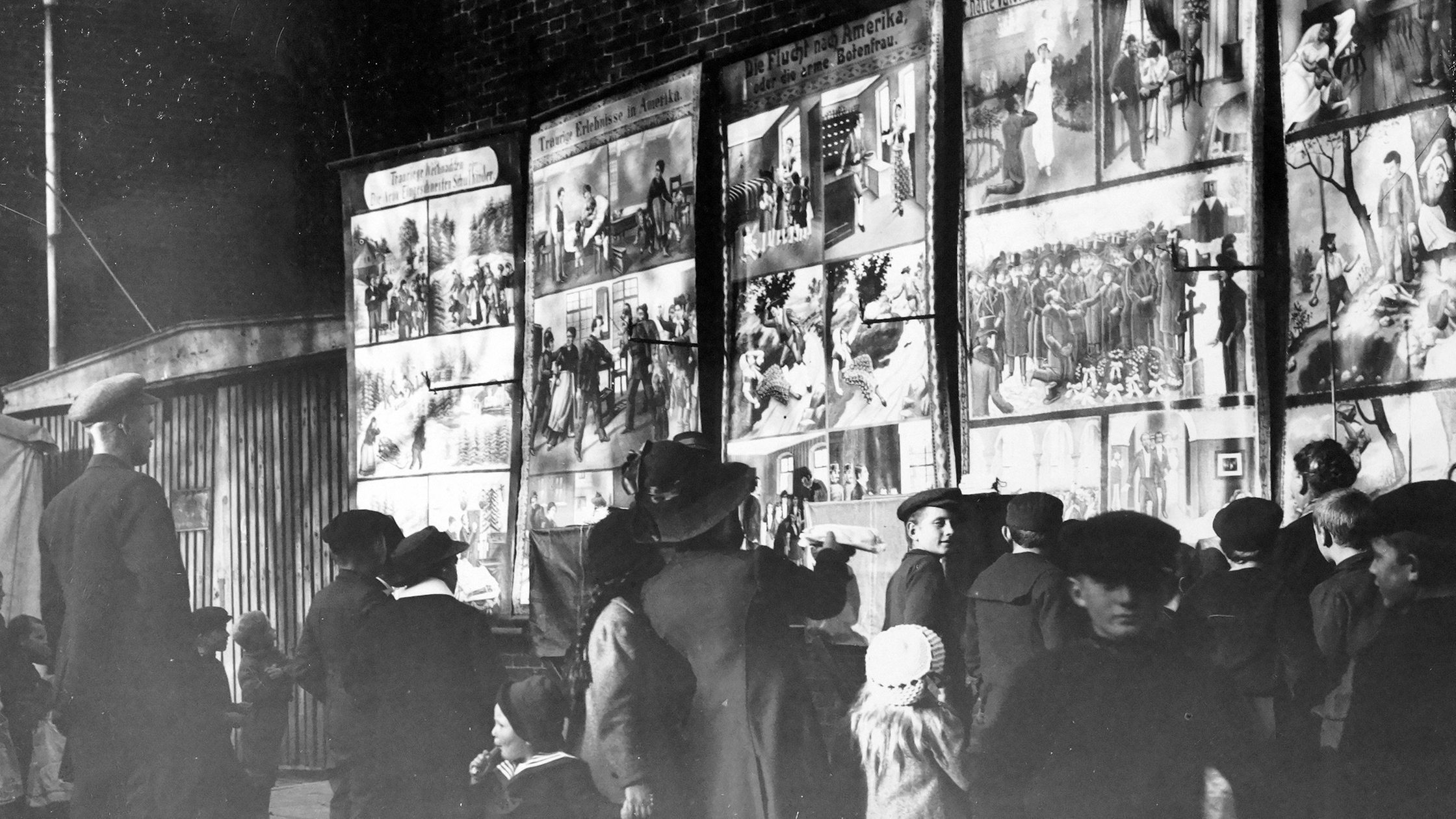
I found the use of music in The Witcher very interesting, because it hearkens back to older storytelling traditions. Bards and balladeers occasionally show up as characters in SFF. Manly Wade Wellman’s Silver John and Tom Bombadil are probably the best known examples, though there is also Ciaran from “The Jewel of Bas”, a Leigh Brackett story that is the subject of an upcoming Retro Review, and of course Fritz Leiber’s Fafhrd. But what makes the use of ballads in The Witcher so interesting is that the ballads comment on the story. And of course, ballads originally were a storytelling and also a news medium. At least in the German speaking world, ballads as a storytelling medium survived well into the twentieth century. For example, here is a photo of a balladeer at the Bremer Freimarkt sometime in the early twentieth century. The Nazis largely wiped out the tradition of wandering balladeers, because they disliked showpeople and carnival folk in general and balladeers in particular, because by the twentieth century the ballad had also become a medium of satire. “Mackie Messer” a.k.a. “Mack the Knife” by Kurt Weill and Berthold Brecht is probably the most famous German ballad of the twentieth century (here is the original performed by Lotte Lenya) and definitely satirical. After WWII, the ballad was revived as a medium of satire in West Germany. Furthermore, the ballad also appeared in the West German cinema of the 1950s, used to explain and comment on the plot. This technique shows up in not just in fantasy films like Das Wirtshaus im Spessart (The Spessart Inn) and its sequel Das Spukschloss in Spessart (The Haunted Castle), but also in serious movies such as Wir Wunderkinder (Aren’t We Wonderful?) and Das Mädchen Rosemarie (Rosemary), all of which – yes, also the two fantasy movies – are not only among the best movies made in 1950s West Germany, but they are also offer a slyly satirical look at postwar society, where the old Nazis are worming their way back into positions of power, while their former victims still can’t catch a break. The use of ballads in West German films to comment on the plot stopped abruptly in the early 1960s, likely due to the untimely death of Wolfgang Müller, one half of the comedy duo Wolfgang Neuss and Wolfgang Müller who played wandering balladeers in most of these movies, in 1960.

I have no idea, if Andrzej Sapkowski or Witcher showrunner Lauren Schmidt Hissrich have ever seen any of those movies, though it’s not as unlikely as it seems, because at least the Spessart movies were shown beyond the Iron Curtain and Wir Wunderkinder won a Golden Globe. But Jaskier very much struck me as the second coming of Neuss and Müller or rather Knoll and Funzel, as their characters are known in the Spessart movies, because he also is a comic relief character who uses his songs to comment on the plot (though actor Joey Batey has a better voice than Wolfgang Neuss and Wolfgang Müller). And interestingly, Jaskier’s songs also influence the story. For after Jaskier writes “Toss a Coin to Your Witcher”, a song which apparently went as viral in the story as in reality, the various people Geralt meets begin to treat him notably better, recognising that he is in fact “a friend of humanity” there to help. Jaskier is also instrumental in Geralt meeting the two other main characters of the series, Ciri (or rather her parents and grandmother) and Yennefer. Of course, Geralt reacts to Jaskier improving his image with glumness and grunting, as usual. Though it becomes clear to the viewer, if not to Jaskier himself, that Geralt does care about the bard. When Jaskier is hurt during an encounter with a djinn, Geralt tries to get him medical help and anxiously asks if Jaskier will be all right, because Geralt said some not very nice things about Jaskier’s music (more precisely, he called it “a pie without the filling”, which is really not a nice thing to say). And when Geralt lashes out at Jaskier, after Yennefer has dumped him, and points out that all his troubles, particularly his connection with Yennefer and Ciri, are all Jaskier’s fault, the bard is hurt, but by now he knows what Geralt is like. The last two episodes were packed with plot, but it’s still a pity that we did not get to see Geralt and Jaskier reunite.

Apart from Geralt and Jaskier (and a couple of villains), all characters of note in The Witcher are female. A lot of people have remarked on the many, many awesome women of The Witcher and quite a few believe that the fact that showrunner Lauren Schmidt Hissrich is a woman is responsible for the strong female presence in the series. However, except for one case where a male alderman is replaced by his teenaged daughter in the show, all of the female characters in The Witcher can be found in the books and are just as formidable there.

Quite a few people (here is one example) have complained about the way the series treats Yennefer who starts out as a disabled (she has a hunchback, a curved spine and a deformed jaw) and severely abused young girl, then has her physical flaws magically corrected for the price of losing her womb. She subsequently tries to regain her fertility by any means possible. Both disability cure narratives and fertility loss treated as a curse are potentially offensive tropes. And as a woman who has no children and never wanted any I normally dislike any kind of story which focusses on a woman’s desperate attempt to gain/regain her fertility. However, both Yennefer’s disability and her infertility are important plot points in the books, so the series couldn’t really leave them out without significantly altering Yennefer’s storyline. Plus, the series manages to handle these potentially offensive tropes in a way that minimises their offensiveness.

For starters, note that Yennefer is not actually happy, after her body has been corrected and not just because of the infertility issue either. It’s obvious that she misses her old self at times. At one point, she even tells an apprentice sorceress with a scarred face that beauty is overrated. The decision to let Yennefer have a boyfriend and sex, while still in her original body, also helps to mitigate the problematic aspects, because it shows that there were people able to look beyond her disability even before. I also suspect that Geralt wouldn’t have been put off by Yennefer’s original body either, because he isn’t the type to care only for outward beauty. Never mind that Geralt has also undergone traumatic physical changes, when he was turned into a Witcher against his will.

I have to admit that I did find Yennefer’s desire for a child a bit baffling, because she didn’t display any maternal tendencies in the series before and indeed agrees to have her womb removed to magically change her appearance (and no, we did not need to see the gory details). So I was baffled that she is suddenly willing to risk her life to cure her infertility. However, the Yennefer looking for an infertility cure is several decades older than the girl who wants power and beauty and thinks she cannot have one without the other. Also Yennefer is clearly troubled by the royal baby she is unable to save from a magical assassin sent to eliminate the baby and its mother. Furthermore, issues like menstruation, fertility, contraception, pregnancy, abortion and miscarriage play a bigger role in The Witcher books than in most epic fantasy novels, particularly epic fantasy novels by male authors. As detailed in this Tor.com post by Rachel Ashcroft, in one of the later books a female character finds herself unexpectedly pregnant, which leads to a debate whether she should have the baby or have an abortion, with the male characters conceding that it is primarily the woman’s decision. This is a topic that would be extremely uncommon even in Western fantasy, let alone fantasy by a male author. Considering that Poland is dominated by a particularly reactionary strain of Catholicism and has one of the most restrictive abortion laws in Europe, Sapkowski daring to mention abortion at all and pointing out that it’s the woman’s decision and no one else’s is downright revolutionary.

Finally, Yennefer is not the only character in The Witcher who was rendered infertile by magic. It is implied that her fellow sorceresses underwent the same ritual and none of them seem to be as troubled by losing their fertility as Yennefer. Of course, one could interpret Tissaia’s attachment to the magical school of Arethuza, whose rectress she is, as a displaced motherly instinct, but maybe she just likes being a teacher. Furthermore, Geralt was also rendered infertile by the process that turned him into a Witcher and is perfectly fine with this. In fact, he tells Yennefer that their lives are not good for children, so it’s probably for the best that they cannot have any. So of course, destiny, being a bitch gives Geralt (and eventually Yennefer) exactly what he doesn’t want, namely a child in the form of Ciri, when Geralt saves the life of Ciri’s father-to-be and invokes a custom called “the law of surprise” in response, which gives him something the person he saved has, but doesn’t yet know about. Almost as soon as Geralt has invoked the law of surprise, Ciri’s mother-to-be Pavetta pukes on the floor, revealing her pregnancy. “Fuck” is Geralt’s response, because he wants nothing to do with this child and indeed does his utmost to keep away from Ciri and the kingdom of Cintra for the next twelve years or so. He doesn’t even know that Pavetta’s unborn child is a girl until he returns to Cintra. It’s only after Geralt has seen the lengths to which a dragon was willing to go to protect his egg and when Cintra is at risk of being attacked by Nilfgaard that Geralt finally decides to take his responsibility seriously and returns to Cintra, offering to protect Ciri. Geralt even makes it clear that he only wants to help and doesn’t want to take Ciri away from her grandparents, but his offer is rebuked anyway and Geralt is imprisoned (he escapes pretty easily). In fact, if Ciri’s grandmother had been more reasonable and accepted Geralt’s offer, the traumatic experiences of Ciri’s flight from Cintra and subsequent search for Geralt (even though she is no idea who this person her grandmother insists is her destiny even is) could have been avoided. Of course, that would also have wiped out much of the plot of season 1.

The two most discussed TV (well, streaming video to be exact) series during the 2019/2020 holiday period were undoubtedly The Witcher and The Mandalorian. Yes, there was also His Dark Materials and Watchmen, though season 4 of The Expanse seems to have attracted less discussion than earlier seasons. And though The Witcher and The Mandalorian seem to be completely different shows on the surface – one epic fantasy and the other space opera – they also share remarkable parallels and not just because I was initially reluctant to watch either show and then wound up enjoying both a whole lot.

If you strip away all the fantasy or respectively Star Wars trappings of The Witcher and The Mandalorian, what you find in both cases is the story of a traumatised, monosyllabic and emotionally stunted loner, who hunts bad guys (many of whom aren’t quite so bad), finds himself guardian to a child with special powers, a child everybody is after, and becomes a better person in the process. Of course, Baby Yoda is still a baby, while Ciri is a young teenager, but apart from that it is notable that both The Witcher and The Mandalorian are stories of (reluctant) fatherhood. Furthermore, both Mando and Geralt find themselves at the centre of a found family, only that Mando gets a magical alien baby with Force powers, a troubled former shock trooper, a grumpy Ugnaught and a gun-toting droid nanny, while Geralt gets a teenaged princess with magical powers, a troubled sorceress and a goofy bard. I suspect it’s the found family aspects that made me fall in love with both shows, because I am a sucker for found family stories.

However, it’s certainly interesting that the two most discussed SFF shows of the 2019/2020 holiday period were both stories of reluctant fatherfood and stories which feature a largely positive image of parenthood. Now I know that quite a few people of a usually conservative bend complain about the image of fathers in US TV shows as useless bumblers, mostly referring to sitcom characters. I don’t watch sitcoms, so I rarely see the bumbling and idiotic US sitcom fathers. However, I have issues of my own with the portrayal of fathers of US television, namely that fathers (and sometimes mothers) are portrayed as overly controlling towards their teenaged children. Examples are Roger Murtaugh in the TV version of Lethal Weapon (which made me dislike Murtaugh, a character I liked in the films) and Danny Williams from Hawai Five-Oh, who at one point freaks out that his ten-year-old daughter (!) is smiling (!) at a boy. To German viewers like me, these overly controlling fathers seem very alien, not to mention borderline abusive, because my father never tried to tell me how to dress (and if he had, he’d have gotten some massive pushback) or who to hang out with. And while some of my friends had more controlling fathers, not even the worst of them reached the level of a Danny Williams or Roger Murtaugh. This is also why I was so annoyed at the grisly book turned movie turned TV series Das Pubertier (the title is a really offensive German pun that equates teenagers with animals), which features terribly controlling parents, because German parents didn’t use to be like that and hopefully aren’t today either. As a result, I was pleasantly surprised to see two positive portrayals of reluctant fatherhood in the kind of show where I would have least expected them.

So toss a coin to your Witcher, because it is a highly enjoyable series, which will almost certainly appear on my Hugo ballot.

*The Polish name means “Buttercup” as far as I know. In English, he’s Dandelion, in Czech Marigold (which causes issues with Trish, the character who actually is called Marigold) and in German, he’s Larkspur.

Posted in Books, TV | Tagged , , , , , , , , , , , , , , , , , | 7 Comments

Cora is a 2020 GUFF Candidate

The ballot for the 2020 Going Under Fan Fund (GUFF) race has been announced and I am one of the candidates.

What is GUFF, you ask? The Going Under a.k.a. Get Up and Over Fan Fund is a great project which sends fans from Europe to Australia/New Zealand and vice versa. This year a European fan/fans gets to go to CoNZealand, the 2020 WorldCon in Wellington, New Zealand.

This year, we have six GUFF candidates and a total of eight people on the ballot, namely Hisham El-Far and Lee Fletcher from the UK, Hanna Hakkarainen from Finland, Elizabeth Jones and Claire Rousseau from the UK, Dave Lally from the UK, Alison Scott from the UK and of course yours truly. All of them are awesome people and I’m honoured to be in such company. You can find out more about the candidates at the GUFF site and at File 770.

I’d also like to thank my nominators, Jo Van Ekeren and Camestros Felapton from Australasia and Adrienne Joy, Kári Tulinius and Mark Yon from Europe as well as June Young and Hampus Eckerman, who were also willing to nominate me, but aren’t listed on the ballot.

So how does it work? Simple. You make a donation to GUFF and fill out the ballot, which may be found here. The votes are ranked, similar to Hugo voting, i.e. you rank your first choice first, your second choice second, etc… There also are the options “no preference”, which means that you want to support GUFF and want one of the candidates to go, but don’t particularly care who, and “hold over funds”, which is like “no award” at the Hugos. You can vote until April 13, 2020.

Who can vote? Anyone anywhere in the world who makes a donation to GUFF and has been active in SFF fandom (e.g. attending cons, running fanzines and fansites, reviewing books and movies, participating in online discussions or engaging in other fannish activities) since at least January 2018.

Let me also give a shout-out to DUFF, the Down Under Fan Fund, a similar project which sends fans from North America to Australasia and vice versa. The 2020 DUFF race is also currently open for voting with four great candidates. The official ballot is here.

What happens if I win? Well, first of all I get to attend WorldCon in New Zealand and meet fans from the other side of the world, which is pretty damn awesome in itself. And you get to vicariously participate in my adventures, because a GUFF winner is required to produce a trip report. So if you enjoyed my reports about WorldCon 75 in Helsinki, my two-part report about WorldCon 77 in Dublin or my report about the local Steampunk con Steamfest in Papenburg, you can expect something along those lines, only with more waterfalls.

And if someone else wins? Well, then you’ll also get a trip report, though one with a different protagonist. But most importantly, you’ll have supported a great fan-run project, which is entirely funded by donations.

So what are you waiting for? Donate and vote for me or one of the other great GUFF candidates.

Posted in General, Personal | Tagged , , , , , , , , | Leave a comment

Retro Review: “The Man Who Wouldn’t Hang” by Stanton A. Coblentz

Werid Tales July 1944“The Man Who Wouldn’t Hang” is a short story by Stanton A. Coblentz, which was first published in the July 1944 issue of Weird Tales and is therefore eligible for the 1945 Retro Hugos. The story may be found online here.

Warning: There will be spoilers in the following.

This story takes the form of a tale told around the fireplace. One night, man called Carrigan, who’s worked as a state executioner for thirty years, is hanging out with friends and telling stories about his work. The fact that Carrigan is so open about what he does for a living is remarkable, considering that most real life executioners rarely talk about their work (executioners also have a high rate of depression and suicide), though there are exceptions who like to give interviews or write memoirs. And considering that executioners were historically shunned and often had to live outside the city gate, it’s also remarkable that Carrigan even has friends, even if those friends mainly seem to be interested in the macabre stories Carrigan has to tell.

Carrigan is quite unapologetic about his line of work. And so when one of his friends, the first person narrator of this story, asks him if there was ever a prisoner who got away, Carrigan tells the story of a convicted bank robber and murderer he calls Scar-Face because the man had a distinctive scar on his face.

Throughout his trial, Scar-Face insists that he is innocent and did not fire the shot that killed a bank clerk, but it is to no avail. He is sentenced to death anyway. On death row, Scar-Face is remarkably cool and sanguine, even as his execution date draws near.

On the way to the gallows, Scar-Face is polite and cheery and even helps his executioners to blindfold him. Meanwhile, Carrigan is overcome by a spooky feeling. And though Carrigan has zero moral qualms about executing people and even brags that he has already hanged fifty men, he is uncommonly reluctant to pull the lever. When Carrigan finally pulls the lever after all, what happens is… nothing. The trap door does not open and Scar-Face does not hang.

Carrigan pulls the lever again and again, but the trap door just won’t open. So Carrigan and his assistants check the gallows and everything seems to be in order. Even the trap door opens as intended, when Scar-Face is not standing on it. But as soon as they return the condemned to the gallows, the trap door once more refuses to open. At one point, Carrigan even has his assistants try the gallows on himself, with the rope tied around his waist rather than his neck. The trap door opens. So Scar-Face is brought back to the gallows and once again nothing happens.

Eventually, Carrigan and his assistants give up. Scar-Face is returned to his cell and Carrigan has to explain to the state governor why the execution could not be carried out. The governor is furious and threatens to fire Carrigan, but eventually relents, since there are plenty of witnesses to confirm that the failed execution wasn’t Carrigan’s fault.

And so a new execution date is set and a new gallows is built. The governor even shows up in person to witness the execution. Scar-Face is taken to the gallows and once more nothing happens. The trap door refuses to open and a thorough examination of the gallows finds no technical fault. Exasperated, the governor finally gives up and commutes Scar-Face’s sentence to life imprisonment. Of course, this would never have happened in reality, at least not in the US, where executioners try again and again, if the first execution attempt fails. And yes, there are several examples.

Carrigan concludes his tale by reporting that a few years later, a member of Scar-Face’s old gang made a death bed confession and admitted that he shot the bank clerk. So Scar-Face was innocent after all and is promptly freed. When his friends ask Carrigan about his theories why Scar-Face couldn’t be hanged, Carrigan admits that during the final execution attempt, he saw a strange mist in the gallows chamber, a mist which coalesced into a pair of hands that held the trap door shut.

I have to admit that I chose this story at random, while (virtually) flipping through the July 1944 issue of Weird Tales. What attracted me was the title and the evocative interior art by A.R. Tilburne. Besides, the story is very short – only four pages long – and so I decided to read it.

I wrote in my review of “Guard in the Dark” by Allison V. Harding that her stories were often dismissed as forgettable fillers in later years. I felt that was too harsh a verdict for “Guard in the Dark”. “The Man Who Wouldn’t Hang”, on the other hand, really is a filler. The story is well written – the general writing quality in Weird Tales seems higher under Dorothy McIlwraith than during Farnworth Wright’s tenure – and effective, but it is also very slight. There isn’t any deeper meaning nor does the story offer any opinion on the death penalty one way or another. “The Man Who Wouldn’t Hang” is merely a spooky anecdote. There also is very little supernatural content in this story apart from the mysterious misty hands. “The Man Who Wouldn’t Hang” could have been published just as well in the likes of Black Mask or Dime Mystery or any other crime pulp.

The fact that the story is well written is no surprise, as author Stanton A Coblentz was a veteran pulp writer who had started publishing in the 1920s and kept writing well into the 1960s. He was a frequent contributor to Amazing Stories and the other Hugo Gernsback magazines. “The Man Who Wouldn’t Hang” is somewhat atypical for Coblentz, since most of his work seems to have been science fiction, quite a lot of it satirical. In addition to writing speculative fiction, Coblentz also was a poet and literary critic.

“The Man Who Wouldn’t Hang” is very likely based on a real case, that of John “Babbacombe” Lee, who was sentenced to death for the murder of his employer in England in 1885 and survived three attempts to hang him, when the trap door would not open. As in “The Man Who Wouldn’t Hang”, the gallows functioned perfectly fine, when tested. Like the fictional Scar-Face, John “Babbacombe” Lee had his sentence first commuted to life imprisonment and was eventually freed. Though John “Babbacombe” Lee was not saved by supernatural intervention. Instead, the most likely explanation for the failure to hang him is that the gallows had been disassembled and set up in a different part of the prison prior to Lee’s execution. In the process, the trap door mechanism had become misaligned and the trap door refused to open. An alternate explanation is that a prisoner tasked with setting up the gallows in its new location had deliberately sabotaged the mechanism. But whatever the reason, John “Babbacombe” Lee survived his execution by sixty years.

The case of John “Babbacombe” Lee is fairly well known and was also described in detail in the memoirs of James Berry, the executioner who was supposed to hang him. Coblentz likely stumbled over this story at some point and fictionalised it.

A neat spooky anecdote, lots of atmosphere, but little substance.

Posted in Books, Retro Reviews | Tagged , , , , , , , , , | 1 Comment

Retro Review: “Guard in the Dark” by Allison V. Harding

Werid Tales July 1944“Guard in the Dark” is a short story by Allison V. Harding, which was first published in the July 1944 issue of Weird Tales and is therefore eligible for the 1945 Retro Hugos. The magazine version may be found online here. This review is also crossposted to Retro Science Fiction Reviews.

Warning: There will be spoilers in the following.

“Guard in the Dark” is the story of Jeffry Wilburts, a young teacher straight from college, educated in the latest theories of child psychology, who is hired as a private tutor for a twelve-year-old boy named Ronald Frost. Ronald’s parents are concerned, because Ronald is neglecting his school work and doesn’t want to hang out with his peers. What is more, Ronald – like many a boy in the middle of World War II – is obsessed with lead soldiers and has a huge collection of them.

However, Ronald’s obsession with lead soldiers goes beyond staging and re-enacting famous battles. Instead, Jeffry witnesses that Ronald arranges the soldiers in a precise pattern on the floor of his bedroom and regularly replaces the soldiers with fresh ones from his stash. Jeffry also cannot help but notice that the soldiers seem to be guarding Ronald’s bed. And whenever Jeffry asks Ronald what he is doing with the soldiers and why he has so many, Ronald only replies that he needs them.

By now, it is quite obvious where the story is going. And indeed, when Jeffry enters Ronald’s room the next morning, he catches Ronald trying to hide several broken lead soldiers (and speaking as someone who used to collect the tin soldiers in historical uniforms that used to be in Kinder Surprise Eggs in the 1970s and 1980s, let me tell you that such figures are almost impossible to break). Ronald’s parents confirm that Ronald keeps breaking his toy soldiers. They also are angry, both because of the costs of replacing the soldiers and because they fear that Ronald’s aggression will make him even more isolated. But when Jeffry asks Ronald point blank why he keep breaking his soldiers, Ronald insists that he did not break them – they died. Jeffry presses Ronald for the truth and the boy finally blurts out that the soldiers protect him from something that comes into his room by night.

Of course, Jeffry does not believe him and instead recommends that the Frosts send Ronald to see a psychiatrist. Meanwhile, Ronald’s stock of lead soldiers dwindles, for the soldiers keep dying and Ronald’s parents refuse to buy any more. Ronald begs Jeffry to get him more soldiers, but Jeffry refuses as well. He suggests repairing the broken soldiers, but Ronald insists that won’t help, because dead is dead.

One night, when Ronald’s soldiers are almost all gone, Jeffry decides to sneak into Ronald’s room, while the boy is sleeping, and observe what is going on. He also takes along his trusty notebook. Maybe, Jeffry muses, he can even catch Ronald red-handed, while he stomps around on his toy soldiers.

But while Jeffry is waiting for something to happen, he nods off… or so he thinks. He awakes with a start and finds himself in the middle of a pitched battle. The toy soldiers are on the move, running, shooting, fighting and dying, while battling a heavily breathing shadow which is closing in on Ronald’s bed. During the battle, a lead soldier jumps onto the notebook on Jeffry’s lap, firing his pistol at the shadow.

As is common for stories published in Weird Tales, we never see the monster that menaces young Ronald, even though interior artist Boris Dolgov portrays it as a horned and hoofed devil. Meanwhile, Harding describes the monsters as follows:

“A breathing, panting noise of a thing. Nameless, descriptionless, except for the grotesque shadow it threw.”

When the battle ceases and all soldiers have fallen, Jeffry – being a coward at heart – grabs his notebook and flees back to his own room. When he wakes up the next morning, he assumes he simply had a bad dream and heads for breakfast with the Frosts. However, Ronald does not come down for breakfast, so his mother goes up to fetch him and lets out a scream. Jeffry and Mr. Frost run upstairs to investigate and find Ronald sitting up in bed, utterly insane.

Ronald is carted off to an institution and Jeffry is out of a job. When he opens his notebook, a lead soldier falls out. Jeffry picks him up and notices that instead of the bland features that all of Ronald’s soldiers had – described at several points throughout the story – this soldier has an expression of unspeakable horror frozen on his face.

“Guard in the Dark” is an effective, if somewhat predictable horror story. In many ways, this story reminded me of “Mimsy Were the Borogroves” by Lewis Padgett a.k.a. Henry Kuttner and C.L. Moore, winner of the 1944 Retro Hugo for Best Novelette. Both stories feature children in peril from unknown forces, toys which are not what they seem (and there are stories that booby-trapped toys were used as weapons in WWII by all sides) and unsympathetic parents and child psychologists who refuse to listen to their kids and lose them in the end. I wonder whether these stories were inspired by worries about mothers neglecting their children as many women entered the workforce due to World War II, while fathers were absent altogether due to fighting overseas. At any rate, there is a very strong message of “Listen to your children and believe them” in both stories.

Jeffry Wilburts not a child psychologist, but a teacher. However, he frequently mentions that he studied child psychology and tries to apply his psychological knowledge to the problem of Ronald. But even though Jeffry is the protagonist and POV character of “Guard in the Dark”, he’s not a very likeable character. He’s incompetent and also an idiot who ignores what is bleedingly obvious, that the soldiers are alive and protecting Ronald from some kind of nightly horror. Though to be fair, readers naturally expect some kind of supernatural going-ons from a story published in Weird Tales. Jeffry, on the other hand, has no idea that he is a character in a Weird Tales story, so he refuses to consider any supernatural explanation for what is happening in the Frost household. However – and this is the one thing I cannot forgive him for – Jeffry is also a coward and complete and utter failure as a teacher. Because teachers are very much wired to protect their students, even if that means endangering themselves. We see this again and again in the case of school shootings, fires and other disasters. Teachers will risk their own lives to protect their students. And therefore, Jeffry running away and abandoning Ronald to the monster just feels wrong to me. Any teacher worth their salt would have battled the monster to protect Ronald.

As I read the story, I also noticed how much Ronald’s behaviour matches the symptoms of autism spectrum disorder. Ronald is withdrawn and isolated, he refuses to socialise with other children, he engages in ritualistic behaviour, becomes anxious when his rituals are disrupted and he is focussed on a narrow special interest. Of course, Ronald has a very good reason for doing what he does – there really is a monster in his closet that is out to get him. But if you ignore the supernatural explanation, Ronald’s behaviour seems like a textbook example for autism spectrum disorder. And considering that Leo Kanner and Hans Asperger were carrying out their studies on children with autism and Asperger syndrome in 1943 and 1944 respectively, i.e. around the time this story was published, I wonder whether Allison V. Harding was familiar with their research.

When I started the Retro Reviews project, I wanted to cover not just popular stories by big names, but also stories by lesser known authors. Allison V. Harding is certainly one of those lesser known authors, even though she was prolific, publishing thirty-six stories in Weird Tales between 1943 and 1951. Furthermore, Allison V. Harding is one of the forgotten female authors of the golden age – yes, there were women other than Leigh Brackett and C.L. Moore writing SFF in the 1940s, several of them publishing in Weird Tales. That made her work a natural choice for a review.

Avon Fantasy Reader No. 15Comparatively little is known about Allison V. Harding. She was clearly popular in her day, as Weird Tales letter columns and reader polls from the 1940s indicate. However, after 1951 she abruptly vanishes from the SFF scene. She never published another story, never appeared at conventions, her stories were dismissed as forgettable fillers and very little of her fiction was reprinted. “Guard in the Dark” was reprinted only once, in Avon Fantasy Reader No. 15 in 1950.

Allison V. Harding herself was a phantom. Sam Moskowitz managed to shed some light onto the mystery of Allison V. Harding, when he dug into Weird Tales‘ old files and found that Allison V. Harding was a pen name for Jean Milligan, daughter of a prominent East Coast family, who may or may not have been an attorney and who would go on to marry Charles Lamont Buchanan, associate editor for Weird Tales and Short Stories, in 1952. Some people believe that the author behind the Allison V Harding stories was not Jean Milligan at all, but Charles Lamont Buchanan, who used the name of his future wife to be to avoid a conflict of interest. I have no idea whether there is any truth to this theory, though “her family did not know that she was a writer” isn’t much evidence, because people don’t necessarily share every detail of their life with their extended family. Furthermore, as outlined by Joanna Russ in How to Suppress Women’s Writing, attributing women’s achievements to the men in her life is an incredibly common phenomenon. So unless there is definite proof to the contrary, I’ll assume that the person behind Allison V. Harding is the person whose name appeared on the royalty check from Weird Tales. I’ll also continue using female pronouns, when referring to Harding.

Jean Milligan lived until 2004, when she died at the age of 85. Her husband Charles Lamont Buchanan lived until 2015 to the ripe old age of 96. And considering how well researched Weird Tales and its contributors are, it’s a mystery why none of the many Weird Tales scholars ever thought to interview Jean Milligan or Charles Lamont Buchanan and ask them point blank who wrote the Allison V. Harding stories. Just as it is a mystery why Allison V. Harding, who was after all one of the ten most prolific contributors to Weird Tales, is so completely forgotten these days. Part of the reason is probably that Harding was very much a phantom. Robert E. Howard, H.P. Lovecraft and other prolific Weird Tales contributors left plenty of notes, drafts and letters behind, but all we have of Allison V. Harding are her stories. Furthermore, Harding’s stories appeared during Dorothy McIlwraith‘s tenure as editor of Weird Tales, whereas glory days of the magazine are considered to have been under the previous editor Farnsworth Wright.

So were Allison V. Harding’s stories “forgettable fillers”, as Robert Weinberg supposedly called them in his study of Weird Tales? At least based on “Guard in the Dark”, I would disagree. Yes, the story is fairly predictable, but it is also atmospheric and effectively written. I have certainly read worse Weird Tales stories from much bigger names. I also wouldn’t mind reading further stories by Allison V. Harding. After all, there are six stories published in 1944 alone to choose from.


Posted in Books, Retro Reviews | Tagged , , , , , , , , , , | 3 Comments

Retro Review: “The Big and the Little” a.k.a. “The Merchant Princes” by Isaac Asimov

Astounding Science Fiction August 1944“The Big and the Little” is a novelette by Isaac Asimov, which was first published in the August 1944 issue of Astounding Science Fiction and is therefore eligible for the 1945 Retro Hugos. The magazine version may be found online here. This review is also crossposted to Retro Science Fiction Reviews.

Most readers will probably know the story under its alternate title “The Merchant Princes”, which is how it appeared in Foundation, the first book of the eponymous trilogy.

Warning: There will be spoilers in the following.

I already recapitulated the Foundation series so far in my review of “The Wedge”, the story which directly precedes this one. So rather than repeat everything again, I’ll just direct you over there.

“The Big and the Little” takes place approximately thirty years after the events in “The Wedge” and also focusses on the traders, who peddle the Foundation’s atomic powered gadgets and spread its influence along the galactic periphery. One of those traders is Hober Mallow, the protagonist of “The Big and the Little”.

Like Limmar Ponyets from “The Wedge”, Hober Mallow is also something of an outsider on the margins of Foundation society. Like Ponyets, he was born in one of the four kingdoms the Foundation controls via its fake religion and was later given a lay education. But even though Mallow has enjoyed the benefits of a Foundation education, he is still not considered a true Foundation citizen, because he was not born on Terminus. Asimov rarely bothers to give us physical descriptions of his characters, but what little he tells us about Mallow’s appearance suggests that he also looks different than other Foundation citizens. For starters, he still dresses in the style of his homeworld Smyrno. And in one scene, while Mallow is hanging out naked (!) with a male friend in his private sun room in what is surely just a harmless discussion about politics, his skin is described as brown. So it’s at least possible that Hober Mallow is a man of colour. It is also possible that he is not straight, because the homoerotic vibes in that sun room scene are very strong (at one point, Mallow’s friend places a phallic object – a cigar – in Mallow’s mouth), even though this went completely over my head when I first read the story as a teen.

At the beginning of the story, Mallow is approached by Foundation politician Jorane Sutt, who worries that a Seldon crisis – one of the flashpoints in Foundation history where Hari Seldon’s hologram shows up to prove the protagonist right – is approaching. Now Sutt wants Mallow to head to the Korellian Republic – the Star Wars associations of the name were not lost on my teen self – to investigate the disappearance of three Foundation trading ships in Korellian space. Because the Foundation are the only ones who are supposed to have atomic power on the galactic periphery, attacking and destroying Foundation ships should be impossible. Unless the Korellian Republic also has atomic power, that is. And if the Korellian Republic really has atomic power, the question is how they got it. Sutt fears that there may be a traitor in the ranks of the Foundation, maybe one of the traders who aren’t “real citizens” anyway. Maybe even Mallow himself.

So Mallow sets out for the Korellian Republic with his ship, the Far Star, a politically ambitious trader named Jaim Twer in tow. Mallow rightly suspects that Twer may be a spy for Sutt, but takes him along anyway. The Korellian Republic is a republic in name only, but has been ruled by members of the same family for generations now. The latest leader, Commdor Asper Argo calls himself “the well-beloved”, but resides in a fortress-like estate and surrounds himself with bodyguards.

Even though Mallow is an official envoy of the Foundation, the well-beloved Asper Argo keeps him waiting. One day, a man claiming to be a Foundation priest shows up on the landing field, begging for help. For while the Korellian Republic tolerates Foundation traders, they forbid Foundation missionaries from entering their territory on the penalty of death, since the fate of the four kingdoms and Askone, the world from “The Wedge”, has made all other polities on the galactic periphery wary of the Foundation’s fake religion. Mallow’s crew lets the wounded priest aboard – against Mallow’s explicit orders. Mallow now finds himself in a similar situation to Limmar Ponyets from “The Wedge” – he has to deal with a Foundation citizen who wilfully flaunts the laws of other worlds. Unlike Ponyets, however, Mallow makes no attempt to save the priest. Instead, he delivers him to the mob baying for his blood outside the ship, to the horror of both Jaim Twer and his crew.

I had completely forgotten the episode with the priest. Upon rereading the story, I was stunned by Mallow casually abandoning the man to certain death. Of course, the priests of the Foundation’s sham religion are not particularly likeable, but that doesn’t mean that you want to see one of them get lynched. Mallow justifies his actions by telling Twer that he believes that the episode with the priest was a deliberate trap. After all, the Far Star has landed in a largely deserted area. So where did the priest and the mob pursuing him suddenly come from? All these are good questions, if there had been any hint regarding these facts, before Mallow brings them up. In the end, Mallow is proven right, too. But even though the plot is rigged in Mallow’s favour, the casual cruelty with which he throws the priest to mob still left a bad taste in my mouth. Not to mention that Mallow seem to believe in the “rum, sodomy and the lash” school of captaincy, pulls a blaster on his own crew and even remarks at one point that while he may be a democrat at home, aboard the Far Star he is a dictator. All of the protagonists of the early Foundation stories are jerks, but Hober Mallow is more open about it than either Salvor Hardin or Limmar Ponyets.

Soon after the episode with the priest, Mallow is suddenly given an audience with the Commdor, which he takes as further proof that his instincts were correct. During that meeting, Mallow assures the well-beloved Asper Argo that he has zero interest in spreading the Foundation’s religion, all he wants is to sell his wares for mutual benefit. Mallow’s dislike for the Foundation’s fake religion seems genuine, most likely because as someone born in the four kingdoms he was once on the receiving end of that religion.

The one scene in the story that I clearly remember some thirty years after I first read it also occurs during this meeting, when Mallow demonstrates one of his products, a necklace and belt combination that glows thanks to the miracles of atomic power, on an unnamed female servant in the Commdor’s household. This female servant is one of only two female characters in this story (and the entire first Foundation book, for that matter), the other being the Commdor’s wife, who is married to him in a political union. The Commdor’s wife even gets a few lines – mostly nagging her admittedly awful husband – while the female servant only gets to model pretty glowing jewellery. I remember this scene so clearly thirty years on, because a) this set of glowing jewellery sounded awesome and I would have loved to have one, and b) wearing a belt with a miniature nuclear reactor in the buckle also sounded incredibly dangerous and like a recipe for cancer. However, if someone had managed to make the glowing jewellery without the nuclear reactor, I would have been so there. I clearly wasn’t the only person who was fascinated by that scene, because William Timmins’ cover illustration shows a hand, presumably Mallow’s, holding the glowing necklace aloft.

But Mallow doesn’t only have nuclear powered trinkets for sale, he also has more practical wares, which he’d be only too happy to demonstrate to the Commdor, provided he could be given access to a steelwork. The idea behind this is that if the Korellians have atomic power, an industrial facility like a steelwork would be the place to find it, though don’t ask me why Mallow expects to find evidence of nuclear power at a steelwork. The Commdor agrees quickly, too quickly, and so Mallow gives his demonstration. He also finds evidence of atomic power, though not in the way he had expected. For the Commdor’s bodyguards are armed with atomic blasters bearing the crest of the Galactic Empire.

Foundation

Cover of the Gnome Press edition of Foundation.

Once Mallow knows where the Korellians got atomic weapons from, he sets out to investigate further, heading for a world called Siwenna that was once the capital of an Imperial province. But all he finds is an impoverished world under the thumb of a cruel Imperial viceroy who has ambitions to become Emperor himself. Failing that, the viceroy is planning to build up an empire of his own on the periphery and has already married off his daughter to Commdor Asper Argo of the Korellian Republic.

Mallow learns all that from an impoverished and disgraced Imperial patrician who just happens to be the first person he encounters on Siwenna. But contrived as this encounter seems, the story the old man tells about a succession of increasingly weak emperors and ambitious viceroys, about rebellions, counter-rebellions, massacres and genocide is powerful, even if all the action once more happens off stage, as is common with Asimov’s work.

But Mallow not only learns that the Galactic Empire, while still existing, is in dire straits, he also learns that the Foundation’s technology is more advanced than the Empire’s, that most of the Empire’s technology are legacy systems which the maintenance techs can’t even repair, should they break down, and that the Foundation are believed to be a semi-mythical group of space magicians this far from their sphere of influence. Viewed from the POV of our current information society, where every bit of news travels around the world in seconds and it is possible to have a conversation on Twitter with participants on four different continents, the complete breakdown of communication between the remnants of the Empire and the Foundation as well as the mutual ignorance of each other (Mallow is surprised that the Empire still exists) seems unlikely. I suspect it would have seemed unlikely even in 1944, where Asimov himself had a map in his office at the Navy Yard marking frontlines and troop movements on the other side of the world. If anything, the mutual ignorance of the Empire and the Foundation of each other reminded me of the tendency in the Star Wars universe to treat events that occurred only a few decades ago as ancient and quasi-mythical history.

Armed with this knowledge, Mallow returns to Terminus to build factories to fulfil the lucrative trade contracts he brought back from his trip to the Korellian Republic, accumulate wealth and run for office. But Mallow’s political ambitions anger Jorane Sutt, who then brings up the death of the priest in the Korellian Republic to have Mallow arrested and tried for murder.

Now the story takes a sharp turn into courtroom drama territory with the murder trial of Hober Mallow. Mallow takes the stand and proceeds to tear the case apart. First, he presents a hitherto unknown recording of the incident with the priest, which conveniently reveals that the supposed priest has a black light tattoo (something I for one did not know already was a thing in 1944) marking him as an agent of the Korellian secret police. Mallow further reveals that Jorane Sutt was trying to set him up and is planning to use the Foundation’s fake religion and the associated church to topple the secular government. Finally, Mallow reveals that his travelling companion Jaim Twer was a spy for Sutt all along and is not a trader, but a Foundation priest. As for how Mallow knew that Twer had to be a priest, in a conversation early in the story, Twer did not know what a Seldon crisis was and Mallow had to explain it to him, even though anybody who’d enjoyed a Foundation lay education would have known about Seldon crisises.

Like many golden age authors, Isaac Asimov wrote in more than one genre and was also a mystery writer. Now Asimov would not start writing straight mysteries until the 1970s and his 1953 science fiction crime novel The Caves of Steel is generally considered his first foray into the mystery genre. Nonetheless, many of Asimov’s early science fiction stories are structured like mysteries, even if the puzzle to be solved is “Why does this robot misbehave?” rather than a classic whodunnit. “The Big and the Little” is a good example, especially since there actually is a crime to be solved here.

But even if “The Big and the Little” is a science fiction mystery, it’s not a very good one. For even though Mallow’s deductions are all logical and make sense, the reader is not given the chance to make the same deductions, because they are not given the same information. Mallow might wonder how an escaped priest and an enraged mob come to show up at the largely deserted landing place of the Far Star, but the reader never learns that the area is deserted until Mallow tells us. Nor does Asimov ever mention that the fake priest’s robes are uncommonly new and clean, until Mallow decides to let us know. The incriminating tattoo comes completely out of nowhere as well. And the initial mystery of the vanished trader ships is resolved almost as an afterthought with a single line: “It was the Korellians using Imperial technology. Who else could it have been?” However, I do have to applaud Asimov for turning the incredibly awkward “As you know, Bob…” dialogue to explain what a Seldon crisis is into a vital clue to the central mystery.

Mallow is acquitted, since no crime was committed, and also elected mayor, since his political rival Jorane Sutt was revealed to have been plotting treason all along. However, there still is that pesky Seldon crisis to deal with, which finally arrives two years later, when the Korellian Republic declares war on the Foundation by attacking its trading ships with the much larger and more powerful Imperial dreadnoughts that Asper Argo, the well-beloved, managed to inveigle out of his father-in-law, the ambitious Imperial viceroy. If you’ve been hoping for a big space battle, you’ll be disappointed though, because once more Asimov keeps the action off stage and only gives us a short scene of a crewmen aboard a doomed trading ship getting his first glimpse of a gigantic Imperial warship.

Hober Mallow responds to the Korellians’ attack not by launching a counterattack, because this will only put the Foundation into the crosshairs of the Empire (which is what happens in the following story “Dead Hand”) and the Foundation is not yet strong enough to deal with the Empire. Instead, Mallow declares a trade embargo against the Korellian Republic. Then he sits back and waits until first the nuclear powered gadgets he sold to the Korellians break down and then the larger, industrial systems as well. And since Mallow knows that the Empire, though allied with the Korellians, does not have the technology to repair or replace the broken Foundation tech, he need only wait until the Korellian economy fails and the populace revolts.

“The Big and the Little” is the story which introduced me to the concept of economic embargos and the logic behind it. And as explained by Mallow, it all makes sense and neatly works out, too. There is no shooting and no bombing, the Korellians back down eventually and hardly anybody is hurt. Of course, reality is never quite so simple, but then the plot of the Foundation stories is always rigged in favour of the Foundation –until it isn’t.

Even though there is a Seldon crisis in “The Big and the Little”, Hari Seldon himself does not appear in this story. I assume that Seldon’s hologram does appear at some point to explain why Hober Mallow is right and Jorane Sutt is wrong, but for some reason we never get to see this moment. Instead, Mallow himself explains to his old enemy Sutt and his friend, sounding board and occasional nude sunbathing partner Ankor Twael that the Foundation will henceforth move away from conquest and domination via religion towards conquest and domination via trade. Sutt, a steadfast adherent to the old ways, is outraged, while Twael worries what will happen during the next Seldon crisis, when domination and expansion via trade stops being effective. Mallow agrees that his tactics will eventually cease working, but since it’s not likely that there will be another Seldon crisis in his lifetime (though Salvor Hardin got two), that’s a problem for someone else to worry about.

Foundation 1983 Panther edition

The 1980s Panther edition of “Foundation”, wherein I first encountered this story.

Upon rereading this story, I realised that I remembered very little about it apart from the scene with the glowing necklace and that this was the story with the economic embargo. Part of the reason for this may be that “The Big and the Little” (the title refers to the big but lumbering Empire and the small but nimble Foundation) is something of a mess. The story is long – at the upper edge of the novelette range – and somewhat disjointed. It almost feels as if Asimov – who was after all only twenty-four, when he wrote this story – bit off more than he could chew with “The Big and the Little”. Asimov juggles lots of plot strands – there is the central mystery of where the Korellians are getting their weapons from and what they’re up to, the political manoeuvring and backstabbing between the various fractions in the Foundation, the Seldon crisis and the shift in Foundation policy as well as setting up the conflict with the Empire, which will come to a head in the next story “Dead Hand” – so it’s no surprise that he doesn’t tie up all of those many plot strands in a satisfying manner. What is more, the four stories that make up the first book in the Foundation trilogy are mainly set up. The truly memorable Foundation stories – “The Mule”, “Now You See It…”, “…And Now You Don’t” – all come later in volumes two and three. If Asimov had never written another Foundation story after “The Big and the Little”, I doubt that the series would be remembered as fondly as it is today.

Isaac Asimov has always stated that the Foundation series was inspired by The History of the Decline and Fall of the Roman Empire by Edward Gibbon and the parallels are certainly notable, particularly in the latter story “Dead Hand”. However, the Foundation series also bears strong parallels to the course of European imperialism and colonialism, which began with sending missionaries (though unlike the Foundation’s fake religion, the Catholic missionaries sent out by the Spanish and Portuguese empires were absolutely sincere) and eventually came to focus on trade. Like the Foundation, Europe’s colonial powers also exported trinkets and imported the raw materials they lacked. And just like Hober Mallow, people from the colonised countries were never quite viewed as real citizens, even if they had been educated in the colonising country. Finally, the tactics used by the Foundation are also eerily reminiscent of American postwar policy, where the US tried to dominate its sphere of influence both via trade and also via exporting its political, if not religious beliefs (and occasionally those, too, or how else did South Korea come to have a sizeable number of evangelical Christians?).

In fact, the thing that most struck me upon rereading the Foundation stories was how political the series is and how very much it is about imperialism, particularly the American variety thereof. Not that my younger self did not realise that the Foundation series was political, but I mostly viewed it as a blueprint for preventing/reversing social and technological decline (and I was very worried about this at the time, viewing every empty shop and every broken neon sign as a symptom for decline, because Hari Seldon points out broken neon signs as symptom for the decline of the Empire in Prelude to Foundation) and bringing about a better future. And indeed, there is something very seductive about the idea of the Foundation using its superior technology as well as every trick in the book to make the universe a better place and bring about a political aim that none of the characters will ever see.

This is the reason that so many politically interested people – figures as different as Paul Krugman, Newt Gingrich and Osama Bin Laden have all cited the Foundation series as an influence – have been inspired by the Foundation series, when they read it at a young age. I don’t even exclude myself there. My love for the Foundation series was the reason why I picked sociology as my secondary subject at university, because I wanted to do what Hari Seldon did, predict the future and find a way to make it better. Of course, I quickly figured out that it doesn’t work that way in reality and that psychohistory is far more fiction than science.

The Foundation series will always remain a classic of political science fiction. However – and this is something my younger self missed – the vision of politics the series presents is not necessarily a good one and the Foundation is not necessarily right.

Posted in Books, Retro Reviews | Tagged , , , , , , , , , , , | 4 Comments

Retro Review: “The Wedge” a.k.a. “The Traders” by Isaac Asimov

Astounding Science Fiction October 1944“The Wedge” is a short story by Isaac Asimov, which was first published in the October 1944 issue of Astounding Science Fiction and is therefore eligible for the 1945 Retro Hugos. The magazine version may be found online here. This review is also crossposted to Retro Science Fiction Reviews.

Most readers will probably know the story under its alternate title “The Traders”, which is how it appeared in Foundation, the first book of the eponymous trilogy.

Since “The Wedge” is one of the stories that make up the Foundation trilogy, perhaps a recap is in order, though Asimov, whose 100th birthday we are currently celebrating by remembering his accomplishments and personal faults, never gives us one, neither in the magazine nor in the book version. Still, for anyone who needs a reminder, here is the story so far:

Warning: Spoilers!

The Foundation started out as a group of scientists sent to the planet Terminus on the galactic periphery to compile an encyclopaedia and preserve knowledge at a time when the Galactic Empire was falling apart. However, the true purpose of the Foundation, revealed by psychohistorian Hari Seldon or rather his hologram, is to guide humanity through the dark age following the fall of the Galactic Empire, to reduce the length of that dark age from thirty thousand to a mere thousand years and to establish a second Galactic Empire, all following Seldon’s master plan.

Alas, the Foundation is still just a group of encyclopaedists on a small and poor planet, surrounded by aggressive neighbours who have declared themselves independent from the Empire. However, Terminus has atomic power (Asimov’s word choice) and its neighbours do not. And so Salvor Hardin, mayor of Terminus, creates an artificial religion called Scientism to bring and keep the neighbouring four kingdoms under the control of the Foundation.

Foundation

Cover of the Gnome Press edition of Foundation.

All this happened in the first two stories of what would eventually become the Foundation series, published in Astounding some two years prior in 1942. “The Wedge” is chronologically the third and by publication order the fourth Foundation story. It is set some fifty years after the previous story “Bridle and Saddle”. The four kingdoms are now fully under Foundation control thanks to the fake religion, but other planets have caught on to what the Foundation is doing and understandably want nothing to do with them. So the Foundation tries to spread its influence via traders who peddle atomic powered gadgets along the galactic periphery.

One of these traders of Limmar Ponyets (named Lathan Devers in the magazine version, but I will stick with the name most readers will be familiar with in this review) who has a hold full of unsold wares and problems making his quota. A call reaches him in the shower (literally) and a ship pulls alongside to deliver an important message that self-destructs upon reading – twenty-two years before Mission Impossible.

A trader named Eskel Gorov has been arrested on the planet Askone for attempting to sell atomic gadgets there, even though Askone has banned all Foundation traders and gadgets, because using atomic power is against their religious beliefs. Gorov is facing the death penalty for sacrilege and Ponyets is supposed to get him out. An additional complication is that Gorov is not a trader at all, but an agent of the Foundation whose mission it is to introduce atomic powered gadgets to Askone to soften up the local government to Foundation control.

Ponyets has a quite interesting backstory. It is implied that he was not born on Terminus, but in the four kingdoms and initially trained as a priest (and indeed a later story explains that most traders actually hail from the four kingdoms). But representatives of the Foundation recognised his intelligence and brought him to Terminus to be educated there. So, unlike most citizens of Terminus, Ponyets is actually familiar with the scripture and rituals of the Foundation’s fake religion. This knowledge will come in handy on his mission.

Fake religions, which are science in disguise, were a popular trope during the so-called golden age of science fiction. And since fake religion stories predominantly appeared in Astounding, I suspect this was one of Campbell’s pet subjects which he foisted on his writers. The early Foundation stories are probably the best known examples of this trope, but the 1944 Retro Hugo finalist Gather, Darkness by Fritz Leiber is another science as religion story and a most excellent one, too. Now Fritz Leiber actually did train as an Episcopalian priest and left, because he did not feel the vocation, even though the church wanted to keep him. These experiences influenced Gather, Darkness and Leiber’s hilarious 1959 story “Lean Times in Lankhmar”. And in fact I wonder if Leiber, whom Asimov must have known, wasn’t an inspiration for Limmar Ponyets, the failed priest turned Foundation trader.

On Askone, Ponyets meets with the local elders who imply that Gorov may be released, if Ponyets is willing to pay for his freedom. However, the Askonians have no interest in Ponyets’ wares. Instead, they want gold.

Ponyets has no gold – the Foundation had no particular interest in precious metals for their own sake. However, he uses his superior scientific knowledge to rig up a matter transmutator to turn iron into gold, which he demonstrates to the Askonian elders with great theatrical flair. The Askonians may hate atomic power and science in general, but they really love gold, so they are willing to turn a blind eye to where it came from.

Ponyets also exploits tensions inside the council of elders by setting up a private meeting with an ambitious council member named Pherl. Ponyets offers to sell the transmutator to Pherl, so he will have enough gold to finance his rise to power. Pherl knows that the religious taboos of his world are just superstition “for the masses”, but he has to pretend to adhere to them to avoid the gas chamber. Ponyets assures him that no one need ever know that he has the transmutator.

Pherl finally agrees. He purchases the transmutator and Gorov is freed. However, Ponyets has tricked Pherl and installed a camera in the transmutator. He then proceeds to blackmail Pherl by threatening to broadcast footage of Pherl using forbidden technology to the superstitious masses of Askone. This would mean certain death for Pherl, so he is forced to purchase Ponyets’ entire inventory. And so Ponyets not only makes his quota, but has also fulfilled both Gorov’s mission and his own by installing a Foundation friendly leader on Askone.

I first read the Foundation series as a teenager and was blown away by the sheer scale, the twists particularly in the later volumes and also by how the Foundation usually triumphs by using brain over brawn.

Foundation 1983 Panther edition

The 1980s Panther edition of “Foundation”, wherein I first encountered this story.

My memories of “The Wedge” were vague – I mainly remembered it as “the one with the gas chamber”, because several characters are threatened with execution by gas chamber, which disturbed my younger self a lot. Upon rereading, the gas chamber references are not nearly as prominent as I remembered. It also turned out that a vivid scene of Gorov being taken to the gas chamber, only seconds from execution, only existed in my mind. This occasionally happens for me with stories I first read as a teen – scenes I remember very clearly don’t exist, because my vivid imagination supplies the details.

As I reread the story, I also remembered Ponyets’ transmutation parlour trick and how much it impressed my younger self. Because I’d learned in chemistry class that it was indeed possible to turn mercury or lead into gold, but that it took a whole lot of power and the resulting gold was unfortunately radioactive (the Foundation has solved the latter problem, but not the former). In fact, radioactive gold was first synthesized from mercury in 1941 in an experiment that Asimov as a graduate student of chemistry would have been familiar with and that may well have inspired this story. The Foundation series is often called hard science fiction, largely because the stories originally appeared in Astounding, even though there is very little in the way of hard science in the series. The transmutation parlour trick in “The Wedge” is probably as close as the Foundation stories come to actual hard science fiction. And my younger self was very pleased to see something I’d heard about in chemistry class pop up in a science fiction story (so pleased that I even told my chemistry teacher about it) and used in such a clever way to trick a bunch of idiots.

The cleverness that pleased my teen self so much is still evident in the story when I reread it as an adult, because Limmar Ponyets is a very clever man who comes up with a very clever scheme to trick the Askonians. There is just one problem. Ponyets may be clever, but he’s also an arsehole and even admits it. After all, he quotes a saying attributed to Salvor Hardin, mayor of Terminus and hero of the first two Foundation stories, “Never let a sense of morals prevent you from doing what is right.”

It’s a great line, which also serves as the epigraph of the magazine version of the story. But is what Ponyets and the Foundation are doing truly right? My teen self would probably have said yes. After all, the Foundation are the good guys here. They are trying to preserve civilisation and stave off the dark ages, even if I’d have preferred it is the ultimate aim of the Foundation was the creation of a Galactic Republic or Federation rather than an Empire. Still, if the Foundation has to use subterfuge and dirty tricks to fulfil that purpose, then so be it. Never mind that it is hard to feel sorry for the Askonians, because at least the ones we meet are all greedy and pompous idiots. And besides, the Askonians have gas chambers and obviously like to use them. As a matter of fact, Askone would probably be better off under Foundation control. After all, the Foundation has better technology, they are smart and they don’t have gas chambers.

Adult me can see that the Foundation is in the wrong here. Yes, the Askonians may be pompous, greedy and superstitious idiots, but they have made it very clear that they want nothing to do with the Foundation as is their good right (though I still disagree with the gas chamber threats. Just send Gorov back to where he came from and blast him out of the sky, if he comes back). It’s the Foundation which keeps violating the Askonians’ sovereignty and which clearly wants to take over Askone as it took over the four kingdoms. At least with the four kingdoms, the Foundation had the excuse of self-defence, since the four kingdoms were threatening Terminus. With the Askonians, they have no such excuse, because the Askonians are no threat.

No matter how noble the intentions of the Foundation are (and they only are noble, if you believe that Hari Seldon was right. Otherwise, the Foundation becomes a bunch of fanatics taking orders from a hologram), their methods of coercing other planets are wrong. Adult me also cannot ignore how strong the undercurrents of imperialism and colonialism are in the Foundation stories. Because the Foundation uses religion, trade (silly gadgets against various resources they lack) and force to take over other worlds – for their own good, of course – just like any real world coloniser. And just like the USA post-WWII in the real world, the Foundation has absolutely no qualms about meddling with the governments of sovereign nations. There are golden age stories which are critical of colonialism and imperialism – the 1944 Retro Hugo finalist “The Citadel of Lost Ships” by Leigh Brackett is one example – but “The Wedge” is not one of them. The Foundation is always right, at least in the early stories (They are disastrously wrong in “The Mule”), and the narrative doesn’t invite us to question them or their motives.

But it’s not just the uncritical endorsement of imperialism that makes “The Wedge” and the other early Foundation stories feel dated. In fact, these stories were already dated when I first read them as a teen in the late 1980s. And so you’ll find people nonchalantly smoking aboard spaceships and a total lack of women. All five named characters are male and no women appear at all, not even as walk-ons.

But the most glaring issue to me was the uncritical veneration (in the most literal sense of the word) of atomic power in the early Foundation stories. Because when I first read those stories a few years after Chernobyl, nuclear power was viewed as a failed and extremely dangerous technology that needed to be phased out as soon as possible (By 2022, Germany will finally get there). Literally everybody in Germany who wasn’t either completely stupid or a rightwing politician (which was pretty much the same thing) was opposed to nuclear power, so seeing an organisation as smart as the Foundation endorsing it was jarring to say the least.

However, I had developed the habit of checking copyright dates by that point and could see that the Foundation stories were very old and had been published before the first atomic bombs hit Hiroshima and Nagasaki, so I decided to give Asimov a pass, because he couldn’t have known how dangerous nuclear power was. Of course, the dangers of radioactivity were well known even in 1944 – the radium girls lawsuit took place in 1927/28 – and as a graduate student of chemistry, Asimov would certainly have known about the dangers. And to his credit, Asimov made a sharp turn away from nuclear optimism after Hiroshima. Nuclear power is barely mentioned in the post-1945 Foundation stories and by the Galactic Empire stories of the 1950s, Asimov frequently described Earth as a radioactive wasteland.

“The Wedge” is one of the less memorable Foundation stories and coincidentally also the only one where Hari Seldon’s hologram does not appear, since a Foundation agent nearly getting himself killed trying to undermine the society of a neighbouring world apparently does not qualify as a Seldon crisis. “The Wedge” also displays several of Asimov’s trademark weaknesses such as bland characters and clumsy dialogue, though the latter isn’t as noticeable here, because the Askonian elders are supposed to be pompous. This story also shares the unfortunate tendency of Isaac Asimov to let his climactic scenes happen off stage. And so instead of showing us Ponyets confronting Pherl with filmic evidence of the latter committing sacrilege, Asimov just tells us about it by having Ponyets recount the events to Gorov after the fact.

In spite of the story’s obvious weaknesses, the plot of “The Wedge” still holds up seventy-five years later and I enjoyed the story upon rereading. “The Wedge” is still a clever science fiction story – albeit one that comes with a generous helping of the unexamined imperialism and colonialism that afflicts the entire Foundation series.

Posted in Books, Retro Reviews | Tagged , , , , , , , , , , , | 7 Comments