Love and Crime 2020 – A Round-up of Indie Valentine’s Day Mysteries and Crime Fiction

Love and Crime banner

Our monthly round-ups of new speculative fiction and new crime fiction releases by indie authors are a perennially popular feature. Therefore, we now offer you a round-up of our favourite Valentine’s Day mysteries by indie and small press authors.

The holiday mysteries cover the broad spectrum of crime fiction. We have plenty of cozy mysteries, small town mysteries, culinary mysteries, animal mysteries, paranormal mysteries, historical mysteries, jazz age mysteries, police procedurals, crime thrillers, legal thrillers, amateur sleuths, crime-fighting witches, crime-fighting bakers, crime-fighting socialites, crime-fighting ghosts, crime-fighting dogs, masked vigilantes, missing children, kidnappings, jewel thefts, sleazy lawyers, serial killers, assassins and much more. But one thing unites all of those very different books. They’re all set on or around Valentine’s Day.

As always with my round-up posts, this round-up of the best indie holiday mysteries is also crossposted to the Indie Crime Scene, a group blog which features new release spotlights, guest posts, interviews and link round-ups regarding all things crime fiction several times per week.

As always, I know the authors at least vaguely, but I haven’t read all of the books, so Caveat emptor.

And now on to the books without further ado:

Death by Baguette by Jennifer A. AldersonDeath by Baguette: A Valentine’s Day Murder in Paris by Jennifer S. Alderson:

Paris—the city of love, lights … and murder? Join tour guide Lana Hansen as she escorts five couples on an unforgettable Valentine-themed vacation to France! Unfortunately it will be the last trip for one passenger…

Lana Hansen’s future is looking bright. She has money in her bank account, a babysitter for her cat, and even a boyfriend. Regrettably she won’t get to celebrate Valentine’s Day with her new beau, Chad. Instead, she will be leading a lovers-only tour in France. Luckily for Lana, her best friend, Willow, and her partner, Jane, will be joining her.

Things go downhill when Lana’s new boyfriend shows up in Paris for her tour—with his wife. Chad is not the website developer he claimed to be, but a famous restaurant critic whose love of women rivals his passion for food.

After Chad drops dead during a picnic under the Eiffel Tower, a persistent French detective becomes convinced that he was poisoned. And the inspector’s sights are set on several members of the tour—including Lana!

While escorting her group through the cobblestone streets of Montmartre, the grand gardens of Versailles, and the historic Marché des Enfants Rouges market, Lana must figure out who really killed Chad before she has to say bonjour to prison and adieu to her freedom.

Introducing Lana Hansen, tour guide, reluctant amateur sleuth, and star of the Travel Can Be Murder Cozy Mystery Series. Join Lana as she leads tourists and readers to fascinating cities around the globe on intriguing adventures that, unfortunately for Lana, often turn deadly.

Valentine's Day is Murder by Carolyn ArnoldValentine’s Day is Murder by Carolyn Arnold:

Cupid’s arrow may have missed its mark…

Jimmy finally takes a vacation–and a chance on love–only to be abducted. His female companion originally thinks he had cold feet about their relationship, but Sean and Sara know there’s more to it. Jimmy isn’t the type to just up and disappear, let alone leave a lady stranded.

Setting out on their private jet, Sean and Sara reach the tropical paradise of Ocho Rios, Jamaica with sightseeing as the last thing on their minds.

With a gold coin being their initial tie to Jimmy’s kidnapper, Sean and Sara even speculate about the involvement of pirates. Yet as the hours pass, and there’s no word from Jimmy’s captors, Sean and Sara will need to figure out the real motive before it’s too late.

With help from their friend, Adam, back in Albany, the pieces come together and not a moment too soon.

A Valentine for the Silencer by Cora BuhlertA Valentine for the Silencer by Cora Buhlert:

Valentine’s Day 1938: All Richard Blakemore a.k.a. the masked crimefighter known only as the Silencer wants is to have a romantic dinner with his beautiful fiancée Constance Allen.

But on his way to his date, Richard happens upon a mugging in progress. Can he save the victim and make sure that young Thomas Walden has the chance to propose to his girlfriend? And will he make it to dinner with Constance on time?

This is a short Valentine’s Day story of 7200 words or approx. 24 print pages in the Silencer series, but may be read as a standalone.

He never brings me flowers...He never brings me flowers… by Cora Buhlert

He never brings me flowers…

Waiting for your boyfriend to finally come home from work can be hell, especially if it’s your anniversary and you suspect he forgot – again. But does the ringing of the doorbell promise roses and sex and the long overdue proposal or something far more sinister?

Lovers’ Ridge

A foundling, a newborn, abandoned and left to die. But tonight, he will have his revenge on the parents who deserted him. Tonight, they will pay, at the very place where the story once began, at Lovers’ Ridge…

This is a bumper edition containing two short crime stories of 3200 words altogether. Both stories are also available as part of the collection Murder in the Family.

Valentine's Madness, edited by Beth ByersValentine’s Madness: A 1920s Historical Mystery Anthology, edited by Beth Byers:

Welcome to a very flapper Valentine’s Day!

Are you ready for the roaring twenties? For spunky young women crafting their own lives? If so, you’ll love Violet, Julia, Abigail, Evelyn, and Rosemary.

Inside, you’ll find four short Valentine’s day adventures, 1920s style including roses, chocolates, kisses, and cocktails. With stories from The Violet Carlyle Mysteries, the Piccadilly Ladies Club Mysteries, the Abigail Dutcher Mysteries, the Jazz & Gin Cozy Mysteries, and The Lillywhite Mysteries.

Mystery on Valentine's Day by Beth Byers and Lee StraussMystery on Valentine’s Day by Beth Byers and Lee Strauss:

The worlds of Ginger Gold and Violet Carlyle collide in this fun Valentine Mystery short story by bestselling authors Lee Strauss and Beth Byers.

While both Ginger and Violet had plans for a romantic evening of dinner and dancing to celebrate Valentine’s Day with their husbands, something goes terribly awry. One by one, female patrons discover that they are missing jewelry.

In this closed room mystery filled with a brigade of colorful characters, Violet and Ginger join forces to put their skills of deduction to work. Can they unveil the culprit and solve the mystery in time for dessert?

Don’t miss this delectable bite-sized tale. Pairs perfectly with a box of chocolate and a comfy chair!

The St. Valentine's Day Cookie Massacre by Elisabeth CrabtreeThe St. Valentine’s Day Cookie Massacre by Elisabeth Crabtree:

It’s Valentine’s Day in quiet, cozy Hatter’s Cove, Florida and food columnist, Kat Archer, has been assigned the event of the year, the grand opening of Miss Dolly’s Cookie Jar and Sweets Emporium.

What begins as a run of the mill, albeit tasty, assignment turns into something much more dangerous when one of the Cookie Jar’s employees is poisoned.

Now Kat is chasing the biggest story of her life, while trying to catch the eye of her handsome editor and avoid becoming the killer’s next victim.

A cozy novella: approximately 44,000 words

Murder on Valentine's Day by P. CreedenMurder on Valentine’s Day by P. Creeden:

It’s Valentine’s Day and 20-year-old Emma Wright just wants her crush to take notice of her. But Colby Davidson, the K9 search and rescue deputy only thinks of her as a kid sister. How will she get him to take her seriously?

When her veterinarian boss calls her to pick up a cat at a potential crime scene, she finds herself at the house of the richest woman in Ridgeway. Her father—the sheriff—and Colby are there. They both dismiss the untimely death as a heart attack, but Emma finds clues that it might be something more. Did the software billionaire die of natural causes, or was it murder?

The Valentine Mystery by Kathi DaleyThe Valentine Mystery by Kathi Daley:

If you love small towns, endearing relationships, food, animals, and a touch of murder, you will love this new mystery series by Kathi Daley, author of the popular Zoe Donovan Cozy Mystery Series.

It is Valentine’s Day in White Eagle Montana and Tess and Tilly are busier than ever delivering Valentine Cards along with the daily mail. Of course it wouldn’t be Valentine’s Day in White Eagle without a mystery to solve or a holiday adoption party to prepare for.

When Tess happens upon a vehicle accident where one man dies, she gets pulled into a mystery with roots into the past. With Tony’s help she not only tracks down a killer but she looks into the occurrence of a missing person as well.

Tony is still looking into the case of Tess’s father’s disappearance, meanwhile Tess and Tilly team up with Brady to make sure that every animal shelter resident finds their perfect match in time for Valentine’s Day.

A Valentine Murder by Steven DemareeA Valentine Murder by Steven Demaree

In this delightful combination of a whodunit mixed with humor, a woman, who has been celebrating her birthday and Valentine’s Day, is rushed to the hospital complaining of stomach pains and nausea. She grabs the doctor and tells him she has been poisoned, but before she can tell him any more, she dies. When Lt. Dekker and Sgt. Murdock investigate, they find out that no one liked her, with the possible exception of her husband.


Corridor Man: Valentine by Mark FaricyCorridor Man: Valentine by Mark Faricy:

BETTER CHANGE THE LOCKS. BOBBY DID.

Disbarred attorney Bobby Custer continues to use his main skill set; murder, treachery and perversion in an ongoing effort to increase his personal gains.

Ever the charmer, Bobby provides Emily with an unforgettable valentine that up until now she could only dream about . . . or maybe it was a nightmare. Together they forever mark the day with a memorable secret. Psychotic, sociopathic, always charming– and you thought he was here to help.

The Heartless Valentine by Kacey GeneThe Heartless Valentine by Kacey Gene:

Roses are red; violets are blue
Is a lover from the dead here to kill you?

Valentine’s Day. 2020. Middlebridge, Wisconsin. When the quick-witted second grade teacher and amateur sleuth, Jennifer Hunter, receives a gift from a secret admirer on Valentine’s Day, she heartily investigates who her cupid could be. When she opens the box, though, she doesn’t find chocolates; she finds a human heart wrapped in red tissue paper.

And that’s not all. Her admirer has written a note confessing their desire to watch Jennifer die. That’s when Jennifer’s best friend and Middlebridge’s Police Lieutenant, Jake Hollow, steps in.

Jake and Jennifer put their dynamic duo focus on finding Jennifer’s deranged valentine, and that leads them to the recently deceased body of David Bird IV. He looks like an average dead guy except for one fact — his heart has been removed. Jennifer must investigate this heartless valencrime; otherwise, she fears she’ll be the next victim. Yet, her attempt to protect her own heart leads her to a set of love letters that tell the story of broken hearts from the past.

Valentine’s Day. 1910. Salem, Massachusetts. Clay Trunkett, a twenty year old hard-working journalist, is scheduled to hang for assaulting a man. His accuser? David Bird II, son of the wealthiest man in Salem. Clay’s true crime? Falling in love with Meghan White, the woman David has his heart set on marrying.

The love triangle of 1910 holds the clues Jennifer needs to find the heart snatcher of 2020, but with her own crazed valentine delivering threatening messages and bits of heart like they’re candy, Jennifer struggles to piece together this crime of passion from 1910.

And, Jennifer’s own passions get in the way when she discovers that her best friend, Jake, has a girlfriend — one that he’s been hiding from Jennifer for months. Betrayal runs high as masquerade parties, craft sales, murder mystery dinners, and a strange encounter at the local diner all distract Jennifer from her one mission: To find out who’s making her Valentine’s Day the most horrifyingly heart-filled in history. The problem is, Jennifer’s discoveries may end her friendship with Jake, and that’s a heartbreak she can’t take.

This clean cozy mystery will keep reader’s hearts pounding as they flip through love letters from the past and the alternating stories of Jennifer Hunter and Clay Trunkett. Jennifer’s down-to-earth and lovable personality plunges into new territory as she must assess her relationship with Jake and the type of love she wants in her life. She goes on crochet benders; she attends parties where she gets to be someone other than herself; and all the time she’s piecing together a crime that makes this Valentine’s Day anything but sweet.

Valentine by Celina GraceValentine by Celina Grace:

A respectable, middle-aged housewife. An ambitious young lawyer. A student burlesque dancer. Three women with nothing in common – except for the fact that someone has sent them a macabre Valentine’s Day gift; a pig’s heart pierced by an arrow.

Is this a case of serious harm intended? Or just a malicious prank? Detective Inspector Olbeck thinks there might be something more sinister behind it but his colleague Detective Sergeant Kate Redman is too busy mourning the departure of her partner Tin to New York to worry too much about the case. Until one of the women receives a death threat…

Valentine is a novella in the best-selling Kate Redman Mystery series by crime writer Celina Grace.

The Ghost of Valentine Past by Bobbi HolmesThe Ghost of Valentine Past by Bobbi Holmes:

A romantic weekend at Marlow House Bed and Breakfast turns deadly when Earthbound Spirits founder, Peter Morris, is murdered. Plenty of people had a reason to want the man dead—especially Danielle’s current guests.

But it isn’t Morris’ ghost distracting Danielle on this deadly Valentine’s Day weekend, it’s her late husband Lucas. She has her hands full with suitors coming from all directions—both living and dead—while she tries to figure out if there’s a killer in Marlow House.


Ghoul You Be My Valentine? by Olivia JaymesGhoul You Be My Valentine? by Olivia Jaymes:

It’s time for another Ravenmist Whodunnit! A tiny Midwestern town with charming covered bridges, quirky residents, delightful antique shops, and more than their share of haunted activity.

Tedi has another packed inn of people for the Ravenmist Valentine’s Day Ball. The evening was a complete success until she and Jack find a dead body on the back patio with a Cupid’s arrow through his heart. There’s no shortage of suspects for his murder either. Jack will have his hands full paring down the list.

And Tedi? She’s staying out of this. No way is she going to be pulled into it. Not after last time. She has her own investigation. She and her friend Missy are trying to find why the town has suddenly been infused with paranormal energy. Ghosts are literally getting up and dancing around. It’s all going well too. That is until the investigation starts to hit just a little bit too close to home.

Hop into your ghostmobile and take a ride with Tedi as she meets a spirit who doesn’t think he’s dead, two ghosts in love, and a hard partying specter who just might have witnessed the murder. It’s a hauntingly good time in the little town of Ravenmist and you’re invited to the party.

Lady Rample and Cupid's Kiss by Shéa MacLeodLady Rample and Cupid’s Kiss by Shéa MacLeod:

Just when Lady Rample has given up on love, a former flame reappears, bringing with him all sorts of emotions she thought buried. Unfortunately, that flame comes with one very aggressive and rather angry almost-ex-wife. The ensuing catfight is almost worth the price of admission.

When the ex-wife is found dead in Hyde Park, stabbed with a hatpin in the shape of a heart, the police naturally assume the killer is the husband. Our intrepid heroine is not about to allow her love to go down for a crime he didn’t commit. Unfortunately, proving him innocent may put her own neck on the line.

Never one to shirk from danger, Lady R—with the help of her eccentric Aunt Butty—will need all her wits about her if she’s to solve the crimes of the Cupid Killer.

Enjoy the glitz and glamor of the 1930s with the sixth book in the popular 1930s historical mystery series, Lady Rample Mysteries.

Moonshine Valetnine by Tegan MaherMoonshine Valentine by Tegan Maher:

It’s Valentine’s Day, and Noelle has no idea what to get for Hunter. While she’s getting her hair cut and tossing around gift ideas, Coralee’s long-term boyfriend pops in and declares his undying love via a marriage proposal, breaking rule numero uno of their relationship clause.

He’s only the first to fall, though. When the men of Keyhole Lake start acting like lovesick lunatics, Noelle and Rae have to put their heads together to figure out what happened before the whole town goes loopy in love, or someone ends up in jail.

This story falls in between book 4, Murder and Mayhem, and Book 5, Murder and Marinade, in the Witches of Keyhole Lake Mystery Series.

Heart Attack by Terri MainHeart Attack by Terri Main:

When Smelling Roses, Watch Out for the Thorns

Strange things are happening in Armstrong City right before St. Valentine’s Day. Several women who found roses on their doorstep passed out inexplicably. Carolyn and Mike must figure out how this happened, who is doing it, and why?

A fun little mystery for the holiday of love.


Valentines & Victims by Donna MuseValentines & Victims by Donna Muse:

After being snowbound for much of the winter, amateur detective duo Geneva Pomolo and Iris Reeves are looking forward to a Valentine’s Day getaway with a few older friends at Bittersweet Lodge, a ski resort in the chilly foothills of southern Indiana. Both women are looking forward to a weekend of dance contests, luaus, roasted pigs, and toboggan scavenger hunts. Tensions mount when one of their friends comes down with a sudden illness. Geneva fears the worst: someone is poisoning the lodge’s guests.

The case takes a deadly swerve when Horace Weatherspoon—millionaire head of a railroad empire—dies in a toboggan accident. The old man had been deathly afraid of toboggans and Geneva knows there is malice at work: one of their fellow guests is a murderer. As Iris and Geneva begin to investigate, they uncover a trail of secrets leading back more than thirty years, and one person will kill again to keep those secrets buried.

Be My Valencrime by Amy M. ReadeBe My Valencrime by Amy M. Reade:

It’s Valentine’s Day in Juniper Junction and love is in the air. Or is that just a dark cloud?
Lilly’s shop assistant, Harry, is about to pop the question to his girlfriend, Alice Davenport. He’s got the ring, he’s planned a romantic dinner, and he’s even thought of a gracious escape if Alice says no.

The only thing missing is…Alice.

Lilly wants to do all she can to help find Alice, even if that means interfering with a police investigation. But as she begins to learn more about Harry’s sweet, unassuming girlfriend, she discovers that Alice is hiding a shocking secret that will complicate everything.

And when Lilly suffers a lapse in judgment, the consequences are swift and painful. Can she pull herself together enough to help her daughter through a tunnel of teenage angst, deal with her mother’s dementia-related wanderings, and still help Harry find his Happily Ever After?

Sweet Hearts by Connie SheltonSweet Heart by Connie Shelton:

Will there be Valentine wedding bells for Samantha Sweet and Beau Cardwell? (introduced in this mystery series opener Sweet Masterpiece) Sam’s bakery, Sweet’s Sweets is busier than ever this Valentine week, as she struggles to replicate the magical chocolate-making techniques of the enigmatic chocolatier who boosted her winter holiday sales into the stratosphere. However, candy classes take second place to a new mystery, when Sam meets a woman whose missing son’s case seems to have been dropped by the authorities. Marla Fresques learns that she is dying and needs for her son to come home and raise the daughter he left behind. Sam agrees to help, hoping that Sheriff Beau’s inside connections will bring about a quick and happy resolution.

But what about Sam’s and Beau’s own wedding plans? They may be in jeopardy when an entirely new development appears in the form of Beau’s ex-girlfriend who is determined to win him back.

With the familiar mix of mystery, romance and a touch of magic that has enchanted readers of this series, Sweet Hearts draws the reader even further into the captivating world of Samantha Sweet.

My Wicked Valentine by Lotta SmithMy Wicked Valentine by Lotta Smith:

Valentine’s Day is just around the corner… Love is in the air and so are the ghosts!

When Rick’s old friend, up-and-coming celeb psychic Brian Powers is accused of murdering an esthetician at a luxe gentlemen-only spa, Mandy’s cozy afternoon at home goes from cookie-baking to crime solving.

With baby Sophie and ghost-pal Jackie in tow, Mandy and Rick take to haunting the spa where the facials are fab and the intrigue is high-end.

Every suspect has a secret, but who’s willing to kill to keep theirs under wraps? [Seaweed wraps, that is.] Find out in this dangerously funny installment of the Manhattan Mystery series.

The Draed Arrow by Grigor WeeksThe Dread Arrow by Grigor Weeks:

Dark Space is strange, and so are the hitmen who live there. Strap in sweetheart. Love never hurt so good.


Valentine's Blizzard Murder by Linnea WestValentine’s Bizzard Mystery by Linnea West:

When a minor celebrity staying at the Shady Lake Bed and Breakfast dies of an allergic reaction during a blizzard, it doesn’t seem like it could get much worse. But was it really an accident?

Jake Crawford is a D list celebrity who loves to come back to Shady Lake to be the big fish in a small pond. This time, he brought his new wife back to Shady Lake for his honeymoon and they are staying at the bed and breakfast that Tessa Schmidt helps her family run. Jake is kind of a jerk, but then a blizzard hits and he dies of an allergic reaction. It seems like things couldn’t get any worse for a Valentine’s Day weekend. But Tessa is starting to suspect that the allergic reaction isn’t the horrible accident she had assumed.

As the blizzard stretches on and on, secrets keep coming out. It seems like almost everyone has a motive to kill Jake. Can Tessa figure out who wanted to kill Jake Crawford before the killer strikes again?

Posted in Books, Indie Crime Fiction of the Month | Tagged , , , , , , , , , , , , , , , , , , , , , , , , , , , | Leave a comment

Star Trek Picard realises that “The End is the Beginning” and gets on a spaceship

Since it seems that I’m doing episode by episode reviews of Star Trek Picard, my previous reviews are here.

I initially misread the episode title as “The End of the Beginning”, which would have been highly appropriate, because this third episode of Star Trek Picard seems to be the end of the set-up period and the start of the adventure proper.

Warning: Spoilers behind the cut! Continue reading

Posted in TV | Tagged , , , , , , | Leave a comment

Retro Review: “When the Bough Breaks” by Lewis Padgett a.k.a. Henry Kuttner and C.L. Moore

Astounding Science Fiction November 1944

Not Alexander, but the Killdozer from Theodore Sturgeon’s eponymous story

“When the Bough Breaks” is a novelette by Lewis Padgett, one of the many pen names of Henry Kuttner and C.L. Moore, which was first published in the November 1944 issue of Astounding Science Fiction and is therefore eligible for the 1945 Retro Hugos. The story may be found online here. This review will also be crossposted to Retro Science Fiction Reviews.

Warning: Spoilers beyond this point! We also need a trigger warning for harm done to a child here.

“When the Bough Breaks” is the story of the Calderon family: physicist Joe, his wife Myra and their eighteen-months-old son Alexander. The Calderons are amazed to have found a good apartment close to the university where Joe works and for a reasonable rent, too. Apparently, the housing market was already tight in 1944, even though the US housing stock was not being diminished by World War II bombings, unlike in Europe.

A neighbour informs the Calderons that no one lasts long in apartment 4-D. It’s not exactly haunted, but there are unusual visitors, strange little men who keep asking for a man no one knows. And indeed, the Calderons have barely moved in, when the doorbell rings and four little men with huge heads and wizened faces stand outside.

“Are you Joseph Calderon?” they ask Joe. When Joe says yes, the little inform him that they are the descendants of his son Alexander, that Alexander is a superbaby and that the little men are there to educate him.

Joe doesn’t even have time to react, before the little men storm the apartment and gather around baby Alexander. They claim that they come from the year 2450 and that Alexander himself has sent them back in time to educate him. Oh yes, and Alexander is an immortal superhuman.

The Calderons do what everybody would have done in that situation, they throw the little men out. Or at least they try, for the little men paralyse them with some kind of futuristic technology. Then the little men give Alexander some educational toys from the future. Alexander isn’t particularly keen on the toys, but the little men are extremely patient. Once they’re satisfied that Alexander has learned enough, they leave.

The Calderons are understandably panicked – after all, Alexander is just a baby, a perfectly normal baby and not homo superior. So, to avoid a further visitation by the little men, they go to the nearest theatre to watch a movie, taking Alexander along. But in the middle of the film, Alexander vanishes. The terrified Calderons head home, where they find Alexander happily playing with the little men and one of their educational toys.

The little men try to stun the Calderons again, but Joe says there is no need, they will cooperate. And the little men don’t want to hurt Joe and Myra either, because they know how important a stable home environment is to Alexander’s development.

So Joe and Myra watch as the little men play with Alexander, while Bordent, the leader of the little men, explains that Alexander is the first homo superior, mutated because both his parents worked with radioactive material and were exposed to radiation. Bordent also explains that Alexander’s abilities were not recognised until he was thirty. So the future Alexander sent Bordent and his companions into the past to find his infant self and give him an education suitable for a superhuman.

Bordent also explains that because Alexander is a superhuman, he will mature more slowly than regular human children. Until he is twenty, Alexander will physically remain at the state of an eight-year-old. Mentally, he will be higher developed than his parents, but irrational like a small child.

From that day on, the Calderons resign themselves to the daily visitation of the little men. They also note mental and physical changes in Alexander. After four days, he begins to talk and after a week, Alexander is able to hold conversations, though his speech is sometimes slurred, his baby muscles and teeth not yet ready for talking. Also like any baby, Alexander displays irritating behaviour, made even more irritating by the fact that he can talk. And so he demands milk and assembles the educational toys from the future into strange structures. But when Joe asks what Alexander is building, Alexander just says “No” over and over again. Alexander also decides to practice vomiting and crying and generally turns into a tiny dictator. At one point, he even tells Joe (whom he refuses to call “father”) that he and Myra are primitive biological necessities.

Alexander becomes steadily more difficult to handle. He learns to teleport, communicate telepathically and dispense electric shocks and promptly decides to try out those new skills on his parents. He also stops sleeping – it’s an artificial habit anyway, Bordent explains. By now, we and the Calderons are beginning to suspect that Alexander has a great and glorious future as a comic book supervillain ahead of him. However, Bordent assures Joe and Myra that Alexander is only playing and that he didn’t mean to hurt his parents. And no, spanking Alexander is not the answer.

While on the subject of spanking, the portrayal of parenthood and child rearing in this story are seriously dated. Not only does Joe consider spanking his admittedly tyrannical kid, no, Joe and Myra also drink larger quantities of hard alcohol around their baby (and Joe considers giving Alexander some alcohol at one point, when Alexander demands “a drink”, before Joe realises that he means milk), they smoke around their baby and take him the cinema at one point to see a movie that very likely is not appropriate for young children. To be fair, none of these things were uncommon for parents of young children well into the 1970s and beyond, but viewed from a 2020 POV they are jarring. Though it’s also interesting that Alexander berates his parents for smoking around him, because it’s bad for his lungs, which is probably the most prescient thing in the whole story.

After a few months of living with an ever more dictatorial superbaby, Joe and Myra are at their wits’ end. Human may have a nigh endless supply of parental love and tolerance, but even that has its limits and Joe and Myra have just about reached them.

Myra quietly wonders whether they’re really the first parents to deal with a homo superior baby. She finally decides that no, they’re probably not the first. However, Alexander is the first homo superior, so something must have happened to the others. And Joe and Myra as well as the reader can imagine only too clearly what it was.

The bough finally break one night, when Alexander breaks open a cupboard and retrieves an object, a blue egg, that the little men had locked away, because it might be dangerous to Alexander. Joe and Myra know the object is dangerous and that they should intervene, but somehow they cannot bring themselves to do it. Besides, Alexander probably wouldn’t let them intervene anyway.

And so it happens what has to happen. Alexanders blows himself up and all that remains are his smouldering baby shoes. Joe and Myra realise that Alexander is gone and that since Alexander never grew up into the first homo superior, Bordent and his companions never travelled back in time either and the whole thing ever happened. Joe and Myra are more relieved than anything, while Myra pities the parents of whoever the first homo superior to reach adulthood may be. We suspect that parents of Charles Xavier, Erich Lehnsherr a.k.a. Magneto and Magnifico a.k.a. The Mule might sympathise.

Line to Tomorrow by Lewis Padgett

On the other hand, the baby on the cover of this Lewis Padgett collection may well be Alexander.

“When the Bough Breaks” is a deeply disturbing story – after all, it is basically a story about parents who kill their kid through neglect. What makes the story even more disturbing by the fact that it’s largely a humorous story closer in tone to Henry Kuttner’s Gallegher stories about an inept inventor than to Kuttner and Moore’s more serious and sombre works such as their other 1944 science fiction novella “The Children’s Hour” or C.L. Moore’s solo works of the period like “No Woman Born” or Judgment Night. The cartoony interior art by A. Williams further reinforces the feeling that “When the Bough Breaks” was intended as a humorous story.

Children, marriage and family life are not a common theme in golden age (or for that matter contemporary) science fiction, though these themes show up quite frequently in the works of Henry Kuttner and C.L. Moore, e.g. in “Mimsy Were the Borogroves”, the 1944 Retro Hugo winner for best novelette. The fact that Kuttner and Moore were a married couple that mostly wrote together certainly has something to do with the marriage and family focus in many of their works. In many ways, Kuttner/Moore stories from the 1940s such as “Mimsy Were the Borogroves”, “The Twonky” or “When the Bough Breaks” already look ahead at what Joanna Russ called Galactic Suburbia science fiction, silver age science fiction with domestic themes often written by women writers. Because thematically and stylistically “When the Bough Breaks” is very reminiscent of the Galactic Suburbia stories of the 1950s and early 1960s, even though the Calderons live in a city apartment rather than a suburb.

There are further parallels between “Mimsy Were the Borogroves” and “When the Bough Breaks”. In both stories, someone from the far future interferes with the development of children in the present. And in both stories, educational toys from the future cause psychological and physiological changes in children that their parents cannot understand. “When the Bough Breaks” is a much darker story than “Mimsy Were the Borogroves”, though. And “Mimsy” is not exactly a happy story. However in “Mimsy Were the Borogroves”, the narrative is on the side of the children. In “When the Bough Breaks”, the narrative is squarely on the side of the parents who wind up killing their child in the end.

We know a lot about Kuttner and Moore’s writing process, but comparatively little about their marriage and family life, when they were not writing. However, in a letter dated May 1943, John W. Campbell mentioned that C.L. Moore had missed deadlines because of a difficult pregnancy, which means that Henry Kuttner and C.L. Moore were parents of a baby at the time this story was written. I now wonder whether there isn’t a kernel of truth to this story and whether “When the Bough Breaks” was at least partly inspired by Kuttner and Moore’s experiences with a fussy and difficult baby.

ETA: According to Paul Fraser and Rebecca Lohr, C.L. Moore had a miscarriage, which sheds a different light on the story.

It’s also telling that the behaviour and feelings of the Calderons, though caused by the fact that their child is a superbaby, very much mirrors the symptoms of postpartum depression, a condition that was known long before the 1940s, even if it wasn’t yet referred to by that name. At once point, Kuttner and Moore also use the term “autistic” to describe Alexander’s behaviour in what may be one of the first uses of that term in fiction. As I mentioned in my review of Allison V. Harding’s “Guard in the Dark”, Leo Kanner‘s and Hans Asberger‘s pioneering research into autism spectrum disorder happened in the late 1930s and early 1940s. It’s highly likely Kuttner and Moore (and Harding) were familiar with Kanner’s paper, which was first published in 1943. It’s also telling that the visitation by Bordent and the little men begins when Alexander is eighteen months old, i.e. at the age where symptoms of autism spectrum disorder first manifest.

Another term that is used in connection with Alexander is “homo superior”, a term which was coined by Olaf Stapledon in the 1935 science fiction novel Odd John, though nowadays it is mainly associated with the X-Men comics. It is well known that the silver age Marvel Comics in general and the X-Men in particular were inspired by golden age science fiction and that the literary predecessors of the X-Men may be found in Stapledon’s Odd John, A.E. van Vogt’s Slan, Isaac Asimov’s The Mule and particularly Wilmar H. Shiras’ Children of the Atom. As a fan of both, I have been aware of the connections between the X-Men comics and golden age science fiction for a long time now. However, I found the X-Men at around the same time I encountered The Mule and long before I tracked down Slan or Odd John let alone Children of the Atom. My image of mutants was that of a feared and hated minority – The Mule notwithstanding. And though The Mule is undoubtedly a villain (but then so is Magneto), I was disturbed by the anti-mutant slant of the story. It took me a long time to realise that The Mule was the rule rather than the exception and that homo superior in golden age science fiction were more likely to be supervillains rather than misunderstood heroes and that these were the very stories and tropes that Stan Lee and Jack Kirby and later Chris Claremont were reacting to with the X-Men.

Alexander from “When the Bough Breaks” is another example of a negatively portrayed homo superior from golden age science fiction, though he never gets to grow up into a fully-fledged supervillain. And since Alexander unwittingly brings about his own demise by sending Bordent and his companions back into the past, “When the Bough Breaks” is also a very early example of the “grandfather paradox”, which was actually coined in the very same year by French writer René Barjavel in his science fiction novel Le Voyageur Imprudent a.k.a. Future Times Three.

“When the Bough Breaks” is certainly an interesting story. It is also well written, but then we know that Henry Kuttner and C.L. Moore could write. And unlike some other stories I reviewed for this project, it has been reprinted several times over the decades and is therefore hardly an obscure story.

However, I really can’t get beyond that fact that “When the Bough Breaks” is essentially a story about infanticide. Worse, the infanticide is not punished, Joe and Myra don’t even feel remorse. And yes, Alexander was well on his way to becoming a total disaster, but Joe and Myra could have done something before he became a fully-fledged baby dictator such as throwing out Bordent and his companions, for example. But instead, they kill their own child through neglect, because he was too difficult to handle.

A highly disturbing story that IMO doesn’t belong on the Retro Hugo ballot, simply because of the highly problematic subject matter and the way it is handled.

Posted in Books, Retro Reviews | Tagged , , , , , , , , , , , , , | Leave a comment

Retro Review: “The Monster Maker” by Ray Bradbury

Planet Stories Spring 1944“The Monster Maker” by Ray Bradbury is a science fiction short story, which appeared in the spring 1944 issue of Planet Stories and is therefore eligible for the 1945 Retro Hugos. The story may be found here. This review will also be crossposted to Retro Science Fiction Reviews.

Warning: There will be spoilers in the following!

I liked “Morgue Ship” so much that I decided to read one of Ray Bradbury’s two other stories published in Planet Stories in 1944. And while I did not like “The Monster Maker” quite as much as “Morgue Ship”, it’s still a good story. It’s also a very different story, showcasing Bradbury’s range.

“The Monster Maker” hurls us right in medias res, as a spaceship carrying newsreel photographer Click Hathaway (not his real name, we presume) and Interplanetary Patrolman Irish Marnagan (not his real name either – he’s actually called Steve, as we learn on the last page) is hit by a meteor and crash-lands on an asteroid. Both Click and Irish (and Click’s camera) survive the crash, but their ship is destroyed. Worse, they only have oxygen for sixty minutes.

Click suspects that the meteor strike was no accident, but the work of the man Irish is hunting, a space pirate called Gunther. It’s 1944, so of course the villain of the piece has a Germanic name. And since they have only sixty minutes of air and nothing to lose, Click and Irish decide to go in search of Gunther and his base.

During the trek across the surface of the asteroid, Click and Irish first come across an area, where the gravity is lower, suggesting that Gunther used a super-gravity trap to hasten the crash of their spaceship. But before they can figure out what all that might mean, they are attacked by monsters. And Irish’s gun doesn’t even slow them down.

Our dynamic due hides in a cave, where the monsters can’t reach them. Click argues that Gunther has built the perfect trap on the asteroid, because the meteors and the gravity well make the attacks on spaceships look like accidental crashes. And if some crewmembers happen to survive the crash, the monsters will deal with them and it will all seem like a tragic accident.

To pass the time, while they’re trapped in the cave, Click takes the film – self-developing film, his own invention – out of the his camera and inserts it into a viewer to admire the great footage he got, footage that no one will likely ever see. And he promptly gets the surprise of his life, when the film doesn’t show the monsters, but only Irish aiming his gun at empty vacuum.

Click correctly deduces that the monsters are not real, because film does not lie. But then, he does not live in our era of fake news and doctored photographs. Irish is sceptical, but still volunteers to step outside the caves, whereupon the monsters promptly vanish. Click muses that the monsters are another trick by Gunther to keep his base hidden, because anybody who happens to land on the asteroid for whatever reason (apparently, space tourism is a thing in this future) will be quickly persuaded by the monsters to take off again.

Click and Irish resume their search for Gunther’s base, but their oxygen is getting low, Click’s more than Irish’s. Click suggest following the monsters – which are just telepathic projections – to their source. However, that requires willing the monsters to return. And if Click and Irish believe that the monsters are real again, the monsters can also hurt or even kill them. And in fact, Irish almost succumbs to a monster attack, until Click tells him to snap out of it.

They finally find the base, but Irish is captured and disarmed. Click escapes, but he has no weapon, only his camera. Which he promptly points at the guards who have captured Irish and pretends it’s a weapon. Lucky for him, the guards aren’t the sharpest knives in the drawer and drop their weapons. So now, both Click and Irish have real guns. They tie up the guards, procure fresh oxygen tanks and infiltrate the base.

Our dynamic duo finds the telepathic projector that creates the monsters, but they’re still outnumbered and outgunned. “If only the US Cavalry would ride over the hills”, Irish laments. “That’s it”, Click exclaims and quickly explains his plan to Irish, if not to us. But I suppose most readers will have gotten it anyway by this point.

Click now allows himself to be captured and is taken to Gunther. When Click (and we) finally see the feared pirate, he turns out to be a shrivelled, old man who relies on smoke and mirrors to maintain his reign of terror.

But Click is about to outsmoke and outmirror Gunther. He informs the pirate that the Interplanetary Patrol has landed on the asteroid with a thousand men and has Gunther surrounded. “You’re bluffing”, Gunther says, but then the Patrol attacks and Patrolmen advancing towards Gunther’s headquarters with raised guns. Gunther’s men fight back, some are killed and absolutely no one notices that the Patrolmen all look suspiciously like Irish Marnagan.

Because Click had noticed that the telepathic projector used film images to project the monsters, so he took some shots of Irish and used them to turn the projector on the pirates. Gunther is captured, Irish is a hero and Click has some first-rate footage that will make him famous.

Unlike the melancholic “Morgue Ship”, “The Monster Maker” is a fun romp, a pulpy science fiction adventure, where the focus is more on the fiction and adventure than on the science. It’s also a fairly atypical tale for Ray Bradbury. If not for his byline in the magazine, I’d never have taken this for a Bradbury story.

In my reviews of “The Lake” and “Morgue Ship”, I noted that Ray Bradbury’s stories feel more timeless than most other golden age stories, because instead of getting bogged down in technical details, which usually age badly, Bradbury focussed on memories, emotions and experiences.

“The Monster Maker”, however, is dated. This is not Ray Bradbury’s fault, for how could he have known that newsreels would vanish within a few years, as television increasingly took over the function that newsreels once had? And though newsreels go back to the silent era and lasted into the 1950s and early 1960s, I mainly associate them with the 1940s. Because when I was a young girl, there was a TV program – broadcast on Saturday evenings of all times – which consisted of World War II newsreels intercut with interviews with survivors of the events shown. My Dad liked that program a lot – just as much as I hated it, because it was basically just footage of people dying in various awful ways, followed by interviews with people describing in great graphic detail about how other people around them had died in various awful ways.

The fact that Click’s camera uses actual physical film also dates the story, though Bradbury had no more way of knowing that film would go digital than he could know that newsreels would die out. Though I was stunned how much I have gotten used to film being digital by now that the reminder that film used to be a physical medium almost threw me out of the story. That said, Bradbury does capture the mindset of a photographer well, because you really do experience events differently when you’re behind the camera (I was a member of a film group documenting local events in the 1990s) and “Did I get that?” or “Wow, what great footage…. Ahem, I’d better get away from here” really are common sentiments.

The science – what little there is – is the usual magic by another name with a slight scientific veneer that can often be found in Planet Stories. The gravity well and the meteors used as weapons are both at least plausible and not uncommon even in the harder science fiction of the era, but the telepathic projector is pure magic technology and its function is also very convenient to allow Click to use his filmic skills to turn it against Gunther and his men.

Though it’s interesting that Click saving the day with his camera and his filmic knowledge is the second example after “Morgue Ship” of a non-combatant saving the day with their specialist skills in a 1944 Bradbury story. I guess Bradbury really wanted to make the point that yes, non-combatants also serve and can be vital to the war effort. But whereas “Morgue Ship” was a tragedy, “The Monster Maker” is closer to  farce.

But even though “The Monster Hunter” is dated, it is still a fun story. The plot zips along and the reveals that the monsters are fake and that Gunther is a withered old man are nicely done. And since this is a Ray Bradbury story, the writing is well above the standards of the time and the descriptions of the crash and later of Click rushing to rescue Irish, even though he’s running out of oxygen, are suitably visceral. Even in this comparatively slight story, Bradbury proves once again what a good writer he already was at this early point in his career.

What is more, Click and Irish have a great odd couple dynamic and in fact, I’m surprised that Bradbury never revisited the characters. They reminded me a bit of Fritz Leiber’s Fafhrd and Gray Mouser – a big redhead who is the muscle and a short fellow who is the brains. And yes, Steve “Irish” Marnagan is our second waking Irish stereotype after Mike Donovan from Isaac Asimov’s “Catch That Rabbit”. Considering that there was still lingering discrimination against people of Irish ancestry in the 1940s (and beyond), maybe those Irish stereotypes (and the Italian stereotypes and the Brooklyn guys) were the golden age’s idea of diversity?

“The Monster Maker” is another golden age story with no female characters at all and in fact the third one in a row I have reviewed. And as it tends to happen, when you have two male characters in close contact and no women at all, there also are definite homoerotic vibes between Click and Irish. When their ship crashes, Click finds himself “cradled in Irish’s arms”. Later in the story, Click ends up on top of Irish during a fight with the fake monsters and at one point Click even sheds some tears, when Irish survives a particularly dangerous moment unscathed. Of course, you could find plenty of similar moments in the Fafhrd and Gray Mouser stories and we have Fritz Leiber’s word for it that those two were really just good friends. But so many moments in one story are certainly notable.

Like “Morgue Ship”, “The Monster Maker” has never been reprinted until the three volume The Collected Stories of Ray Bradbury: A Critical Edition in the 2010s. But while “Morgue Ship” is an unjustly forgotten gem, “The Monster Maker” really is just a fun romp that’s not particularly deep and dated besides. But a slight Bradbury story is still better than eighty percent of stories by other writers. And so “The Monster Maker”, while not a classic, is nonetheless well worth reading.

Posted in Books, Retro Reviews | Tagged , , , , , , , , | 1 Comment

Cora time travels to 1965 and visits a space prison

I’m over at Galactic Journey again today, reviewing the 1965 science fiction novel The Escape Orbit a.k.a. Open Prison by James White as part of the February Galactoscope review round-up. Furthermore, Rosemary Benton reviews another 1965 science fiction novel, Space Opera by – no, not Catherynne M. Valente, but Jack Vance. But then “Space Opera” is such a good title, it’s no surprise that it’s been used at least twice in 55 years.

Between Galactic Journey and Retro Science Fiction Reviews, I’ve spent a lot of time reviewing older science fiction lately. And as a result, I have encountered a lot of good stories I might otherwise never have read, whether it’s “Morgue Ship”, a forgotten Ray Bradbury story from 1944, or The Escape Orbit a.k.a. Open Prison, which – while not exactly forgotten, since it was a finalist for the first ever Nebula Award and promptly lost out to Dune* – is nonetheless fairly obscure compared to James White’s better known Sector General stories about a hospital space station.

Of course, my recent trips to the Golden Age and the Silver Age/New Wave** respectively don’t mean that I’ve foregone contemporary SFF entirely. Have no fear, I still read contemporary SFF, though I’m focussing my reviewing efforts on older works for now, if only because the world doesn’t really need the umpteenth hot take on A Memory Called Empire by Arkady Martine or The Light Brigade by Kameron Hurley or The Raven Tower by Ann Leckie, whereas “Morgue Ship” or The Escape Orbit could use some rediscovery.

There is a bit of a prejudice against those who read and review older SFF at the moment, probably inspired by the puppies and other traditionalist fans who keep complaining that speculative fiction has been going downhill since 2010/1998/1985/1965/1950/1937/insert arbitrary cut-off date here. But sometimes, it’s important to take a look back at where we’re coming from to appreciate where we’re going. Also, if you actually look at older SFF, you’ll find that it was not nearly as monolithically straight, white and male as many believe.

*Not really a surprise, though personally I prefer The Escape Orbit these days, because Dune hasn’t aged all that well IMO.

**Open Prison/The Escape Orbit is a bit of an edge case. Stylistically, it’s more a Silver Age story, but it was serialised in New Worlds, which – along with the pacifist/anti-war message – makes it New Wave. But then, science fiction eras and movements are not nearly as monolithic, as latter day chroniclers make them seem.

Posted in Books | Tagged , , , , , , , | Leave a comment

Star Trek Picard explores “Maps and Legends” in search of the plot

All right, so it seems I am doing episode by episode reviews of Star Trek Picard. Previous reviews (well, just one really) may be found here, by the way.

Two episodes and ninety minutes in, Star Trek Picard is still mainly set-up. To be fair, so was Discovery two episodes in. And so, by the end of “Maps and Legends”, Picard doesn’t even have a ship or a crew yet, though he will probably get there in the next episode (and come to think of it, Star Trek Discovery didn’t even show us the Discovery until episode three either). A slower set-up, coupled with shorter seasons, seems to be de rigeur for Star Trek (and pretty much every other TV show, whether genre or not) in the streaming era, probably because so many shows are designed to be binged (awful term, like TV bulimia) these days.

Warning: Spoilers beyond the cut! Continue reading

Posted in TV | Tagged , , , , , , , | 2 Comments

Retro Review: “Morgue Ship” by Ray Bradbury

Planet Stories Summer 1944“Morgue Ship” by Ray Bradbury is a science fiction short story, which appeared in the summer 1944 issue of Planet Stories and is therefore eligible for the 1945 Retro Hugos. The story may be found here. This review will also be crossposted to Retro Science Fiction Reviews.

Warning: There will be spoilers in the following!

Sam Burnett is one of two living humans aboard the Constellation, the titular morgue ship, which picks up the dead of an interplanetary war between Earth and Venus and then returns the bodies to Earth. The ship has room for one hundred bodies and Burnett has just picked up body number ninety-eight of his one hundredth run. It will also be his last, for Burnett is burned out both by the sheer amount of death he’s seen and also by the fact that instead of wartime heroics, Burnett and the morgue ship only arrive when the war has already moved on.

Body number ninety-eight turns out to be a Venusian officer named Lethla, the righthand man of the Venusian commander Kriere. Burnett’s younger and less jaded partner Rice is excited by this find, for if Lethla is aboard the morgue ship and dead, then Kriere must be close by and perhaps injured or dead as well. Retrieving Kriere might well end the war and make Burnett and Rice heroes. However, Burnett dampens his young partner’s enthusiasm. The war has long since moved on and Lethla is just another body to be retrieved and prepared.

There is just one problem. Lethla isn’t dead. He suddenly sits up on the morgue slab, draws his gun and points it at Burnett and Rice, both of whom are unarmed. Turns out that that he survived because of a thin glass mask and oxygen capsules (the requirements of surviving in the vacuum of space were not yet well known). Lethla then proceeds to destroy the radio of the Constellation and demands that Rice and Burnett help him rescue his superior Kriere. For the ship carrying Lethla and Kriere was attacked and destroyed. Lethla and Kriere managed to survive in a liferocket (the term “escape pod” wouldn’t be coined until much later), but they had neither a radio nor sufficient supplies. The morgue ship is their best chance of getting past the Earth blockades back to Venus.

Rice is something of a hothead and attempts to defy Lethla, but Burnett seemingly goes along with Lethla’s orders, while plotting to capture both Lethla and Kriere and thus end the war. When they spot Kriere’s floating body, Burnett leaves the controls of the Constellation to Rice and operates the morgue ship’s retrieval claw to pull in Kriere – body number ninety-nine.

However, Burnett deliberately lets the retrieval claw grip Kriere too tightly, crushing and killing the Venusian. The death of his commander shocks Lethla long enough that Burnett and Rice can attack him. Together, they manage to disarm and kill Lethla, but not before Burnett is shot.

Burnett dies, knowing that he has ended the war and that there will be no more morgue ship trips necessary. He becomes body number one hundred of the last cargo of the Constellation.

When thinking of Planet Stories – home of space opera adventure and planetary romance – Ray Bradbury is not the first author who comes to mind, even though he wrote a fair number of stories for the magazine, three in 1944 alone. Many of the stories that would eventually make up The Martian Chronicles were also first published in Planet Stories.

“Morgue Ship” manages to be both a typical Planet Stories yarn and a typical Ray Bradbury story. It has all the space action, adventure and suspense one expects to find in Planet Stories and it has the poetic style and introspective melancholia one expects from a Ray Bradbury story.

Few authors of the golden age have the command of language that Ray Bradbury had. Mostly, speculative fiction of the golden age either features the invisible prose found in Astounding or the overly purple prose often associated with Weird Tales under Farnsworth Wright. Not many authors managed to find a golden means between those two extremes, but Bradbury is one of them.

“Morgue Ship” is short, only six pages long (and half a page is taken up by an illustration), but Bradbury perfectly manages to capture the atmosphere aboard the morgue ship with its clinical interior, its shelves full of dead soldiers, the churning blood pumps and whirring machinery, in such a short space. Bradbury also manages to pack the horrors of war in space, the exploding ships and spinning dead bodies among the wreckage, into just a few paragraphs. Finally, Bradbury captures overwhelming weariness of Sam Burnett, weariness with his grisly task, weariness with the war and the feeling that because Burnett is not a combatant, he is not contributing to the war effort.

This last sentiment is something that I have occasionally encountered on the Allied side of World War II, mainly among Americans who were either not fit for active military service or on assignments far from the frontlines and yet yearned for frontline action. On the German side, there also are plenty of accounts of mostly very young boys eager to fight and die for Führer and Fatherland (and by the end of World War II, the Nazis were drafting boys of sixteen and younger, many of whom did not survive), but just as many accounts by mostly somewhat older men, many of whom still remembered World War I and tried to avoid being sent to the frontline by all possible means. In fact, relatively safe posts far from the frontlines were often handed out as rewards for “solid” citizens, while particularly dangerous frontline assignments were viewed as a way of getting rid of malcontents and shutting up problematic people.

“Morgue Ship” was written and published, while World War II was still going on, so the desire of Burnett and Rice to finally get to take part in the action rather than picking up the pieces afterwards is understandable in the context of the time. Furthermore, men of fighting age, who were not in active service, were often treated with contempt or outright hostility on both sides of World War II. “Morgue Ship” is clearly an attempt to show that non-combatants also serve and are vital for the war effort. And since Ray Bradbury was not in the military during World War II (he was rejected for medical reasons), I also wonder whether he did not have first hand experience with the contempt for and hostility towards young male non-combatants at the time.

Though much of the so-called golden age of science fiction coincided with World War II, comparatively few stories of the time reference the war. Of the 1944 Retro Hugo finalists in the fiction categories, the two works that actually reference the war – The Magic Bedknob; or, How to Become a Witch in Ten Easy Lessons  by Mary Norton and to a lesser degree The Little Prince by Antoine de Saint-Exupéry – are both outliers from outside the American science fiction scene. “Morgue Ship” is one of the very few science fiction stories published in the American pulp magazines of the time that address the war at least indirectly.

As I’ve remarked before, Ray Bradbury’s stories are the most timeless of the various Retro Hugo finalists and Retro Hugo eligible stories I have reviewed over the years. Some of the technical details in “Morgue Ship” are dated, but with a few edits the story wouldn’t feel out of place in a contemporary issue of Uncanny or Tor.com or Lightspeed or Clarkesworld.

Isaac Asimov and Ray Bradbury were almost the same age (both born in 1920, though Asimov’s exact birthdate is not known) and started publishing around the same time, though Asimov managed to break into the pro magazines before Bradbury did. However, the three Asimov stories I reviewed show that Isaac Asimov was still very much developing as a writer at this point in his career, while Ray Bradbury’s writing skills are much further along.

In Zen in the Art of Writing, Bradbury wrote that the 1944 Retro Hugo winner for Best Short Story “R is for Rocket” as well as “The Lake”, which I reviewed here, were his breakthrough stories, where he stopped trying to imitate other writers and also stopped writing what he believed magazine editors wanted and finally found his own voice. “Morgue Ship” dates from the same period and is another example of Bradbury finding his own voice and style. For “Morgue Ship” is very unlike most stories from this period. In fact, the story of which “Morgue Ship” reminded me most is “Aftermaths” by Lois McMaster Bujold (nowadays included in Shards of Honor as a sort of epilogue), which was first published in 1986, more than forty years after “Morgue Ship”.

“Morgue Ship” is not nearly as well known as either “The Lake” or “R is for Rocket” and in fact had never been reprinted until the 2010s in the three volume The Collected Stories of Ray Bradbury: A Critical Edition. This is unfair, because “Morgue Ship” is a great story that shows just how good a writer Ray Bradbury already was at the age of barely twenty-four.

In fact, “Morgue Ship” is probably the most pleasant surprise I’ve had since I started the Retro Science Fiction Reviews project. For I already knew that “The Lake” and the Leigh Brackett stories were good. “Morgue Ship”, on the other hand, was completely unknown to me and turned out to be an unjustly forgotten gem.

Posted in Books, Retro Reviews | Tagged , , , , , , , , | 4 Comments

First Monday Free Fiction: Valentine’s Day on Iago Prime

Valentine's Day on Iago PrimeWelcome to the February 2020 edition of First Monday Free Fiction. To recap, inspired by Kristine Kathryn Rusch who posts a free short story every week on her blog, I’ll post a free story on every first Monday of the month. It will remain free to read on this blog for one month, then I’ll take it down and post another story.

February 14 is Valentine’s Day, so what could be more fitting than to post Valentine’s Day on Iago Prime, one of two Valentine’s Day stories I’ve written.

So follow newly-weds Maisie and Kai, as they prepare to celebrate…

Valentine’s Day on Iago Prime

It would be Maisie and Kai’s first Valentine’s Day on the newly settled Earth colony of Iago Prime.

Of course, on Iago Prime a year was only two hundred and sixty two days long. But for religious and traditional holidays, the colonists still adhered to the old Earth calendar, even if it meant that Valentine’s Day fell into the middle of summer — or at least what passed for summer here on Iago Prime.

Back on Earth, Maisie and Kai Jones — together for more than six years now and married for one and a half, mostly to fulfill the outdated requirements of the colony settlement board — had always celebrated Valentine’s Day by having a picnic on the beach.

Of course, February wasn’t the ideal time for a romantic picnic on the beach at all, not when the beach was in Wales rather than California. But it was the tradition that Maisie and Kai had established for themselves and they were determined to stick to it, even if it meant shivering together on a blanket in Aberystwyth, eating sandwiches and drinking champagne from plastic cups and hot tea from a thermos.

Kai and Maisie had met, when they were both students at the University of Cardiff, she of communication science and he in the engineering department. They shared a beer at the student union and bonded over their shared dream to go out into space one day, to become pioneers, the first humans to set foot onto a brand new world.

However, in those days, space had seemed very far away indeed, even if the university campus was plastered with recruitment posters for the colony settlement board, all of them showing intrepid pioneers posing in front of awe-inspiring alien landscapes, calling out to all those students who felt that Wales was so suffocating that they’d even board an interstellar spacecraft to escape.

And so for their first date — during the height of summer in the Northern hemisphere — Kai and Maisie drove to the seaside town of Aberystwyth instead. They took the vintage funicular railway up Constitution Hill, enjoyed the view and visited the equally vintage camera obscura, stunned that both the railway and the camera obscura were both lovingly maintained and still functional after almost three hundred years. They duly admired the vintage machinery and marvelled at the artistry of people who hadn’t even developed moving pictures yet, let alone lasers and holograms and flight and space travel. Afterwards, they had a picnic on the beach — with sandwiches and salad and a cheap bottle of wine. And finally, they’d enjoyed a night of hot and sweaty sex in one of the historical bed and breakfasts along the promenade.

It had been a truly magical day, so magical that Kai had decided to recreate it for their first Valentines Day together. Of course, neither the funicular railway nor the camera obscura were open in February — three hundred year old antiques apparently did not like winter, even if they were meticulously restored. So Kai and Maisie had simply settled for a picnic on the beach and a night spent at a bed and breakfast. And thus a tradition was born.

***

This story was available for free on this blog for one month only, but you can still read it in Valentine’s Day on Iago Prime. And if you click on the First Monday Free Fiction tag, you can read this month’s free story.

Check back next month, when there will be a new story available.


Posted in Books, First Monday Free Fiction, Writing | Tagged , , , , , , , , | Leave a comment

Retro Review: “Catch That Rabbit” by Isaac Asimov

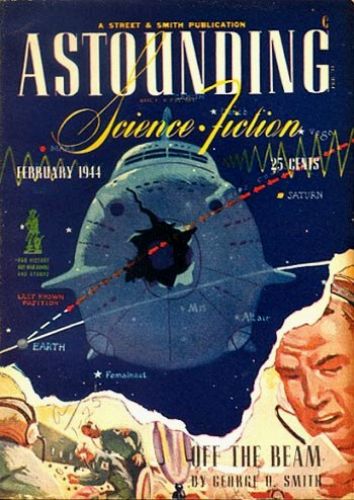
Astounding Science Fiction February 1944“Catch That Rabbit” is a short story by Isaac Asimov, which was first published in the February 1944 issue of Astounding Science Fiction and is therefore eligible for the 1945 Retro Hugos. The magazine version may be found online here. “Catch That Rabbit” has also been widely reprinted in I, Robot, The Complete Robot and other Asimov robot collections. This review will also be crossposted to Retro Science Fiction Reviews.

Warning: Spoilers beyond this point!

“Catch That Rabbit” is one of five stories Asimov wrote about Mike Donovan and Gregory Powell, a pair of troubleshooters in the employ of United States Robots and Mechanical Men Inc. “Catch That Rabbit” is also the last of the Powell and Donovan stories except for “First Law”, a 1956 “tale told in a bar” story that Asimov himself has called a spoof and the 1945 short story “Escape”, wherein Powell and Donovan work with and are upstaged by Dr. Susan Calvin.

In “Catch That Rabbit”, Powell and Donovan are tasked with field-testing DV-5, a robot of US Robots’ brand-new line of mining robots. What makes DV-5 – or “Dave”, as Powell and Donovan call him – special is that he controls six smaller robots via his positronic field. What’s a positronic field? Don’t ask, cause Powell and Donovan have no idea and neither does Asimov. However, the smaller robots are not independent, instead Powell and Donovan liken them to the fingers of a human body.

Dave passed all factory tests with flying colours. But when he is deployed on an asteroid for field tests, along with Gregory Powell and a grumbling Mike Donovan, Dave and his “fingers” sometimes fail to mine any ore at all. Worse, Dave can’t or won’t explain what the problem is. Instead, he claims he can’t remember what happened.

In my review of “The Big and the Little”, I said that many of Asimov’s early stories – both robot and Foundation stories – are structured like mysteries. But instead of figuring out whodunnit, the investigators are tasked with figuring out why a robot malfunctioned. “Catch That Rabbit” is an excellent example, because it is essentially a science fiction mystery with Powell and Donovan trying to figure out what the blazes is wrong with Dave.

Gradually, the clues pile up. For starters, Dave only malfunctions, when neither Powell nor Donovan are around. This, of course, makes it difficult to figure out what is wrong. Tests reveal no problem with Dave’s positronic brain. Questioning Dave doesn’t help either, because Dave claims amnesia, though Donovan at least is sceptical about the veracity of his claims. But then, Donovan is given to panic and wild speculations, whereas Powell is much more practical.

Gregory Powell comes up with the idea to install a kind of viewscreen, called “visiplate” in the story, so they can remotely watch what Dave and his subordinates are doing. And so one day while they are bickering (and Powell and Donovan bicker a lot), they spot Dave making his subordinates march up and down the mine tunnels in a military formation. Donovan worries that this might be a prelude to the robot revolution, but Powell assures him that this is impossible and uses the opportunity to remind Donovan and the reader of the Three Laws of Robotics.

When our dynamic duo heads out to the mining site, the robots promptly return to normal, once they detect the presence of Powell and Donovan. Worse, Dave once more claims to have no idea what happened. Since the robots only malfunction when no humans are present, Powell suspects that the reason for the problems may lie in Dave’s personal initiative circuit. Dave’s decision making facilities are overloaded, because there are no humans supervisors around to defer to.

Powell and Donovan finally decide to interview one of Dave’s subsidiaries. Unlike Dave, the subsidiary remembers what happened and reports that during difficult or potentially dangerous situations, he would receive an order from Dave, which would be immediately superceded by another, nonsensical order. However, the subsidiary has no idea what the original order was.

So our dynamic duo decides to figure out which specific order causes Dave to malfunction. There is only one problem. They cannot observe Dave and his subsidiaries directly, because Dave only malfunctions when there are no humans around. And because Dave communicates with his subsidiaries via a positronic field, they cannot intercept his orders either. Therefore, Powell and Donovan agree to take turns watching Dave and his subsidiaries via the visiplate.

For the next eight days, Powell and Donovan keep the robots under continuous supervision. But while there are malfunctions, neither of them can tell what causes them. For the image on the visiplate is too small and too blurry to make out clearly what Dave and his subsidiaries are doing. Our dynamic duo needs to take a closer look at the robots, preferably at the exact moment a malfunction occurs. Luckily, Donovan has a plan for causing Dave to malfunction deliberately.

For by now Donovan has figured out what at least this reader had already figured out a few pages ago, namely that Dave only malfunctions in particularly difficult or potentially dangerous situations such as when the robots are laying explosives or there is a cave-in. Donovan now suggests deliberately provoking a dangerous situation and causing Dave to malfunction.

So our dynamic duo put on their spacesuits and head out into the mine to cause a small cave-in. However, they miscalculate and manage bring down the roof upon themselves rather than upon an empty section of mine tunnel. Now Powell and Donovan are trapped, their oxygen is limited and the only help – Dave and his subsidiaries – have malfunctioned once again and are performing a bizarre ballet in the mine. If you’re thinking at this point that Powell and Donovan are idiots, you’re not alone.

Donovan points out that if they can get close enough to Dave that he detects them, the robot will function normally again and can dig them out. And luckily, Dave and his chorus line of subsidiaries move right into the direction of our dynamic duo, only to turn around right before they get close enough to detect the two men. Donovan hollers to attract Dave’s attention, only to be reminded by Powell that he’s wearing a spacesuit and they’re on an airless asteroid, so how the hell should Dave hear him? Okay, so Mike Donovan really is an idiot.

However, Gregory Powell has an idea that might just save them. He draws his blaster, aims through a convenient hole in the rubble and shoots one of Dave’s subsidiaries. And guess what? Dave immediately snaps back to normal and proceeds to rescue the dynamic duo.

Donovan begs his partner to explain what just happened and Powell – being a protagonist in a hard science fiction story published in Astounding – is of course only too willing to oblige. After all, they already knew that the problem lies with Dave’s personal initiative circuit and that the malfunctions only occurs in difficult or dangerous situation, which require Dave to use a lot of personal initiative. Powell now deduced that Dave’s decision making facilities were overloaded with controlling six subsidiaries. He could manage the six subsidiaries in ordinary situations, when some of them were engaged in routine tasks which require little to no supervision. But in emergencies, when Dave must make decisions for and give orders to all six subsidiaries, he freezes up and malfunctions. Powell shooting one of the subsidiaries lightened the decision load on Dave and turned him back to normal.

“But why…” Donovan wants to know, “…did Dave make his subsidiaries perform those marches and dances?” “Well, that’s obvious”, Powell replies. After all, the subsidiaries are Dave’s fingers and when unsure what to do, Dave simply twiddled his fingers.

As a solution to a science fiction mystery, Powell’s explanation is weak. Of course, it makes sense that Dave’s malfunctions are caused by the cognitive demands of controlling his subsidiaries and in fact, I suspected that the subsidiaries were the cause of the malfunctions long before Powell and Donovan did. But how could Powell possibly know that the correct number of subsidiaries was five rather than three or four (beyond the fact that human hands usually have five fingers)? And how will US Robots – whose motto is “No employee makes the same mistake twice – he’s [Asimov’s pronoun choice, not mine] fired the first time” – react to react to Powell shooting what is presumably a very expensive prototype robot? Especially since keeping one subsidiary behind at the base and checking if the malfunctions still occur would have been a much more cost effective and less risky way to test the hypothesis. Okay, so getting trapped by the cave-in forced Powell’s hand, but the only reason Powell and Donovan got trapped by the cave-in in the first place is because they’re idiots. So is this the true reason why appearances of Powell and Donovan became scarce after this story? Because US Robots and Mechanical Men Inc. finally fired those two idiots?

I, Robot by Isaac Asimov

Powell and Donovan being idiots on the cover of the paperback edition of “I, Robot”

Isaac Asimov would eventually go on to become a fine mystery author and he was clearly already interested in the mystery form at this early point in his career. But – as I also pointed out in my review of “The Big and the Little” – he wasn’t yet very good at writing mysteries. Unlike in “The Big and the Little”, Asimov does at least give the reader all the information they need to solve the mystery and indeed, I solved it before Powell and Donovan did. Even the groanworthy “finger” pun at the end was set up from the beginning, as the subsidiary robots are referred to as “fingers” throughout the story. Indeed, the main problem with “Catch That Rabbit” is not that the clues are set up badly, but that the investigators are too stupid to interpret those clues.

As a teenager, I read my way through pretty much Asimov’s entire science fiction oeuvre. The stories and novels impressed me deeply and I find that I often have pretty clear memories of these stories even thirty years later. However, when rereading Asimov’s stories for the Retro Hugos and for Retro Reviews, I find that I have comparatively few memories of the Powell and Donovan stories. Maybe that’s because Powell and Donovan simply aren’t very memorable compared to Susan Calvin or Elijah Baley and R. Daneel Olivaw.

That said, the two troubleshooters do have distinct personalities. Mike Donovan complains a lot, is given to outbursts of temper (at one point, he even smashes the visiplate) and blind panic. Gregory Powell is calmer and the more rational of the two. As always with Isaac Asimov, we are only given very sparse descriptions of our two protagonists, though Donovan is repeatedly described as red-haired. Red hair and a volatile temper are of course common stereotypes about the Irish, something which went completely over my head, when I first read this story as a teen.

As for Gregory Powell, the only physical descriptions we ever get of him is that he is older than Donovan and has a moustache which he fingers a lot (and one point tries to finger, only to realise that he is wearing a spacesuit). However, my teen self was absolutely convinced that Gregory Powell was a black man. Even now, when rereading the story, I still picture Powell as black, though his skin colour is not mentioned either in this nor in any other story featuring Powell and Donovan and the interior artist portrays both men as white (but then pulp artists routinely portrayed even unambiguous characters of colour like Eric John Stark as white). I have no idea why I imagined Powell as black, though I suspect that when I first read the stories, I mainly associated the name Gregory with actor and singer Gregory Hines, who was indeed black and had a moustache. So sorry, no diversity points for Asimov, because Gregory Powell is only black in my mind, not on the page.

While on the subject of diversity, once again there are no female characters in this story at all. Even the robot is referred to by a male name and masculine pronouns. And indeed, in the three science fiction stories Asimov published in 1944, there are only two female characters, one of which has neither a name nor any lines, while the other is a strictly secondary character. The stereotype that golden age stories are all about white male characters doing heroic things in space is not necessarily true, not even if you look only at Asimov’s oeuvre – after all, Asimov also created Susan Calvin, Bayta and Arkady Darell, Jessie Baley and Gladia Delmarre during this period. But it is absolutely true for his 1944 output. Though the lack of female characters in “Catch That Rabbit” grates less than in “The Wedge” or “The Big and the Little”, because “Catch That Rabbit” only has two human characters.

In my review of “The Big and the Little”, I noted that the story contained some homoerotic vibes that went completely over my head, when I first read it as a teenager. Considering that the protagonists of “Catch That Rabbit” are a two-man team of troubleshooters, are there similar vibes between Powell and Donovan? Well, I didn’t notice any, but then Powell and Donovan are way too busy to take turns watching Dave to get down to more interesting business such as nude sunbathing and cigar smoking. However, when I checked out the other Powell and Donovan stories, I didn’t notice any overt homoerotic vibes there either. The closest any of the stories comes is when Powell suggests to Donovan that they go to bed – no mention of how many beds there are. However, I’m pretty sure that if you want to read about Powell and Donovan doing more exciting things than spouting technobabble, AO3 has you covered.

The Complete Robot by Isaac Asimov

This UK edition of The Complete Robot with a striking Chris Foss cover is where I first read this story.

Considering that “Catch That Rabbit” is comparatively long – I suspect it lies at the upper edge of the short story range – there isn’t a whole lot of plot. Nor is there a whole lot of action. Clues are doled out, there are two interviews – one with Dave and one with one of his subsidiaries – and there is the climactic cave-in. But most of the story’s nineteen pages (in the magazine version) are taken up by Powell and Donovan talking and bickering. Now Asimov was never much of a stylist and the dialogue he gives his two protagonists sounds like nothing anybody ever said either in 1944 nor in the future where the story is set (which should be around 2020, come to think of it). But even though the dialogue in “Catch That Rabbit” feels about as natural as the dialogue in a Silver Age Marvel comic, i.e. not very, it is nonetheless snappy and zips along. I had fun reading this story, even if not much actually happens and the protagonists are idiots besides.

Isaac Asimov is not normally a writer associated with humorous science fiction. Nonetheless, at least at this early point in his career, Asimov did write funny stories. And while “Catch That Rabbit” is not nearly as funny as “Victory Unintentional” and “Robot AL-76 Goes Astray” – both of which sadly failed to make the 1943 Retro Hugo ballot, even though they were better than the Asimov story which did make the ballot – it is nevertheless an example of the lighter side of Asimov’s work. Even the title – a reference to the saying “If you want to make rabbit stew, you must first catch a rabbit” – would have brought Bugs Bunny to mind more than anything else in 1944, for Bugs thwarted four would-be makers of rabbit stew that year alone.

Most of the humour comes from our heroes bickering, though we also get moments such as Donovan enjoying “a non-too-nutritious diet of fingernail” or an anecdote about Powell jumping out of the window of a burning house with nothing but a pair of shorts and the Handbook of Robotics – and if necessary, he would have foregone the shorts (sadly, Asimov never wrote that particular story). And yes, Powell is certainly aware that Donovan is an idiot and I’m pretty sure that Asimov is aware that both his protagonists are idiots.

Asimov is also poking fun at the conventions of what passed for hard science fiction in the 1940s in general and at the sort of stories published by John W. Campbell in Astounding Science Fiction with their endless infodumps (see Steve J. Wright’s review of Cleve Cartmill’s “Deadline” for a prime example) and “As you know, Bob…” dialogue in particular. For example, Asimov unmasks the “positronic field” via which Dave controls his subsidiaries as the technobabble it is by having Powell state that there isn’t a roboticist at US Robots who knows what a positronic field is or how it works and neither do Powel and Donovan. All that matters is that it does work. As for the competent men that Campbell wanted as protagonists for the stories he published, Gregory Powell and Mike Donovan are many things, but competent is not one of them.

At this early point in his career, Asimov wasn’t yet skilled enough to avoid “As You Know, Bob…” dialogue altogether, but he at least tried to use it in interesting ways. And so a painfully clumsy “As you know, Bob – pardon, Jain…” conversation on Seldon crises in “The Big and the Little” actually turns out to be an important clue to the central mystery, because it reveals that a character is not who he claims to be or he wouldn’t have needed a primer on what a Seldon crisis is. And in “Catch That Rabbit”, Asimov points out how ridiculous characters telling each other things they should both already know really is by having Donovan interrupt Powell’s “As you know, Mike…” monologue with “I know that”, whereupon Powell shushes him with, “Shut up! I know that you know that, but I’m just describing the hell of it”.

I will always have a soft spot for Isaac Asimov, because his work was pretty much the first serious adult science fiction I discovered – all earlier science fiction reads were YA, Star Wars novelisations and some Anne McCaffrey. However, rereading some of those old Asimov stories for the Retro Hugos, I also realise that they hold up better for me than many other books I read around the same time.

“Catch That Rabbit” is not a particularly good story. It’s not even the best Asimov story of 1944, for “The Wedge” is better. However, “Catch That Rabbit” is the story I enjoyed reading the most and the one that has suffered the least from a visit by the suck fairy, maybe because even my teenaged self realised that Powell and Donovan were bumblers and idiots and pretty much the science fiction equivalent of Laurel and Hardy.


Posted in Books, Retro Reviews | Tagged , , , , , , , , , | Leave a comment

Indie Speculative Fiction of the Month for January 2020

Indie Speculative Fiction of the Month
It’s that time of the month again, time for “Indie Speculative Fiction of the Month”.

So what is “Indie Speculative Fiction of the Month”? It’s a round-up of speculative fiction by indie authors newly published this month, though some December books I missed the last time around snuck in as well. The books are arranged in alphabetical order by author. So far, most links only go to Amazon.com, though I may add other retailers for future editions.

Once again, we have new releases covering the whole broad spectrum of speculative fiction. This month, we have epic fantasy, urban fantasy, sword and sorcery, paranormal mystery, science fantasy, fantasy romance, science fiction romance, space opera, military science fiction, dystopian fiction, Cyberpunk, Hopepunk, Steampunk, aliens, angels, dragons, shifters, superheroes, pirates, ghosts, druids, fae, crime-busting witches, supernatural serial killers, alien mating rituals, planet killers, space marines, living swords, life after death and much more.

Don’t forget that Indie Speculative Fiction of the Month is also crossposted to the Speculative Fiction Showcase, a group blog run by Jessica Rydill and myself, which features new release spotlights, guest posts, interviews and link round-ups regarding all things speculative fiction several times per week.

As always, I know the authors at least vaguely, but I haven’t read all of the books, so Caveat emptor.

And now on to the books without further ado:

Strange Love by Ann AguirreStrange Love by Ann Aguirre:

He’s awkward. He’s adorable. He’s alien as hell.
Zylar of Kith B’alak is a four-time loser in the annual Choosing. If he fails to find a nest guardian this time, he’ll lose his chance to have a mate for all time. Desperation drives him to try a matching service but due to a freak solar flare and a severely malfunctioning ship AI, things go way off course. This ‘human being’ is not the Tiralan match he was looking for.

She’s frazzled. She’s fierce. She’s from St. Louis.
Beryl Bowman’s mother always said she’d never get married. She should have added a rider about the husband being human. Who would have ever thought that working at the Sunshine Angel daycare center would offer such interstellar prestige? She doesn’t know what the hell’s going on, but a new life awaits on Barath Colony, where she can have any alien bachelor she wants.

They agree to join the Choosing together, but love is about to get seriously strange.

Magic Lies by Fatima BaderMagic Lies by Fatima Bader:

Hunting a serial killer can be hazardous to your health.

My name’s Selena Valeron, and I’m the Supernatural Bureau of Investigation’s best undercover witch. After three years, the bureau has just handed me my biggest case: hunting the magical community’s most prolific serial killer, Xavier.

Lately the dead women on the morgue table bear an eerie resemblance to me. A shocking revelation indicates the killer is someone from my past—if I can remember it. Years ago, an accident wiped out my memory and threatened to end my career. Now my magical powers seem to be manifesting into something stronger.

Was my memory loss really an accident, or a failed murder attempt?

Time’s ticking as I dig through my past to find the killer. I need answers. If I can’t get them in time, I’ll lose friends, family—even my own life.

MAGIC LIES is a fast-paced urban fantasy mystery with plenty of thrilling twists and turns that will keep you guessing. Agent Valeron may have lost her memory, but she hasn’t lost her snarky attitude and she’s still a badass witch. Jump into this magical world and start reading the Selena Valeron series today!

King of the Republic by P.J. BermanKing of the Republic by P.J. Berman:

Queen Silrith has fallen. Now she must rise again. However, when her army lands in Etrovansia in search of reinforcements and political support, their welcome is far from warm. Their retreat from one war could start another.

Ezrina, a vengeful Hentani priestess, feels the weight of expectation placed on her by her tribe. Without Jezna by her side, her headship is a lonely one. Will the arrival of strange new allies prove a welcome help or complicate matters further?

Zethun, an ambitious young politician, rides a wave of public support amid the passion of revolution. Now he must restore order before the mob descends into anarchy.

All three rebels stand on the precipice of their defining moments. There is no going back now.

Meanwhile, the tyrannical usurper, King Jostan, brings new violence to the Verusantian reign of terror over Bennvika.

Planet Killer by Lindsay BurokerPlanet Killer by Lindsay Buroker:

Casmir has survived against impossible odds, and now he longs to return home. But an invasion force is blockading the Kingdom’s wormhole gate, and it would be suicidal to fly through it now. Worse, his family and friends are stuck on the other side, with hostile forces attacking their home world.The only way Casmir can help is to find out who’s behind the invasion… and convince him to stop. But Casmir isn’t known for his ability to strong-arm people, and this is one enemy who won’t be won over by his friendly demeanor. As he soon finds out, he must face the very rich and very powerful person who’s been trying to have him killed for months.

Firebird's Lair by Rachel FordFirebird’s Lair by Rachel Ford:

A mysterious warlock. A ruthless band of wyvern poachers. A marriage neither of them wants.

Tsar Kirill’s only daughter is ailing. Poachers and robbers plague his kingdom. He doesn’t want a wife. Especially not that one.

Tsarevna Yuliana has a home already. She doesn’t want to leave everything she’s known, the seaside that she grew up by, to start a new life in a strange land. Especially not with him.

But Tsar Fyodor, his ally and her father, has other plans. He wants to forge an empire. And empire building by marriage is so much less taxing than empire building by war.

Or so he thinks.

First at odds, Yuliana and Kirill unite to outwit Fyodor and save themselves from his machinations. But as a mysterious sorcerer and a dangerous band of wyvern poachers threaten the future of both kingdoms, the two must risk everything – including their hearts – to save the hard-won peace.

A humorous fantasy novel, full of lovable characters, dangerous villains, and laugh-out-loud moments.

Osmium War by Thomas GreenOsmium War by Thomas Green:

He betrayed her. Her revenge will shake their worlds.

Captain John Lang has devoted his life to his duty. Raised as a child soldier, he has never known another life.

And since the cold war between Earth and Mars has been going on for over two centuries, he never will.

To save his lover, Raina, from the same fate, he sent her to Earth.

But things didn’t go for Raina the way John expected them to. Wearing an artificial face, she works as a corporate assassin for the Earth’s largest weapons manufacturing syndicate.

On Earth, she’s an escaped prisoner while on Mars, she’s officially dead. And has neither forgiven nor forgotten.

So, when Earth bans deep core mining, creating a system-wide osmium shortage, she seizes the opportunity and escalates the crisis.

For if she manages to make Earth and Mars go to war, they are sure to destroy each other. And her syndicate would then rule over the wasteland.

After all, she could have no better revenge than for John and all his soldier brothers to die in a nuclear apocalypse.

Ever the Hero by Darby HarnEver the Hero by Darby Harn:

Superheroes are big business. Imagine not being able to afford them.

Kit Baldwin just wants to make rent. The only work she can find in the ruins of her devastated city is scavenging for alien technology. When she finds a powerful alien weapon, her discovery pays off more than she could have hoped: it draws the attention of the most powerful of the superhuman Empowered, Valene.

Valene hears everything, everywhere. She suffers for it, and as they begin a precipitous romance, Kit believes she can use the weapon she’s scavenged to mitigate Valene’s pain. If she can’t, Valene will retreat to the soundlessness of space. Without Valene’s compassion, the stricken city is left to the mercy of Valene’s ruthless father, who denies the assistance the city needs unless it can pay for it.

As Valene’s condition worsens, Kit becomes more desperate and unleashes the full power of the alien weapon. In an instant, she is transformed into a being of cosmic power. She can acquire the knowledge and energy of anything – or anyone – she touches.

Ghostly Charms by Lilly Harper HartGhostly Charms by Lilly Harper Hart:

Harper Harlow thought the only thing she was going to have to worry about in the shadow of spring was planning her wedding. She was wrong.A string of break-ins in Whisper Cove have caught the attention of the cops, including her fiancé Jared Monroe. Things take a turn for the worse when one of those break-ins results in the death of a local barber. It seems what was once written off as teenage hijinks is something else entirely. In addition to the break-ins, Harper finds herself distracted by a new resident. He’s bringing an art gallery to town … as well as his troubled sister. Rain Porter doesn’t want to be in Southeastern Michigan and she’s hiding a big secret. Harper is determined to help the girl until the young woman pushes the exact wrong buttons. Things aren’t what they seem and the deeper Harper digs the more she worries that she doesn’t really want to find an answer. When a ghost from the other side of the state shows up and starts invading her dreams, things go from bad to worse. Jared wants nothing more than to protect Harper, but there are some things he can’t fight … and a ghost is one of them. It’s going to take everyone working together to find a way out of this one and even then survival is not a given. Jump on the ghost train with Harper, Jared, and Zander … because this one is going to be a wild ride.

Mother Savant by A.L. HawkeMother Savant by A.L. Hawke:

It is now 2244 and the all-female society of Arkite is on the brink of revolution. Only the return of the Mother Savant can hope to maintain order.

Savant Elise Jackson, Arkite’s supreme leader, is stricken with terrible grief over the recent loss of her lover. She has spent the last two years with her assistant, Sara, trying to repair and genetically engineer her lover’s damaged body and mind.

But the Viceroy of Pyramid City and her followers in the Savant Council have no interest in squandering the city’s resources for Elise’s personal gain. With the help of the mainframe AI, they will vie for power, even attempting collusion with Sara and sabotage.

And even if her enemies fail and Elise somehow manages to revive her lover, Elise knows she’ll have to vie for something she covets even more—her lover’s love. For Sara once loved her just as much, if not more.

Mother Savant is the sequel to Candy Savant—Book 2 in the Candy Savant Series.

The Living Sword 2: The Road Ahead by Pemry JanesThe Living Sword 2: The Road Ahead by Pemry Janes:

Eurik & Leraine have escaped the land of the necromancers, but still face a long journey. Eurik is looking for answers about who his parents were and how they ended up adrift at sea. Leraine must carry the news of her teacher’s death back home, yet also has a debt to Eurik for helping her to avenge Irelith.

Together, they’ll have to traverse the Neisham Hills, where lone travelers are snatched in the night and even numbers don’t guarantee safety. And beyond the hills, all along the long Inza Road, the drums of war beat louder and louder.

But the greatest threat may not be goblins, elves, or bandits. It may be the people they’ve chosen to travel with.

Trinary by Gaja J. KosTrinary by Gaja J. Kos:

Cairo MacKennon doesn’t give a shit about rules, save for one. Avoid SCAR Force at all costs.

When a high-end heist goes south and not even the best stealth ship in the Vedrina trinary system can keep her off SCAR Force’s radar, Cairo’s thieving ways become the least of her problems.

The Space Combat and Retrieval Force doesn’t forget past sins.

And what they have in mind for Cairo’s transgression beats even her worst nightmare.

Scroll up and start reading the first episode in the action-packed sci-fi serial with a slow-burn romance, daring pilots, and space ships galore!

Halfax by Joseph R. LalloHalfax by Joseph R. Lallo:

If you can’t have good luck, you should at least have a good dragon.

The princess has inherited the family curse. Plagued by terrible luck, it is all the palace staff can do to keep her safe from herself. When her father pricks himself with an assassin’s needle meant for her, her mother Queen Jade knows there is only one thing they can do. They must seek a cure. To reach it, they will need the help of their greatest protector. But even the great dragon Halfax may not be ready for the challenges ahead.

Halfax is a direct sequel to Jade. It takes place many years after the events of the Book of Deacon series.

Hex Type Thing by Amanda M. LeeHex Type Thing by Amanda M. Lee:

Hadley Hunter is feeling on top of the world.

She’s embracing her new home on Moonstone Bay and coming into her own as a witch. Her boyfriend Galen Blackwood, who happens to be sheriff, is even involving her in his investigations.

Unfortunately, the peace on Moonstone Bay is about to be threatened.

A local millionaire and a one-hit-wonder songstress are hosting the Skyclad Festival, a paranormal beach extravaganza that features a bevy of famous faces in paranormal circles … and those who want to hobnob with them. There’s only one little problem ….

One of the local influencers, a woman whose only job is to rave about things on the internet, ends up dead. Then, in short order, the organizer himself goes missing. That means Galen is on the case … and Hadley insists on serving as his sidekick.

There are a lot of witches on the island. The question is: Is magic to blame for murder or is something more insidious happening?

It’s going to take everyone working together to find the correct answers – and keep each other safe – as the problem on the beach deteriorates.

Someone has murder on the mind and Hadley is determined to find the culprit. All she has to do is survive long enough to uncover a mystery that has roots in a past long since forgotten … well, and not step on the wrong witchy toes.

The odds of doing both seem long but where there’s a witch, there’s a way.

Druid Vices and a Vodka by Annette MarieDruid Vices and a Vodka by Annette Marie:

I’ve said it before, but sometimes I’m a bad person. I cheated on my twelfth grade math final, I’ve run countless yellow lights, and I gossip about how hot my kickass best friends are. (Good thing my job as a guild bartender doesn’t require moral perfection.)

But there’s bad, and then there’s bad. And I’m not sure which applies to a certain dark druid/wanted criminal/reluctant friend of mine. His transgressions include black-magic dealings, kidnapping, and murder, and he’s about to add “revenge-fueled killing spree” to his resume—if I don’t stop him.

Should I stop him?

He and his nemesis are gearing up to tear each other apart, rogues and vultures are converging with their sights on the spoils, and the guilds that would normally stomp them into the ground are under attack. We’re on the verge of an all-out criminal turf war, and my time to decide is almost up.

Who’s the real bad guy … and do I dare stand in his way?

Sky Scorcher by Harlan J. MeadeSky Scorcher by Harlan J. Meade:

James Blackwin and his body guard, Misty, are appointed to provide security for the King’s Ball, but their plans are soon disrupted after Misty has a dangerous encounter with a mysterious man with ill intentions. Join James and his crew on board his flying airship as he attempts to defeat pirates, recover stolen plans, and save his friend. Will he prevail or will the obstacles he must face be more than he can handle?


Fallen Reign by Nazri NoorFallen Reign by Nazri Noor:

Half human, half angel, 100% pissed off.

Mason Albrecht’s life changed the day the angels tried to kill him. As the son of a fallen angel king, Mason is an abomination, one who can command the Vestments, divine arms and armor summoned from heaven’s own arsenals. And everybody wants a piece: death witches, demon princes, even deities of ancient myth.

Then an enterprising enchantress offers to cloak Mason from those who would corrupt him into a living weapon. But will Mason run from supernatural entities forever, or embrace his unholy birthright and defy the very forces of heaven and hell?

Sins of the Father is a new adventure series from Nazri Noor, bestselling urban fantasy author of the Darkling Mage series. Follow Mason’s first steps in Fallen Reign, a humorous, high-impact supernatural suspense story filled with magic, mythology, and plenty of mayhem.

The Last Mystic by Susan Kaye QuinnThe Last Mystic by Susan Kaye Quinn:

What if you knew there was life after death?

Eli is back from the dead… and determined to stop the powerful ascenders who blasted him out to the void. But in the three days he was gone, the world moved on. The girl he loves is determined to build an army of augmented humans to fight the ascenders—with herself as the next Offering. The ascenders are lining up in a death cult based on the charismatic ascender Eli accidentally released from storage—and all the restraints that have kept the ascender world in balance are now off. Everyone is rushing to be the first to bring a Second Singularity—to reach the numinous world from which Eli just returned—regardless of the cost. And the chaos and bloodshed of the first Singularity show just how high that cost can be. How can he stop the world from hurtling off the cliff when he’s the one who proved there’s something to reach, if only you could learn how to fly?

The Last Mystic is the thrilling conclusion to the Singularity series. This philosophical, HopePunk sci-fi series explores the intersection of mind, body, and soul in a post-Singularity

Price of Imperium by Dave RobinsonPrice of Imerpium by Dave Robinson:

The Imperium is on the brink of annihilation, and only one person can save it.

After centuries of peace, the Enemy has returned, and the only one who can unlock the Imperium’s last line of defense is the rightful emperor. Unfortunately, the throne has been empty for a decade.

The sole remaining heir is rumored to be on a backwater planet where no one has heard of the Imperium. Can he be found before the Imperial system is dissolved and the ships of the Imperial Guard are sent to the Wreckers?

Tam’s a destroyer skipper who’s been passed over for promotion one too many times. He’s on a routine mission in his last command.

Meanwhile, on Earth, a homeless man dreams of the stars. John doesn’t know who he is, or where he’s from. He just knows someone will come looking for him and he needs to be found.

Jayne is a woman who works at a homeless shelter in Seattle and finds herself a long way from home.

Who among them will be willing to pay the Price of Imperium?

Alarik by Aurora SpringerAlarik by Aurora Springer:

Two people fleeing their planets discover a shared destiny.

When an alien spacecraft crashes on Mars, the repercussions sweep throughout the solar system and endanger the fragile new alliance with the Warrish mermen.

Alarik Kenton Tallis, Eldest of three brothers, was forced to infiltrate human society on Earth as a spy to insure his injured brother receives proper medical care. But, when his transmissions are detected, he must flee the planet.

On Mars, Phoebe Wong, a veterinary scientist with dubious family connections, is desperate to escape the underworld gangs terrorizing the domed city. She jumps at the chance to join the colonists bound for a distant exoplanet.

Their paths converge on a space ferry bound for the outer planets. Troubles created by the mysterious spacecraft pursue them to Jupiter. Will their flight end on Europa, the hyperspace gateway to the stars protected by three diverse species?

Shifters and Sabotage by Lily WebbShifters and Sabotage by Lily Webb:

All’s fair in love and roar…

Zoe Clarke’s life is changing shape. After solving a litter of paranormal mysteries, Zoe’s ready to slow down and focus on domestics with her new live-in shifter boyfriend, Beau.

But someone in Moon Grove is eaten up with jealousy about their relationship — as Zoe learns from the series of disturbing anonymous letters addressed to Beau in their mailbox. So when Zoe finds Beau trapped in his golden retriever form, it’s up to her to sniff out what happened.

From his obsessive co-workers to the secretive community of shifters surrounding him, Zoe’s convinced the attacker is someone in Beau’s pack — until another prominent shifter is found locked in their animal form.

Can Zoe track down the culprit and reverse the shifter curse? Or will the attacker take a bite out of her too?

Shifters and Sabotage is the seventh book in the Magic and Mystery series of witch cozy mysteries. If you like shady shifters, raving reporters, and magical murder mysteries, then you’ll love this lighthearted seventh entry in Lily Webb’s spellbinding series.

Steel City, Veiled Kingdom by Danielle WilliamsSteel City, Veiled Kingdom: The Complete Edition by Danielle Williams:

Jerimin Icarii’s life is in shambles. Once an ambitious young scientist, years of hardship on the streets of his homeworld have transformed him into a desperate man, willing to do anything to get his life back.

In his darkest hour, he strikes a deal with the bizarre Queen of the faerie world. Now her supernatural powers help him keep up appearances while he claws his way back into society. The longer he keeps up the charade, the closer he gets to respect, wealth, and glory. But one slipup will get him killed.

And that’s not even the dangerous part. Because the cost of the Queen’s aid is obedience to her every whim. And Jerimin never knows what she’ll make him do next…

Steel City, Veiled Kingdom is a science fantasy overflowing with intrigue, adventure, and colorful characters you’ll love (and a few you’ll love to hate). It’s the perfect story for any sci-fi/fantasy lover looking for an immersive, inventive read.

Steel City, Veiled Kingdom: The Complete Edition presents the entire story as it was originally envisioned–as a single, complete, epic-length novel. The Complete Edition is only available in digital format at this time. However, all 5 parts of the story are offered as individual volumes in both digital and paperback and are listed here:

Posted in Books, Speculative Fiction of the Month | Tagged , , , , , , , , , , , , , , , , , , , , , , | Leave a comment