
The good folks over at DriveThruFiction are running a Bloody Valentine sale this weekend and offer 25% off e-books that fall under the “dark romance” umbrella.
Lots of good stories on offer, including a couple of mine.
The good folks over at DriveThruFiction are running a Bloody Valentine sale this weekend and offer 25% off e-books that fall under the “dark romance” umbrella.
Lots of good stories on offer, including a couple of mine.
The Maischberger talkshow featuring two raging homophobes debating whether the fact that GLBTQI people exist should be included in school curricula that I mentioned in yesterday’s post is now available online at the ARD Mediathek. Alas, it’s 75 minutes long, only in German and only for strong stomachs. Here’s also a commentary by the media magazine Zapp, which IMO is a lot more worth watching than the Maischberger show, but then I have been an enthusiastic Zapp viewer for years. Meanwhile, Matthias Mattusek, very Catholic (in a totally retro Mel Gibson way) and very conservative German journalist, is happy to be a homophobe. Meanwhile, I’d be very happy if the Mattuseks of the world would just vanish into the ether.
Meanwhile, the SFWA debate seems to have turned into a debate about American politics in general and particularly the Republican – Democrat divide. Chris Gerrib draws parallels between the SFWA debate and the resistance of US Republicans against taxes, even as Republican majority constituencies overwhelmingly profit from tax dollars , whereas many majority Democrat constituencies are net payers. Found via Jay Lake.
Interestingly, we have this mechanism as well here in Germany, even though the political landscape looks vastly different. And hence some conservative South German states were only too happy to take tax money from the more left-leaning North German and city states, when they were poor, but balk against paying taxes to subsidise the poorer city states now, even though the reversal of financial fortunes was largely due to tax law changes in the 1970s which disadvantaged the city states.
Meanwhile, on the far end of the political spectrum, the inevitable Vox Day also weighs in with the by now well-known complaints about how he and his were purged from the SFWA (nope, they only purged Vox Day for violating statutes). He also links to a post by Sarah Hoyt, which predates the current SFWA uproar and refers to the post-binary gender discussion instead (she is against it, as might be expected). Oh yes, and she thinks that Orson Scott Card is not rightwing, which is mindboggling. Obligatory warning: Don’t click if either writer or their political views bother you, though this is one of Vox Day’s less offensive posts.
It’s the usual stuff about evil feminists and Communist straw editors trying to drive rightwing writers out of the SFF genre, but what I found interesting is Vox Day’s “threat” that rightwing SFF writers would find little reason to join SFWA, which curiously echoes Ilona Andrews’ post that woman writers, particularly those working in genres like urban fantasy or paranormal romance, find little cause to join SFWA. Even though both writers are about as far from each other as two (or three, since Ilona Andrews is a husband and wife writing team) people can be.
Vox Day also makes another point, namely that rightwing writers can just go indie and leave the whole traditional publishing system which is hostile to their political views behind. Now he does have a point that there seems to be an underserved audience for conservative and rightwing SF out there, since I frequently see such works by indie writers on the SF subgenre bestseller lists at Amazon.
Now I have absolutely no problem with writers whose work didn’t fit the paradigms of traditional publishing going indie and finding audiences hungry for whatever they write. And many of those writers are lovely people, though I disagree with their politics.
However, it annoys me when indie publishing gets equated with rightwing tea-partiers, which happens with increasing frequency. Take John Green’s anti self-publishing rant from last summer, which famously ended with the words “Fuck Ayn Rand”.
There are many people for whom traditional publishing was not a good fit and many of them are politically far away from Ayn Rand and her ilk. Indie publishing has also been a boon to writers of colour, international writers, GLBTQI writers, writers of unfashionable genres and all those whose work just doesn’t fit into the narrow paradigms of traditional publishing. So please, don’t lump us all in with Ayn Rand and the tea party, because many of us are about as far away from them politically as Vox Day and Sarah Hoyt are from Sahra Wagenknecht.
For those confused about the title, Menschen bei Maischberger is a German TV talkshow where several guests talk about “current affairs” (which can mean anything from actual political issues to the dangers of New Age culture). In yesterday’s edition of the show, Ms. Maischberger felt the need to debate whether the fact that GLBTQI people exist is an appropriate subject for schools (because some people are having a freak-out about a state initiative to include GLBTQI topics in the curriculum) and invited two raging homophobes, a gay politician, a drag queen (and yes, “drag queen” is the correct term, because that’s how Olivia Jones defines herself) and a heterosexual chick lit writer. More here, here and here. The result was mindbogglingly offensive, as I found out when I opened Twitter, noticed that #Maischberger was the top-trending hashtag and clicked to see what people were saying. As far as I could tell, Menschen bei Maischberger had apparently turned into a hotbed of raging homophobia, so I switched on the TV and Oh, my God… it was even worse than I thought.
Which brings me to this comment by John Scalzi, which perfectly illustrates my feelings while watching the Maischberger show. Since I’m pretty sure that John Scalzi has not been watching Menschen bei Maischberger (especially since the episode in question is not yet available online), Scalzi’s Tweet can only refer to one thing, namely the ongoing SFWA drama.
First of all, S.L. Huang reminds us why the whole SFWA issue blew up in the first place. It was not because of the cheesy Red Sonja cover of the SFWA Bulletin or Barry Malzberg and Mike Resnick showing more interest in the bikini curves of a female editor than in her professional life or because someone felt the need to extoll the quiet dignity of Barbie, but because Resnick and Malzberg felt the need to compare those who criticized their column to Stalin and Mao. For those who need a refresher, S.L. Huang has also compiled a handy timeline of the controversy(ies).
Black Gate and Amazing Stories also both offer a summary of the controversy.
At C.C. Finlay’s Facebook page, Ilona Gordon, one half of the Ilona Andrews writing duo, explains why she refuses to join SFWA, namely because she feels disrespected by the organisation both as a woman and a writer of urban fantasy with romantic elements. This is a very important point, because it illustrates how SFWA is viewed by many writers.
Silvia Moreno-Garcia points out that whatever one thinks of Red Sonja covers and Resnick and Malzberg reminiscing about the good old days, this sort of content does not belong in the official magazine of a professional writers’ organisation and also offers the membership magazines of other writing organisations for comparison. Meanwhile, Jim C. Hines has taken it upon himself to launch a (not entirely serious) petition to Terry McLaughlin, president of the RWA, to include more mantitty on the covers of the Romance Writers Report, while Larry Nolan offers a parody of the “cover letter” of the petition at The OF Blog.
At The World in the Satin Bag, Shaun Duke wonders how e.g. SFWA’s many Mormon members would feel if the SFWA were to carry an article insulting their religion, while Ferrett Steinmetz detects a generation gap in the reaction to the SFWA uproar, as evidenced by the fact that most of the signatories of the petition are older writers. Indeed, one thing that struck me about the original uproar was for how many people, particularly but not exclusively older fans and writers, Mike Resnick and Barry Malzberg were cultural touchstones and therefore somehow inviolable.
And because some people apparently still don’t get it, ysabetwordsmith takes it upon herself to explain the difference between editing and censorship, while Andrew Barton points out that writers of all people should know the difference. For the POV of supporters of unlimited free speech, Steven Brust does not agree with the petition, but does worry about suppression of free speech, while Will Shetterly is mainly annoyed about being banned at Radish Reviews. Now I have never banned anybody from commenting here (including Mr. Shetterly, who occasionally comments here), though I did have to delete rude comments of the personal attack variety once or twice and once I had to step in when two writers who had banned each other from their blogs started arguing in mine. But Natalie has the right to moderate her own blog as she wishes and it’s no secret that Will Shetterly can be inflammatory at times.
Finally, the SFWA feels the need to issue a statement that no, they are not intending to censor anybody.
You may remember the uproar surrounding sexist and otherwise problematic content in the SFWA Bulletin from last summer (exhaustively chronicled here).
The SFWA promised to mend their ways and suspended the Bulletin until a new editor could be found (the old editor resigned over the uproar). They also came up with some guidelines to avoid problems like the ones that had led to the suspension of the magazine in the future. So far, so good, right?
Well, not so fast, because David Truesdale, who has been at the centre of genre controversies before, objects to what he believes will infringe on the free speech rights of the future editor of the SFWA Bulletin and has started a petition against what he considers politically correct censorship, though he apparently isn’t even a member of the SFWA. He also got a lot of well known SFF writers, including several whose books are found on my shelves, to sign it.
Natalie of Radish Reviews has a lengthy dissection of the petition as well as links to two drafts, the current draft and a previous draft full of racist and sexist crap. The comments are also illuminating, since one of the signatories shows up to defend signing the petition.
Bennett North also offers a dissection of the petition, while Rachel Acks points out that whatever one thinks of scantily clad women on magazine covers (and personally I don’t have much of an issue with the objectionable cover, though I find it rather retro and a tad silly), they really have no place on the cover of the official magazine of a professional organisation. Angela Highland and Sunny Moraine weigh in as well.
C.C. Finlay points out that editorial decisions are not in fact censorship and that the SFWA as a private organisation does not have to respect the free rights guaranteed by the US constitution in its own space. Indeed, I always find it very interesting that the very same people who have absolutely no issue with private companies censoring content that these people personally find objectionable such as erotic or GLBT content (see this post over at Pegasus Pulp), cry foul whenever a private entity decides not to honour their god-given right to spew racist, sexist and homophobic crap. Now I can understand the position of free speech absolutists who believe absolutely everybody should be free to say everything everywhere and who are opposed to censorship in any form. But those who believe that erotica is not free speech but sexist crap in the SFWA Bulletin is continue to boggle me.
Finally, at Crime and the Forces of Evil, Solarbird points out that the author of the petition not just misunderstands the nature of free speech, but that the petition itself is an unholy mess. Indeed, this was very much my impression as well. I mean, do you really need eleven pages full of back and forth e-mail correspondence with SFWA president Steven Gould, digressions to Andrew Hamilton and some stuff about black lesbian friends of Dave Truesdale, who may or may not exist, just to explain why you disagree with the editorial policy of the SFWA Bulletin? Indeed, a shorter petition would have almost been guaranteed to cause less offence and uproar.
But then the offence was the point, wasn’t it?
ETA: S.L. Huang is just tired of the whole thing. I can certainly sympathize.
Cheryl Morgan has a great response to my post about internet debates and the tone argument.
In her post, Cheryl points out two different ways in which such internet debates progress. The first one goes as follows:
Privileged person posts something clueless → Less privileged people disagree, sometimes loudly or snarkily → Friends of the original poster and bystanders complain about the toxic atmosphere on the internet.
The second one goes as follows:
Marginalized posts about asking for more representation of themselves → More privileged people have a fit and feel that their freedom of speech is endangered → Marginalized person receives rape and death threats for their trouble → There are comparatively few complaints about the toxic atmosphere on the internet.
Of the debates raging currently in the SFF community, the debate about “masculine” writing and the debate about awards eligibility lists are examples of No. 1, while the debate about post-binary gender in SFF is an example of No. 2.
Though I found it striking that the most vehement objections to the Alex Dally McFarlane’s post about post-binary gender all seemed to originate with members of the same religious community, which suggests that a certain religious denomination really seems to have issues with the idea of post-binary gender. Meanwhile, debates about the irrelevance of genre awards and the fact that the wrong works and artists tend to get nominated usually originate with male British writers, critics and fans (quite often the same people, too, year after year), which suggests that a certain group of male British writers and critics is really at odds with the rest of the genre.
Though the two different modes of internet debates aren’t just confined to the online SFF community and related geek communities either. For example, I hang out quite a bit in the online community for self-published writers and we get the same type of debates with the same dynamics there, including complaints from the privileged (i.e. big sellers and some trad-published authors) about the toxic atmosphere on the internet, when they’re just trying to be helpful by telling everybody else how they are just hobbyists and will never be successful, because they are doing it wrong, i.e. not the way the successful person offering advice is doing things.
So this seems to be a universal thing.
I did another eight-hour e-book challenge the last weekend in January and here is the result, a somewhat gloomy end of the world tale called The Iron Border.
There is some more information about the process of writing The Iron Border over at the Pegasus Pulp blog. And in case you’re wondering why I waited until now to announce a story that went live more than a week ago, I wanted to wait until the story was available at all major stores and particularly Apple tends to be slow. What is more, I’m trying to space out the promotional posts and there have been a few of late.
So here is The Iron Border, a tale of privilege, despair and the end of the world:
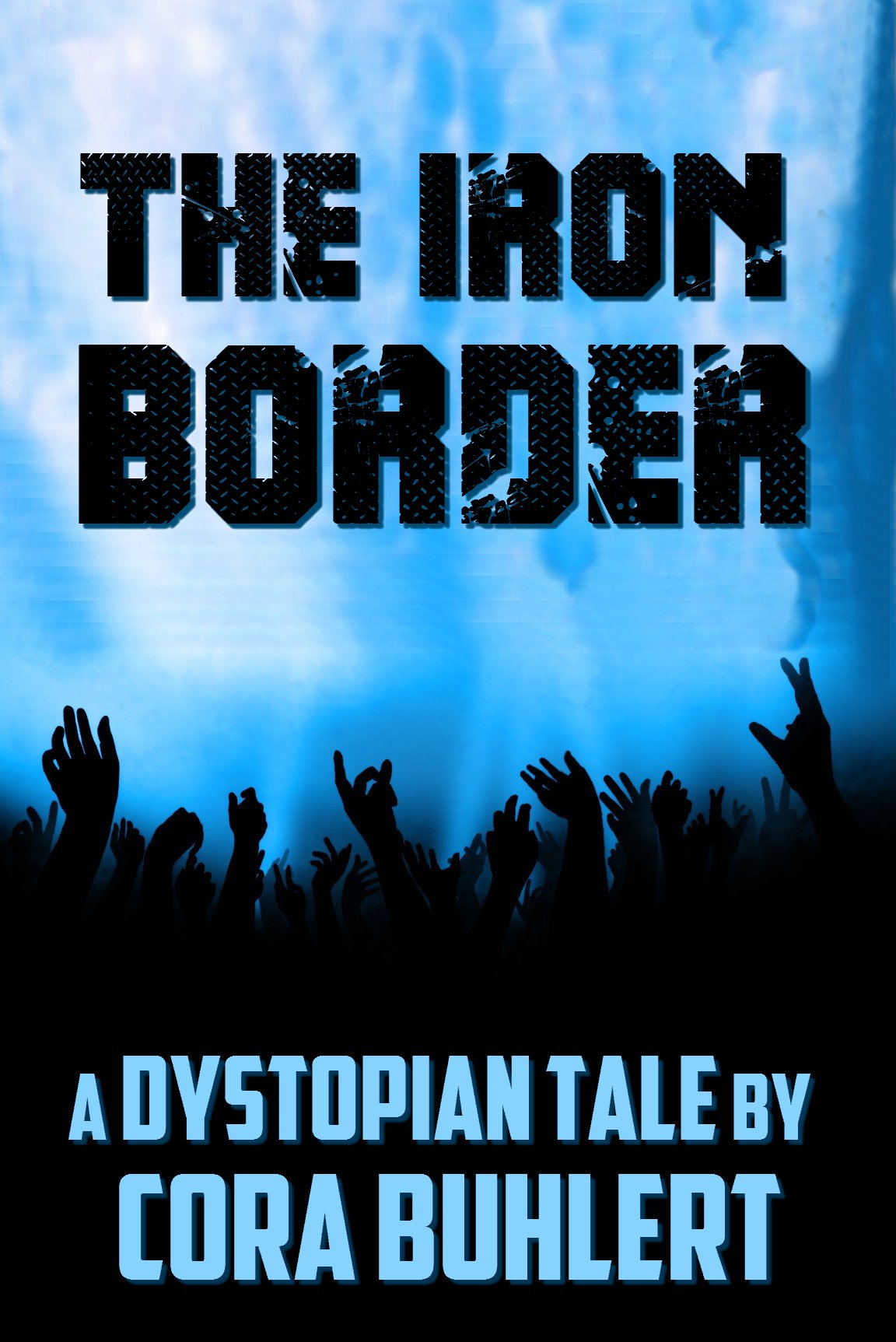 Ana has lived in the shadow of death all her life. For when she was six years old, a TV broadcast announced that an asteroid would hit the Earth twenty-two years later, extinguishing all life as we know it.
As Ana grew up, she put her faith in the worldwide lottery supposed to select the chosen ten thousand, the survivors of humanity who would escape the doomed planet in giant space arks.
But the lottery is not as fair and unbiased as Ana has been led to believe. And even her best efforts to turn herself into someone who would be useful aboard the great space arks do not bring Ana any closer to the gleaming shuttles that are being constructed behind the iron border only a few miles away…
For more information, visit the dedicated The Iron Border page.
Buy it for the low price of 0.99 USD, EUR or GBP at Amazon US, Amazon UK, Amazon Germany, Amazon France, Amazon Spain, Amazon Italy, Amazon Canada, Amazon Australia, Amazon Brazil, Amazon Japan, Amazon India, Amazon Mexico, Kobo, Barnes & Noble, Apple iTunes, Casa del Libro, Thalia, Weltbild, Hugendubel, Der Club, Libiro, Nook UK, DriveThruFiction, OmniLit/AllRomance e-books, Flipkart, e-Sentral and XinXii.
You may remember the debate sparked last month by Paul S. Kemp’s explanation why he writes masculine stories (link round-up here and here).
Well, now Paul S. Kemp has seen it fit to respond to the debate caused by his initial post and basically states that he doesn’t care about internet outrage fits and that he will continue to write what he writes, namely masculine stories. He also calls his critics “donkeys”.
Now I have zero problem with Paul S. Kemp writing what he considers masculine stories. He’s free to write whatever he wants, just as I am free not to read it. And since there seems to be an audience for his stuff, then more power to him.
However, I do take exception to the way Paul S. Kemp characterises his critics by talking about an “internet outrage culture” which holds regular “outrage-a-thons” and consists of “hangers-on” with psychological issues whose sole aim is to “chasten and humble their targets and elicit an apology and a promise to engage in ‘rightthink’ thereafter”. And that’s before he called people who disagreed with him “donkeys”.
I can’t speak for the others who criticised Paul S. Kemp’s post, but I have absolutely no intention to get him to change what he writes. There are more than enough of writers writing books that interest me, so I don’t need to persuade writers whose works aren’t my cup of tea to change their ways. And indeed the only part of his post that I agree with is “Do your thing and go your way.” So let Paul S. Kemp write what he wants to write, just as I’m writing what I want to write.
However, those who criticised Kemp’s original post were not engaging in an internet “outrage-a-thon”. They simply saw a stupid post and decided to respond, cause that’s the way conversation on the internet works. Now I’m not saying that internet debates can’t get overly heated and that they can’t turn into personal attacks and houndings. I occasionally had that feeling during Racefail, which started out as an important discussion and after a couple of months degenerated into outings, counter-outings, threats, letters sent to employers, blacklists and the like.
However, the reaction to Paul S. Kemp’s post was actually pretty mild. No one told him to die in a fire, no one sent him death or rape threats, no one published pictures of Kemp’s family, no one wrote to Kemp’s publishers threatening a boycott, if they continue to publish Kemp. All people did was disagree with him and maybe get a bit snarky at times. Welcome to the internet.
However, I have seen several posts of late – usually by men for some reason – that complain about the “internet outrage culture” (which has been part of the internet since the days of Usenet) and call for more civil discussions. They often use similar language, too, e.g. I recently read a post (forgot where) comparing internet uproars to the “two minute hates” of Nineteen Eight-Four fame, while Kemp uses the newspeak term “rightthink”. Uhm, the only thing Orwellian on the internet is the constant NSA surveillance. People disagreeing with stupid blog posts is not “two-minute hate”, it’s a debate.
Not all criticisms of heated internet debates are like that. Take this post by Alastair Reynolds in which he complains about the toxicity of the online SFF community as exemplified by the responses to Adam Roberts’ anti-awards-eligibility posts and the responses to Alex Dally MacFarlane’s post about post-binary gender in SF at Tor.com (which I didn’t get around to blogging about, so just read this summary by Foz Meadows). Now I actually agree that the SFF community can be toxic at times, though I find it striking that Alastair Reynolds has issues with the tone of Amal El-Mohtar’s (IMO reasoned) response to Adam Roberts and even mentions her by name, while he spends much less time on criticising Larry Correia for taking some time out of his busy schedule of trying to persuade people to please, please nominate him for a Hugo to pick apart Alex Dally MacFarlane’s post in great detail and accuse her (though Correia kept mistaking Alex Dally MacFarlane for male throughout) of trying to destroy the SF genre through political correctness, even though Correia’s tone was much more confrontational than Amal El-Mohtar’s. But maybe Alastair Reynolds simply didn’t get trough Larry Correia’s lengthy rant – I can’t even say I blame him for that.
But while I’m sympathetic to calls for more civil debates in the SFF genre, such calls can also veer dangerously close to the tone argument, especially if the tone in the arguments criticised is not even all that confrontational (and none of the responses to Adam Roberts or Paul S. Kemp struck me as crossing the line, though I may have missed some).
Besides, reasoned calls for civility and comparing internet uproars to Orwellian “two-minute hate” sessions both fail to ask an important question, namely why there are so many heated debates in fandom and why they seem to be circling eternally around the same few subjects. And the sad answer is that these debates continue to be necessary, because people keep saying and writing stupid and offensive stuff like this, so critical responses like this one continue to be necessary as well.
Maybe one day we won’t need to have these debates anymore. But for the time being, we still do.
It’s time for our irregular series “Interviews with international indie writers” again. Today I welcome science fiction author Matthew Alan Thyer to my blog. Matthew has been kind enough to answer some questions for me.
 1. Tell us a bit about yourself.
These days I’m a card carrying member of the middle aged. A stay-at-home dad. Husband. And, most notably for the purposes of this interview, a new author. A big transition is coming my Family’s way, my wife Tess just accepted a new position that will move us from my native homelands in Colorado to the east coast. Although I’m currently half way through my next book and neck deep in moving boxes, I’m actually looking forward to the new environment and the new challenges and experiences that will come with living in the DC area. So, at this point in my life, I think you could safely say that I am an optimistic person.
2. For how long have you been writing and why did you start?
As a hobby, I have been writing for a long time. I’m not sure I could put a date on it. Telling stories used to be a way for me work things out. Also, journaling kept my pen busy when I had time to fill working as a wilderness guard, when I was younger, or when I was deployed. But until recently, writing was never more than a past time.
In the spring of 2012 I had the first of many seizures. At the time I was working for a large software corporation in the Pacific North West. “Overworking” would be a more apt description. What followed was a long and difficult tale of recovery. I had to come back to health and ultimately, I know I am a very lucky fellow. I had the support of my family and friends, and especially of my wonderful wife Tess.
Eventually, when I got the seizures under control, it felt like I had some spare time on my hands and a desire to try something new. And for the first time in my adult life I was able to search for my earthworm. By July of 2013 I had several stories outlined and was steadily tapping away at the keys. And that’s when I made the transition to being an author.
Since then I have not looked back. Each and every time I get to write I feel a sense of contentment that is unrivaled in my adult experience. I would tell stories even if I never sold any, stacking manuscripts up on the table Jack London style.
 3. Tell us a bit about your books, The Big Red Buckle and Joulupukki.
The Big Red Buckle is the first in a series I’ve been working on that are designed to be shorter length reads (novelette to novella). The unifying theme of this hard science fiction series is “sports in space”. This book is the story two Martians who are the first native-born colonists to compete in the solar system’s premier endurance race, The Grand Martian Traverse. “The Big Red Buckle” is the prize. Competitors run and soar, using foot launched aircraft, about 1,500 kilometers between two shield volcanos on the surface of a partially terraformed Mars.
Joulupukki is a YA short story that I wrote in response to an online writing challenge in December. The idea was that we were supposed to write a 2,000 word story about the Holiday. I suppose I went a little further back into history to build the framework for my holiday than many other challengers did, but I’m very happy with the result. Again, this turned into a series, number two is nearly done.
4. The theme of your series is “sports in space”, which is a pretty unique subject for an SF series. So how did you come up with the idea?
I hate to admit this, but I really don’t know how the idea got going or where it came from. The truth is, more often than not, this is the case. Something overheard or a passing conversation is the seed for a story, but the story itself only emerges seasons later when it has had enough time to sprout underground.
As far as I can tell, “sports in space” is unique within both genres (Sci-Fi and sports fiction). There are some sports I’m really enamored with (like paragliding and distance running), but then I’ve got outlines for sports I know almost nothing about (like rugby and solar car racing). The stories have been fun to work on and I hope that others find them compelling and entertaining reads.
Number two in the series is titled “Up Slope” and I’m targeting April for its release. It is about scientists living on Europa who ride fat-tired trikes in their spare time. I’m having a lot of fun with this manuscript because it is less about the competitive elements of the bicycle and more about the utility of the sport. I’ll save the spoilers, but rest assured there is plenty happening and trikes bridge a functional gap for the scientists in a moment of turmoil.
5. Are you a sports person yourself, either as a fan or active participant? What sports do you like?
Oh yes, long distance running has been a life long influence. I got my P3 paragliding certification years ago too, but ended up giving up soaring when my youngest son came along. I’ve always been a pretty active guy.
6. Sports are a subject which is often neglected in the science fiction genre to the point that you get entire worlds or even galaxies where no one seems to care about sports at all. Given the huge amount of attention sports receive in the real world, this is flat out unrealistic. So which science fiction works handle sports right in your opinion?
Kim Stanley Robinson touches upon sports and leisure activities in his seminal Mars Trilogy. One of my favorite descriptions is of Nirgal’s around Mars foot race. I love this narrative because Nirgal does this because of the pleasure it brings him, no other reason. KSR does an admirable treatment of the topic when he imagines how a single person might circumnavigate thousands of kilometers at a time without support, and his marriage of Paleolithic survival methods to future materials technology is compelling to say the least. But at the root of the endeavor is Nirgal’s pleasure in this activity. He loves it, the runner’s high, the proximity to the landscape, the challenges, physical and mental, that he must confront with each advancing step.
I’m sure there will be readers who say “What about Ender’s Game?” And yeah, Orson Scott Card’s descriptions of competitive war simulations in zero gravity has all the trappings of a “game”, but the stakes are different. Not a single child at Command School participates because they love it. Not even Ender. There is no poetry of motion, not flow state obtained. None of these kids are polishing skills that will take them to the Olympics. The activity is utilitarian at its core and this denies how much pleasure you can get playing frisbee in the first meaningful spring warm up, in bare feet, on a recently defrosted lawn.
7. Worldbuilding is crucial for science fiction. So how did you approach the worldbuilding for your series?
I dove in. I have outlines, time lines, and plenty of character treatments, but ultimately I like to let the world emerge on its own. The first story I played with in this world has a working title “Orbital Courier”. It follows a rather solitary man who maintains one of many networked orbital sling ships that move goods, materials and labor throughout the solar system aboard hollowed out asteroids that have bootstrapped propulsion systems attached. This story opened up a plethora of implied technologies and settings.
I wrote a number of additional “test pieces” in a variety of locations. Each one linked back to the original. And I kept on discovering more about the future I was writing about.
Finally, my wife and I have conversations about this world as if it’s a real place and time. We exchange articles that suggest new, interesting plot twists. When the seedlings are ready they get transplanted to stories.
 8. Your short story Joulupukki draws on the traditions of the Sami people of Lapland, which is quite an unusual background for a science fiction story. So how did you get the idea?
So take a close look at my face and you’ll see an epicanthic fold over both my eyes. My oldest son has expressed a strong interest in knowing and understanding his own heritage. Often I think some of this is his desire to fill a void with a cultural legacy lacking in his contemporary reality. Years ago I began following the thread of our shared genetic and cultural history and with the aid of some genetic testing I discovered that we share a common ancestry with the Sami.
It is a distant and tenuous connection to be sure, but that realization sparked an interest in the cultural heritage of Lapland. Joulupukki is a traditional Yule hunt held near the winter solstice. The protagonist in my story, Birki, is a young man who, as fate would have it, shares some common traits with my oldest boy. Birki is growing up in a place where myth is of cultural importance, and the power to make myth manifest exists. The challenge is making the stories matter despite that god like power over matter.
The next in that series is “Jojk” and it is about done. Keep an eye open for its impending release. I’m writing these as if they were comic books, each one has to end with a cliffhanger. Make the reader want more. Soon.
9. Have you ever been traditionally published or did you ever pursue traditional publishing? And if so, what were your experiences?
I have article publishing experience, all non-fiction, but when I started writing fiction for publication none of that seemed to translate within this new publishing context. Beginning last July I started collecting rejection notices. Often these were just form letters that seemed to indicate no one read my samples. Worse, I’d write and wait for months before I got back a couple of paragraphs of generalities that could have been sent to anyone.
It never occurred to me that I would not be successful writer; if I invest myself fully in the effort I know, deep down, that eventually I’ll find my readers. The rejection letters never said to me “Don’t be a writer.” Rather they seemed to be saying, “Do it yourself.” I’ve never been the kind of person to wait on someone else’s permission or approval to do something, anything.
And I know I have a lot to learn. The business side of writing is simultaneously a distraction and an interest of mine. When I’m wrapped up in copy-edits or distribution questions I’m not writing, that’s bad. But, because those questions of business ultimately get made on the edge between producer and consumer, I feel like I’m a lot more in touch with my readers than I ever would have been had I taken the “big ink” route. I hear back from readers. They tell me when I’m making mistakes and also tell me what they like. Readers are a component of the rocket fuel that propels future stories.
That said, at this point in my publishing career I would gladly accept the help of a traditional press. My writing time is constrained enough as-is and having that kind of leverage would sure take some weight off my wagon. But there are two caveats. First, I know how valuable that link to the reader is and I just don’t see it happening for a lot of traditional writers. They may not even know its missing, or if they have it, they spend a lot of time cultivating it (see John Scalzi and his blog). So if I ever signed a contract, I’d make certain that I could still respond to readers in a meaningful way. Which means being able to write what I want, when I want.
Second, I’ve already got this ball rolling. Sure, mine is imperfect, but it is rolling. I’ve found an illustrator who does brilliant, unique and eye-catching work. I’m searching for an editor who has both an interest in my work and can help me put the polish on future works for a reasonable price. I’m already building a team and I know they’re the right people for the job.
10. According to your author bio, you’ve lived a really exciting life? So how did those experience influence your fiction?
I think I’ve had an unconventional life, but let me tell you there is very little about capacity management at a large software corporation that I’d consider “exciting”. That said, some of my past experiences have informed what I write. For instance, because I spent hundreds of hours learning how to pilot soaring aircraft, and subsequently soaring everything from butter smooth marine air to rodeo thermals in Eastern Washington and Oregon, I have a fair appreciation of what might go into the sport. Also, it is an ongoing interest of mine so I watch video and pay attention to some of the people who are opening up the sport.
Proximity helps, and while I am fabricating fictions, they are stories grounded in experience.
11. According to your website, you will be attending this year’s WorldCon in London (so will I BTW). Is this your first WorldCon and/or your first visit to London? And are you excited?
I am very excited to make appearances at a growing list of conventions. I just got back from Legendary ConFusion in Detroit and not only did I have an awesome time I learned a ton and met many awesome people.
That said, my wife and I are in a transitional period. She just accepted a new job and will be over seas for the next six months. I would very much like to go to London this year, so I’m holding onto that candle. But at the moment, I’m just not certain how I’m going to make it happen. I’ve got to figure out the finances and have a viable childcare plan in place before I can board the aircraft (or ride Heathrow’s PRT).
London would be my first WorldCon and that would be very exciting. I’m sure it would be a lot like walking into an Ancient Egyptian tomb, just a treasure trove of information and experience. For this reason I’m doing my best to make it a priority.
12. As a WorldCon member you’re also able to nominate and vote for the Hugo awards. So what’s your choice for the best novel of 2013? And are there any other works, writer, artists or editors you believe deserve some Hugo recognition?
Kim Stanley Robinson’s Shaman came out last year and I certainly enjoyed the read. I’m not certain if it really fits though, it is more of a hard anthropology fiction. So maybe, since anthropology is a science.
If The Human Division made it on the ballot (John Scalzi) I would not be displeased. In many ways the later books in the Old Man’s War series are much better than the first few. It would also be interesting to see any one of the episodes from the collected series on the ballot (I’m guessing here, but they felt novelette in length) because it might force the question that I’ve never felt was answered last year in Texas around Mary Robinette Kowal’s contribution.
Finally, if it were my ballot I’d nominate Terry Pratchett and Stephen Baxter’s The Long War. I read all of these last year and of them all “War” was my favorite. A really interesting departure for Pratchett which does not get mired down in the dystopic. In the baseline Earth there is still deprivation and scarcity, but the story seems to overcome the sadness.
13. Is there anything else you’d like to tell our readers?
Sure! I want to thank them for giving my stories a try.
Thanks for answering my questions, Matthew. Hope to see you in London in August.
Visit Matthew’s blog at Feet for Brains, follow him on Twitter at @feetforbrains, Facebook or Goodreads.
Matthew’s books The Big Red Buckle and Joulupukki are available at Amazon.

Welcome to “Indie Speculative Fiction of the Month”, a new feature on this blog.
So what is “Indie Speculative Fiction of the Month”? It’s a round-up of speculative fiction by indie authors newly published this month, though for the debut edition some December books snuck in as well. The books are arranged in alphabetical order by author. So far, all the links only go to Amazon.com, though I may add other retailer for future editions.
We have a broad spectrum of books, ranging from modern fairy tales via historical fantasy, epic fantasy, paranormal romance, urban fantasy, dystopian SF and space opera all the way to hard science fiction. There are books for all age ranges, from a collection of bedtime stories for young children to some very dark and adult works. I know all of the authors at least vaguely and have read other works by several of them. However, I haven’t read the books themselves, so Caveat emptor.
And now on to the books: Continue reading
I’m not sure whether this hit the news abroad at all, but the German TV station ARD did an exclusive TV interview with NSA whistleblower Edward Snowden. I only stumbled across the interview by accident, because I was waiting for the literary program Druckfrisch to begin, since ARD did not do much to promote it and hid the interview in a graveyard slot at 11 PM, the same graveyard slot usually occupied by Druckfrisch, which is a scandal in itself. However, you can watch the whole thing, in English even, at their website.
Over at Pegasus Pulp, I talk about the novella form and why it is ideal for certain genres and subgenres.
Jo Walton has an interesting post about swearing in science fiction and fantasy at Tor.com. I find her observations quite interesting, especially since I never really noticed that swearing became more common in SF novels between the 1980s and 1990s, though that was exactly the time I started reading SF in English.
But then, Germans are not all that sensitive towards swearing, especially not in my generation and so the controversy in the 1980s about tough cop Horst Schimanski (played by Götz George) saying “Scheiße” on German TV seemed very silly to me at the time and seems even sillier in retrospect, since Dietmar Schönherr had already said it on Raumpatrouille Orion back in 1966, albeit used as an adjective. It’s also used in adjective form in Salto Mortale, a German TV drama about a family of circus artists which ran from 1969 to 1972. The momentous occasion of Schimanski uttering “Scheiße” on German TV can be viewed on YouTube here. It happens at 3:28, though just watch the whole beginning, because it’s a marvelous bit of characterisation without any dialogue, until Schimanski yells “Du Idiot, hör’ auf mit der Scheiße” (You idiot, stop that shit!) a little over three minutes in (unfortunately, the moment is somewhat marred by a racist remark a little later, which is more shocking today than “Scheiße” and yet went entirely unremarked in 1981). This is the first line he ever said BTW as a new character in the venerable crime drama Tatort. Nowadays, it’s hard to imagine what a breath of fresh air Schimanski was in the staid atmosphere of German TV of the pre-private TV era. I pretty much fell in love with him at first sight, because he was the coolest German cop I’d ever seen. Even cooler is that actor Götz George wanted Schimanski to be gay and played him that way in the early episodes, but was shot down by the TV bosses, because while uttering “Scheiße” might have been barely acceptable back in 1981, a gay cop was not. To this day, I wonder what would have happened if George had gotten his way.
Come to think of it, I did wonder about the “swearing of oaths” that was so common in many English language novels of the late 1980s and before, because I interpreted it as swearing an oath before a court and wondered why on Earth everybody felt the need to sweat oaths all the time. The meaning of “oath” for “vulgarism” doesn’t exist in German, so I didn’t get what was meant. And of course, I adapted the neutered fake swearing (“darned” for “damned”, “heck” for “hell”) from the Marvel Comics of the period for myself, because I mistook it for “authentic American slang” and the idea of anybody, even the sort of people outraged at Horst Schimanski saying “Scheiße”, being troubled by “damned” or “hell” was totally inconceivable to me.
At Vulture, writer/critic Lev Grossman and writer Adam Sternbergh talk about genre fiction and theories of nerd-dom. What I liked best about this dialogue is the acknowledgement just how broad the overall field of SFFH geeky interests really is and also the discussion about crossgenre works and genre hybrids, which also jives with my personal theory that we are seeing more and more works mixing elements of two or more genres.
Australian SF writer Patty Jansen has some ideas on what science fiction needs to do to stay relevant. I agree with her, since it always makes me cringe when a young reader asks for science fiction recommendations and someone suggests the Heinlein juveniles or Isaac Asimov. Now don’t get me wrong, I still like Asimov (Heinlein not so much, but then I never did). But it’s not a good entry point into the genre for a young reader.
In Russia, they still take literature seriously and so an argument about poetry versus prose came to a lethal end in the Siberian town of Irbit. Poetry won BTW, by stabbing prose to death. Meanwhile, in September a man was shot, but thankfully survived, in the South Russian city of Rostov-on-Don because of an argument about philosopher Immanuel Kant, who – though German – was born in the West Russian city of Kaliningrad, then known as Königsberg.
Bremen has a beautiful Renaissance townhall (you can see a photo here) with a famous wine cellar, now a gourmet restaurant. Among many other treasures, the wine cellar also contains Germany’s oldest barrel of wine, dating from 1653. The wine is not for sale and very few people alive have ever tasted it, including some international wine journalists back in 1996 and an American GI who was given a bottle by the cellar master in 1945 (he visited Bremen for the 50th anniversary of the end of WWII, pointed at the barrel and said, “I got a bottle of that”, which stunned everybody present). However, now a Chinese billionaire has offered 150000 Euro for just one bottle of Ratskeller wine, 1653 vintage. Normally, this offer should be a no brainer, since the barrel is still largely full and especially since Bremen is chronically short of money. However, the market square and town hall are a UNESCO world heritage site and therefore the question is whether selling a bottle of wine a historical barrel in the wine cellar of the town hall would violate the sanctity of the world heritage site.
Want to learn Low German (which is a separate language BTW and not a dialect)? Radio Bremen has a free online course for you. Furthermore, Radio Bremen also has a whole Low German page, where you can listen to the daily Low German radio news as well as audio dramas and other Low German programs.
American folk singer and songwriter Pete Seeger died Monday aged 94. Here is a wonderful appreciation from the German cultural TV program Kulturzeit. Watch out for Pete Seeger singing the Moorsoldatenlied as well as the German folk song “Die Gedanken sind frei” (Thoughts are free).
 sending...
