The Obligatory Birthday Post 2016

April 18 is my birthday.

Though I didn’t get around to celebrate a whole lot today, because I had to work. And so I spent the whole afternoon teaching German as a second language to refugees. The class is brand new, too, and only started last week, so it’s still very exhausting.

I did start off the day by watching Snowpiercer late last night. I usually watch a nice movie for my birthday, though I probably wouldn’t have picked Snowpiercer (which is an excellent movie, but also rather harrowing and not exactly a feel-good film), if it hadn’t been on TV that night.

Then today I was mostly at school. When possible, I go out for lunch with my parents on my birthday, but not today, because of school. Cause for my birthday, I don’t want to hurry and I want to have a glass of wine with my lunch, too.

I did have a birthday cake of sort, since after school, I bought some pastries at a local bakery for myself and my parents and the neighbour who dropped by.

Quarkini dough balls

Quarkini – little balls of deep-fried dough made with curd cheese.

Here is an explanation of Quarkini from the company that produces a batter mix. I’m quite fond if Quarkini, since they are not so loaded with icing as other deep-fried pastries such as Berliner and Victoria.

Of course, I got presents as well. Books mostly, as well as a bottle of red wine from my neighbour.

Wrapped presents

Wrapped presents.

Books

Unwrapped presents: Behold all the lovely books

I’m really happy with that book haul. It’s also notable that except for the Adam Christopher novel, all the books are either small press or self-published. Even if you are primarily a print reader (though I own two e-readers, a Kobo Glo and a Tolino Shine), indie books are becoming a lot easier to come by.

I got a few phonecalls, too (and probably missed a few more due to being away at school), from my aunt, my cousin and a former student.

I also got another phonecall, late tonight, that was not so happy. Because the phone suddenly rang at half past ten. “Huh”, I thought, “That’s rather late for a birthday call.” Though it might have been someone who knows I don’t normally go to bed early.

So I answered the phone and found that it was my aunt, which was odd, because my aunt is a) not the type of person to make late evening calls, and b) she had sent me a card (the one with the pink roses), so I was surprised she called as well.

However, it turned out that the call wasn’t a birthday call at all. Instead, my aunt called me to inform me that my uncle had died that evening. Now this is less tragic than it sounds, because my uncle has been extremely ill for years now. He’s also been close to death several times before, so the news wasn’t entirely unexpected. Nonetheless, I was stunned, especially since I had talked to my cousin earlier that evening with no indication that anything was wrong.

Coincidentally, my uncle happened to die not just on my birthday, but also on the birthday of his mother, my grandmother (I share a birthday with my grandma), and one day before the birthday of his grandson.

Posted in Books, Personal | Tagged , , , , , , , | 2 Comments

Two New Science Fiction Releases: Lovers’ Lane and Double Feature

I have two new stories to announce today, two stories that are in many ways two sides of the same coin.

Let’s have a bit of background: In November 2013, I published a short story called Acacia Crescent, in which a young boy is saved from a mafia hitman by an unexpected alien invasion (Are there ever expected alien invasions?). Acacia Crescent was supposed to be the first story of The Day the Saucers Came…, a series of first person eye-witness accounts of a B-movie type alien invasion in a alternate 1956. Alas, I never wrote the other stories, so Acacia Crescent remained a standalone. Until now…

For today I present you not one but two new stories of The Day the Saucers Came… Both stories offer not just a glimpse into 1950s small town teenager life, just before it is interrupted by death ray shooting flying saucers, they are also companion pieces, featuring two very different female first person narrators whose stories just happen to overlap.

By the way, if you want to read all three stories of The Day the Saucers Came… together, you can also purchase them for a reduced price as a handy series bundle at DriveThruFiction.

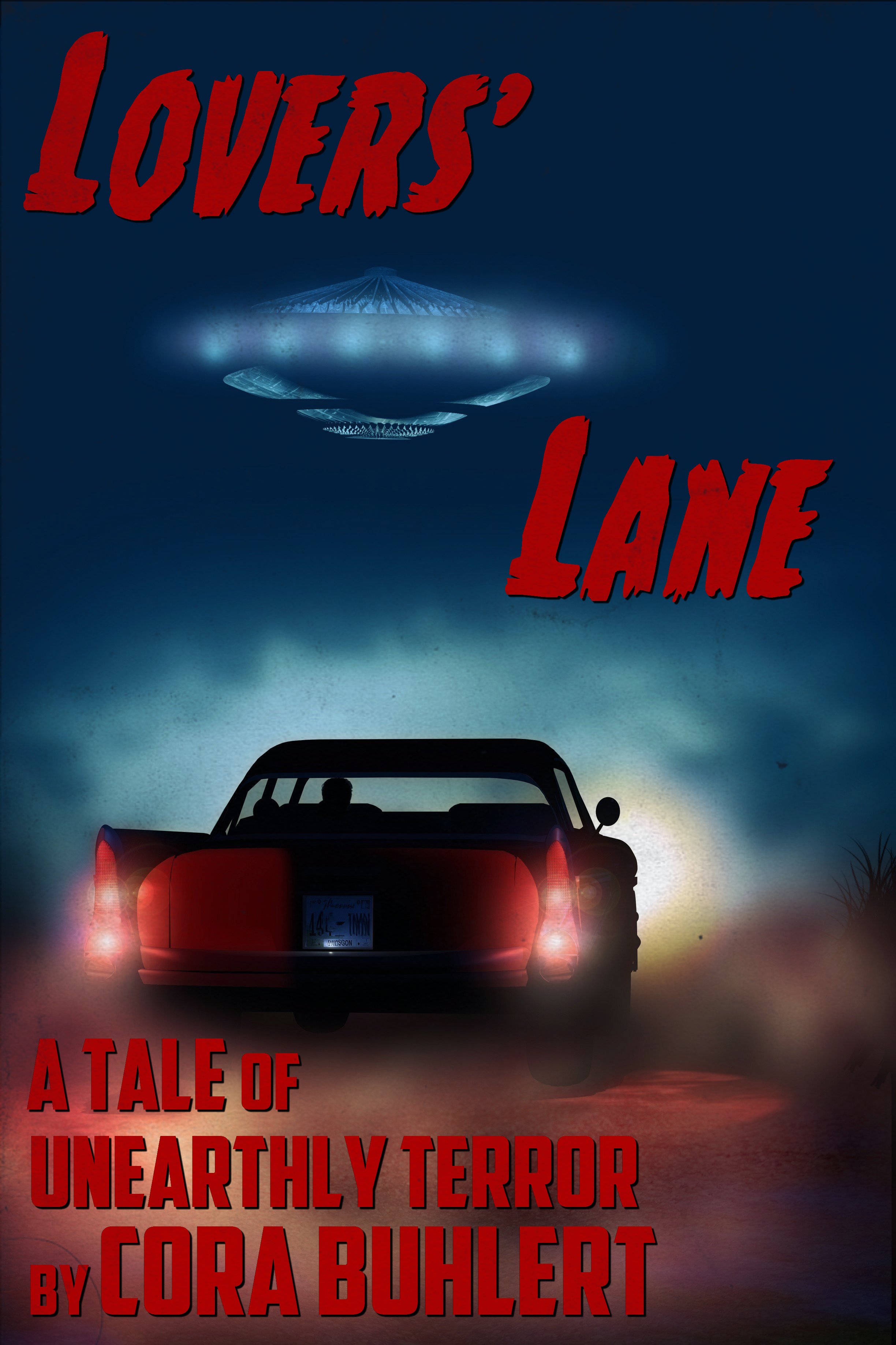
Lovers’ Lane
Lovers' Lane1956. After a sock hop at the local high school gym, teenagers Betty and Cody drive out to Lovers’ Lane together. Betty knows only too well that good girls don’t go to Lovers’ Lane with boys. But Cody is her one true love and besides, he swore that he’d love her forever or may he be struck down where he stands. But then, an alien invasion shows Betty just what Cody’s word is truly worth…


More information.
Length: 6200 words
List price: 0.99 USD, EUR or GBP
Buy it at Amazon US, Amazon UK, Amazon Germany, Amazon France, Amazon Netherlands, Amazon Spain, Amazon Italy, Amazon Canada, Amazon Australia, Amazon Brazil, Amazon Japan, Amazon India, Amazon Mexico, Kobo, Barnes & Noble, Apple iTunes, Scribd, Smashwords, Inktera, txtr, Thalia, Weltbild, Hugendubel, Buecher.de, Libiro, DriveThruFiction, OmniLit/AllRomance e-books, Casa del Libro, Flipkart, e-Sentral, 24symbols and XinXii.

Double Feature
Double Feature by Cora Buhlert1956: Judy is the designated town slut of Stillwater Creek. After getting thrown out of a sock hop at the local high school, Judy winds up going to the movies with bad boy Hank instead, where a science fiction double feature is playing. However, before the first reel of the second movie is through, the night is interrupted by a very real invasion of flying saucers from outer space…

This is a novelette of 8500 words or approx. 30 print pages.


More information.
Length: 8500 words.
List price: 2.99 USD, EUR or GBP
Buy it at Amazon US, Amazon UK, Amazon Germany, Amazon France, Amazon Netherlands, Amazon Spain, Amazon Italy, Amazon Canada, Amazon Australia, Amazon Brazil, Amazon Japan, Amazon India, Amazon Mexico, Kobo, Barnes & Noble, Apple iTunes, Scribd, Smashwords, Inktera, txtr, Thalia, Weltbild, Hugendubel, Buecher.de, Libiro, DriveThruFiction, OmniLit/AllRomance e-books, Casa del Libro, Flipkart, e-Sentral, 24symbols and XinXii.

Posted in Books | Tagged , , , , , , , , , , | Leave a comment

Photos: Flowers and Sunsets… and Pirates!

Enough politics for today, let’s have some pretty photos.

The mild and sunny weather of the past week has given nature a boost with spring flowers in full bloom all over. So here are some of them. These are all mobile phone shots BTW, hence the quality is a bit lower than usual:

Violets

Some kind of violets blooming in the neighbour’s garden.

Spring flower medley

A medley of springtime flowers, also in the neighbour’s garden. There are forsythias, daffodiles, pansies, primroses and others.

Forsythias

More forsythias blooming over a fence.

Some kind of shrub with bright pink blossoms peeking over a fence.

Some kind of shrub with bright pink blossoms peeking over a fence.

Forsythias and pink blossoms

Forsythias and the pink blossomed shrub peek over the fence.

Tulips and blue flowers

White tulips and little blue flowers whose English name I do not know in the garden.

Sunset

Panoramic view of a particularly pretty sunset last week.

Finally, here is not a nature photo. No, this is a group shot of the small crew of five Playmobil pirates as well as one parrot and one monkey who live on my desk. I still hope for a female pirate someday, but though Playmobil makes female pirates, they only come in the big sets, not individually packaged:

Desk pirates

The Desk Pirates pose for a group photo.

Posted in General | Tagged , , , , , , | 2 Comments

The Böhmermann Case

I’m one of them. One of the approximately 300000 to 500000 German TV viewers who knew who Jan Böhmermann was before last week and who regularly watched his comedy program Neo Magazin Royale in its Thursday/Friday night post-midnight graveyard slot.

Now everybody knows who Jan Böhmermann is. His case is the top news headline in Germany and his smiling face looks at you from international news sites like The Atlantic (good summary, just don’t read the comments) or The Guardian that normally would never have paid any attention to an obscure German comedian.

More neepery about German politics, German TV and freedom of speech, press and art behind the cut: Continue reading

Posted in TV | Tagged , , , , , , , | Leave a comment

Of Star Wars and Mary Sues

Last Thursday, the first teaser trailer dropped for Rogue One, this year’s Star Wars movie (apparently we’re getting one every year for Christmas now) and it looks pretty damn good, particularly considering very few people cared a whole lot about a prequel/sidequel story like Rogue One.

Though I’ve been a Star Wars fan since the age of five, I was one of those people who weren’t particularly excited about Rogue One. I wasn’t all that keen on going back in time once again (and I actually like the prequels for what they are). Never mind that what little we knew about Rogue One made it sound like “Star Wars does Grimdark” and we all know how I feel about Grimdark. To be fair, I wasn’t all that excited about The Force Awakens either (and still have some ambivalent feelings about the film), but of course I went to see it anyway and promptly fell in love with Rey, Finn, Poe and BB-8 like the rest of the geek world.

As for Rogue One, that teaser trailer looks pretty damn good and has made me a lot more likely to go and see the movie come December. Besides, I’ll be happy to watch something labeled Star Wars that for once is not about Jedi (I’ve never been a huge fan of the Jedi anyway – ninety percent of the bad things that happen in all Star Wars movies are the direct or indirect fault of the Jedi) and people named Skywalker. It seems that the folks of Lucasfilm have finally noticed what the various tie-in novels, comics, videogames, etc… knew all along, namely that they have got a huge universe in which you can tell lots of different stories. And not all of these stories have to be about Jedi and people named Skywalker.

Apparently, I’m not the only person who thinks that the Rogue One teaser trailer looks pretty good. Within a few hours, Twitter was all ablaze with people excited about the trailer. And within 24 hours, the Internet was full of speculation, analysis and frame by frame breakdowns.

But with the excitement also came the ugly. Because you see, the protagonist of Rogue One is a woman, Jyn Erso played by Felicity Jones. Now this isn’t exactly new – it’s been known for a while now that Felicity Jones would be playing the lead in Rogue One. Nonetheless, certain dudebros on the Internet were shocked – shocked, I’m telling you – that two Star Wars movies in a row would have a female protagonist. Never mind that we’ve had six Star Wars movies in a row with male protagonists – two Star Wars movies in a row with female protagonists and actors of colour in more than bit parts (Rogue One also promises Diego Luna, Donnie Yen and Forest Whitaker among others), now that’s political correctness gone mad and proof that the Social Justice Warriors have taken over Hollywood and that a ban of movies with straight white male protagonists is imminent (well, maybe that would solve the “Oscars so white” problem).

It’s all quite silly and part of the futile attempts of certain very insecure white men to turn back the clock to a time when every single piece of media catered to them and them alone. The same sort of people also proclaimed a “boycott” of The Force Awakens due to its stars being a white woman, a black man and a Hispanic man and we all know how much impact that “boycott” had.

The most common complaint about Jyn Erso, the protagonist of Rogue One, was that she is a Mary Sue. Now this is quite a remarkably conclusion, considering that we know next to nothing about Jyn apart from what we have seen in a ninety second trailer. Which basically comes down to: Jyn is an angry young woman with a shady past who winds up working for the rebellion not quite voluntarily. In short, she’s basically a female version of Han Solo. Oh yes, and she is a fairly slight young woman who is seen running around the Death Star (okay, really just Canary Wharf tube station) and beating up and shooting Stormtroopers (who are not exactly known for being formidable opponents, though what they lack in skills, they usually make up in numbers). Of course, the trailer also gives us a blind man with a staff (played by Donnie Yen) beating the crap out of some Stormtroopers, but seeing a able-bodied woman doing the same means that she must be a Mary Sue. Because you see, Jyn Erso is a woman, a competent and attractive young woman who is good at something. So of course she must be a Mary Sue.

I’ve blogged about the problems with the term “Mary Sue” and its current application to pretty much any competent female character before. And the dudebros complaining about Jyn Erso on the basis of a ninety second trailer, wherein most of the spoken dialogue is actually provided by characters other than Jyn, is a perfect illustration of the phenomenon. And indeed, Jessica Lachenal has posted an open letter to all the angry fanboys calling Jyn Erso and Rey Mary Sues at The Mary Sue, while at Film School Rejects, Alisha Grauso asks what’s so bad about being a Mary Sue anyway.

Now the Star Wars movies, particularly the original trilogy, are set in a universe with a seriously skewed gender balance, a universe that seems to be approximately eighty to ninety percent white and male. The prequels are a little bit better about that – indeed I still remember how stunned I was to see female Jedi – all non-human supporting characters who had barely any lines – in the prequels, because up to then I had assumed that women couldn’t be Jedi, since Obi Wan and Yoda only showed any interest in one of the two potential Jedi available, namely Luke. Even though Leia was shown to be a lot more competent at pretty much everything than either Luke or Han from the moment she was introduced. Just as Padme was a lot more competent than Anakin. But now that competent women actually get to be the heroines of their own Star Wars movies rather than supporting characters to a male chosen one, we have the usual suspects crying Mary Sue.

Never mind that everybody ignores the clearest and most obvious Mary Sue in the entire Star Wars universe (and indeed one of the clearest example of a Mary Sue in pop culture). And this Mary Sue is neither Leia nor Padme nor Rey nor Jyn, it’s Luke Skywalker.

Let’s look at the evidence: Luke is an orphan with a mysterious background who grows up in obscurity, is nigh effortlessly good at some extremely arcane skills and goes on to rescue the princess and save the day. He is severely tested, finds out something horrible about his birth family, has a limb chopped off, resists the dark side and saves the day again and topples a whole evil Empire in the process, an evil Empire that people a lot better trained and more skilled than Luke could not topple. Oh yes, and he shares a name (sort of) as well as a passion for racing with his creator. And like his creator, Luke grew up in a sleepy desert town where nothing ever happened, in a country that was billed as the best and most perfect place to live in, even though the cracks were only too visible to anybody who made the effort to look. The parallels become even clearer, if you’ve seen George Lucas’ previous film American Graffiti, which is not just partly autobiographical, but also an indispensable companion piece to Star Wars. In short, Luke Skywalker is a Mary Sue, one of the most obvious male Mary Sues in popular culture along with James Bond, Conan and Old Shatterhand. But for some reason, no one ever complains that Luke is a Mary Sue.

In fact, the very Mary Sueness of Luke was part of what drew me to Star Wars in the first place. Because the story of the adventurous young man from a sleepy desert town where nothing ever happens, who can see all the problems in the supposedly perfect system he lives in and wants nothing more than to get out of his sleepy little town and put everything right, written by another young man from a sleepy desert town disillusioned with his supposedly perfect country, its corrupt leaders and senseless wars, resonated across time and space with a young girl living in a sleepy small village where nothing ever happens, a girl who was told all the time by parents, teachers and the media that she should count herself lucky to be living in such a wonderful free and democratic country, even though she, too, could see all too clearly that the system and the country were far from perfect and how could anybody not see that?

I’m always amazed how many critics fail to see how political the Star Wars movies really are. After all, the original trilogy is a not all that subtle allegory for the America of the Vietnam and Watergate era and the disillusionment of the postwar generation who grew up in what was supposed to be the best country in the world, only to find that their leaders were corrupt and their friends were dying in senseless wars no one wanted. The original trilogy radiates George Lucas’ anger and disillusionment at the US of the Vietnam and Watergate era and Star Wars was Lucas creating a universe where he or rather his fictional counterpart gets to take down the system and fix everything. And though I didn’t know a whole lot about either the Vietnam war or Watergate, when I first watched the Star Wars movies, I could still sympathise with Lucas’ anger and his desire to make things right.

Leia was who I wanted to be – beautiful and good at everything with adoring men and Wookies fighting for my attention – and Han was who I wanted to have. But though Leia is a great and inspiring character, few of us are princesses, senators, spies and rebel leaders at twenty (ditto for Padme, who is a queen at twelve and a senator at twenty*). What we are instead is Luke, the kid from the nowhere town who looks up at the stars. Luke is the most obvious audience identification character, because few of us are as accomplished as Leia or as cool as Han. No, we’re Luke, the dorky small town kid with the big dreams.

Now the new Star Wars films have given us new characters to identify with and aspire to: Rey, Finn, Poe and soon Jyn and whoever else Rogue One will give us. These new heroes are a lot more diverse than the old ones and that’s a good thing, because it’s no longer 1977 and white men are no longer the only group deemed worthy of having a hero to identify with. And if certain dudebros have problems with that – well, tough luck.

*I’d argue that one of the main problems with the prequels is the lack of characters the audience can identify with. Both Padme and Obi Wan are rather inaccessible, since few of us are Jedi masters or accomplished teenaged diplomats and rulers. And as for Anakin, who the hell wants to be Anakin Skywalker?

Posted in Film | Tagged , , , , , , , | Leave a comment

Indie Speculative Fiction of the Month for March 2016

Indie Speculative Fiction of the MonthIt’s that time of the month again, time for “Indie Speculative Fiction of the Month”.

So what is “Indie Speculative Fiction of the Month”? It’s a round-up of speculative fiction by indie authors newly published this month, though some February books I missed the last time around snuck in as well. The books are arranged in alphabetical order by author. So far, most links only go to Amazon.com, though I may add other retailers for future editions.

Once again, we have new releases covering the whole broad spectrum of speculative fiction. We have space opera, military science fiction, science fiction romance, paranormal romance, fantasy romance, epic fantasy, urban fantasy, horror, post-apocalyptic fiction, vampires, wizards, demons, alien invasions, flying saucers, telepathic space pirates, monstruous conspiracies, dead druids, magical wars, royal bodyguards, gods in the modern world and much more.

Don’t forget that Indie Speculative Fiction of the Month is also crossposted to the Speculative Fiction Showcase, a group blog run by Jessica Rydill and myself, which features new release spotlights, guest posts, interviews and link round-ups regarding all things speculative fiction several times per week.

As always, I know the authors at least vaguely, but I haven’t read all of the books, so Caveat emptor.

And now on to the books without further ado:

Ishtar's Blade by Lisa BlackwoodIshtar’s Blade by Lisa Blackwood:

Warrior.
King’s confidant.
Avenging blade of the Goddess Ishtar.

Iltani asked to be none of these things. Yet fate does not ask permission when she weaves souls upon destiny’s loom.

On the day of Iltani’s birth, an assassin tried and nearly succeeded in ending the line of the gryphon kings. Out of that bloodshed, an unbreakable bond was forged between child-king and goddess-chosen infant, and from that pivotal moment forward, Iltani was never farther from King Ditanu than his shadow. Not until her training to become Ishtar’s Blade required her to leave.

After four brutal years of training, Iltani now returns to court as Ishtar’s Blade and takes up her role of king’s shadow—a dangerous position in a court where the threat of another assassination is but a blade’s width away. But for the chance to stand at the side of her beloved king, she will endure the dangers of court intrigues, assassins, and political maneuverings.

Lovers' Lane by Cora BuhlertLovers’ Lane by Cora Buhlert

1956. After a sock hop at the local high school gym, teenagers Betty and Cody drive out to Lovers’ Lane together. Betty knows only too well that good girls don’t go to Lovers’ Lane with boys. But Cody is her one true love and besides, he swore that he’d love her forever or may he be struck down where he stands. But then, an alien invasion shows Betty just what Cody’s word is truly worth…

This is a story of “The Day the Saucers Came…”, a loosely connected series of eyewitness accounts of a B-movie type alien invasion in 1956.

Caugzht in the Dream by Eva ChaseCaught in the Dream by Eva Chase:

Mateo Jimenez is haunted by the death of his first girlfriend, and his fear of repeating past mistakes has cost him personal relationships and now his job. While his colleagues protect L.A. from the demonic Glowers, he’s been demoted to office work.

So when a Glower approaches him to negotiate a ceasefire, Mateo agrees to listen, planning to gather information on the demons that will prove his worth. He isn’t prepared to be so tempted by Kess, who uses her supernatural talents to bring his most buried desires to life. As he struggles to keep the upper hand, he discovers he can provoke human emotions in the demon, but the more warmth and kindness Kess offers, the more confused his own feelings become. No longer sure what’s an act and what’s real, Mateo sees a chance to stop the Glowers for good. But first he must decide whether trusting Kess is the key to succeeding or the greatest betrayal he could ever commit.

The third book in The Glower Chronicles, a steamy New Adult paranormal series.

Your Name, In Fire by Kera EmoryYour Name, In Fire by Kera Emory:

Connor Black doesn’t believe in the supernatural, and that’s about to bite him in the ass.

Connor’s life gets interesting when a new writer joins his video game studio. Sparks fly; Wendy is pretty, intelligent, and definitely into Connor—but careful never to reveal much about herself.

And before long, Connor has his own secrets to worry about: a tattooed stranger attacks and nearly kills him, giving no explanation. Angry but mystified, Connor doesn’t tell anyone what happened, and tries to put the attack behind him—and he tries to convince himself that the weird little things he’s starting to notice about Wendy aren’t really that weird. Stressed and sleep-deprived, with the looming deadline of a multi-million-dollar video game launch weeks away, Connor just doesn’t have time to deal with ‘weird’.

But when the evidence trail of an horrific crime begins to lead back to Connor himself, Connor must seek out answers to the questions he’s been avoiding, even if it means risking his own life and sanity—and the lives of those around him.

Shadow Play by Domino FinnShadow Play by Domino Finn:

I’m Cisco Suarez, and a week ago I was dead.

Cursed into serving a clandestine shadow group, I have a lot of blood on my hands. Good thing I also have a juvenile problem with authority. I’m not taking orders anymore, and the first thing on my bucket list is bringing them down.

If I’m good at anything, it’s looking in dark places. But I’ve got shadows of my own. Horrific deeds coming back to haunt me, and not the metaphorical kind of haunting, either. I’m talking ghosts, mages, and that thing with the glowing red eyes.

Just goes to show you, it really is true what they say. What goes around comes around. I only hope to give more than I get.

Is resurrection overrated or what?

Destroyer by Chris FoxDestroyer by Chris Fox:

Mankind’s outer colonies are disappearing. Without warning. Without a trace. Fleet command chalks the attacks up to pirates, but Captain Dryker of the UFC Johnston isn’t buying it.

Defying command, he leads his misfit crew into hostile territory in search of answers. They encounter the mythical Void Wraith, an unstoppable legend whispered by the first race. After 26,000 years the Void Wraith have returned to begin the next Eradication. Their technology is superior, their motives unclear.

Humanity cannot stop them. Not without help. Captain Dryker’s only hope is to forge an alliance with mankind’s greatest enemy, the savage Tigris.

One maverick captain, an unlikely crew, and an aging vessel are all that stand between humanity and the Eradication.

The Wizard's War by Angela HolderThe Wizard’s War by Angela Holder:

For the first time in its history, Tevenar is at war. The Matriarch of Ramunna, furious with the wizards she believes betrayed her, has sent the Armada to conquer and destroy. Armed with a secret weapon that makes them the unchallenged terror of the seas, the ships of the Armada descend on vulnerable Tevenar.

Elkan and Josiah, along with the rest of the Wizard’s Guild, scramble to rally the people of Tevenar to defend their home. The Mother’s power gives them a chance to stand against their foes, but alone it’s not enough. To defeat the Ramunnans, they must find a way to duplicate their enemies’ weapons. Josiah believes they can, because they’ve encountered a similar explosive before. But only one person in Tevenar knows how to make and use the deadly blasting powder—Meira, the woman Elkan once loved and rejected.

Pirate Bound by Carysa LockePirate Bound by Carysa Locke:

A desperate gamble…

Sanah would do anything to protect her little sister, even if it means taking refuge with ruthless pirates. But the psychically Talented pirates terrorizing Commonwealth space are not quite the monsters she has been led to believe. When Sanah’s empathic gift shows her the truth behind the stories, she is no longer certain who the villains are in her world.

A race on the verge of extinction…

Dem’s only goal is to protect his people, especially since a deadly bio-weapon decimated their population. Only a handful of women survived, and every day is a fight to rebuild. With Sanah’s empathy and her sister’s rare ability to heal, they could be the salvation Dem and his people have been looking for.

A dangerous secret that could destroy everything…

But how can Sanah trust Dem with her life? Especially when he’d kill her if he knew the truth.

Dead Druid by Salvador MercerDead Druid by Salvador Mercer:

A thousand years ago, on the world of Claire-Agon, a war raged between men and dragons, destroying both the creatures and the land’s many civilizations.

Targon Terrel accepts his fate as a Ranger, a servant of the Mother and Defender of the Arnen. Having protected his fellow countrymen, he continues his battle against the sinister Kesh wizards, but he does not fight alone. Aided by unlikely allies, he presses his attacks to liberate Ulatha and its people.

The Kesh continue to dominate the realms of Agon, enslaving those of neighboring realms and seeking to obtain the one artifact that will ensure their perpetual domination of Agon forever.

Meanwhile, ancient evils stir from their long slumbers, moving to ensnare all within their reach as Dor Akun, Father Death approaches.

Evil prepares to cover the land and only one thing stands in its way, a simple Ulathan family that goes by the name of Terrel.

Ghost of the Navigator by Tommy MuncieGhost of the Navigator by Tommy Muncie:

Three years on from the birthday party that left him crippled for life, Shadow is well on the way to wrecking what’s left of himself. When stealing morphine from a hospital almost lands him in prison, his family give him one more chance to clean up, and he takes it. By his 21st birthday, he’s six months sober and settling for a simple and honest life. Then an unexpected visitor turns up at Shadow’s home, with a new idea about how to get his body restored.

Everything comes at a price though, and the elusive Blake Stanford’s price is going to be more than Shadow wants to pay. Despite his loyalty to both Shadow’s family and the Talent Council, Blake has dangerous ideas. The kind that can either make history or get people put in prisons that don’t officially exist. If they live long enough to reach them.

The Serious Crimes Office are hot on the tail of Blake and his new protegé, and Shadow has made enemies out of people high up in the world’s most powerful organisation: The Seekers’ Council, known for making unpredictable people disappear without trace. A nosy journalist won’t stay out of Shadow’s personal life, and a crime boss who wants Shadow for her own plans will stop at nothing to own his allegiance. Is anyone truly his ally? The good doctor Kit Calloway still is, but keeping Shadow alive might just cost him more than his career this time.

Especially if the world’s most powerful Seekers discover Shadow’s true identity. Or the three tubes of Liquid Talent he once buried deep in a forest, and promised never to dig up unless lives depended on the secrets inside them…

That Which Dwells BeneathThat Which Dwells Beneath by Andrew Nicolle:

Detective Elliot Winter believes an innocent man may hang, framed for murders he didn’t commit. He’s convinced the condemned knows too much, and even if the man escapes the hangman’s noose, powerful people want him dead.

On the grounds of the abbey at the edge of town, the catacombs conceal terrible secrets. There are whispers of murder, ritual sacrifice, and worse. Winter cannot abide a world where such crimes are allowed to go unpunished.

In a race against time, Detective Winter risks his life and sanity to unravel a conspiracy concealing something far more sinister than even he can imagine.

Engineering Murder by T.S. PaulEngineering Murder by T.S. Paul:

Ensign Athena Lee has finally been rescued. The galaxy has changed over the last fifteen years. She finds herself arrested, her rights taken away, and tortured. Political corruption has taken over. Now someone is out to kill her. With assassins and bounty hunters at every corner what is an Engineer to do? Use the right tool for the right job and Fix it!


Freemont by P.J. PostFreemont by P.J. Post:

This romance brought to you by the end of the world…

Freemont’s River Walk is romantic, exciting and has the best cafes and restaurants in the county. And the residents intend to keep it that way. They opened up the armory, fueled the World War II trucks and even got the ancient generators working. They turned on the lights.

To improve the security of the townspeople, they put up a fence, manned by the good soldiers from Crayton Industries, selflessly protecting the refugees, and the nurses and doctors that care for them in their selectively policed triage units.

Freemont is a beacon for the survivors of the War.

Come to Freemont: you’ll be fed, you’ll be warm, you’ll be safe…

And now Lane’s here.

And somewhere among all of those River Walk cafes and restaurants, the pretty church steeples and the good intentions, the snow covered maple trees and the street lights along Main, among the Cart People and the Button Eye plague…

Sam is too.

The Girl Who Twisted Fate's ArmThe Girl Who Twisted Fate’s Arm by George Saoulidis:

The gods are back in town. Skyscrapers pop out of nowhere all around Athens. Corporations rename themselves as Greek gods. It all started with the Greek crisis of 2009 and it will forever change the world as we know it. Some say that CEO’s have gone mad. Others, that they know damn well what they are doing. That there is something solid amongst the myth. In the day of inter-connectivity and social media admiration, can the myths come back to life?

When the daughter of Greece’s premier singer fails to sing as expected, she finds out about a biker group of women. But will she manage to find the elusive Orosa, the bikers’ motovlogger, when all she has to go on are random street-sightings of criminal behaviour, when her family is opposed to her following this path and when her dad’s employer wants to keep her as she was for marketing purposes?

SURE by Hollis ShilohSURE by Hollis Shiloh:

Pete has a pretty good life these days: a job he likes, friends, and a boyfriend who accepts him as he is. But despite all this, life isn’t without its challenges — and dangers.

a Men of the ESRB novel
takes place after “KEEP” and contains the same characters
gay paranormal fiction

66,000 words

The Extra Sensory Regulatory Bureau rates talented individuals like empaths and clairvoyants. They have special gifts — and often some extra burdens that go along with them. The ESRB takes care of its own, but these guys still have a lot to figure out about life — and love. Stay tuned for more tales from the men of the ESRB.

Bound by Magic by Jasmine WaltBound by Magic by Jasmine Walt:

With the silver murders solved and her training as a mage underway, Sunaya figured her life would get easier. But between the Chief Mage’s packed schedule and the grunt work demanded of her as an apprentice mage, magic lessons are few and far between. Worse, her apprenticeship leaves little time for her job as an Enforcer, and without bounties Sunaya’s money pouch is drying up — fast.

Even so, when Shiftertown Inspector Boon Lakin asks for Sunaya’s help digging deeper into the murder of a fellow Enforcer, Sunaya has no trouble making room in her life to help him. The trail leads them to a series of crimes victimizing shifters for the entertainment of vicious humans. Sunaya and her friends race to identify the perpetrators and free the survivors, and the stakes are heightened when she discovers one of the victims has a connection to her. But if Sunaya is not careful, she may end up a very dead shifter herself…

Posted in Uncategorized | Tagged , , , , , , , , , , , , , , , , , , , , , , | Leave a comment

More on J.G. Ballard, High-Rise, Brutalism and Architectural Horror

Last week, I posted about J.G. Ballard’s 1975 novel High-Rise, Ben Wheatley’s recent film adaptation of said novel and about Brutalist architecture in general and its connection to science fiction. I also included several links to articles discussing the book and the movie.

In the meantime, I have come across some more articles about High-Rise. Interestingly, most articles about High-Rise I have seen come from architecture rather than film sites, which suggests that this is a movie that will appeal to architecture and design freaks. Which is okay, I mainly watched Mad Men for the vintage design porn as well. And coincidentally, Elisabeth Moss, who played Peggy Olsen in Mad Men, also appears in High-Rise.

Phaidon tackles the architectural aspects of High-Rise straight away and offers a Brutalist guide to the movie and book, courtesy of architectural historian Peter Chadwick.

Meanwhile, at uncube, Jon Astbury has an extensive interview with High-Rise director Ben Wheatley. Among other things, Ben Wheatley discusses the ideas that went into designing the look of the movie and also the problems of creating a believable building.

Ben Wheatley also discusses both the Doctor Who episode Paradise Towers, which is believed to be a sort of clandestine adaptation of Ballard’s novel, as well as David Cronenberg’s movie Shivers, which came out the same year as Ballard’s novel and bears some thematic similarities. See the original trailer for Shivers here.

Another thematically similar film about a high-rise apartment block turned scene of horror is the 1983 Dutch movie De Lift (The Lift). I don’t know if The Lift had any influence on High-Rise at all – at any rate, Ben Wheatley doesn’t mention it in the interview – but it’s a great movie nonetheless. The full movie in Dutch with English subtitles is available on YouTube, by the way. There is also an American remake from 2001 called The Shaft (also directed by Dick Maas, who directed The Lift), which goes for an Art Deco look instead of the modernist/brutalist sensibility of the original. The remake is available on YouTube as well.

For another work of high-rise and elevator related horror, also see Abwärts (Out of Order), a German thriller from 1984 starring Götz George, Hannes Jaenicke, Wolfgang Kieling and Renee Soutendijk. Once again, the movie is available on YouTube and well worth watching. Abwärts was shot in the so-called Silberturm (Silver Tower), a distinctive 1970s bank building in Frankfurt am Main and once Germany’s tallest building.

Finally, for movies featuring high-rise buildings as places of horror, there’s also the 1971 disaster classic The Towering Inferno, in which a newly completed skyscraper (portrayed by 555 California Street, a brutalist office building in San Francisco) catches fire on the night of its grand opening and kills a whole bunch of famous actors, including Robert Wagner, Richard Chamberlain and Jennifer Jones. A pre-murder-trial O.J. Simpson was also in the movie, though I have no idea, if his character survived or not.

Like many people who grew up during the 1970s and 1980s, I have a deeply conflicted relationship to the disaster movies of that era, because I clearly remember being terrified by many of them as a kid and not least of all because they killed off all the big stars (and for me the likes of Robert Wagner and Richard Chamberlain were big stars, because I knew them from TV, while I had no idea who Paul Newman or Steve McQueen were), which simply wasn’t supposed to happen. Meanwhile, rewatching these movies as an adult often reveals how corny and predictable they really are, while at the same time turning them into interesting period pieces.

However, no 1970s disaster movie has the potential to scare my adult self with one exception: I still don’t feel comfortable watching The Towering Inferno, though the fact that the last time I tried watching it was fairly shortly after the house across the road burned down, which caused the movie to trigger some latent PTSD I didn’t know I had, might have something to do with that.

Last but not least, there is also the original Die Hard from 1988 for another movie that features a skyscraper as a place of terror. The setting in this case was the postmodern Fox Plaza in Los Angeles, built in 1987, which to generations of moviegoers will always be the Nakatomi Plaza.

Coincidentally – and I for one did not know this – Die Hard was based on the 1979 novel Nothing Lasts Forever by Roderick Thorp, which in turn was inspired by the movie The Towering Inferno.

Films and books where high-rise buildings, particularly modernist and brutalist high-rise buildings, become places of horror were definitely a thing in the 1970s and early 1980s. Sometimes the horror is due to external sources (fire, terrorists), sometimes due to the people inside the building turning upon each other and sometimes it is supernatural or semi-supernatural in nature. But it’s definitely telling that even in the 1970s and 1980s, i.e. the prime period of Brutalism, when such buildings were touted as the very embodiment of progress and modernity in the Western world, people were eagerly producing stories where the very alienating nature of such buildings leads to horror. So J.G. Ballard’s novel definitely fits into the spirit of the times, so to say.

It’s also telling that the filmic versions of these high-rise horrors are quite often set in very new buildings that were only a couple of years old at the time of filming, if that. And yes, most of them are Brutalist – the postmodern Fox/Nakatomi Plaza being the big exception here.

So with a renewed interest in Brutalism, including a renewed filmic appreciation of the style, it was only a matter of time before the architectural horror movie of the 1970s/early 1980s made a return as well. The film version of High-Rise seems to herald this return.

Posted in Film | Tagged , , , , , , , , , , , , , | Leave a comment

Hugo Season 2016: The Return of the Puppies

The deadline for the 2016 Hugo nominations and 1941 Retro Hugo nominations approaches fast, so we’re seeing the annual increase in pre-Hugo nomination chatter. BTW, if you were a member of Sasquan, MidAmeriCon II or Worldcon 75 before January 31, 2016, go here to nominate.

The nominees for the Hugo Awards have been contentious since forever and you can see my take on and summary of previous debates here. However, in the past two years, particularly the last year, the annual Hugo nomination controversy has been cranked up to eleven due to the so-called Sad and Rabid Puppy campaign. If you don’t know what I’m talking about, just read the posts linked above, cause it’s all there.

The Sad Puppies are at it again, for the fourth consecutive year, and announced their recommendation list last Thursday. The link goes to File 770, where the list was reposted, just in case you don’t want to visit the Sad Puppy site itself. There is also a lot of discussion in the comments.

Meanwhile, occasional Sad Puppy fellow-traveller Vox Day has been posting his own Rabid Puppies slate in bits and pieces over the past month or so. Once again, the tireless Mike Glyer at File 770 has reposted the Rabid Puppy picks, so click here, if you don’t want to wade through the morass that is Vox Day’s blog.

ETA: Mike Glyer has now also posted the full, somewhat revised Rabid Puppies list at File 770, just in case you’re curious. Coincidentally, I wouldn’t have taken Vox Day for a fan of Strange Horizons of all places. Or for a My Little Pony fan. Oh yes, and he seems to have found the dinosaur erotica subgenre. Unfortunately, it did not make his head explode.

Leaving aside the Rabid Puppies for now, one thing that is notable is that the Sad Puppy list for 2016 a) contains up to ten choices in many categories rather than just five and b) contains works like e.g. Ancillary Mercy by Ann Leckie, Binti by Nnedi Okorafor, Hungry Daughters of Starving Mothers by Alyssa Wong, The Long Way to a Small, Angry Planet by Becky Chambers or The End of All Things by John Scalzi that don’t look like obvious Puppy picks at fist, second and third glance.

So it seems that the Sad Puppy 4 organisers headed by Kate Paulk did stick to their word and created their list based on all recommendations they received and not just those of puppy affiliates. What is more, they also posted a list of ten recommendations in many categories, making a puppy sweep due to bloc-nominating like last year less likely.

This is a good thing.

Nonetheless, following last year’s controversy, a lot of people are less than thrilled to find themselves on the Sad Puppy list. Continue reading

Posted in Books | Tagged , , , , , , | 4 Comments

Remembering Guido Westerwelle

Yesterday, Guido Westerwelle, former head of the liberal party FDP and German foreign minister in the second Merkel cabinet from 2009 to 2013, died aged only 54. Westerwelle was diagnosed with leukaemia in 2014, but was until recently believed to be recovering.

I did not necessarily agree with Mr. Westerwelle’s politics, though I always liked him as a person and did not agree with the ridicule heaped on him for his sometimes unorthodox campaigns and ideas. But there was one thing I always admired about Guido Westerwelle and that is that he was one of the first openly gay politicians in Germany and the first openly gay cabinet minister. And he wasn’t just a second and third rate cabinet minister, but our foreign secretary and Germany’s representative in the world.

A lot of people – even people I wouldn’t classify as outrightly homophobic otherwise – had issues with being represented by a gay man in the world. However, I always loved the idea that every foreign dignitary who came to visit Germany – no matter from what homophobic and backwards country they originated – would have to shake the hands of not one, but two gay men – Guido Westerwelle and former mayor of Berlin Klaus Wowereit (who, at least as far as I remember, was the first big name German politician to come out as gay, a few years before Guido Westerwelle). And they couldn’t even refuse, because to do so would be impolite.

I loved the idea that Guido Westerwelle took his husband Michael Mronz along for state visits just like a heterosexual male politician would take his wife and that he ignored any sly “Well, maybe you should leave him at home, cause some things are just not done” advice. It always made me smile to see Michael Mronz – sometimes together with Angela Merkel’s husband Joachim Sauer – touring touristic sights with all the political wives. Because this sent a big signal to all the bigots, both in Germany and abroad, that LGBT relatioships are normal, as normal as heterosexual couples.

Given the current political climate in Germany, it is also worth remembering that Angela Merkel’s second cabinet from 2009 to 2013 was the most diverse in German history with a woman chancellor (and several women as ministers), a wheelchair user as secretary of finance (Wolfgang Schäuble), a gay men as foreign secretary (Guido Westerwelle) and a man of colour (Philipp Rösler, who was born in Vietnam and later adopted by a German couple) first as the secretary of health and later as secretary of economics. There was also a cabinet minister who was strongly believed to be lesbian, but since she never came out publicly, we shall respect her privacy. What makes this diverse cabinet even more remarkable is that is was not the cabinet of a leftwing government, but of a conservative-liberal, i.e. center-right coalition.

Because Guido Westerwelle’s party FDP is liberal in the European sense, i.e. pro-business and pro-low-taxes, but socially liberal, i.e. closer to what Americans call “libertarian” and not “liberal” as a synonym for “left”, as many Americans tend to use it (which I’ve never gotten – honestly, folks, words have meanings and “liberal” does not mean “left”).

The fact that a conservative-liberal government just happened to have the most diverse cabinet in German history and that this was mostly no big deal except for a few grumbling bigots also shows how much the country has changed for the better. This is important to remember, especially now that a xenophobic party of rightwing bigots (the AfD and no, I’m not using cutesy euphemisms like “national-conservative”, cause bigots is what they are) is gaining voters, particularly but not limited to East Germany.

A lot of commentators blame the rise of the AfD in certain benighted demographics on Angela Merkel who has allegedly moved the conservative party CDU too far to the left and thus alienated conservatives. This always infuriates me, because IMO the great victory of Angela Merkel is that she turned the CDU into a party – and I never thought I would ever say this – that you can vote for without feeling bad about it. Angela Merkel quietly got rid of the xenophobic and racist elements in her party, the ones who hated anything that wasn’t straight, white, German and petit-bourgeois. And the conservative-liberal coalition of the second Merkel government and its diverse cabinet were a beacon in that regard, a beacon that centre-right no longer came part and parcel with ugly bigotry, but that a centre-right government could still be the most diverse in German history and have women, LGBT people, people of colour and disabled people and make absolutely no big deal of it.

The second Merkel government was a big fat signal to the jerks who now support the AfD that their straight, white, bio-German, Christian and petit-bourgeois country is a thing of the past, no matter how much they might want to cling to it. Guido Westerwelle was a big part of that and that’s reason enough to mourn him, whether you agreed with his politics or not.

Posted in General | Tagged , , , , , , , | 5 Comments

J.G. Ballard, High-Rise and Brutalist architecture as instant dystopias

In the past few weeks, there has been a flurry of articles and posts about J.G. Ballard’s 1975 novel High-Rise, inspired by Ben Wheatley’s film adaptation, starring Tom Hiddleston, which opens in the UK this week, following a sort of adaptation as the Doctor Who episode Paradise Towers back in 1987.

At the Guardian, Sam Jordison discusses both whether High-Rise is a surrealist novel and how the detached tone of the book poses a moral challenge to the reader. Meanwhile, Christopher Fowler discusses the psychotic London that J.G. Ballard describes in High-Rise and other novels of the period.

The movie High-Rise looks gorgeous BTW, which marks a pleasant change from the Doctor Who episode Paradise Towers, which tells an interesting story, but is serious marred by low production values. However, High-Rise offers something both for architecture and design freaks as well as for fans of Mr. Hiddleston. Though it’s probably not a movie for dog lovers, knowing how dogs fare in J.G. Ballard’s novel. Here is a trailer.

There is also this faux advertisement for the titular building of High-Rise:

One I saw those trailers for the first time, I was stunned by how very much production designer Mark Tildesley nailed the look of the early to mid 1970s. Coincidentally, the films also nails the look of the science fiction films of that era – all of which inevitably were dystopian before Star Wars came along and changed everything – which makes it eerily appropriate for the film adaptation of a 1970s dystopian novel.

However, the most interesting article about High-Rise is this one by Oliver Wainwright in the Guardian, which views both novel and movie in the context of the Brutalist architecture of the 1960s and 1970s as well as of contemporary luxury skyscrapers being built in London and elsewhere. The article also features a great photo of Ernö Goldfinger, the British architect who managed to inspire both the eponymous Bond villain as well as the sinister architect of Ballard’s High-Rise who just happens to live in the luxurious penthouse just as Ernö Goldfinger once lived on the top floor of one of his most famous buildings, the Balfron Tower in London.

The adaptation of High-Rise comes at a time where there is a revived interest in and appreciation for Brutalist architecture, ironically while many of those buildings are being torn down and destroyed as eye-sores. Meanwhile, Brutalist buildings in the UK are also among the biggest attractions of the annual open house weekend, often the very same buildings I used to walk past and ignore as a student only twenty years ago.

On the one hand, the renewed interest in Brutalism manifests itself in the campaigns to save such classic Brutalist buildings as the Robin Hood Gardens estate in London (still standing so far), Birmingham’s Central Library (currently being demolished) or the Tricorn Shopping Centre in Portsmouth (gone since 2004). On the other hand, it also manifests itself in the sheer amount of mostly British films and TV shows, which use Brutalist architecture as settings and background, with the camera often lovingly travelling over the crumbling concrete to the point that I have dubbed this aesthetic (featuring prominently in Misfits, but also found in Luther, Hustle, Spooks, The Fades and others) “council estate punk”. The film adaptation of High-Rise fits right in here, because it looks like prime council estate punk, coupled with currently popular dystopianism.

The revival of Brutalism is fascinating, given that these buildings are incredibly ugly, hard to love, often vehemently hated by the public and have a horrible reputation as a hotbed of all sorts of social ills. Indeed, the sheer ugliness of these buildings is probably part of what makes them so fascinating and iconic. A lot of the current British Brutalism revival seems to be a defiant celebration of the sheer ugliness of these buildings. I even sympathise – something I never thought I’d ever say, considering how vehemently I hated modernist and Brutalist architecture as a teenager – because a lot of the more iconic Brutalist buildings are truly fascinating in their ugliness. I find that I experience a pleasant shudder when I look at a particular notable example of Brutalism – something like Ernö Goldfinger’s Trellick and Balfron Towers, Robin Hood Gardens, the Birmingham Central Library or the Alexandra Road Estate in London. I also find myself snapping photos, because a building that awful must be recorded for posterity, since it will either be gone or renovated beyond recognition in a few years time.

Another part of the appeal of Brutalist buildings is that they are science fiction become concrete. These buildings began as utopian visions for a better life for ordinary people (and it is notable how many of the great icons of Brutalism are either social housing estates or civic buildings of some kind like schools, universities, museums, libraries, sports facilities, etc…, i.e. buildings for the people) that quickly degenerated into instant dystopias.

In fact, the utopian intention behind those buildings is at least part of the impetus behind saving them. No matter how ugly many of them were, these were buildings for the people and not just the wealthy and the middle classes either (and High-Rise – both novel and film – serve as reminders that these estates were once viewed as housing for the aspirational middle classes, even though they became associated with the lower classes later on), but for the working class as well. No matter how flawed, housing estates like Thamesmead, Robin Hood Gardens and the Balfron Tower (the latter two conveniently located right across from Canary Wharf with its gleaming bank towers) offer some of the last affordable social housing in central London. And that alone is reason enough to save them, because you know that once they go down, whatever is built in their stead will be luxury flats of some kind and no longer offer any place for the poor. Indeed, the attempt to get rid of the current social housing tennants and create flats for the bankers of Canary Wharf is rather obviously the motive behind the attempts to demolish Robin Hood Gardens. Meanwhile, the Balfron Tower has been privatised and the social housing tennants “decanted”, as this Guardian article puts it euphemistically. It almost sounds like something from a J.G. Ballard novel.

What is more, Brutalist architecture also is the iconic look of 1970s visual science fiction. If you squint a little, Brutalist buildings look like something from A Clockwork Orange (shot at least partly in Thamesmead and the Barbican, both Brutalist icons), Rollerball (which features the iconic BMW Headquarters in Munich), Logan’s Run (shot at the Dallas Market Center), Soylent Green or Star Wars . There is something incredibly cinematic about Brutalist buildings, which is why so many of them have been used as film sets. If you take a stroll through Thamesmead, you expect to walk right into Alex and his droogs or the Misfits gang in their orange overalls. If you walk past the Balfron Tower, you cannot help but remember how it was overrun with zombies in 28 Days Later and also featured in the Oasis video “What’s the Story, Morning Glory?”. In fact, I spent years referring to the Balfron Tower as “the morning glory building”, because I didn’t know it’s proper name.

Oh yes, and the Balfron Tower was designed by a genuine Bond villain or at least the model for one, while John Poulson, the Yorkshire architect who wound up in prison for bribing officials, was the model for memorable morally dubious to outright villainous characters in works such as the TV shows Our Friends From the North and Ashes to Ashes as well as David Peace’s Red Riding Quartet and the TV adaptation thereof, which is only a trilogy for some reason. Of course, the real Ernö Goldfinger never gold-plated ladies, attempted to slice off the genitals of heroic MI6 agents or nuke Fort Knox and while John Poulson may have bribed officials, he was never involved in a massive kidnapping and sexual abuse scandal as in David Peace’s novel. Nonetheless, there is something larger than life about those buildings and the men who designed and built them. Brutalist buildings are science fiction dystopias designed by men who may not have been bonafide supervillains, but who certainly inspired them.

I have a recurrent dream of walking through the endless corridors of a gigantic sprawling Brutalist complex, often lost, often trying to get someplace that I never reach. There are lifts that get stuck, staircases that lead into nowhere, walkways and open atriums. The dream varies a bit. Sometimes the building is a space station or a space ship or an undersea base. Sometimes, I am chased by zombies or Stormtroopers or – in one memorable version – a mob of protesters throwing wrapped gifts. Sometimes, I am a secret agent on a mission, trying to rescue someone or get crucial information to someone important. Sometimes, I am merely on the run. I have had variations of this dream for almost thirty years now and it is easy to see where it comes from, namely from bits and piece of movies I’ve seen, combined with the buildings, many of them Brutalist, I remember from my youth. And since I have an interest in architecture, my dreams usually feature architectural details.

My generation has a curious love and hate relationship with Brutalism, because we were the generation which grew up inside these failed dystopias of our parents’ generation. My highschool, my university and the church where I was baptised and had my confirmation were all Brutalist buildings (coincidentally all long since refurbished, often beyond recognition). I never lived in a Brutalist building, apart from spending a few memorable months in this Dutch apartment block that sits at the borderline between Brutalism and Postmodernism (it was a great building BTW), but many of my generation did. And though a lot of us intensely disliked these buildings growing up – I certainly did – they are also inevitably tied up with memories. Seeing them demolished or refurbished beyond recognition is also a destruction of our youth, often even more difficult to grasp, because those buildings were not just futuristic, they also looked solid enough to survive a nuclear war or the zombie apocalypse. Seeing them going down is seeing the impossible.

Posted in Books, Film | Tagged , , , , , , , , , , , , , , | Leave a comment