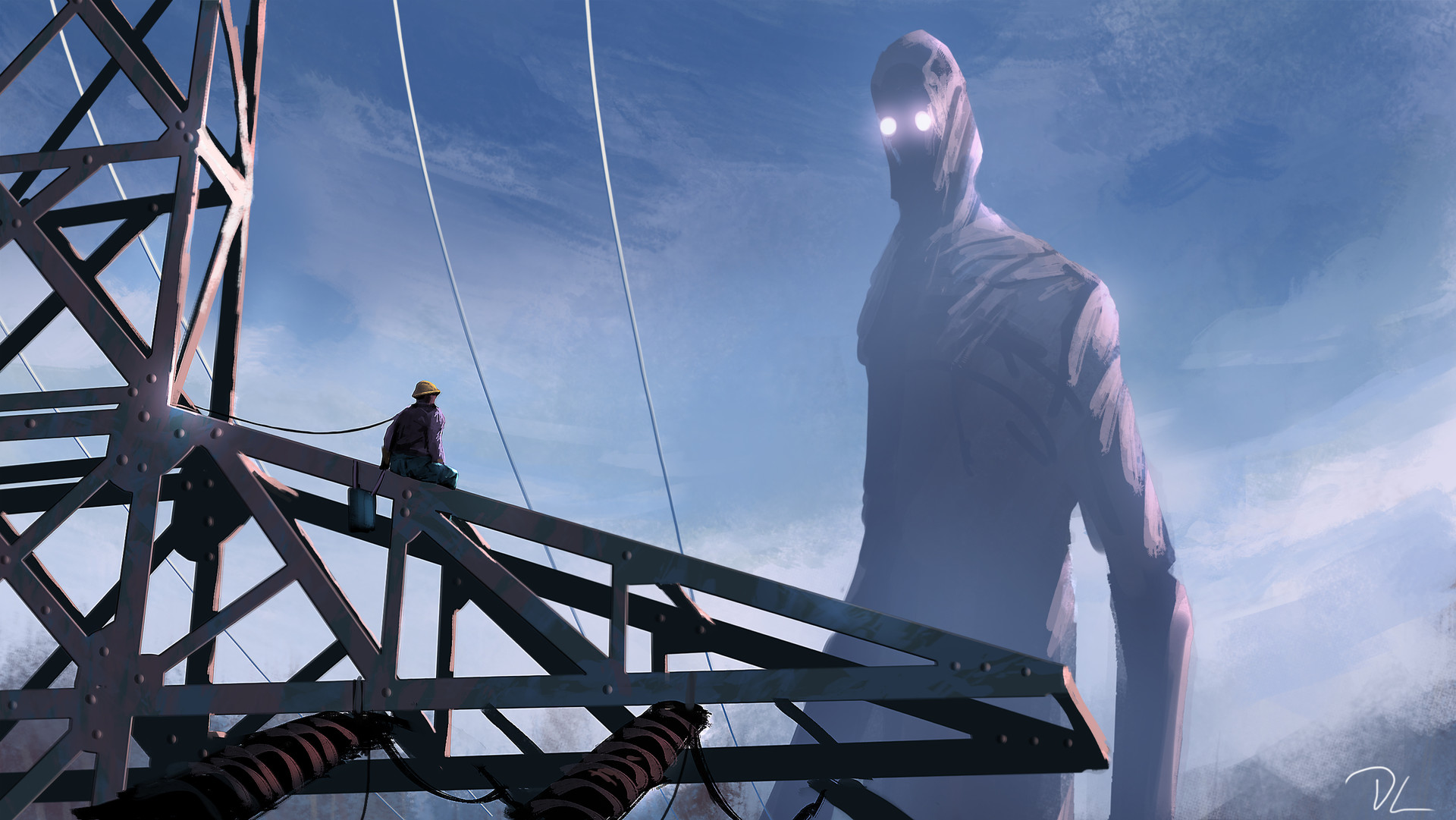
Brief Worldcon Update – and a Fannish Poem

I had a great time at the Glasgow Worldcon, but the internet in my hotel isn’t great. Plus, it turns out that my travel laptop is on its last legs and extremely slow. So you’ll have to wait a bit longer for my Worldcon report as well as the Hugo winner and Dragon Award finalist commentaries, especially since I’m off to Eurocon in Rotterdam almost directly after Worldcon (I have one and a half days to do laundry and shuffle clothes from one suitcase to another). I’ll post my Eurocon schedule once I’m back at home.

But for now, since I’m at the hotel, waiting for the taxi that will pick me up at 3:45 AM to take me to the airport, enjoy this poem I wrote. Any resemblances to persons living, dead or undead are entirely coincidental.

The Phantom of the Armadillo

There’s a spectre haunting Glasgow,
a spectre by the name of Dave.
You might spot him lurking in hotel bars
and skulking around the Armadillo,
forever on the outside,
longingly gazing,
at all the fun had within.

‘Twas scarcely a year ago,
that he was one of them,
wined and dined and feted
and treated like royalty.

And now he’s a pariah,
shunned and barred from entry
and fated to be cursed out
by women in glamorous hats.

How could this happen?
How could it ever come to this?
After all, it’s not his fault that
those Hugos arrived broken.
And surely no one cares about those stats.
And Nepal, Tibet, who
can tell the difference anyway?

And so the spectre of Dave
continues to haunt Glasgow,
forever trapped on the outside,
looking in, ignored
by those who don’t know him
and cursed by those who do,
his very name a cautionary tale
to scare young fans at the con bar.

“Have you…” the old-timers whisper,
“…heard the story of Dave who
fucked aorund with the Hugos and
found out how long
fandom’s memories can be?”

Posted in Con Reports, General | Tagged , , , , , , , , | 4 Comments

Cora goes to the 2024 Worldcon in Glasgow, Scotland – plus bonus He-Man and Teela

Glasgow Worldcon bannerThis week, I’m off to Glasgow for Worldcon. I’ll be flying very early on Tuesday morning and will be gone for a week, then I have two days at home to do laundry, etc…, before I’m off to Rotterdam for Erasmuscon, the 2024 Eurocon. The timing is not great. I think the reason the two cons are so close together is that the organisers wanted to make it easy for overseas visitors to attend both cons in a single trip. However, Rotterdam is not as attractive for overseas visitors as it is for me, who spent some very formative times there, so it looks as if Eurocon will be mostly European fans.

So there will be light to no blogging for the next two weeks and plenty of photos and con reports and Hugo discussion (come on, you know there’ll be Hugo discussion) once I get back. You can also get live updates of what I’m up to on Twitter, Threads, BlueSky or Mastodon.

In the meantime, the Speculative Fiction Showcase and the Indie Crime Scene will still be chugging along, including (somewhat truncated) link round-ups.

But should you find yourself in Glasgow for Worldcon or in Rotterdam for Erasmuscon (schedule will be posted separately), say hello to me. You might even get a tasty North German treat (while supplies last).

You can also find me and several other fine folks on the following panels:

A World Tour Through Comics

Saturday, August 10, 2024, 16:00 BST

Location: Alsh 2, Duration: 60 mins, In Person

Panelists: Barbara Postema (moderator), Cora Buhlert, DestructCode (As an artist), Fulvio Gatti

Whether you call them bande dessinées, historietas, manga, manhua or comics, stories told with sequential art have a long history and a global appeal. Regional traditions can influence each other through publishing styles and ideas, and in this panel we’ll take a tour through the shared history and culture of comics.

The Conclusion of the Retro Hugo Era

Saturday, August 10, 2024, 19:00 BST

Location: Carron, Duration: 60 mins, In Person, Online

Panelists: Cora Buhlert, David E. Hook (moderator), Mark Plummer, Perrianne Lurie, TrishEM

The Retro Hugo Awards, a tradition where Worldcons retrospectively awarded prizes for years prior to the establishment of the Hugo Awards, have had both avid supporters and vocal critics. The last two Worldcons eligible to grant Retro Hugos opted not to do so, and Glasgow is following suit. Does this signify the demise of the Retro Hugos? And if so, is this necessarily detrimental?

Women of Post-war Science Fiction: Writers, Editors, Fans, Artists.

Sunday, August 11, 2024, 13:00 BST

Location: Meeting Academy M4, Duration: 60 mins, In Person

Panelists: Carrie Cooper, Claire Brialey, Cora Buhlert (moderator), David E. Hook, Gabrielle de Cuir

It would be wrong to think of post-war science fiction as a boys club with a “No Girls Allowed” sign on the door. Women were active as writers, editors, fans, and artists, key players in the scene even if outnumbered by their male counterparts. Look back with us on the contribution of these often fascinating characters of late 1940s science fiction.

The full program guide for the 2024 Worldcon in Glasgow may be found here.

***

However, I’m not going to travel to Glasgow on my own. I’ll be bringing along two friends, so let’s take a look at their travel preparations.

Eternos Palace, the private quarters of the royal family:

He-Man is looking at two swords in his living room, while Teela looks on.

The furniture is IKEA doll house furniture.

“I guess I’ll take both the Power Sword and the Sword of Ancients to Glasgow, just to be on the safe side.”

“No, Adam, we have limited space and you’re taking only one sword.”

“But…”

“Only one sword.”

He-Man puts the Sword of Ancients on top of the bookshelf, while Teela looks on.“Okay, the Sword of the Ancients stays here. Happy now?”

“Yes.”

“But why do you get to take a shield and a sword?”

“A girl needs to defend herself. Besides, I’m the Captain of the Guard and your bodyguard, Adam.”

“You are aware that I’m He-Man, the most powerful man in the Universe?”

“But what if you lose your sword and can’t transform?”

“That’s why I wanted to take a spare.”

He-Man holds a pillow, while Teela looks on.“Can I at least take my heart pillow?”

“No. They have pillows on Earth. Your mother confirmed that.”

“But my heart pillow is so soft and cuddly.”

“Adam, no. The pillow stays here.”

“You’re no fun.”

He-Man and Teela sit on the sofa.“So are you excited to visit your mother’s home, Adam?”

“Of course. Though we’re not exactly visiting Mom’s home. Earth is a big planet and Glasgow is in a completely different part of the world than where Mom grew up. Like Eternos and Avion are different places.”

“So Glasgow is like Avion?”

“Well, Mom says that Stratos sounds like he’s Scottish, so I guess it is.”

Gwildor arrives, brandishing the cosmic key.“Hey there, No canoodling. Or as Orko would call it, training. But then Orko is as idiotic as he is short.”

“Thanks for taking us to Glasgow, Gwildor.”

“No problem, no problem at all. My Cosmic Key can send you anywhere or anytime in the universe, as long as I know the right melody. So let’s see. Keying up the coordinates for Glasgow, Scotland, Earth.”

Duh-duu-dummm!

Adam and Teela sit on the sofa.

“Glasgow, here we come.”

ZOOM.

Posted in Books, Comics, Con Reports, Toy Photo Stories | Tagged , , , , , , , , , , , | 3 Comments

Comic Review: Masters of the Universe Revolution Prequel #3 by Ted Biaselli, Rob David, Tim Sheridan and Daniel HDR

This post continues my issue by issue review of the Masters of the Universe Revolution prequel comic mini-series written by Ted Biaselli, Rob David and Tim Sheridan with art by Daniel HDR and Keith Champagne with a look at issue 3. Go here for my takes on issue 1 and issue 2.

Warning: Spoilers behind the cut! Continue reading

Posted in Comics, TV | Tagged , , , , , , , , , , , , , , , , | Leave a comment

Cora Goes to the Virtual SpiralCon

SpiralCon 3 Poster

We are interrupting your regularly scheduled Hugo drama for a con announcement. There’ll be more of those in the days to come, because I’m planning to attend four cons – three physical and one virtual – over the next months and I’m on programming at three of them.

We’ll start off with SpiralCon 3, a virtual con focussed on sword and sorcery, cosmic horror, space opera and adjacent fields, put on by the good people of Spiral Tower Press, home of Whetstone, Witch House and Waystation magazines.

SpiralCon takes place on Saturday, July 27, 2024, i.e. tomorrow (yes, I know I’m late with this announcement), it’s virtual and it’s free, i.e. everybody can attend.

The full program schedule is here.

I’m on two panels:

The Appeal of Contemporary S&S,

Saturday, July 27, 2024, 11:00 to 11:50 am EST

The panel description should be here, though at the moment there’s only a list of panelists and a bio. But then the title is pretty self-explanatory.

Moderator: Sean CW Korsgaard is a United States Army veteran, an award-winning photojournalist, and a freelance reporter with articles published in titles such as The New York Times, VFW Magazine, and Analog. He served as an assistant editor and media relations manager at Baen Books until 2023 and is recognized for his contributions to science fiction and fantasy, including co-editing the anthology Worlds Long Lost. His most recent project orbits his love of sword and sorcery fiction as he is founding a new magazine, Battleborn. Korsgaard holds a degree in mass communications and history from Virginia Commonwealth University.

Panelists: Matt Holder, Cora Buhlert, and Dr. John “Cal” Baldari

Barbarians at the Gates: The Second Sword and Sorcery Boom and the Birth of the Modern Fantasy Genre.

Saturday, July 27t, 2024, 01:30 to 02:20 pm EST

Panel Description: In the mid 1960s, fantasy exploded into the mainstream, when Ace (illegally) published Lord of the Rings in paperback and Lancer began reprinting the Conan stories with Frank Frazetta covers and new material added. Both were huge successes and opened the floodgates for a Barbarian boom that lasted into the early 1980s. However, the sword and sorcery revival had been simmering under the radar since around 1960, when Cele Goldsmith began publishing sword and sorcery in the pages of Fantastic and John Carnell did the same in the UK in Science Fantasy. Fritz Leiber returned to Fafhrd and Gray Mouser, new writers like Michael Moorcock, Lin Carter, Joanna Russ and Roger Zelazny entered the genre and the fanzine Amra provided a place for fans and writers of the still nameless genre to get together. This panel will explore how the 1960s sword and sorcery boom came to be and how it continues to influence the fantasy genre until this day.

Moderator: Cora Buhlert: Buhlert is a Hugo Award-winning author based in Bremen, Germany. She holds an MA degree in English from the University of Bremen. Buhlert has published a wide array of stories, articles, and poetry in various international magazines. Her literary works span multiple genres, including pulp-style thrillers, space opera series, and the Thurvok and Kurval sword and sorcery series. Buhlert won the 2022 Hugo Award for Best Fan Writer and the 2021 Space Cowboy Award. She also works as a professional translator and has experience teaching English and German as a foreign language.

Panelists: Cora Buhlert, Paul Weimer, Brian Collins, and Kris Vyas-Myall.

ETA: Shownotes with links to the panelists websites, social media, etc… are now online.

So what are you waiting for? Come and see us at SpiralCon tomorrow.

Posted in Books, Con Reports | Tagged , , , , , , , , , , | Leave a comment

We’re Having Hugo Drama… Again

Apparently, we are not able to get through an awards season without Hugo drama and Worldcon drama in general. Especially since I really don’t have time for this right now, cause I have to prepare for three cons where I’m on programming, plus I’m still trying to write a story every day and I also have to work to pay for food, power (just ordered the yearly supply of oil for the furnace), books, toys, Worldcons and other essentials.

So since I’m busy, this is going to be a fairly short post, amended as and if necessary.

Earlier today, in the Hugo finalist Discord (which I founded, so I’m active there, even though I’m not a finalist this year), finalists were talking about receiving an e-mail about a virtual town hall meeting for all finalists that was set up on short notice. These virtual meetings are not unusual and usually involve logistical issues and since I’m not a finalist this year, I didn’t pay much attention.

Anyway, it turns out that the Glasgow Hugo administration team dropped a bombshell at this virtual town hall meeting and later also in a public statement, which can be found here. There’s also a YouTube video of the statement by 2024 Hugo administrator Nichlas Whyte, which has some additional information.

Basically, it turned out that there had been an attempt to stuff the Hugo ballot by someone or rather someones buying a large number of supporting membership with blatantly false names like several variations of the same name (John L. Smith, John S. Smith, Joan Smith, Joanne Smith, J. Smith, etc…) as well as consecutive numbers. These fake members bullet-voted for a particular finalist and generally submitted very unusual ballots.

The Hugo team caught this and disqualified 377 obviously fraudulent votes altogether, which is almost ten percent of the total. The finalist who was the beneficiary these fraudulent votes was not disqualified and has not been publicly named, since there is no evidence that they were aware of any of this.

This is obviously a big deal and even though there have been attempts to game finalists onto the ballot before, I don’t think any person, entity or group has ever attempted to manipulate the final voting, since it takes many more votes to win a Hugo than to make the ballot. Also, a supporting a.k.a. WSFS membership costs 50 US-dollars, so this is also quite expensive – roughly 19000 US-dollars – so whoever is behind this has deep pockets. Thankfully, they were also clumsy and didn’t even consider using a name generator or otherwise hiding their trail.

I applaud Nicholas Whyte and the Glasgow Hugo team for transparency in what must have been a difficult decision, because Hugo ballots are not disqualified lightly, and also for keeping the name of the finalist in question out of this.

That said, speculations are obviously flying high, both among finalists and the general public. I’ve been told that some of the fake member names were visible on the public membership list until fairly recently and I have seen screenshots, but most of those names seem to have been removed. The list of countries of origin of Worldcon members broken down into membership categories is also interesting.

John/ErsatzCulture noticed the membership weirdness some time ago and took screenshots, which he shared on Twitter. He also points out that the Glasgow statement refers merely to a finalist and notes that there are more Hugo categories than just the fiction categories.

Of course, this is all just speculation. We don’t know who the finalist in question is, though we can make some educated guesses, and we will probably be able to tell for sure when the detailed voting data is released, though the fraudulent ballots have been removed.

ETA: John/ErsatzCulture also tweeted that it’s possible to make an educated guess about who the finalist in question might be by checking out the number and range of nominations needed to make ballot that was released with the finalist announcement, because there is a notable outlier in one category. Though again, we have no way of knowing for sure and there is also no indication that this finalist was aware of what was going on.

ETA 07-24-2024: Heather Rose Jones has taken up John/ErsatzCulture’s suggestion and compared the 2024 Hugo nomination data we have at this point (the full nomination data won’t be released until after the Hugo ceremony) to previous years and found that two categories – Best Fancast and Best Related – did receive more nominations than usual for those categories and had outliers, where one finalist received a lot of nominations. However, Heather also points out that this isn’t without precedent and that there have been previous examples where the Hugo electorate had a strong preference for one finalist who received a lot more nominations than the next finalist. So in short, something shady might be up or it might be that a lot of people organically nominated one particular finalist. At this point, it’s too early to tell.

Also, as I said in my coverage of the 2023 Hugo mess, it’s never a great idea to try to screw with a community that does data analysis for fun, because you’ll not only get caught, but they’ll probably catch the Worldcon member who filled out a ballot on behalf of their cat, too, while they’re at it. And last year’s and this year’s attempt to manipulate the Hugo votes were so clumsy that it’s amazing anybody thought they could get away with this.

ETA 07-24-2024: Another theory is that this might be a case of betting fraud, since a betting website is offering betting on the Hugo winners for Best Novel, Best Graphic Story and Best Fancast. Best Fancast is one of the two outlier categories identified by Heather Rose Jones. Of course, you can bet on pretty much anything, if you’re so inclined, and besides, the betting website wrongly credits the Publishing Rodeo fancast to Steven Soderbergh rather than to Sunyi Dean and Scott Drakeford, who actually run it.

There is some discussion about this issue in the comments at File 770 and Camestros Felapton’s blog.

Also, considering a WSFS membership includes privileges other than Hugo voting, may I remind you to vote in site selection for the 2026 Worldcon this year, if you’re an attending or supporting Worldcon member. The race seems uncontested, since the only bid is for Los Angeles, California, but write-ins are a possibility.

ETA: 2024 Hugo finalist John Scalzi weighs in on the latest Hugo drama and praises the Glasgow Hugo team for their handling of the issue.

ETA 2: The latest round of Hugo drama has reached the Guardian. The headline of Sian Cain’s article is misleading, since it says that the fraudulent votes were intended to benefit a writer. However, the statement by the Glasgow Hugo team only uses the term “finalist” and never specifies that the finalist in question is a writer, since there are Hugo categories which are not for written works.

ETA 07-24-2024: The latest round of Hugo drama has reached CNN, a news outlet I don’t recall covering the Hugos in previous years. There is an article by Louis Mian and the Hugo drama is also included in CNN‘s “Five Things” brief news round-up.

ETA 2 07-24-2024: The Bookseller also has an article by Maia Snow about the Hugo fraud attempt. This one doesn’t say anything new, though it’s interesting that the illustration is a bin of used Star Trek tie-in novels. Nothing against Star Trek tie-in novels – I think a lot of us read and enjoyed them back in the day – but it’s not really an ideal illustration for an article about the Hugo Awards.

ETA 3 07-24-2024: At Polygon, Tasha Robinson has a pretty extensive article about the current Hugo drama as well as a rundown of previous Hugo messes. The Polygon article also appears on the Spanish site Zona Gamer and the German site News Text Area in what appears to be a machine-translation (or a not very good human translation). Found via trackbacks to my site.

ETA 1 07-26-2024: BookRiot also has an article about the 2024 Hugo scandal with references to previous scandals.

ETA 2 07-26-2024: At Comics Beat, Dean Simons has an article about the 2024 Hugo voting fraud scandal with the depressing headline “Another year, Another scandal”.

ETA 4 07-26-2024: Mark McDougall reports about the 2024 Hugo voting fraud scandal for the Scottish newspaper The Herald.

ETA 07-25-2024: The Brazilian news site O Globo also has an article about the 2024 attempted Hugo fraud. Found via 2024 Nebula and Ignyte finalist Renan Bernardo.

Finally, in other, better news, the finalists for the 2024 Ignyte Awards have been announced today. I don’t cover the Ignytes in detail in this blog, because I have only so much bandwidth, but they alway have interesting finalists, including some that are overlooked by other genre awards. I’m particularly happy to see my good friends of the Simultaneous Times podcast on the Ignyte ballot this year.

Posted in General | Tagged , , , , , , | 12 Comments

The 2024 July Short Story Challenge – Day by Day

Blogging is light right now, because I’m getting ready for Worldcon and I’m also doing the July Short Story Challenge again.

What is the July Short Story Challenge, you ask? Well, in July 2015, Dean Wesley Smith announced that he was planning to write a brand new short story every day during the month of July. The original post seems to be gone now, but the Wayback Machine has a copy here. At the time, several people announced that they would play along, so I decided to give it a try as well. And then I did it again the following year. And the next. And the next. If you want to read my post-mortems of the previous July short story challenges, here are the posts for 2015, 2016, 2017, 2018, 2019, 2020, 2021, 2022 and 2023.

Initially I was unsure whether I was going to do the challenge this year, because I caught some nasty cold/flu bug (not covid according to a test) in June, which knocked me out for a week, and was also busy with translation work, taxes and preparations for Worldcon in Glasgow. But then I decided to give it a try and see I could make it work. And since I wasn’t sure whether I would be able to do the challenge, I also held off posting the day by day post.

Initially, I committed to the challenge only for a week, but when the first week was over, I kept going. And now we’re already at the two week mark, so I might as well post the day by day overview.

In previous years, I’ve always done a post-mortem post about the July Short Story Challenge in August. In 2019, I also started keeping a running tally of all stories written to date right here on this blog to hold myself accountable. It worked well and so I did it again in 2020, 2021, 2022 and 2023. I will do it again this year as well and will update this post with every new story. This tally will be very basic, listing just the date, title, word count, genre, series, if any, and maybe a one or two sentence summary/comment.

Most of these stories will become longer in editing. Many will eventually change their titles and some may never see the light of day at all.

If you want to follow along with the challenge, bookmark this post. And if you want to play along or cheer me on, feel free to do so in the comments.

And now, let’s take a look at the stories:

July 1, 2024: “So You Want to Be a Cozy Witch…”, cozy fantasy, 1069 words

Basically, this story is a summary of every witch cozy mystery series ever. The inspiration was compiling the end-of-the-month new release round-up for the Speculative Fiction Showcase and the Indie Crime Scene. One type of book I unfailingly have in the round-up every month are witch cozies. And having read so many blurbs for witch cozies, it’s hard not to notice that these series have a lot of similarities. So I set out to write a ultimate guide to every witch cozy series ever.

July 2, 2024: “Hansemann’s Bakery” (The Culinary Assassin), crime fiction, 1366 words

The world’s only gourmet hitperson goes to a bakery, buys a caraway breadstick and kills an abusive husband.

Yeah, it’s another Culinary Assassin story. I really need to collect these, since I have a bunch of them by now. The inspiration for this story was heading to a local bakery when they open at five AM and it was just getting light outside. And yes, the bakery is real.

July 3, 2024: “The Restaurant at the End of the World”, post-apocalyptic, 3182 words

Steve is fourteen, when the nukes fall. He survives inside an abandoned Cold War era bunker in the woods. When his supplies finally run out after four years, Steve is forced to leave his bunker in search of other survivors. But all he finds are burned out ruins, until he comes across an almost intact restaurant by a crossroads – and it’s owner, Ruth…

The inspiration for this story was this piece of concept art by Alariko. Steve is named for Steve Guttenberg, who was in The Day After, while Ruth is named for the closest thing to a protagonist that Threads has.

July 4, 2024: “Limbo”, crime fiction, 774 words

Sam is in prison, awaiting execution. But there is an unexpected delay…

The inspiration for this one was Punk Noir Magazine‘s flash fiction writing prompt “Limbo”. Of course, I missed the deadline to actually submit the story, but nonetheless, I suddenly had the idea of writing a story about someone in prison, awaiting execution.

July 5, 2024: “The Watcher on the Heath”, historical fiction, 1407 words

Millennia of history are told from the POV of a glacial erratic deposited on the heath.

The inspiration for this one was visiting a neolithic grave mound and assembly of glacial erratics in the village of Anderlingen.

July 6, 2024: “The Night The Thing Attacked Harbour Town”, cosmic horror, 1590 words

Prohibition era gangsters versus Cthulhu, ’nuff said.

The inspiration for this one were these three pieces of fantasy art by Richard Wright.

July 7, 2024: “Revenge of the Black Gargoyle”, pulp fiction, 2469 words

Thomas DeVane a.k.a. the vigilante the Black Gargoyle has finally found the man who murdered his parents, industrialist Atlas Snow. So DeVane infiltrates Snow’s skyscraper headquarters to take out the man himself.

The inspiration for this story was this piece of artwork by Christophe Vacher. It appealed because of the pulpy vibes and so I wrote a pulp vigilante story. Of course, I already have a pulp vigilante character in Richard Blakemore a.k.a. The Silencer, but he wouldn’t have worked for this story because of the revenge angle. So I created a new character who is somewhat inspired by Batman.

July 8, 2024: “The Whispering Stone”, time travel, 1102 words

In a small town about an hour inland from the North Sea there stands a stone stele that emits eerie whispers. The stele is very old and mentioned in the writings of Roman historians, Frakish missionaries and medieval chronists. Once recording equipment becomes available, scientists examine the stele and record the whispers and finally realise that they are message transmitted through time. And then they receive a terrifying warning…

The inspiration for this story is a sculpture in the city park of the town of Zeven named the Time Whisperer. I came across the sculpture during a stroll through the city park, though I can’t find any info about it online. The name intrigued me, so I wondered what if that sculpture really could transmit whispered through time. The story grew from there.

July 9, 2024:  “Meg’s First Day of School”, post-apocalyptic, 541 words

Meg lives in a mountain hut and today is her first day of school in the valley. But getting there requires crossing a field full of fallen mechas left over from the robot uprising…

The inspiration for this story was a piece of science fiction art of a little girl in a meadow full of fallen and overgrown robots. Unfortunately, I forgot to bookmark the artwork and I can’t find it right now. This is more of a vignette than a story, but I was tired.

July 10, 2024: “Fairy Doors”, fantasy, 1937 words

Fairy doors suddenly appear in the trunks of tree all over the neighbourhood of Shady Grove. The people believe it’s a prank or an art project, though no one ever comes forward to confess being responsible. Nonetheless, everybody is delighted. But then a cat goes missing and then other pets. And finally, children go missing…

The inspiration for this story was an article about fairy doors appearing in Brooklyn Heights. This story starts off quite cosily and then takes a turn into darkness…

July 11, 2024: “Home Story”, horror, 911 words

A TV journalist arrives at the country home of Secretary of the Interior Jeremiah Rice-Smythe. However, all is very much not as it seems…

The inspiration for this story was a news headline that the former British conservative MP Jacob Rees-Mogg would star in reality about himself and his family, which prompted plenty of jokes on Twitter about how Rees-Mogg was a vampire or some Lovecraftian entity. So I thought, what if he really was a vampire. What would happen to that TV team?

July 12, 2024: “King of the Raven”, horror, 572 words

Ravens are gatherine in the town of Fog Haven, watching and waiting for their king to arrive…

The inspiration for this story was this piece of horror art by Denis Loebner and the book and movie The Birds. Another quick flash piece, because I was tired.

July 13, 2024: “The Skull Mace”, dark fantasy, 697 words

The skull mace is a prized museum exhibit, a rare artefact of the Vilkor people who used the body parts of their slain enemies to fashion their weapons. But intern Kitty Chan questions whether it’s ethical to display a weapon made from a human skull. The skull, meanwhile, has ideas of its own…

The inspiration for this story was this drawing by Alexander Trufanov of a mace made from a skull, paired with a recent Twitter thread about museum exhibitions, warning labels and exhibits removed from display or not. Kitty Chan is also the name of the doomed museum intern from my story Paris Green.

July 14, 2o24: “Revenge Served Hot”, crime fiction, 428 words

The unnamed protagonist has had enough and decides to take revege on a greedy law firm. So the protagonist heads to the law firm’s office, a can of gasoline hidden in their briefcase…

The inspiration for this one was a report about an lethal arson attack on a club in Munich in 1984, which I had never heard of before. The real arsonists were far right fundamentalist Catholics intent on exterminating supposed “sinners”, but I changed the target and motivation of the arsonist.

This is the shortest story yet, but it didn’t any more space and I’m quite happy with how it came out.

July 15, 2024: “Indigo Deep”, cosmic horror, 606 words

Indigo Deep is a unique undersea luxury resort and its biggest attraction is the Deep Water Lounge, where you can watch deep sea lifeforms in their natural habitat through the large observation windows while enjoying a five course gourmet meal. The highpoint of the evening is when a Great Old One shows up outside the observation windows during the fourth course. However, the guests of Indigo Deep are about to find out that tonight, they are the last course on the menu…

This story was inspired by this piece of artwork by Denis Loebner. It’s very bare bones and will need fleshing out, but I rather like the idea.

July 16, 2024: “The Lighthouse at the Edge of the World”, cozy fantasy, 2140 words

Fifteen-year-old Fiete ran away to sea, because he wanted to get out of the confines of his hometown and he wanted adventure. He certainly found it, too, when the signed on aboard the Cockatrice, which is headed for the edge of the world and beyond.  Alas, the sea is treacherous so close to the edge of the world. The Cockatrice sinks and while Fiete survives, clinging to a barrel, he is pulled inexorably towards the waterfall at the edge of the world. But then he finds salvation in a lighthouse that sits at the very edge of the world…

The inspiration for this story was this piece of fantasy art by Denis Loebner. I really like how this story came out.

July 17, 2024: “The Tall Man of Misty Valley” (Hallowind Cove), cozy horror, 1448 words

One evening, electrician Bob O’Leary stumbles into The Croaking Foghorn, a harbourside pub in the fog-shrouded seaside town of Hallowind Cove, also known as harbour of the weird due to being a magnet for supernatural occurrences. Bob needs a drink and he has a story to tell, a story about his encounter with the Tall Man…

Yup, it’s another Hallowind Cove story and another tale told in a bar. The inspiration for this one were these two pieces of fantasy art by Denis Loebner.

July 18, 2024: “Headsman’s Cross”, historical fiction, 1459 words

Matthias von Zornhau is a travelling executioner in medieval Germany. He’s unhappy with the profession he was forced into and while taking a break on the shores of the Baltic Sea, he has an epiphany…

The inspiration for this story was this piece of artwork by Piotr Jab?o?ski called Headsman’s Cross. It looks like an executioner’s sword rammed into the ground, so the pommel and crossguard form a cross, while the sun comes up behind, so I wondered what might persuade an executioner to abandon the most importanht instrument of his job like this. I’m quite happy with how this story came out.

July 19, 2024: “The White Tree”, dark fantasy, 869 words

The Sorceress Lilaya goes on a pilgrimage to the mythical white tree to beg for a cure for the silver fever which has struck down her lover Oronis. But there is a price for the tree’s aid…

This inspiration for the story was this piece of fantasy artwork by Nele Diel. Considering how short the story is, this one gave me a lot of trouble.

July 20, 2024: “Dark Homecoming”, dark fantasy, 1070 words

Keragon was driven out of the mountain kingdom of Caridia when he was just a boy – for being born a bastard and dabbling in magic. Now, fifteen years later, he’s back, armed with powerful magic and thirsting for revenge. But things don’t go the way he thinks…

The inspiration for this story was this piece of fantasy artwork by Nele Diel.

July 21, 2024: “The Mystery of Gnumpet Rock”, Nordic noir weird, 1909 words

The famous painter Lars Ramsland goes missing on a nature painting trip in Northern Norway. Inspector Karin Sandvik of the Bergen Police is called in to find him. She does manage to track Ramsland to his last painting spot on a plateau opposite a curious jutting rock named Gnumpet Rock that is a connected to a local legend. But sometimes, there is no culprit who can be arrested and no explanation that makes sense in a rational world.

The inspiration for this story was this piece of fantasy artwork by Ørjan Ruttenborg Svendsen (who’s actually Swedish rather than Norwegian). I actually wrote another Noridc Noir Weird (hey, I coined a new genre) story for a previous July short story challenge, where the premise is basically Inspector Wallander meets aliens. Maybe this should be a collection eventually.

July 22, 2024: “The Ghostcatcher” (Jelka the Ghostcatcher) , sword and sorcery, 783 words

Jelka is a ghostcatcher, who prowls graveyards and other places of death by night to capture ghosts and sell them to alchemists, sorcerors, necromancers and anybody else who has need of a ghost in a jar.

This is another story inspired by a piece of fantasy art, namely this one by Lie Setiawan.

July 23, 2024:  “The Hand of Glory” (Jelka, the Ghostcatcher), sword and sorcery, 1071 words

Jelka the Ghostcatcher returns, this time to steal the hand of a hanged women and sell it to an alchemist to make a Hand of Glory.

The inspiration for this story was this piece of fantasy art by James-Christopher Fauvelle as well as coming across a reference to a Hand of Glory. And since I already had a character who supplies alchemists and sorcerers with hard to come by ingredients, I just reused Jelka, so I guess she’s a series character now.

July 24, 2024: “Clone No. 17 is Dead”, science fiction, 340 words

Colonel Dhansak reports to his superior General Madras that another member of their clone army has keeled over and died.

A very short flash piece today, but then I had a busy day. The inspiration for the story was this piece of science fiction art by Alex Pronin and its title.

July 25, 2024: “The Crypt of the Mourning Lady” (Jelka, the Ghostcatcher), sword and sorcery, 1394 words

Jelka the Ghostcatcher is hired to procure a specific ghost from a private cemetery and the tomb known as the crypt of the mourning lady…

Yup, it’s another Jelka story, the third to originate from this challenge. I guess there’ll be a collection eventually. The inspiration for this one was this piece of fantasy art by Erik Nykvist.

July 26, 2024: “Invasion Thwarted”, science fiction, 656 words

An alien invasion of Earth is thwarted, when the aliens decide to land in Antarctica, but are not at all prepared for cold and ice…

A short flash piece, because I had a busy day. This one was inspired by a piece of SFF art, depicting spaceships frozen in the ice, but I can’t find it now.

July 27, 2024: “The Valley of the Cosmonauts”, post-apocalpytic, 1367 words

Ruslan and Nazira work as couriers in Kazakhstan after a nuclear war. One day, they must cross the Valley of the Cosmonauts, a former rocket launch site littered with giant statues of cosmonauts…

This story was inspired by two pieces of evocative SFF art, namely this one and this one by Xiaoyu Wang. There isn’t much of a plot, it’s more of a mood piece, but I like how this one came out.

July 28, 2024: “The Gateway”, time travel, 1091 words

1241 AD: The Cistercian monk Brother Aloysius walks through the large gateway into the abbey church and emerges into a scene of pure hell and pandaemonium. Will his faith be enough to protext him?

2024 AD: Chief Inspector Katrin Nordholz and her assistant Inspector Nils Hatten investigate the mysterious death of a man dressed in a monk’s robe who stumbled into traffic and was run over outside a ruined abbey. But where did the mysterious monk come from, when no monk has been reported missing?

The inspiration for this story was Caspar David Friedrich’s famous (and lost) painting “Ruined abbey in the snow”. Friedrich’s painting depicts Eldena abbey near Greifswald, but even though I have visited Eldena abbey, what I had in mind was Hude abbey rather than Eldena. They’re both Cistercian ruins, though.

I really like the idea behind this one and may expand it.

July 29, 2024: “The Grove of Thorns”, folk horror, 716 words

The woodland known as the Grove of Thorns has been standing in the middle of the moors for as long as anybody can remember. And for just as long, the locals have avoided the grove and children have been warned never to go there. But warnings do not deter fourteen-year-old Aidan, who is determined to visit the Grove of Thorns one summer day…

This creepy little folk horror tale was inspired by this piece of horror artwork by Nikita Shushman. In general, I seem to be writing a lot of flash pieces this year, but then the past few days have been difficult with Worldcon less than a week away, SpiralCon and the workload generated by the Speculative Fiction Showcase link round-up near tripling due to all the news from San Diego Comic Con.

July 30, 2024: “The Bones in the Forest”, fantasy, 797 words

While chasing after an escaped goat, Mellyn finds the bones of a giant creature on a hilltop as well as a rusty sword still embedded in the ribcage. Her grandfather tells her the story of Morvoren, the last dragon, and of the knight who claimed to have slain him, but was cheated out of his just reward…

Another flash piece. Gearing up for Worldcon, I’ve been busy, so flash pieces are all I can manage right now. The inspiration was this piece of fantasy artwork by Jesper Andersen.

July 31, 2024: “Witch Queen of the Shadow Isle”, sword and sorcery, 2020 words

Aurya, captain in army of Avoria, leads her squad of amazon warriors against the stronghold of Vultra, the Witch Queen of the Shadow Isle. But Vultra is not what she seems and harbours a deadly secret. However, Aurya has a secret of her own…

A longer story to finish the challenge. The inspiration for this story was this stunning piece of fantasy artwork by Simon Eckert based on the 1980s Golden Girl toyline by Galoob. Golden Girl and the Guardians of the Gemstones was a She-Ra competitor that at least here in Germany actually hit shelves before She-Ra herself did. I actually have two of the figures in my collection and always liked them, though I remember very little of the backstory. Not that I think there was much backstory or a lot of serial numbers to file off.

This story is basically the Golden Girl version of the 2018 She-Ra reboot, where everybody is queer. I really like this one and think I will expand it eventually.

***

And that’s it for the 2024 July short story challenge. This one was hard at time, particularly towards the end, when I was busy with Worldcon preparations.

Lots of flash pieces this time around, but also some more substantial stories plus a new character in Jelka the Ghostcatcher and a handful of stories I really like.

Posted in Writing | Tagged , , , , , , , , , , , , , , , , , , , , , , , , , , , , , , , , , , , , | 1 Comment

Comic Review: Masters of the Universe Revolution Prequel #2 by Ted Biaselli, Rob David, Tim Sheridan and Daniel HDR

This post continues my issue by issue review of the Masters of the Universe Revolution prequel comic mini-series written by Ted Biaselli, Rob David and Tim Sheridan with art by Daniel HDR and Keith Champagne with a look at issue 2. For my take on issue 1, go here.

While the first issue opened with the creation of the universe according to Ha’vok, this issue opens in outer space. We see Zal-Kron, a glittering crystalline orb in space. An unseen voice explains that Zal-Kron is a kind of Dyson sphere that houses an advanced civilisation and masquerades as a star to keep would-be invaders away. For Zal-Kron has developed advanced crystal-based semiconductor technology, which would make them a juicy morsel for any would-be conqueror and has now brought a Horde cruiser to their doorstep. And the crew of that Horde cruiser is not fooled by the star disguise at all.

I know my fair share of Masters of the Universe lore, but I’d never heard of Zal-Kron before. I initially assumed Zal-Kron originated in The New Adventures of He-Man cartoon, because New Adventures had a science fiction/space setting, so that would make sense. However, it turns out that Zal-Kron and its inhabitants actually stem from a Brazilian Masters of the Universe comic, so that’s a very deep cut. Though artist Daniel HDR is Brazilian and therefore familiar with those comics. Besides, I’m also happy to see the various international Masters of the Universe tie-in media acknowledged, whether it’s the German audio dramas or Brazilian comics or whatever else is out there. Because in its heyday, Masters of the Universe was a truly global phenomenon and to some degree it still is.

The scene then shifts to the bridge of the Horde cruiser, where we see Keldor in full Horde garb, sprawled in the captain’s chair while channelling his inner Captain Kirk, which makes sense, considering that William Shatner voiced Keldor in Masters of the Universe: Revolution. And yes, I’m sure that the bridge of the Horde cruiser was very deliberately designed to look like the bridge of the USS Enterprise NCC-1701 to evoke that Star Trek feeling. Screen Rant reviewer Shaun Corley also notes the Star Trek parallels here.

Captain Keldor’s crew consists of several familiar Horde members whom we already saw in issue 1. The infodump about Zal-Kron is delivered by none other than Galen Nycroft a.l.a. Modulok. Again, this makes sense, because J. Michael Straczynski, who created the backstory for the character, loosely based him on Mr. Spock – if Spock were evil, had two heads and could reconfigure his body. And if Modulok is the Spock to Keldor’s Kirk – well, imagining the fan fiction is fascinating, especially since Keldor has been confirmed as bisexual in the Masters of the Multiverse comic mini-series.

Also present on the bridge are Mantenna, new Horde members Tarangela and Succubug, who seems to have taken Uhura’s part, as well as Grizzlor (explicitly addressed as “Mr. Grizzlor” by Keldor at one point) who mans the weapons station. This turns out to be a mistake, because Grizzlor isn’t the sharpest knife in the Horde’s cutlery drawer and indeed there’s a running gag of other characters telling Grizzlor to shut up, because he’s not very smart. And so Grizzlor not only arms the torpedoes, as Keldor orders, but fires them as well – after all the firing button is right next to the other one – which pretty much ruins Hordak’s orders to observe and gather intelligence, but not to engage. Not that Keldor minds much, though he does tell Grizzlor to shut up. On the contrary, he seems to be having the time of his life in a glorious splash page that shows him cutting loose with his magic and blasting the hapless inhabitants of Zal-Kron. I enjoyed Daniel HDR’s artwork in issue 1, but issue 2 is even better, because Daniel HDR clearly excels at drawing gorgeous science fiction settings.

Masters of the Universe may be primarily fantasy, but there have always been science fiction elements as well. Spaceships aren’t all that uncommon in Masters of the Universe. We see several spaceships in the Filmation He-Man cartoon and even more in the She-Ra cartoon. Even Skeletor or rather Keldor commanding a spaceship isn’t something we haven’t seen before – since Skeletor did exactly that in 65 episodes of the New Adventures of He-Man cartoon.

What is more, there are quite a lot of links between Star Trek and Masters of the Universe. Filmation produced both the original He-Man and She-Ra cartoons and Star Trek: The Animated Series. All three shows also shared several sound effects. What is more, Star Trek writer and story editor D.C. Fontana also wrote the memorable He-Man episode “Battlecat”, which explains how Adam found Cringer and how Cringer first became Battlecat. And Masters of the Universe: Revolution has three Star Trek actor among its stellar voice cast: William Shatner as Keldor, John de Lancie as Granamyr and Gates McFadden as Queen Marlena.

But in spite of all the behind the scenes connections, the explicit Star Trek feel is something new for Masters of the Universe. Because Masters of the Universe spaceships normally don’t look all that Star Trek inspired but instead draw on sources ranging from vintage pulp science fiction via Star Wars, H.R. Giger and Jack Kirby comics to 1980s science fiction. In New Adventures, Skeletor looks positively cyberpunky. His crew are a bunch of Space Mutants who are among the most bizarre beings ever seen in Masters of the Universe, a property which has plenty of weird creatures. The Mutant Mothership is an organic looking monstrosity, while the Space Mutants’ base Nordor is a hollow moon shaped like a skull. In the Filmation She-Ra cartoon, Horde Prime’s flagship The Velvet Glove (which must be one of the best spaceship names of all time) is a Gigeresque nightmare of pipes and jets, which sports a stylized face of someone who looks like a member of Hordak’s species (likely Horde Prime). So in short, spaceships in the various incarnations of Masters of the Universe are usually a lot weirder than those of Star Trek. That said, it’s notable that the exterior of the Horde cruiser seen in orbit above Zal-Kron in the opening page looks exactly like the Horde cruiser King Micah of Bright Moon used to escape from imprisonment on Horde World in the Filmation She-Ra episode “Micah of Bright Moon”. The interior is very different, because the cruiser stolen by Micah has a much smaller cockpit than the large Star Trek style bridge seen in this comic.

That said, while parts of this comic have a distinct Star Trek vibe, this is very much the Star Trek of the mirror universe, not the prime universe. Because Keldor and the Horde, even if they’re cosplaying Star Trek, are still very much the bad guys here who attack an innocent world with zero provocation. In the previous issue, Keldor was still a confused young man who’d been raised with expectations of future greatness he doesn’t know how to fulfil and who wants nothing more than for his Daddy to love him. But by issue 2, he is a full blown villain, though he is still Keldor and not yet Skeletor. Also – and I hate to say this – he is a very handsome villain. Now Keldor usually is portrayed as handsome, because that makes the contrast to Skeletor even bigger. But Daniel HDR’s version of Keldor is very handsome indeed and – dare I say it – sexy. I could completely understand Lyn falling for him, except that in the Revelation/Revolution continuity, Lyn didn’t even meet Keldor until he was Skeletor.

While Keldor and the Horde Forces are taking Zal-Kron, Hordak – who never fights his own battles, as he himself pointed out in Masters of Universe: Revolution – is once again elsewhere. We see him in what appears to be a yurt with a burning fire and a baby’s crib filled with straw. Of course, Hordak and baby cribs will always be associated in our minds due to the kidnapping scene from The Secret of the Sword. But that’s not what we’re seeing here. Instead. we are seeing a memory or rather a dream of Hordak’s childhood and the place where he spent it with his older brother – an older brother who enjoyed games and riddles and tormenting his younger sibling. That older brother of course grew up to be Horde Prime (which is confirmed later on in the comic). We also learn the name their father, because Hordak is referred to as “Son of Gaull”.

The yurt, the fire and the crib – which turns out to be empty – look very low tech, almost primitive, which is fascinating, because I for one had not expected that Hordak and Horde Prime, the two premiere tech lords of the galaxy, grew up in a yurt and slept in straw-filled cribs. I also hadn’t expected Hordak to come from a steppe culture. But then, we’ve never actually seen another member of Hordak’s species except for Horde Prime (and we never see him in the original Filmation cartoon either, though we do see him later in in comics and of course in the 2018 She-Ra series, which has a completely different continuity), so we don’t know anything about Hordak’s people. Of course, this also begets the question: How exactly did two boys from a steppe culture grow up to run a high tech intergalactic empire?

Masters of the Universe Classics Horde Prime and Despara and Masterverse Emperor Hordak

An unhappy family: The sons of Gaull, Horde Prime and Hordak, and Hordak’s adopted daughter Despara. I must really get Horde Prime his staff, which was sold as part of a Masters of the Universe Classics Weapons Pack, because without his staff, Horde Prime feels rather impotent. And we don’t want the supreme ruler of the Horde Empire to feel impotent, do we?

While Hordak is dreaming of his clearly unpleasant childhood, an unseen voice is taunting him and also points out that there are a lot of parallels between Hordak and their mutual acquaintance, Prince Keldor, since both suffer from a massive and extremely toxic case of sibling rivalry. Though it must be noted that Keldor didn’t hate or resent his younger brother, at least not when we encounter them as young children in Masters of the Universe Revolution. Meanwhile, Hordak seems to have had a terrible relationship with his brother from the very start.

The reference to Keldor finally tips off Hordak about the identity of the unseen voice. It’s none other than Shadow Weaver, though she is only referred to as “Weaver” here and also doesn’t wear her iconic fuchsia-coloured robes, probably due to the well-known rights issues with the characters originating in the Filmation She-Ra cartoon.

Hordak is understandably pissed off that Shadow Weaver is invading his dreams. We also get an image of Hordak enjoying his “nightly restoration cycle”, as he puts it, in a high-tech bed aboard the Horde flagship, surrounded by monitors and with cables attached to him. This suggests that Hordak needs regular medical support, which again isn’t something we haven’t seen before. After all, Hordak is very old – hundreds, possibly thousands of years old – and we don’t know if his species gets so old naturally or whether they require life-extending technology. Hordak also has cybernetic parts such as his arm cannon and his ability to transform into anything from a rocket to a tank is also clearly not something he was born with. The “Eternity War” comics by DC show Hordak permanently attached to a mess of cables that keep him alive and in the 2018 She-Ra cartoon, Hordak is suffering from a genetic defect and needs his suit/exeskeleton to keep him alive and upright.  Something similar is likely happening here.

As for why Shadow Weaver is invading Hordak’s dreams – or, as she cattily puts it, nightmares – it turns out that the rest of her coven of Ha’vok worshipping weird sisters were not exactly thrilled when Shadow Weaver told Hordak about the Havoc Staff and that he needed to find someone to wield it on his behalf. They clearly would be even less thrilled, if they were to find out that Shadow Weaver is still hanging out with Hordak and so she can only communicate with Hordak in his dreams. Though Hordak doesn’t want to talk to Shadow Weaver at all. After all, she already pointed him towards Keldor and the Havoc Staff, so Hordak no longer has any need for her. Shadow Weaver, however, points out that Hordak still needs to learn more about Keldor, about his backstory, his dreams and ambitions, if he is to use Keldor to fulfil his own ambitions. Shadow Weaver also promises Hordak to turn Keldor into a loaded weapon. And because Shadow Weaver has always been a master or rather mistress of manipulation and knows exactly how to push Hordak’s buttons, she tells Hordak that his brother would try to learn everything about Keldor, because you can’t expect to play the game, if you haven’t learned the rules.

So Hordak agrees to communicate with Shadow Weaver in his dreams, though he really doesn’t want to spend time in the yurt of his childhood trauma and instead suggests changing the scenery to his private chambers. These briefly glimpsed chambers are another fascinating design. There is a domed ceiling – possibly a conscious or subconscious reminder of the yurts of his childhood – and the entire place is filled with hunting trophies and all sorts of preserved animals. To stick with the Star Trek parallels, Hordak’s chambers are reminiscent of Captain Gabriel Lorca’s ready room aboard the Discovery with its stuffed Gorn and tortured Tribbles. Besides, we have seen before that Hordak likes to collect animals, both dead and alive. There’s a quite well-known piece of Masters of the Universe art, showing Hordak in his office with a framed photo of She-Ra on his desk, his little pal Imp pretending to be a desk lamp and the head of She-Ra’s faithful steed Swift Wind mounted on a plaque on the wall. And in the Filmation episode “Zoo Story”, we learn that Hordak has his own private zoo, where he keeps endangered animals imprisoned for his own pleasure.

But before Hordak and Shadow Weaver can continue to delve into Keldor’s mind and memories, Hordak first has to deal with the issue at hand. For his new Force Captain Keldor has conquered Zal-Kron for the Horde – unfortunately in direct defiance of Hordak’s orders to not engage. What is more, Keldor is obviously proud of his achievement and hankering for Hordak’s approval. He even has a present for Hordak, the Zal-Kronian ruler Queen Zal, and triumphantly presents the bound and hooded prisoner to Hordak. And yes, Keldor giving Hordak a bound and hooded woman, who is being led around on a halter by Grizzlor and Leech, as a present is rather disturbing in its implications. Of course, we know that Hordak enjoys imprisoning and tormenting the rulers of the planets he conquers. See what he had his underlings do to poor Stonedar in Masters of the Universe: Revolution or how he left Queen Angella of Bright Moon to the tender mercies of Hunga the Harpy and kept King Micah of Bright Moon imprisoned in a slave mine on Horde World in the She-Ra cartoon. So it’s absolutely in character for Hordak to imprison, enslave and humiliate the leaders of the worlds he conquers. Nonetheless, there is a sexual implication to Keldor giving Hordak the bound and hooded Queen Zal as a gift that we didn’t get with Stonedar. Masters of the Universe clearly draws a lot of inspiration from 1960s and 1970s SFF, both new works and older works which were being reprinted during that time. However, up to now, I had assumed that John Norman‘s Gor novels were not among them.

That said, Queen Zal isn’t some meek Gorean slave girl. As soon as Keldor yanks the hood of her head, she gives Hordak, Keldor and the rest of the Horde an earful, calls them filthy scum and promises that she will escape and once she does, they’re all dead. And as a nice nod to the Brazilian roots of the character, she speaks Portuguese. I don’t understand enough Portuguese to tell, but I’ve heard from Brazilian fans that the Portuguese dialogue were not mangled – unlike the hilariously terrible German dialogue found in various Marvel Comics in the 1980s and 1990s.

Hordak is not overly impressed by her threats nor by Queen Zal spitting him in the face. He orders Grizzlor (who is the Horde’s jailer in the Filmation cartoon) to lock her up in the brig of the Horde vessel and also displays unexpected language skills, when he replies in Portuguese that should Queen Zal use her tongue again, Grizzlor should remove it. Grizzlor would probably be only too glad to do that, considering that he threatened to eat Queen Zal earlier in the issue.

Even though Queen Zal did not prove to be the perfect gift for Hordak, Keldor is still hankering for his master’s approval – after all, he just conquered a whole planet for Hordak and presented it to him on a silver platter. Hordak, however, isn’t someone who praises subordinates. And so he reminds Keldor that his orders were to observe and gather intelligence, not to attack and conquer the planet.

“Well, yes, but…” a deflated Keldor stammers, whereupon Hordak notes that it’s been some time since they trained together and that Hordak knows just the place for a training session. Shortly thereafter, we see them sparring together in the Fright Zone in its toy form. We saw bits and pieces of this training session in flashbacks in Masters of the Universe: Revolution, but we see a lot more here.

Keldor is confused, because the Fright Zone looks just like home. Hordak replies that the Fright Zone isn’t Anwat Gar (and it’s telling that Hordak assumes Keldor was referring to Anwat Gar, when he said “home”, because personally I don’t think he ever really considered Anwat Gar home), though it exists there and in many other places as well. “It’s always lurking, bleeding through the cracks, anywhere darkness and dread may flourish. It defies dimension… and explanation.” So basically, the Fright Zone exists in another dimension and pops up, whenever and wherever people (in the loosest sense of the word) are scared, such as when the Horde is invading their island or planet. That’s also why Hordak can access the Fright Zone wherever he is, because he and the Horde spread fear and darkness.

Hordak also offers Keldor as much praise as he’s capable of giving and tells Keldor he did well on Zal-Kron, well enough that Hordak almost doesn’t care that Keldor disobeyed his orders. Keldor, who takes whatever crumbs of approval he can get, asks Hordak why he is still in training. Surely he has learned everything he can from physical combat and it’s time for Hordak to give Keldor the ancient magic he promised him. Hordak responds to this by kicking Keldor’s arse. Because even though Hordak doesn’t fight his own battles, but prefers to let others do the fighting for him, that doesn’t mean that he can’t fight. Hordak is a formidable fighter and so is Keldor. Yes, as Skeletor he may prefer to blast his opponents with magic, but he is also a skilled physical fighter and a master swordsman. This is particularly notable in the 2002 cartoon, where Keldor/Skeletor wields his iconic doubles blades.

Over the years, we have seen many combat training scenes in Masters of the Universe, usually involving Adam, Teela and Duncan. This scene is a lot more brutal, for while Adam landed on his butt during combat training more than once, those sessions with Teela and/or Duncan were always friendly and playful and no one was seriously hurt. Hordak, on the other hand, clearly hurts Keldor, though he stops short of killing him. This is the so-called “tough love” school of teaching, though there is no love involved. Instead Hordak tells Keldor that only by fighting, he’ll get stronger and that magic, though useful, is a cheat and won’t make Keldor strong. And then Hordak really twists the knife and tells Keldor that all the magic in the universe won’t make him his father’s son. Ouch.

Keldor is taken aback. How can Hordak even know about his father, when Keldor never told him about that? The answer is of course that a little bird named Shadow Weaver whispered it into Hordak’s ear, though Keldor has no way of knowing this and Hordak of course doesn’t tell him. Instead, Hordak describes Keldor’s father as a powerless king and magic worshipper who abandoned young Keldor on Anwat Gat and left the boy devastated and crying for weeks. Hordak calling Miro a powerless king is certainly telling, because as ruler of much of the light hemisphere of Eternia, Miro was actually a very powerful man. But of course, Hordak doesn’t want to rule a planet or a chunk of it, he wants to rule the galaxy. He also considers both Eternia and Etheria incredibly primitive place – and this remarkably consistent even in the 2018 She-Ra series, which departs the most from the regularly accepted canon. So King of Eternos is about as impressive to Hordak as king of an ant hill.

Hordak goes even further in his analysis of his acolyte. He tells Keldor that his highest ambition is to become his father’s champion and successor and that Keldor hopes mastering magic will make Miro love him and the people of Eternos accept him. Because no matter what he later says to Adam, Keldor never truly felt at home in Anwat Gar. His magical talent is the one thing Keldor has that Miro and Randor don’t have, so Keldor apparently believes that his magic will allow him to carve out a place for himself in Eternos. The fact that his mother Saryn insisted that Keldor learn magic probably played a role as well in causing Keldor to believe that if he masters magic, he can get out of Anwat Gar and back to Eternos and that he’ll finally be accepted there.

The sad thing is of course that Keldor gets everything he wants in Masters of the Universe: Revolution. When he helps to fight off the Motherboard cultists and Techno-Titan, the people of Eternos cheer Keldor on as a hero. Keldor also finally gains the crown he’s wanted all those years. Adam, Andra, Marlena, Orko, Cringer, Snout Spout and Rio Blast all accept Keldor – only Buzz-Off and Duncan are sceptical. And in fact, I wonder if Duncan actually knew Keldor before he was sent to Anwat Gar. We know that Randor and Duncan have been friends since they were boys, but “boys” could refer to little kids or to teenaged recruits in the Royal Guard. So how long exactly have Randor and Duncan known each other? And is the reason that Skeletor seems to have a particular dislike for Duncan that they knew each other as kids?

But even though Keldor finally gets everything he ever wanted in life – admiration, acceptance, family, the throne of Eternos – he throws it all away and betrays Eternos and his family to the Horde. And yes, Skeletor is still brainwashed by the Horde when he crashed Randor’s funeral as Keldor, but even after Motherboard smashed him around and accidentally undid the Horde’s brainwashing, Skeletor still goes along with Hordak’s plan and hands over Eternia to the Horde and only turns against Hordak, after most of Eternia has already been infected with the techno virus. If Skeletor had gone to Adam as soon as he remembered who he really was, I strongly suspect Adam would have forgiven him and suggested they join forces against the Horde. Because as we’ve seen several times, most recently in Masters of the Universe: Revelation, Adam doesn’t really want to fight Skeletor. It’s just that Skeletor always promptly attacks again, even after a temporary truce.

Hordak’s influence on Keldor goes a long way towards explaining this. Hordak tells Keldor that he’s been where Keldor is now – hankering for approval from someone who wouldn’t give it – and that he has learned the hard way that the power of being loved is no match for the power of being feared. Of all of Hordak’s lessons, Keldor clearly took this one to heart, because by the time he’s Skeletor, he abuses his henchpeople as much as his enemies, he completely ruins his relationship with Lyn, who clearly did have feeling for him once, and he’s not only unable to love anybody, but also doesn’t seem to understand what love even is beyond a weakness to exploit in others.

This becomes very clear, when Skeletor murders the Sorceress in part 2 of Masters of the Universe Revelation and Duncan completely breaks down in pain and grief. It’s one of those scenes that never fail to make me cry (and I don’t cry at movies very often). But what makes that scene hit even harder is that Skeletor literally doesn’t understand just why Duncan reacts the way he does, but at this point Skeletor isn’t just unable to love anybody, he doesn’t even know what love is.

Hordak is very similar. He also abuses his underlings as much as his enemies, he delights in cruelty and is unable to love anybody. That’s also why Hordak’s romance with Entrapta in the 2018 She-Ra cartoon – while unexpectedly sweet and heart-warming – also doesn’t really work for the character as he has been established since 1985. Because Hordak is a monster. And this comic does a great job showing just how much of a monster Hordak is.

As for Keldor, he still very much hankers for Hordak’s approval at this point. In their final battle in Masters of the Universe: Revolution, there’s a brief moment where Skeletor sees Hordak transform into his father King Miro in his mind, which clearly illustrates their relationship. Keldor was abandoned by his father as a young boy, taken away from the only life and home he ever knew (and his younger borther) and sent to Anwat Gar, where he didn’t want to be, to live with a mother he didn’t know. Keldor clearly did manage to forge a bond with his mother Saryn, but while we don’t know what exactly happened to Saryn, she’s obviously no longer in his life at this point. So Keldor was abandoned twice, by both his parents. When Hordak showed up and rescued Keldor from a terrifying situation, Keldor latched onto him as a father figure, only that Hordak can’t give Keldor what he needs either and will of course betray and abandon him in the end, too.

Hordak playing the Daddy card understandably gets Keldor upset, so that he cuts loose with his magic. But Hordak anticipated (and deliberately provoked) this reaction and manifests the cool translucent red laser shield and sword we saw him wielding in the Revolution cartoon (and I really hope we get a figure of Hordak in his battle armour with the translucent red sword and shield somewhere down the line) and proceeds to kick Keldor’s arse again. He also tells Keldor that his father Miro is a fool and that Keldor will inherit that title along with the crown, if he continues chasing the throne. Hordak, on the other hand, has so much more to offer to Keldor, as long as Keldor continues to practice and remains patient.

Keldor, however, is all out of patience. If Hordak can plays the Daddy card, well, then Keldor has an ace of his own up his sleeve (or rather his cloak, since he isn’t wearing a shirt). If Hordak invokes Keldor’s, Keldor will invoke Hordak’s. And he tells Keldor, “Well, if you can’t or won’t give me what I want, I’ll just go to your brother Horde Prime. Maybe he’ll understand me.” Once again, this shows that Keldor is still looking for a parent figure at this point, for someone who’ll understand him.

Hordak’s reaction to this display of insolence would be terrible indeed, but Keldor (and we) are spared it for now, because Hordak and Keldor are interrupted by a holographic call from Grizzlor who reports that Queen Zal has killed several guards, stolen a Horde shuttle and escaped. You go, girl! Honestly, Queen Zal is awesome.

Keldor immediately becomes apologetic for Grizzlor screwing up and offers to review the ship’s sensor logs to recapture the runaway queen, but Hordak wants to deal with the issue himself. He also tells Keldor that Hordak isn’t his father and that Keldor is nothing like Horde Prime and that Hordak will give Keldor the magical power he promised, once his training is complete. We know that this is one promise Hordak will keep, though we also know what happens to Keldor, once he touches the Havoc Staff. Hordak also tells Keldor to come to his private quarters aboard Horde flagship, because there is something Hordak wants to show him.

There’s also a neat Easter egg for long-time Masters of the Universe fans, because we see that Hordak and Keldor use Mantisaurs as a transport to get back to the flagship. A Mantisaur is a robotic praying mantis type creature that was Hordak’s mount in the 1980s toyline. Up to now, I always assumed Mantisaur was a unique creature like Battle Cat, Panthor and Swift Wind, but here Mantisaurs just seem to be a regular mount for Horde members. Mantisaur looks cool, but for some reason this creature was never made again, not in Classics, not in Origins, not in Masterverse. I saw one for sale at Los Amigos and briefly considered buying him, so my Hordak has something to ride. But I still hope that we’ll get a new one eventually.

There’s a scene shift and we see Hordak and Keldor in Hordak’s private quarters. We learn that Queen Zal and some of her lieutenants have escaped Zal-Kron, but that they’ll be back and the Horde will be ready for them. Did I mention that Queen Zal is awesome? But for now, Hordak still has another lesson for Keldor and shows him a device called a mnemonic cradle, basically a machine which can record and replay memories. Hordak gives a bit about its history – it was developed by an alien race called the Rovidians, who were highly technologically advanced, but had no long-term memory, so they created the mnemonic cradle to record their memories. Keldor notes that he’s never heard of the Rovidians. “Then my mission was a success”, Hordak replies, implying that the Horde either wiped out the Rovidians or enslaved them with no memories of who they used to be.

Hordak then encourages Keldor to try out the memory projector. Keldor does put on the memory projector. At first, he’s confused and asks Hordak what exactly he’s looking at. Hordak, of course, is only too happy to explain. Keldor is looking at the last memory of Hordak’s previous acolyte/magic wielder who was supremely ambitious and quickly rose through the ranks – until he decided to go behind Hordak’s back to Horde Prime. The sons of Gaull do not like each other, but nonetheless Horde Prime was so infuriated by the acolyte betraying his brother Hordak that he decided to have the acolyte tortured. And just to twist the knife further, Hordak tells Keldor that though this is the last memory of treacherous previous acolyte, the acolyte is actually still alive and still being tortured, he just doesn’t know why, because Hordak took all his memories – as a kind of mercy-killing which Horde Prime would never grant him.

We never actually see what Keldor is seeing, but the horrified look on his face is enough. Keldor eventually tears the memory projector from his head and collapses, because the experience was just too painful. Hordak, meanwhile, tells Keldor that he works for Hordak and only Hordak, not for Horde Prime and certainly not for himself. Then he orders the still visibly shaken Keldor to get out. It’s also notable that Keldor repeatedly tried to apologise for invoking Horde Prime, ever since he and Hordak left the Fright Zone, but Hordak always cuts him off.

“You work for me” is the very same line that Hordak says to Skeletor in Masters of the Universe. Revolution, when Skeletor turns against him. Just as Hordak does the same thing to Keldor – erase his memories and his past – that he did to his previous acolyte. In fact, I wonder just how many magic wielders Hordak has used and discarded over his long life. Keldor and Shadow Weaver are the best known of Hordak’s magic wielders, but we know that there have been many others such as the floating mages known as the Horde Wraiths whom we saw in th 2002 cartoon. There was a Horde Wraith figure in the Masters of the Universe Classics line, which you can see below. Unlike many other Classics figures, the Horde Wraith didn’t come with a bio on the back of the box, but a bio for this character was written and notes that these sorcerers have been enslaved by Hordak. So yes, Hordak has a long history of using, abusing and discarding magic wielders.

Masters of the Universe Classics Horde Wraith

A Horde Wraith sorceror as he appeared in the 2002 cartoon.

If Keldor were smart, he’d follow Queen Zal’s cue, steal a shuttle (I assume he can fly a spaceship) and hightail it back to Eternia. He wouldn’t even have to go back to Anwat Gar, he could go to Eternos. We don’t know if Miro was still king at this point or whether Randor was already king. Just as we don’t know what happened to Miro in the Revelation/Revolution continuity. But in most versions of the story, Miro vanished abruptly – kidnapped and imprisoned by the Enchantress in the Filmation cartoon and thrown by Count Marzo into an interdimensional portal in the Classics continuity – and Randor was forced to take the throne well before he was ready. I assume something similar happened in the Revelation/Revolution continuity as well. Coincidentally, we also have no idea what happened to Queen Amelia in this continuity. In the Classics mini-comics, which is the only other time she appeared, Keldor “accidentally” killed her, though that’s unlikely to have happened in this version of the story.

Anyway, if Randor is king at this point, he’d happily take Keldor back. After all, Randor loved his brother and never really stopped searching for him – see “The Search for Keldor” mini-comic. And even Miro would probably take Keldor back, especially if Keldor had intelligence about the Horde and their plans to offer.

However, for better or worse, Keldor decides to stick with Hordak. We later see him lying in his bunk aboard the Horde flagship – and unlike Hordak’s spacious quarters, Keldor really only has a bunk – having an uneasy sleep. In his dreams, he’s back on Anwat Gar and hearing the voice of his “mother” or at least what he thinks is his mother. “Saryn” tells Keldor that he has done well and that Hordak trusts him (even though Keldor has just painfully learned that Hordak doesn’t trust anybody). “Saryn” also tells Keldor that Hordak is the key to getting everything he wants and deserves and that Keldor should use him and wield him like a weapon, because for now he needs Hordak.

Interspersed with Keldor’s dream conversation with his mother, we see Hordak and Shadow Weaver communing inside a memory – presumably one of Hordak’s – of a burning city. Shadow Weaver tells Hordak that Keldor fears him, but that they must remember the prophecy. Keldor is Hordak’s sword and his key to getting what he wants, so Hordak should use him, because for now he needs Keldor.

It’s no coincidence that the two conversation, between Keldor and his “mother” on the one hand and Shadow Weaver and Hordak on the other, are very similar. Because the final page – a gorgeous splash page of Hordak and Keldor standing back to back with Shadow Weaver in the center, the hems of her robe curling around Hordak and Keldor like an Art Noveau frame, while the Havoc Staff looms above everything – reveals that not only is Shadow Weaver playing both Hordak and Keldor against each other, she is also the voice in Keldor’s head, impersonating Saryn.

This of course raises the question, if Shadow Weaver is impersonating Saryn, then what happened to the real Saryn? Unless Shadow Weaver is Saryn, but that would both contradict the established backstory of the character (which is remarkably consistent across all the iterations of the story) and also open several cans of worms, because a) Shadow Weaver also raises Keldor’s niece Adora has and is the closest thing to a parent figure Adora has, and b) in the proposal for the never produced He-Ro: Son of He-Man cartoon, Shadow Weaver is also the biological mother of Skeletor’s son Skeleteen, which suggests that Keldor/Skeletor and Shadow Weaver had sex at least once. So in short, I really can’t see Shadow Weaver being revealed as Saryn, because that would be just too freaky.

Personally, I suspect that Saryn is dead at this point and likely has been for a while. And since Saryn violated the laws of Anwat Gar and practiced magic, it’s quite possible that she was killed by the Gar, perhaps even in front of Keldor’s eyes, and that Keldor has suppressed this memory, because it’s just too painful for him. Shadow Weaver, meanwhile, exploits Keldor’s abandonment issues by pretending to be Saryn and she exploits Hordak’s ambition. The question is why? What does Shadow Weaver have to gain? Remember that she is a worshipper of Ha’voc, so maybe she simply wants the deity she worships to rise and rule – or destroy – the universe and she is willing to use two extremely dangerous men to get what she wants. But whatever the reason, Shadow Weaver is playing with fire here. Because both Hordak and Keldor would kill her, if they ever found out what she’s up to.

The Masters of the Universe: Revolution prequel comics are very much a story about villains. The closest thing to a hero there is in this story is Queen Zal. But while Queen Zal is awesome, she is not the focus of this story. The protagonists are Keldor, Hordak and Shadow Weaver, i.e. three of the worst people in Masters of the Universe.

Of these three, Keldor is the least terrible, to everybody’s amazement. Yes, he clearly is a villain here, but he’s not yet a monster. Note thta Keldor does not abuse or belittle the crew of his Horde cruiser, whereas Skeletor regularly abuses his Evil Warriors. Keldor has massive abandonment issues, since both Miro and Saryn abandoned him (though with Saryn, this probably wasn’t intentional), he is clearly traumatised, though we’re not entirely sure what happened, and he is hankering for approval from his parents and the people around him. And because of his abandonment issues, Keldor latched on to the nearest parent figures he found, who unfortunately happen to be Hordak and Shadow Weaver.

Hordak, meanwhile, is a monster. Yes, he probably had a terrible upbringing, but he’s nonetheless a monster who delights in torturing and abusing enemies and allies alike. Abusing subordinates has always been one of Hordak’s main traits – whether it’s dropping Mantenna down a trap door over and over again in the Filmation She-Ra cartoon, near-suffocating Catra in the 2018 She-Ra cartoon or torturing his acolytes and erasing their memories in Revolution and in this comic. Hordak tells Keldor it’s better to be feared than to be loved and this is clearly the mantra he lives by. That’s why he keeps abusing his own subordinates. And Keldor, who just had to pick worst role model imaginable, treats his Evil Warriors very much the same by the time he is Sleletor.

Ever since we first saw him in “The Secret of the Sword” (okay, theoretically, he appeared first in a mini-comic called “The Power of the Evil Horde”, but I didn’t read that until much later), it was obvious that while Skeletor is terrible, Hordak is worse. For starters, Hordak is the one who turned Skeletor into the villain he is today, though back in 1985 we didn’t yet know how very much Hordak was responsible for turning Keldor into Skeletor (and Keldor didn’t even exist yet – the name was not mentioned until two years later) this was. Plus, literally the first thing we see of Hordak is him stealing a helpless baby from its cradle. Skeletor has done many terrible things in his time, but he has never stolen a baby. For Hordak, meanwhile, baby stealing was his opening salvo.

But while Hordak is always terrible, the Hordak we see in Masters of the Universe: Revolution is the most monstrous the Ruthless Leader of the Evil Horde has ever been. That’s also the reason behind Hordak’s confrontation with Stonedar, where Hordak looks on, sprawled on his throne, as Mantenna, Grizzlor and Leech reduce poor Stonedar to pebbles. This scene is a reference to the Rock People’s first cartoon appearance in the She-Ra episode “The Rock People”, where Stonedar and Granita rescue the captured Rokkon from Hordak’s throne room and prove to be impervious to the combined fire power of the Evil Horde. And since the Rock People are pacifists, they’re not even trying to fight. So to see a beloved character like Stonedar (yes, a lot of people joke about the Rock People these days, but pretty much everybody who had the toys back in the day loved them, because they were great toys) completely demolished within less than a minute, not only shows that this version of the Horde is a lot more powerful and scary than their somewhat goofy portrayal in the the Filmation She-Ra cartoon, but also that this version of Hordak is a monster. The Revelation/Revolution Hordak won’t be redeemed by cupcakes, soup and the power of true love of a cute geek girl like his counterpart in the 2018 She-Ra reboot, he’s just pure monster.

Now I found the friendship/romance between Hordak and Entrapta in the 2018 She-Ra cartoon oddly endearing (and it has found its way into my toy photo stories), but it did soften Hordak too much and undermined the fact that this guy is a monster. Also, when I was looking for the artwork depicting Hordak in his study with Swift Wind’s head mounted on the wall behind him and googled “Hordak art”, half of what I got was Hordak being his horrible self and looking terrifying, while surrounded by his Horde or presiding over crucifications in one memorable piece of art. The other half of results was cute and romantic fanart of Hordak and Entrapta inspired by the 2018 cartoon. This combination of horrible intergalactic monster and cutesy romance art featuring the same character was incredibly incongruent.

The 2018 She-Ra and the Princesses of Power cartoon has been much criticised for giving Hordak of all people a happy ending. In addition to the fact that Hordak is a monster, what also makes him getting a happy ending so problematic is that the Horde Empire is a clear analogy for colonialism and has been since “The Secret of the Sword”. The Horde conquers random worlds, many of which are less technologically advanced, they subjugate or enslave the local population and imprison, torture or kill their leaders, they literally suck out the lifeforce of both people and land and leave behind a polluted wasteland. As an analogy, it’s not exactly subtle – which makes those complaints that He-Man and She-Ra have gone woke now so silly, because these shows were always woke. The original She-Ra cartoon had an episode about book burning, for heaven’s sake. So for a show like the 2018 She-Ra, which otherwise prides itself on its progressive values, body positivity and the sheer number of LGBTQ characters featured, to give the No. 2 man in a monstrous colonial empire a happy ending is not a good look.

In many ways, this comic is a story about intergenerational trauma and the cycle of abuse. Both Keldor and Hordak had terrible childhoods full of abuse, neglect and abandonment and grow up to be abusers and tyrants themselves, completely devoid of empathy. In many ways, these two are very similar, both driven by parental neglect and toxic sibling rivalry, both turning the desire to be loved and wanted into the desire to be feared, both wanting to dominate and subjugate others. That’s why these two initially work together pretty well and also why they eventually turn against each other, because they are just too similar. Plus, they both want to rule Eternia/the universe and no empire can have two tyrants.

At its heart, Masters of the Universe has always been a story about family. And while Hordak and Keldor show how family can turn toxic and breed villainy, we also have characters whose family backgrounds aren’t ideal either, but who do not take a turn towards villainy. Randor’s childhood probably wasn’t that much happier than Keldor’s. He saw his brother, whom he loved, taken away and was stuck with Miro and Amelia who clearly are pretty terrible parents. Miro didn’t win last year’s retro Darth Vader Parenthood Award for nothing. But while Keldor found Hordak to his and the universe’s detriment, Randor found a better role model in his father’s Man-at-Arms Dekker, a character who really deserves more appreciation than he gets. The first and only time we see Dekker on screen in the 2002 episode “The Island”, we learn that he was the one who trained Duncan and Randor, whom he calls Randy. We never see anything of that, but it seems to me as if Dekker served as a role model and father figure to two young men who needed one. Coincidentally, it’s also implied that he’s Andra’s grandfather.

Miro abruptly vanishes, leaving Randor to take a throne he clearly doesn’t want. However, Randor does not repeat his father’s mistakes. Randor marries his unsuitable girlfriend – and since Marlena is an alien, she’s just as, if not more, unsuitable than Saryn who is at least from the same planet, if not the same species.

Unfortunately, Randor isn’t all that good as a father either – he did win an honourable mention in the Darth Vader Parenthood Awards, after all – though he does patch his relationship with Adam towards the end of his life. However, like his father, Adam finds role models and support elsewhere. Adam has a great relationship with his mother and he has Duncan and quite possibly all the Heroic Warriors – most of them are considerably older than Adam and were Randor’s team before they were He-Man’s – as role models and surrogate father figures. He also has the Sorceress as a mentor and role model.

Teela has massive abandonment issues, just like Keldor. She never knew her mother and doesn’t know Duncan is her biological father. Those abandonment issues are the reason Teela is such an overachiever and always needs to be the best at everything – because she feels that she needs to prove that she’s worthy of being loved and cared for. She actually says as much in Masters of the Universe: Revelation. Meanwhile, this comic reveals that Keldor apparently assumes that if he becomes very skilled at magic, this will persuade his father and the people of Eternos to accept him. But while Keldor’s desire to be loved and accepted turns toxic, Teela’s doesn’t, largely because she has friends and people who care about her.

Finally, we have Adora whose childhood is every bit as terrible as Hordak’s or Keldor’s. Adora is stolen from her family as a baby and raised by Hordak and Shadow Weaver as a member of the Horde, gaslit and manipulated at every step. Hordak and Shadow Weaver do their utmost to turn Adora into a monster like them and they almost succeed, because Adora becomes a Horde Force Captain and takes part in battles and atrocities. And whenever Adora starts to ask questions, she has her memories erased again and again. However, Adora manages to break through her conditioning – with the help of Adam and his unfailing faith in her – and make a better life for herself. That’s also why Adora’s story is so powerful, regardless whether we’re talking about the original Filmation cartoon,  the 2018 reboot or the Eternity War comics, which made the redemption arc of Adora even more powerful, since she starts out as the full blown villainess Despara there.

It remains to be seen whether we will see Adam or Adora in the final two issues of this comic mini-series. But for now, the Masters of the Universe Revolution prequel comics are all about the villains. But since Hordak and Keldor/Skeletor are popular and fascinating characters, it doesn’t really matter. So bring on issue 3.


Posted in Comics, TV | Tagged , , , , , , , , , , , , , , , , | 1 Comment

Masters-of-the-Universe-Piece Theatre: “Puzzle”

It’s time for another Masters-of-the-Universe-Piece Theatre photo story. The name “Masters-of-the-Universe-Piece Theatre” was coined by Kevin Beckett at the Whetstone Discord server.

Last month, I posted an Evil Horde recruitment ad. It clearly worked, since I have gotten a few more Horde members since then, including a new version of Hordak as he appeared in Masters of the Universe Revolution as well as Leech, one of the core Horde members from the vintage toyline and the She-Ra: Princess of Power cartoon. Eventually, I will have to retake that epic Horde group shot. But for now, I’ve been having some fun with the new Horde recruits.

Masters of the Universe Masterverse Revolution Emperor Hordak

Hordak in his robe of office, as he appeared in Masters of the Universe: Revolution.

One Horde member who’s not a new recruit is Entrapta. Entrapta was one of only two Horde members who was released in the vintage Princess of Power toyline, the other being Catra. All the male Horde members were actually released in the He-Man toyline, since the gender essentialist idiots in charge at Mattel didn’t think that girls would want monster characters. They clearly never met little Cora who loved her King Kong and Godzilla figures. I really should get some of the new King Kong and Godzilla figures that have come out in the wake of Godzilla x Kong: The New Empire and Godzilla Minus One, since my originals from the late 1970s/early 1980s are long gone.

In the vintage Princess of Power toyline, Entrapta had a gleaming golden armour and long pink and purple hair that was twisted into braids. She used her golden armour to mesmerise enemies and her prehensile hair to capture them. Yes, that was her special power. She looked gorgeous and captured enemies with her hair. Entrapta was also (platonic) friends with Catra and they were seen hanging out together in a tree house in one of the Princess of Power mini-comics. Yes, the She-Ra mini-comics were utterly assinine with nothing in the way of conflict or suspense. I think the worst thing that happened was that Catra blasted someone with her shower power water blast. And then Mattel was surprised that girls didn’t like those comics and blamed it on girls not liking comics period.

Entrapta also appeared in the Filmation She-Ra cartoon. She still had her long hair and she still used it to capture enemies, but in an inspired move, Filmation also made Entrapta the Horde’s tech genius, their counterpart to Man-at-Arms for the Heroic Warriors and Tri-Klops and Trap-Jaw for Skeletor. She’s also the most intelligent Horde member. I guess the idea was to show that girls can be pretty and have long hair and wear glittery clothing and can still be smart and good at technology.

The 2018 She-Ra reboot decided to run with the techie part of Entrapta’s character and portrayed her as an autistic tech genius who prefers robots to people. Entrapta still has long prehensile hair, but ditched the glittery outfit for a more practical overall and shirt combo. Entrapta starts out as a member of the Princess Alliance, which is the 2018 She-Ra equivalent of the Great Rebellion, but winds up joining the Horde after she is accidentally left behind in the Fright Zone during a rescue mission gone wrong. Entrapta befriends Scorpia and Catra and also strikes up an oddly endearing friendship/romance with Hordak of all people. Entrapta completely fails to be terrified by Hordak, but views him as her lab partner, while Hordak is impressed by her technical and scientific skills. In fact, Entrapta is probably the only person aside from Imp that 2018 Hordak truly cares for.

Come to think of it, Hordak certainly gets around and has (implied) relationships with Shadow Weaver (they co-parent Adora), Motherboard (I’m not sure how that would work physically, but there’s clearly something between those two) and Entrapta and attractive female Horde members like Octavia and again Entrapta tend to end up draped over Hordak’s lap in the Filmation She-Ra cartoon.

The Horde does have another scientist member, namely Modulok. Though Modulok didn’t start out as a scientist. Instead, he was a kind of construction toy consisting of 22 separate components, including six legs, four arms, two heads, two tails and several connector pieces. The pieces could be assembled however you wanted to and Modulok was known as the “Evil Beast of a Thousand Bodies”.  In fact, Modulok perfectly illustrates how very weird Masters of the Universe could get in its heyday.

Because Modulok came out in 1985, the same year the Evil Horde was introduced, he was billed as a Horde member. As for how he became a scientist, that’s due to the Filmation He-Man cartoon, which introduces Modulok as Galen Nycroft, a humanoid mad scientist languishing in the dungeon of Eternos Palace for conducting unethical experiments and unwilling subjects. He builds a machine that’s supposed to help him escape, but which has the side effect of turning him into a weird monster with multiple reconfigurable body parts. In some versions of the story, he literally mails himself out of the prison bit by bit. Modulok initially joins Skeletor’s Evil Warriors, but later defects and joins the Evil Horde, since he feels underappreciated by Skeletor, and shows up in several She-Ra episodes as well. This backstory of Modulok was created by J. Michael Straczynski, who would go on to create Babylon 5 among many other things.

Because he has so many unique parts, Modulok is expensive to make, which is why he hasn’t yet appeared in either the Masters of the Universe Origins or Masterverse toyline. However, Modulok was made in the Masters of the Universe Classics toyline and I recently got that version of the character for a good price. And since I now had the two Horde technicians/scientists, I decided to have some fun and see what happens, when these two meet.

There are also two other Horde members in the story. The first is Imp, Hordak’s shapeshifting pet/spy and probably the only being in the universe he truly loves. The second is Dragstor, who had a figure in the vintage He-Man toyline, but never appeared in any of the cartoons. The result of Horde science experimentation, Dragstor is a cyborg who has a wheel integrated into his abdomen and exhaust pipes on his back. When he lays down on his belly, he becomes a vehicle that chases after enemies of the Horde and knocks them down. As I said, Masters of the Universe could get very weird indeed and the Horde had some of the weirdest characters of all (plus a good dose of body horror). The vintage toy actually did race across the floor, if you laid him down flat and pulled a rip-cord. The Masters of the Universe Classics figure, the only other version of this character ever made, just looks cool, but the wheel doesn’t actually work.

I should maybe say a few words about the set. In both the original Filmation She-Ra cartoon and the 2018 reboot, Hordak’s base, the Fright Zone is a Gigeresque technological nightmare, a maze of pipes and cables. I wanted to recreate the look of the Fright Zone, so I raided Dad’s workshop for suitable props and came across a box full of some kind of valves. They’re brand new and I’m not entirely sure what they were supposed to be for – I assume it has something to do with the heating system, since the radiator control valves were replaced last year – but they look great as a background for the Fright Zone.

But enough of the preliminaries. Let’s see what happens when Entrapta meets Modulok in

Puzzle

The Fright Zone, Entrapta’s personal workshop:

Entrapta gives Dragstor a tune-up, while Imp looks on, sitting on her tool box“I replaced your spark plugs and adjusted our carburetor, Dragstor. Now your engines should run much more smoothly. I fixed the firing mechanism on your crossbow, too.”

“Thanks for the tune-up, Entrapta. You’re a doll.”

“Wait till I tell Hordak you’re flirting with his girlfriend.”

“Shut up, Imp.”

Hordak shows up in Entrapta's workshop, while Entrapta is tuning up Dragstor“Hordak!”

“Lord Hordak, sir.”

“Don’t you have something to do, Dragstor? Such as hunting down those accursed rebels?”

“Y… yes, sir, Lord Hordak. En… Entrapta was just giving my engine a tune-up. I mean, not like that. She was fixing my… ahem…”

“Snicker.”

“I replaced his spark plugs and adjusted his carburetor, Hordak. He should run much more smoothly now.”

“You’re dismissed, Dragstor. I would like to speak with Entrapta. Alone.”

“Yes, Lord Hordak.”

Hordak strokes Entrapta's cheek, while Imp looks on.

“Alone” onviously does not apply to Imp.

“Sigh, I see you still show flagrant disregard for the official Horde dress code. Oh, Entrapta, what shall I do with you?”

“But I like sparkly and glittery outfits. And pink and purple match my hair so much better than red and black. And besides, Scorpia said I look pretty.”

“Scorpia has a crush on you and would say anything.”

“So you don’t think I look pretty, Hordak?”

“I didn’t say that. But there are rules and regulations about appropriate wear for Horde members, such as the requirement to wear a Horde symbol on your person all the time.”

“But I do wear a Horde symbol. I wear your face, Hordak, right here on my chest where my heart is.”

“Oh my Entrapta, you’re lucky that I happen to like you very much. And talking of which, I have a present for you.”

“A present? For me?”

“Hmph, I never get presents.”

“Quit sulking, Imp. Troopers, bring in the deliveries we received.”

Later:

Hordak shows Entrapta the Modulok parts.“Wow, it’s body parts. Lots of body parts.”

“You really know how to romance a lady, Hordak.”

“Shut up, Imp.”

“So what’s all this about, Hordak?”

“Three weeks ago, we started receiving parcels, all delivered from the Prison Star. Every parcel contained a different body part, twenty-two altogether. The final parcel also included a note. ‘Assemble me’, it said.”

“It’s like a puzzle. A giant puzzle. That’s so cool.”

Entrapte holds one of the Modulok heads in her hand, while Hordak looks on.“Look, Hordak, it’s got two heads.”

“Of course, I have two heads. Cause two heads means twice the brain power.”

“It can speak.”

“Of course, I can speak. What do you take me for? And besides, I’m not an it. My name is Galen Nycroft, Professor Galen Nycroft to be exact, and my pronouns are he/him.”

“What exactly do you want, Nycroft?”

“Beyond being addressed by my name and correct pronouns, you mean? Well, I want to join the Horde, conquer the universe, subjugate countless worlds and carry out unspeakable experiments on enslaved beings.”

“So you are responding to our recruitment ad? Excellent. But then why did you arrive in this disassembled form?”

“Because those jerks in the Tri-Solar system did not appreciate my genius and locked me up on the Prison Star for life for ‘unethical experiments’. As if it’s my fault that fifty-six percent of my test subjects died. You can’t do science without breaking a few eggs or a few test subjects. And besides, my success rate is up from seventy-three percent of test subjects not surviving the experiments.”

“All right, so that’s why the packages were all shipped from the Prison Star. But why did you ship yourself out in separate pieces.?”

“Because this was the only way I could escape. I built a machine from components found in the prison workshop, divided myself into twenty-two parts and shipped myself out one by one.”

“That’s so cool! Don’t you think that’s cool, Hordak?”

“It’s certainly… ingenious. Nycroft, I can use a man like you.”

“Then what are you waiting for? Put me back together!”

“Oh, I never dirty my own hands, Nycroft. I hire well. So Entrapta, if you would do the honours…”

“Put him back together again, you mean? Of course, Hordak. This is so cool.”

“You mean, the girl with the pink hair and the sparkly dress is your technician?”

“The very best.”

“No wonder you have recruitment problems.”

Entrapta has assembled Modulok into two separate beings, while Hordak and Imp look on“Look, Hordak, we’ve got enough parts to make two of them.”

“I’m not two people, you silly girl, I’m one person with two heads.”

“Well, maybe you could have said that beforehand…”

“Maybe you could have asked, nitwit. And now put me together correctly.”

Entrapta has stuck Modulok's second head to his butt, while Imp and Hordak look on.“There. Now you’ve got one body with two heads.”

“What have you done, you imbecile?”

“Put both heads on one body. That’s what you wanted, isn’t it?”

“My head is stuck on my butt, you idiot!”

“Snicker.”

“Well, there was nowhere else to put it.”

“Both heads go on my neck, idiot. And now fix me!”

“Snicker. Giggle.”

“And what are you laughing at, you little flying pest?”

“I’m laughing cause your head is stuck on your butt. Snicker.”

“This is not funny. Hordak, reign in your underlings!”

“I don’t know – snort. Personally, I think this is very funny. But Entrapta, could you please fix Professor Nycroft, before his second head passes out from his own farts.”

“Passes out from his own farts. Ha, that’s so funny! Snicker.”

“Idiots. I’m surrounded by idiots. I should have joined Skeletor’s Evil Warriors instead. Or the Denebrian Space Mutants.”

Entrapta has assembled Modulok into monster with two heads, four arms and six legs, while Hordak and Imp look on.“At last. I am complete at last. Your sorry excuse for a technician finally got it right.”

“Nycroft, I’m warning you. Don’t insult Entrapta!”

“Nycroft? I am no longer Galen Nycroft. In this form, I shall be known as MODULOK!”

“Uhm, actually I was still working on those guns. But you can try them out, if you want.”

“I am Modulok, the Evil Beast of a Thousand Bodies.”

“Yeah, we heard you the first time.”

“The mere sight of me shall strike terror into the hearts of the enemies of the Horde.”

“If they don’t die of laughter first.”

“Imp, be nice to our newest recruit.”

Entrapta hold Modulok's second tail in her hand, while Hordak and Imp look on.“Oh look, Hordak, there’s a part left over. He’s got a second tail.”

“That’s no tail. That’s… Put it down, you stupid girl! Ahhhh!”

“Snicker.”

“Nycroft, final warning. Don’t insult Entrapta, my best and most brilliant recruit. Entrapta, put that thing down. It’s disgusting.”

“You’re right, Hordak. It is kind of sticky.”

“Snicker.”

***

Later:

Loo-Kee emerges from a vat, when the workshop is empty.“Hi folks, I’m Loo-Kee. I hide everywhere, even in scary places like the Fright Zone. That’s my thing, you know. I hide and watch and I see everything. And then, I will tell you what the moral of the story you just witnessed is. Because every story has to have a moral and a lesson. That’s a universal cosmic law, established by the all-powerful council of the Federal Communications Commission. Not that I’ve ever met them, but I guess they’re like the Trollan Council of Mages or the Cosmic Enforcer Corps.”

Loo-Kee emerges into full view, while Imp looks on.“In today’s story, Modulok thought that Entrapta couldn’t possibly by smart and know about science and technology, because she’s a girl and has pink hair and wears glittery clothes. That was very short-sighted of him, because many girls are interested in science and technology. Besides, girls can be both smart and pretty. Hordak knows this and that’s why he appreciates Entrapta. Even though Hordak is a bad guy…”

“Hey, you there! What are you doing here, rebel?”

Imp chases Loo-Kee“Oops, I was spotted. Gotta go. Bye. Be seeing you.”

“Wait, you rainbow-coloured nuissance. Come back here. Or I’ll call the Troopers and then you’re in real trouble.”

The End

***

We’ve got another new character here, namely the rainbow-coloured Etherian woodland creature known as Loo-Kee. In the Filmation She-Ra cartoon, Loo-Kee is always hiding in the background somewhere, Where’s Wally? style. At the end of the episode, he emerges and delivers the moral of the story.

I recently acquired a Masters of the Universe Classics Loo-Kee figure (and trust me, you don’t want to know what I paid for two figures – Loo-Kee comes packaged with Kowl, another diminuitive Etherian creature – of the approximate size and articulation level of a Smurf). And since I have Loo-Kee now, he can do his thing and hide and then deliver a moral lesson.

And yes, if you assemble Modulok into the classic two heads, four arms, six legs configuration, there always is a tail piece left over. And no, I’m not the first person to make a joke about what the second tail really is, since it’s pretty obvious.

Finally, because I can, here’s a photo of Hordak with all the male Horde members (except Multibot) who appeared in the vintage He-Man line.

Masters of the Universe Evil Horde group shot

The Evil Horde. From left to right, we have Modulok, Mosquitor, Mantenna, Hordak, Grizzlor, Leech and Dragstor

And here is one of Hordak’s private family photos:

Hordak, Shadow Weaver and Despara

Proud parents Hordak and Shadow Weaver pose with their adopted (and abducted) daughter Despara. You know her better as Princess Adora of Eternia a.k.a. She-Ra.

***

That’s it for today, folks. I hope you enjoyed this Masters-of-the-Universe-Piece Theatre Photo Story, because there will be more.

Disclaimer: I don’t own any of these characters, I just bought some toys, took photos of them and wrote little scenes to go with those photos. All characters are copyright and trademark their respective owners.


Posted in Toy Photo Stories, TV | Tagged , , , , , , , , , , , , , , , , , , , | 4 Comments

Some Thoughts on the 2023 Nebula Award Winners – and Hamburg Traffic Hell

The winners of the 2023 Nebula Awards were announced this morning at 5 AM my time, which is why I did not follow them live. Normally, I would have already posted my Nebula winner commentary post by now. But I had an appointment north of Hamburg this afternoon, which normally means a one and a half to two hour drive, i.e. I expected to be back by six PM.

However, it turned out that Autobahn A7, one of the main North-South routes for Germany and all of Europe was closed today because a highway bridge in Hamburg was being demolished. Unfortunately, this closure also affected the Elbtunnel, which is the best and fastest way to get to the other side of the river Elbe (and my appointment was north of Hamburg, i.e. on the other side). I heard about the closure, but didn’t cancel the appointment, because it was Sunday, so traffic wouldn’t be too bad and besides, I could still take Autobahn A1 and/or make my way to through the city of Hamburg via the Elbe bridges. I also left half an hour early, so everything should have been fine.

However, what I did not know until I was already on the way is that Hamburg also hosted a biker meeting and religious service today, which meant that the city was full of bikers. Even worse, there was also a massive bicycle protest as well as the women’s run street race, which meant that much of the inner city and several of the bridges were closed down for those events – on a weekend where the Elbtunnel was also closed, which is fucking terrible planning. Oh yes, and there was a European parliament and local council election, too.

As a result, there was a twenty kilometer traffic jam on Autobahn A1, the alternate route past the city. The Elbe ferry from Glücksstadt to Wischhafen, which many people use as a way to bypass Hamburg (not suitable for my route and besides, I hate ferries) had a four hour waiting time. I eventually got fed up with the traffic jam on the A1 and left the Autobahn, but because half the city was shut down for the various events, traffic was hell everywhere. It took me two and half hours to make my way through Hamburg, while my GPS kept trying to redirect me to the closed A7 and the Elbtunnel. It also doesn’t help that I don’t know my way around Hamburg all that well – unlike Dad who commuted from Bremen to Hamburg for almost twenty years and knew every obscure shortcut. Though Dad hated driving through Hamburg or at least driving to anywhere on the far side of the Elbe, because the traffic was often so terrible. Once, he even paid for a pricier plane ticket, so I could fly from Bremen rather than Hamburg, because he didn’t want to take me to Hamburg airport (which is on the far side of the Elbe and which I actually passed today).

BTW, I crossed the Elbe at the so-called Neue Elbbrücke (New Elbe Bridge), which isn’t actually new, but was built in 1887, though the turrets which made the bridge special were removed in 1959 in a postwar urban planning crime against architecture.  Here is a before and after photo of this architectural crime.

Unsurprisingly, I was late for my appointment and then I still had a long way back ahead of me. This time, I didn’t drive through Hamburg again – which was still full of bicycles, motorbikes and running women – but made my way through the sleepy commuter towns and villages north of Hamburg back to Autobahn A1, where the monster traffic jam had mostly dissipated by that time.

Anyway, that’s a long-winded way of explaining why the Nebula commentary post is later than usual. But back to the main event, that is the 2023 Nebula Award winners. The full list of winners may be found here and my commentary on the 2023 Nebula finalists may be found here.

So let’s take a look at the 2023 Nebula winners:

The 2023 Nebula Award for Best Novel goes to The Saint of Bright Doors by Vajra Chandrasekera. I have to admit that this was my least favourite novel on the Nebula ballot and that it doesn’t work for me. Some of the author’s comments on social media also don’t make my inclined to voter for him. Still, others clearly feel differently. And at the very least, this win will pacify the usual suspects who complain that men cannot win Hugos and Nebulas anymore. Okay, who am I kidding here? It obviously won’t pacify them, because the winner is a man of colour from Sri Lanka and for the usual suspects, only white American men count.

The winner of the 2023 Nebula Award for Best Novella is “Linghun” by Ai Jiang. I haven’t read this one yet, but I’m very happy for Ai Jiang who only burst onto the scene in the past two years and has already made a big impression.

The 2023 Nebula Award for Best Novelette goes to “The Year Without Sunshine“ by Naomi Kritzer. I enjoyed this novelette and Naomi Kritzer’s work in general a lot, so I’m happy that it won.

The winner of the 2023 Nebula Award for Best Short Story is “Tantie Merle and the Farmhand 4200“ by R.S.A Garcia. I enjoyed this story quite a bit, when I read it last summer, and it was on my personal Hugo longlist, though in the end it didn’t make my ballot. Nonetheless, I’m glad that it won.

The 2023 Andre Norton Nebula Award for Middle Grade and YA Fiction goes to To Shape a Dragon’s Breath by Moniquill Blackgoose. This is another book I haven’t read yet, even though it’s also a Hugo finalist, because I usually leave the Lodestar finalists for last. However, it did get a lot of buzz last year.

It’s also notable that three of the four winners in the fiction categories are writers of colour, two of them international writers. What is more, three of the four winners in the fiction categories (plus three of the four recipients of the special and lifetime achievement awards) are women. Do I hear the heads of the usual suspects exploding?

The winner of the 2023 Ray Bradbury Nebula Award for Outstanding Dramatic Presentation is Barbie. Now I have to admit that this win surprised me a little. Not because Barbie isn’t a good movie – it is – and besides, it was the highest grossing film of 2023. However, the ballot for the Ray Bradbury Award was very strong this year and personally, I thought that either the amazing The Last of Us episode “Long, Long Time” or Dungeons and Dragons: Honor Among Thieves, which is shaping up to be a dark horse favourite for this year’s SFF awards, would win.

The 2023 Nebula Award for Game Writing goes to Baldur’s Gate 3. Once again, I can’t say much about this category, since I’m not a gamer. But Baldur’s Gate 3 is a huge and popular game in a huge and popular franchise, so popular that even I had heard about it, before it was nominated for the Hugo and Nebula.

Several special and lifetime achievement awards were awarded along with the Nebulas as well.

The recipient of the 2024 Damon Knight Memorial Grand Master Award is Susan Cooper. Now I have to admit that I have never read her famous The Dark Is Rising YA fantasy quartet nor anything else by her. The reason is that children’s and YA books were extremely regional before the 1990s and so I never read many English language children’s and YA classics, because they simply weren’t available in (West) Germany. The intense prejudice against fantasy fiction for children and teenagers in 1980s (West) Germany didn’t help either. But even though I’ve never read anything by Susan Cooper, I have no doubt that she is a most worthy Grand Master.

The Infinity Award, basically a posthumous Grand Master Award for authors who did not receive a Grand Master during their lifetimes, mostly because they died too young, was awarded for the second time this year and the recipient is Tanith Lee. Now Tanith Lee won plenty of awards during her lifetime, including a Stoker and World Fantasy lifetime achievement award, but nonetheless this win made me very happy, because publishing didn’t treat Tanith Lee very well in the last twenty years of her life, because her work was simply a little too weird and too queer for an industry which increasingly demanded that writers write the same kind of book over and over again, preferably in a long series. What is more, I wrote a profile of Tanith Lee for an upcoming issue of New Edge Sword and Sorcery, so the Infinity Award win was a nice note to end on.

The Kate Wilhelm Solstice Award goes to game designer Jennell Jaquays this year, also posthumously, because Jennell Jaquays died in January, much too early. Not only is this award highly deserved, but it also demonstrates that game writing is now an integral part of SFWA.

Finally, the recipient of the 2024 Kevin O’Donnell Jr Service to SFWA Award is James Hosek. This is another posthumous award, because James Hosek died in December 2023.  I have to admit that I wasn’t familiar with his work and had to look him up. Turns out that he’s better known as a mystery writer, though he also wrote science fiction and – more importantly – was SFWA’s Nebula Awards commissioner. Here’s a nice tribute on the SFWA website.

All in all, this is another good year for the Nebulas and associated awards. There’s only one winner I don’t care for and plenty of other people obviously felt differently.

Posted in Books, Film, TV | Tagged , , , , , , , , | 9 Comments

Comic Review: Masters of the Universe Revolution Prequel #1 by Ted Biaselli, Rob David, Tim Sheridan and Daniel HDR

Earlier this year, I reviewed Masters of the Universe: Forge of Destiny, a four issue mini-series by Dark Horse Comics, who currently hold the Masters of the Universe license and have been putting out several comic mini-series. First, there was the Masters of the Universe Revelation prequel comic by Tim Sheridan and Mindy Lee, next there was Masterverse, an anthology type series showing us different iterations of Masters of the Universe throughout the Multiverse, by Tim Seeley and various artists (I never got around to reviewing that one, though I did read it), and finaly there was Forge of Destiny by Tim Seeley and Eddie Nunez. There’s also an upcoming Masters of the Universe and Teenage Mutant Ninja Turtles crossover comic mini-series.

And now there is a new Masters of the Universe comic mini-series, the first issue of which just dropped last week. This one is a prequel to Masters of the Universe Revolution and that’s also the title. The story is by Ted Biaselli and Rob David, who are two of the executive producers and masterminds behind Masters of the Universe Revelation and Revolution (Ted Biaselli is also the voice of Gwildor). The script is by Tim Sheridan, one of the writers of Masters of the Universe Revelation and Revolution as well as the voice of King Miro. He’s also the writer of the very good Alan Scott: Green Lantern series from DC. The art is by Daniel HDR with inks by Keith Champagne.

When they announced that the Masters of the Universe Revolution comic would be a prequel, they certainly weren’t kidding, because issue one literally starts with the creation of the universe and Eternia or at least one version of that creation story. In this version of the Eternian creation myth, at the beginning of the universe, all magic is one, floating in a dark void. Then two types of magical deities emerge – Zoar, the deity of nurturing and protection whose avatar is the falcon, and Ka, the deity of passion and carnal desire whose avatar is a snake. Together, these two magical forces beget Eternia and the rest of the universe and then become locked in an endless battle that threatens to tear the newborn universe apart. Until a third power arises, Ha’vok, the deity of mayhem and change whose avatar is a ram or a fuzzy goat. Ha’vok brings balance to the two opposing forces and the three types of magic were at a stalemate, while Eternia and the universe thrived and grew. But, so the unseen voice who tells that story says, over time this stability became stagnation and time is ripe for a change. All that’s needed is the champion of Ha’vok to wield its power. Note that this is clearly the creation of Eternia and the universe according to Ha’vok. We already saw the creation of Eternia according to Zoar in Teela’s and Lyn’s visions in Masters of the Universe Revelation.

Like much of Masters of the Universe worldbuilding, the theology of Eternia was literally made up by several generations of writers, artists and toy designers as they went along, largely because no one ever expected that a fantasy world created for a kids’ toyline would ever need such a thing as a consistent theology and creation myth. Indeed for a long time, there was preciously little in the way of Eternian religion and theology. The early mini-comics introduced us to a character known as “the Goddess”, who is at this point is a female figure portrayed initially with green skin who walks Eternia and hands magical weapons and a harness to a passing wandering Barbarian warrior. This goddess shows up a few more times, though later appearances portray her with white skin, and eventually morphs into the Sorceress by the time the Filmation cartoon came around.

As for the Filmation cartoon, there are several times where characters exclaim, “By the ancients”, hinting at some kind of ancestor worship. And in the moral segments, He-Man, She-Ra, Orko, Man-at-Arms, Teela, Loo-Kee or whoever delivers the moral this week occasionally advises to “talk to your minister or rabbi”, which baffled me even as kid, because a) there are religions other than Christianity and Judaism on Earth, so why isn’t their clergy mentioned, and b) Eternia is an alien planet, so how do these characters even know what a minister or rabbi is? The Filmation cartoon even had a He-Man and She-Ra crossover Christmas special, which at least tries to address that most of these characters have probably never heard of Christmas. Indeed, there is scenes where two adorable Earth kids explain the meaning of Christmas to Orko, a moral segment where Prince Adam and Orko explain that not everybody celebrates Christmas, but that the Christmas spirit is for everybody and that no, Christmas is not just about presents. Finally, there is a scene where Queen Marlena remarks to King Randor that the preparations for Adam and Adora’s birthday party remind her of Christmas back home, whereupon Randor asks her what this Christmas thing is, which prompted me to yell at the screen, “You’ve been married for twenty years or so and yet you never even thought to ask your wife about her religious and cultural traditions before?” That said, it makes sense that Adam and likely Randor and Adora at least have some idea about earthly, specifically Christian religious traditions, via Marlena. Especially since Marlena gave her son a very meaningful name.

But while the Filmation cartoons occasionally refers to real world religions, particularly Christianity and to a lesser degree Judaism, we learn almost nothing about Eternian religion. Occasionally, we see ruined temples and sometimes we see more or less sinister priests. Often these temples house ancient monsters and Lovecraftian horrors which will run amok only to be finally subdued by He-Man. Sometimes, there is a magical artefact in that temple which Skeletor or some other lowlife will try to steal. Meanwhile, Zoar is not a deity, but just the name the Sorceress uses when she transforms into a falcon. Just as the Havoc Staff is simply the name of Skeletor’s weapon at this point.

In the 2002 cartoon, Zoar is still just the name of the falcon form of the Sorceress, but we learn that Skeletor’s Havoc Staff is but one ram-themed magical artefact originating in the desert city of Zalesia, which is full ramskull imagery and guarded by a powerful sorcerer known as the Faceless One. If the name Zalesia seems familiar, that’s because it’s Evil-Lyn’s hometown and at least in the 2002 cartoon, she is actually the daughter of the Faceless One and has a complicated relationship with her father. The 2002 cartoon also introduced Serpos, a deity worshipped by the Snake People who appears in the form of a giant three-headed snake. Sometime in the past, Serpos was turned to stone and is now known as the snake wrapped around Snake Mountain.

However, the idea of the three Eternian deities – or rather the three different aspects of the same deity – did not appear until the “Eternity War” comics published by DC Comics from 2012 onwards. The three deities here are Serpos the snake deity, worshipped by the Snake People, Zoar the falcon, worshipped by the humans of Eternia, and finally Horokoth the bat deity, worshipped by the Horde as well as Evil-Lyn and Skeletor. Hereby, Serpos represents birth, Zoar life and Horokoth death and destruction. One of the writers of the “Eternity War” comics was none other than Rob David, who’s also one of the producers of Masters of the Universe Revelation and Revolution and one of the writers of the Revolution prequel comic.

Both Zoar and Horokoth also appear in the CGI He-Man series, as a falcon and a bat avatar summoned by Teela and Evil-Lyn respectively. The CGI series also established Havoc as a form of dark and evil magic that corrupts everybody who tries to use it, including King Grayskull and even He-Man at one point, and which turns Keldor into Skeletor.

Masters of the Universe Revelation then gave us a look at the Eternian afterlife and their versions of Heaven and Hell or rather Valhalla and the Underworld. Though both Preternia and Subternia go back much further than Revelation. Preternia first appeared in the late 1980s in the vintage mini-comics and the planned Powers of Grayskull expansion of the Masters of the Universe toyline that was abandoned with only very few toys actually being produced. Though the Preternia of the 1980s was just a prehistoric Eternia, hence the name, and not Valhalla. Though several aspects of the prehistoric Preternia like bionic dinosaurs, the Three Towers and He-Ro do show up in the afterlife version. As for Subternia, it first appeared in the 2002 cartoon. Though again, Subternia was not the lands of the dead, but an underworld realm of lava and caves inhabited by two warring races, the alligator-like Caligars and the bat-like Speleans. Meanwhile, Scare Glow, the ruler of Subternia, goes back to the vintage toyline, though here he was just an evil ghost from another dimension (a lot of villains from the 1980s Masters of the Universe toyline and cartoon were evil beings from other dimensions) and not the lord of the underworld.

Of course, Zoar appears in Masters of the Universe Revelation as does the destructive bat deity Horokoth – when Skeletor makes Evil-Lyn the Sorceress of Grayskull, she wears a bat-themed outfit. We also see the snake and ram deities in visions experienced by Teela and Evil-lyn respectively. Masters of the Universe Revolution finally explicitly mentions three deities and three types of magic: Zoar the falcon, Ka the snake (which is clearly another name for the snake deity Serpos) and Ha’vok the ram or goat whatever he is. There is no mention of Horokoth this time around, but that doesn’t mean that this force isn’t out there somewhere. Especially since Masters of the Universe Revolution does have several bat-themed villains in the Evil Horde.

But while the religion and theology of Eternia are fairly recent retcons, they are based on motifs which have appeared in the Masters of the Universe toyline since the very beginning. Because the original Masters of the Universe toyline is full of animal imagery which pops up in costumes and armour, weapons and vehicles. The ram horn imagery as well as the weapon eventually known as the Havoc Staff shows up in early sketches of Skeletor by Masters of the Universe designer Mark Taylor, who seemed to have a thing for horns and skulls in general, since they show up a lot in his drawings.

The snake imagery was first associated with the Goddess character who had the snake armour and the snake staff known as the Staff of Ka. Alas, the Goddess was never produced as a separate figure in the vintage toyline, so her snake armour and the Staff of Ka ended up with Teela. The original idea was that the Teela action figure would represent both female characters – Goddess with the snake armour, Teela without – but most kids didn’t really understand this, so toy Teela just wore snake-themed armour and had a snake-themed weapon. Teela didn’t have any snake-themed armour or weapons in the Filmation cartoon. She does wield the Staff of Ka in the 2002 cartoon, but it’s just a weapon here, not a magical object. Snake imagery also shows up elsewhere in Masters of the Universe. Skeletor’s fortresss not only sports a giant snake wrapped around it, but it even called Snake Mountain. Viper Tower, one of the three towers of the Eternia playset, is also snake-themed. Finally, an entire fraction of villains known as the Snake Men was introduced towards the end of the original toyline. They are still going strong and gaining new members almost forty years later.

Zoar the falcon has probably the strangest backstory, because Zoar and her evil counterpart Screech only ended up in Masters of the Universe, because Mattel reused an existing mold for an eagle toy with flapping wings that had originally appeared in the Big Jim action figure line, which also was where the mold for Battle Cat and Panthor originated. The name Zoar, meanwhile, stems from a larger flapping wing eagle toy that Mattel produced in the early 1970s. Initially, Zoar was just another animal companion of He-Man’s (and male), but the Filmation cartoon gave the snake-themed Goddess character a bird-themed makeover and turned her into the Sorceress of Grayskull. Zoar was her bird-form, which allowed her to leave the castle. She was not a deity or an aspect of one originally, that only came in with the “Eternity War” comics. Bird of prey imagery also shows up elsewhere in Masters of the Universe, particularly in vehicles like the Talon Fighter, Blasterhawk, Road Ripper or Laser Bolt.

Bat imagery, finally, has also a long history in Masters of the Universe. Skeletor’s armour features a bat motif from very early sketches on. The Filmation cartoon introduced a bat-themed one-of villain named Batros, a thief who raids the royal library. The 1987 movie added Karg, another bat-like villain, and the 2002 introduced an entire race of Eternian bat people, the Speleans. Finally, the Evil Horde literally made the bat the symbol of their entire Empire, sported by every member of the Horde in some form. That’s also why it makes sense to retcon Skeletor into a member of the Evil Horde, because he wears the bat symbol on his armour as well.

So in short, animal motifs which kept recurring in the original toyline because some designers back in the 1980s thought that snake imagery, ram skulls and horns and birds of prey were cool – and in the case of Zoar was only there, because Mattel still had the mold for a bird toy from a completely different toyline – were eventually combined into a semi-coherent theology by later writers, which is personally find quite funny. It also shows how a lot of the worldbuilding in Masters of the Universe was just made up by the writers as they went along.

Now I’m on record that I don’t like religion in my SFF or only like it in small doses. And I have seen some people complain that Masters of the Universe: Revelation and Revolution delve too much into Eternia’s religion(s). Most commenters seem to blame Kevin Smith, who is a practicing Catholic and has introduced his beliefs into several of his works, for the religious content in Masters of the Universe: Revelation and Revolution. Though personally, I suspect that Rob David is actually responsible at least for the three gods or three aspects of the same god, since he did something similar in the “Eternity War” comics. What is more, the religious content in Masters of the Universe: Revelation and Revolution (and other incarnations of Masters of the Universe) doesn’t bother me, because a) it’s relevant to the plot and doesn’t overwhelm the story, and b) it makes sense here, because magic is actually real on Eternia and works, the afterlife realms of Preternia and Subternia are actual places that we see on screen (ditto for the creations myth according to Zoar and Ha’voc) and the avatars of the Eternian gods are actual characters in the story. It’s also notable that not everybody believes in the Eternian gods – Gwildor, for example, explicitly doesn’t. All this is very different from that endless Luminist subplot in season 1 of Foundation, which basically consisted of priestesses of some religion we’d never heard of before delivering sermons about goddesses we have no reasons to care about and that have no real bearing on the plot. That said, turning Zoar from a bird the Sorceress transforms into when she leaves Castle Grayskull to an actual deity means that Duncan – and Adam or that matter – are literally having sex with the deity their people worship, which is a little weird.

But enough about Eternian theology, because after giving us the creation of the universe according to Ha’vok, the Masters of the Universe: Revolution prequel comic jumps forward to events in the much more recent past – roughly twenty-five to thirty years before the main timeline – and gives us an amazing splash page of the Horde invading Anwat Gar. We do see brief flashbacks of the Horde invasion of Anwat Gar in the Revolution series, but we see a lot more here, including several familiar Horde members engaged in battle with the Gar forces. The Horde members we see invading Anwat Gar are Grizzlor, Mantenna, Leech, Modulok, Dragstor (who isn’t seen in comics and cartoons very often for a character dating back to the vintage toyline), Tung Lasher (who’s actually a Snake Man, but has been shown to work for Hordak on occasion) and Squeeze. This surprised me a little, for while his fellow Snake Men Tung Lasher and Rattlor have been associated with the Horde in the past, mostly notably in the Filmation She-Ra cartoon, Squeeze never worked for the Horde as far as I know. That said, he is sure having fun throwing around Gar warriors.

Finally, we also meet two brand-new Horde members, Tarangela, a spider woman, and Succubug, a chubby tick lady. They’re cousins and were created by Tim Sheridan and Axel Gimenez (see an early concept sketch here) as stand-ins for the female Horde members tied up due to the She-Ra rights mess. And of course, the usual suspects immediately complained about Succubug being chubby, though they oddly enough had no problem with the much more alien and less traditionally feminine looking but skinny Tarangela. It’s stunning how certain people will only rate female characters by how fuckable they are. Dudes, trust me, you don’t want to fuck with Succubug, because she’ll suck you dry and leave a withered husk and infected with lyme disease or meningitis, too, cause she is a tick after all. And she’ll go off with Mosquitor or Scorpia or Modulok or whatever her preference is.

Anyway, I like Tarangela and Succubug. They fit right in with the Horde, because not only does the Horde have the highest number of female characters of all villainous fractions in Masters of the Universe, the Horde also features a lot of insectoid and/or vampiric characters. Coincidentally, a glimpse of those two new Horde ladies in a preview for the comic also inspired my Evil Horde recruitment ad. I hope they’ll get figures eventually.

One Horde member, however, is notable by his absence and that is their leader, Hordak. Indeed, the Horde warriors wonder where he is and why Hordak has ordered them to invade Anwat Gar anyway, since Gar technology isn’t any more advanced than Horde technology and the Gar are also putting up a pretty good fight against the Horde.

As for where Hordak is, we see him shortly thereafter in a very familiar location, namely the Fright Zone in its toy look. Many characters and locations looked quite different from their toy counterparts in the Filmation He-Man and She-Ra cartoons, but none more so than the Fright Zone, Hordak’s base of operations. The Fright Zone as seen in the original She-Ra cartoon as well as the 2018 reboot is an H.R. Giger inspired spider-like techno-industrial fortress that literally seems to burrow itself into the surface of Etheria, leaving pollution and a dying devastated land in its wake (and indeed, the “Eternity War” comics explained that the Fright Zone literally corrupts and poisons the land). The toy Fright Zone, on the other hand, was a rocky outcropping with a lone withered tree and two caves, one of which housed a monster and the other a prison cell. The toy Fright Zone also perfectly fits the horror movie monster theme of the original Horde members. I was sorely tempted to buy one during my recent trip to the Los Amigos Masters of the Universe convention in Neuss.

As for why the Fright Zone looks so different in the cartoon and as a toy, the in universe explanation is that there are actually two Fright Zones. The Fright Zone seen in the cartoon is located in Etheria, whereas the toy Fright Zone is located on Eternia. Both are linked by an interdimensional portal.

We did get a glimpse of the toy Fright Zone in Masters of the Universe Revolution in the flashback scenes which show Hordak and Keldor training together. The comic, however, not just shows us more of this version of the Fright Zone, it also shows us where on Eternia is is located, namely on Anwat Gar, specifically on the dark side of the island. This is interesting, because this suggests that Anwat Gar is located on the border between the light and dark hemisphere of Eternia (Eternia is tidally locked and probably directly inspired by Roger Zelazny’s 1971 science fantasy novel Jack of Shadows, which also has the science versus magic theme), whereas the various maps of Eternia floating around usually show Anwat Gar as an island off the coast of the main continent on the light hemisphere. In the 2002 cartoon, Anwat Gar is definitely in the light hemisphere, but also deserted. Though come to think of it, the Anwat Gar scenes in Revolution and the Forge of Destiny comic mini-series all seem to take place at night, so maybe Anwat Gar is in the dark hemisphere after all or right on the dividing line.

Two Masters of the Universe themed YouTube channels, Dad-at-Arms and For Eternia, both interviewed the three writers of this comic and in one of those interviews (I forgot which one), Tim Sheridan said that the Fright Zone isn’t necessarily always on Anwat Gar, but that it is a sort of interdimensional gateways, which appears wherever it needs to be. And right now, it needs to be on Anwat Gar, because that’s where Hordak is. Sheridan likened the Fright Zone to the Dark Side tree on Dagobah from The Empire Strikes Back, though I immediately thought of the infamous “pub with a tree inside”, which is located somewhere in the backstreets of Soho in London (and yes, it’s striking that all three – the Fright Zone, the Dark Side tree and the pub with a tree inside – all feature twisted trees). Many, many people have been there and variations of this pub show up in various novels. However, for some reason it’s difficult to find it again, even if you’ve been there once. At any rate, I never found the pub again, after someone invited me there for a drink in 1996. And yes, the three pints of Guinness I had may have had something to do with that. However, I later talked to other people and while lots of them knew the pub, no one seemed to know where exactly it was beyond “somewhere in Soho”, which made me wonder whether the pub was actually in another dimension and the location of the entrance shifted around Soho. Luckily, Google not only knows the pub – even if all you have to go by is “pub with a tree london soho”, but also where exactly it is. It’s this place and yes, it still exists 28 years later.

Hordak enters the caves of the Fright Zone and encounters – no, not a latex handpuppet monster which falls apart after not quite forty years – but three women in rather familiar purple cloaks surrounding a pool. The women introduced themselves as “fortune’s sisters, the guardians of Aries, weavers of shadows, keepers of power untold”. “Guardians of Aries” is clearly a reference to Ha’vok, the Eternian ram god, since aries is the zodiac sign of the ram. And indeed, we later see that these three guardians of Aries are guarding the Havoc staff. Presumably, these ladies are priestesses of Ha’vok.

“Weavers of shadows” is of course a reference to another purple robed woman from Masters of the Universe lore, namely Shadow Weaver, the sorceress who is Hordak’s chief magic wielder and second-in-command in both versions of the She-Ra cartoon. And yes, the comic strongly hints that one of these women is indeed Shadow Weaver, which is interesting, since I wouldn’t have expected to see Shadow Weaver on Eternia at all. For in both versions of the She-Ra cartoon, Shadow Weaver was a renegade Etherian sorceress who betrayed the Etherian rebellion to the Horde and stole a magical gem, whose power left her withered and disfigured. But if Shadow Weaver is on Eternia, does this mean that she is Eternian in this versions of the story and maybe even that she is a Gar? Or did the interdimensional nature of the Fright Zone allow her to appear on Eternia, even though she is Etherian?

Hordak, however, is far more interested in something else, for according to legend, these three women can see and foretell the future. And Hordak is very interested in what the future holds for him. The parallels to the Weird Sisters from Shakespeare’s Macbeth as well as to the Moirai of Greek mythology, the Parcae of Roman mythology and the Norns of Norse mythology are very obvious. And anybody who has any familiarity with any of these examples at all will immediately know that asking three hooded women gathered around a scrying pool or cauldron to foretell the future is a very bad idea indeed. And since Hordak knows very little about Earth mythology or classic literature, the sisters even spell out the catch for him. Cause now Hordak’s future is still wide open with an infinite number of possibilities. But once the sisters have foretold his future, there is no going back and that future is now set in stone. It’s the classic self-fulfilling prophecy, as found in Macbeth, Appointment in Samarra and many, many others. The protagonist has their fate foretold and by trying to avoid it, they manage to bring about just that fate.

But once again, Hordak’s knowledge of classic literature and mythology is sorely lacking. He is, however, ambitious. At this point, Hordak is already Supreme Commander of the Horde Fleet and second in line to the throne of the Horde Empire. The first in line is of course Horde Prime, who in most versions of the story is Hordak’s older brother. However, Hordak isn’t content to be second. He wants to be first and he wants the throne of the Horde Empire for himself and he’s willing to take any advantage he can to get what he wants, including consulting fortune-telling women in creepy caves – and note that Hordak doesn’t like magic. It’s fascinating how the two main villains of Masters of the Universe, Skeletor and Hordak, are both motivated by an extremely toxic case of sibling rivalry, which proves again that at its heart, Masters of the Universe is a story about family, both good and bad, found and biological.

So Hordak gets his prophecy and is told that is destiny is entwined with that of another, a young half-Gar man named Keldor. What is more, Hordak is also told that Grayskull’s heir, yet unborn, will ground the ascendant bat, i.e. the Horde Empire, and ultimately destroy Hordak. This is of course not at all what Hordak wanted to hear, so he asks how he can ensure that the heir of Grayskull remains unborn. Two of the sisters tell Hordak that there’s no way to avoid that future now and point out that they did warn him. The third sister, however, tells Hordak that there is a way to cheat fate, namely by using ha’vok. She also levitates the Havoc Staff out of the mystic pool – against the objections of the other two. Hordak wants to grab the staff, but the third sister – who is strongly implied to be the sorceress we know as Shadow Weaver – tells him that contact with the Havoc Staff is corruptive to a sorcerer not trained to use it and absolutely lethal to someone without any magical abilities like Hordak. No, in order use the Havoc Staff Hordak needs to place it in the hands of another, one born in the fires of ha’vok who can wield the staff on his behalf. And we all know who that someone is…

This is an absolute textbook case of a self-fulfilling prophecy, for Hordak’s attempts to avoid the fate he has been foretold will obviously bring that very fate about. For starters, by recruiting and manipulating Keldor, Hordak creates his greatest rival and most dangerous enemy Skeletor. And of course, Keldor is also an heir of Grayskull, though already born at this point (and illegitimate), and he does stab Hordak in Masters of the Universe: Revolution, though the post-credits stinger reveals that Hordak survived. But the “heir of Grayskull yet unborn” clearly refers to the Eternian wonder twins Adam and Adora and is also likely what inspired a certain infamous baby snatching operation, of which we see a glimpse in a flashback scene in Masters of the Universe Revolution. Now in most versions of the story, both He-Man and She-Ra fight the Horde, but Adora is usually the one who ultimately brings down the Horde Empire and takes out Hordak and/or Horde Prime. Because Adora is the more ruthless of the twins. He-Man doesn’t kill, not even a villain like Skeletor or Hordak, but Adora has killed before, when she was Force Captain of the Horde, and is absolutely willing to kill again, if necessary. And the very reason Adora is a lot more ruthless than her brother is because Hordak kidnapped her and raised her in his own image. So yes, he absolutely brings his own fate about and highly deserved it is to.

As for Keldor, he is a young man at this point. We first see him as a cloaked and hooded figure, cutting loose with his magic to fight off the Horde, throwing around Horde Troopers and zapping Leech. The Horde members are stunned, because the Gar are not supposed to have magic. And as we know, the Horde has no real defence against magic – especially since Hordak doesn’t have a magic wielding acolyte at this point – so Keldor is definitely evening the odds for Anwat Gar. Though the Gar aren’t exactly grateful, but seem to be more horrified to see one of their own use magic than they are bothered by hostile aliens invading their island and setting their city on fire. I’m beginning to suspect that the Gar are their own worst enemy due to their fanatic isolationism.

While Keldor is fighting the Horde, we get a few flashbacks to his life on Anwat Gar. We see him as a young boy shortly after he was kicked out of the royal palace and shipped back to Anwat Gar, wide-eyed and marvelling at his mother Saryn using magic, in a scene that mirrors Adam being dazzled by Keldor showing him holograms of Anwat Gar’s technological marvels in Masters of the Universe: Revolution. Young Keldor points out that the teacher on Anwat Gar say that magic is bad, but Saryn replies that magic can be good or bad, depending on the intent. She also tells young Keldor that teachers don’t know everything and that young people should eventually grow beyond their teachers. Saryn also insists that Keldor’s father King Miro should have told him that. Keldor replies that his father believes in magic, though he cannot do it himself. “And so, as I said, you will exceed him”, Saryn says and tells Keldor to try again.

We learn quite a few things in this brief scene. For starters, it is confirmed that Keldor’s mother is indeed Saryn, since he did have a different mother in the Classics continuity,  who was actually married to King Miro and then died, because Mattel required that characters had to be married before having children. It doesn’t matter if you’re begetting the Lord of Destruction, you have to be married first. We also learn that Keldor got his magical abilities from his mother, which makes sense because neither Miro nor Randor nor Adam and Adora have ever shown any magical abilities. Saryn also flaunts the laws of Anwat Gar and clearly wants more than what the island has to offer. We also learn that Saryn is ambitious and wants her son to exceed his parents.

This does match her first appearance in the DC “Eternity War” comics, where Saryn was introduced as a young Gar handmaiden at King Grayskull’s court. Saryn clearly harbours an unrequited crush on Grayskull and is also desperate to have a baby and not just any baby either, but a special baby with a special destiny. However, Adi, the Gar member of the Council of Elders, conspires against Grayskull and enlists Saryn in his conspiracy by telling her that Grayskull must be stopped or Eternia will be doomed. And since Saryn has access to King Grayskull via her work at the palace, she is the one who firsts poisons and then stabs him and also steals the Sword of Protection for her special baby with its special destiny. Then she runs off into the forest and hides in a cave on Anwat Gar for centuries – she’s been cursed with immortality due to her crime – until King Miro is shipwrecked on the shores of Anwat Gar. Saryn finds him and nurses him back to health. She also has sex with Miro, which results in Keldor, so Saryn finally has her special baby. She gives the baby to Miro, so he’ll have a better and brighter future in Eternos, though she makes Miro promise to send the boy back, once he comes of age (which Miro never gets around to doing in that continuity). Then retreats back to her cave on Anwat Gar and turns into a withered old hag, until She-Ra finally puts her out of her misery. The writers of those comics were Dan Abnett and Rob David, who’s also a producer for Masters of the Universe Revelation/Revolution and co-writer of this comic.

So Saryn was not exactly a positive character in the “Eternity War” comics. Of course, we don’t know if any of her backstory of murdering King Grayskull (which was a retcon anyway, since we see King Grayskull perishing in battle with Hordak in the 2002 cartoon) applies in the Revelation/Revolution continuity. The whole thing always seemed rather far-fetched to me anyway. However, this version of Saryn is clearly ambitious as well and believes that Keldor has a special destiny and is meant to exceed his parents. She’s also clearly someone who doesn’t fit in on Anwat Gar, since she is a sorceress on an island where magic is banned. We don’t get any hints of how Miro and Saryn got together. Was it true love, only that Miro chickened out and didn’t marry Saryn? Or was there some degree of calculation involved in that Saryn deliberately seduced Miro to either get out of Anwat Gar (and who could blame her?) or to produce a kid with some Grayskull genes? Because once Keldor is introduced as Skeletor’s alter-ego, you quickly run into the problem that Keldor’s existence makes Miro – who was an unambigiously good and sympathetic character in the Filmation cartoon – look like a womanising arsehole, who had no problem sleeping with a hot blue chick, but then wouldn’t marry her and also wouldn’t fully acknowledge the kid he fathered. The alternative is to make Saryn an ambigious or downright villainous character who seduced Miro because she wanted some of that sweet Grayskull sperm.

The brief glimpse we get of Saryn in this comic does not make her seem villainous – even though she does violate the laws of Anwat Gar. She also clearly cares for her son, though she’s also ambitious and wants her kid to be more. But while both Miro and Amelia as well as Saryn clearly played a role in setting Keldor on the path to villainy, the jury is still out to which degree each of them is ultimately responsible.

We get another flashback to a young adult Keldor practicing his magic, while having a telepathic communication with his absent mother. Keldor asks when his mother is coming home, but Saryn or rather her voice merely replies that the expedition is taking longer than they thought. She also cautions Keldor that he needs to be patient and that it has been foretold that he is destined for greatness, that he is the champion destined to wield and unify the ancient magics suppressed by Grayskull and that soon he will be handed the power that is his birthright and that Grayskull and the universe will then belong to him.

If there were a child-raising manual entitled “How to raise your kid, so they will become a supervillain”, Saryn clearly studied it and took its lessons to heart, because in this scene she is doing her damndest to set Keldor on the path to supervillainy.

Though it should be noted that we have no idea if the person Keldor is talking to really is Saryn. For starters, Keldor is clearly mentally unstable and spends most of Masters of the Universe: Revolution having a conversation with himself. So it’s possible that he is hallucinating the voice of his absent mother, especially since Keldor probably already has abandonment issues due to being kicked out of the palace and shipped off to Anwat Gar by his own father.

And even if the voice is real, someone else might be posing as Saryn to manipulate Keldor. Hordak is obviously a suspect, though the three sisters of havoc from the Fright Zone are much likelier suspects. In fact, it’s possible that the woman eventually known as Shadow Weaver is manipulating everybody, including Hordak.

Another question that arises is: Where on Eternia is Saryn, since she’s apparently been absent for a while? And did she really embark on some expedition or is her absence involuntary, since she’s imprisoned or maybe even dead? After all, magic is banned on Anwat Gar and the Gar are clearly terrified of magic, as seen by their reaction to Keldor trying to defend the island against the Horde? So what would the Gar do to someone who repeatedly violates their laws and uses magic? Coincidentally, if Saryn is dead, it would give Keldor another reason to snap.

But for now, Keldor is still using his magic to fight off the Horde invasion, until he stumbles and falls on his face and finds himself lying at the feet of Hordak, who has finally deigned to join his forces. Hordak not only knows who Keldor is, but also stretches out his hand – a scene which we also see in one of the flashbacks in Masters of the Universe Revolution.

Keldor understandably wants to know how Hordak knows who he is and why the Horde are invading Anwat Gar anyway? Hordak replies that the whole thing was never an invasion at all – which I’m sure will be a great comfort to the Gar soldiers and civilians killed and to all the Gar who lost their homes, because the Horde burned the city. Keldor is the reason the Horde came to Anwat Gar, because Hordak knows that Keldor has been denied the power and the life he should have. And now Hordak offers Keldor the chance to seize control of his own fate.

The voice inside of Keldor’s head – whether it’s Saryn or someone else’s – rejoices that this is the moment they’d been waiting for. Destiny is calling. So Keldor accepts and the finale page shows him kneeling before Hordak, who is surrounded by his troops, while Anwat Gar burns around them. And above it all looms the havoc staff.

I found the Masters of the Universe: Revelation prequel comic mini-series somewhat hit and miss, though two of the four issues were very good (and one of those stories has since been retconned). I enjoyed the first issue of the Revolution prequel comic a lot more, even though it is a) a prequel, and b) a Masters of the Universe stories without He-Man.

For starters, the franchise is called Masters of the Universe, not He-Man. And while He-Man is the main character, he doesn’t have to be the focus of every story. I’ve always enjoyed it when other characters get to have the spotlight for a while. The cartoons usually don’t have that much room to focus on characters other than He-Man, though the 2002 cartoon was pretty good about letting secondary characters take the spotlight for an episode – one of the most memorable episodes is a prequel featuring King Grayskull – and gave origin stories to characters who never had any before like Stinkor or Two-Bad. And both the 2002 tie-in comics and the 2012 – 2016 DC Comics run had issues that focussed on characters other than He-Man and their backstory. There was a geat issue focussing on Cringer and telling us what happened to him before Adam found him and just why Cringer is always terrified and there was another great issue focussing on a young Randor being forced to make a terrible decision. There’s even a pretty good issue focussed on Sir Laser-Lot, a much disliked character created for the Classics toyline.

Regarding a), prequels tend to get a bad rap – probably due to the Star Wars prequels being rather underwhelming, though those are currently undergoing a reappreciation – but prequels don’t need to be bad or superfluous. Masters of the Universe has had some very memorable prequels over the year, such as the Filmation episode “The Origin of the Sorceress” or the episode “The Power of the Grayskull” of the 2002 cartoon, which introduced King Grayskull, or a great issue of the DC Comics run which showed us a twelve-year-old Prince Adam accidentally tapping into the power of Grayskull to save his father’s life.

The story of how Hordak met Keldor and how Keldor became Skeletor has been told several times before, most notably in the 2002 cartoon and the Classics mini-comics, which devoted a whole issue to Keldor’s journey to becoming Skeletor. The DC Comics also retold the story of how Keldor became Skeletor in a slightly different way, because in those comics, Keldor didn’t betray his brother and turn evil until Adam was already about twelve, i.e. that version of Adam had known Keldor as an uncle and mentor he admired, which means the betrayal must have hurt him even more. The Revelation/Revolution continuity is different from any of the above, so it makes sense to tell that story again.

Seeing more of Hordak and the Evil Horde is always welcome, specially since we didn’t see very much of them in Masters of the Universe Revolution due to time constraints. As for Keldor, the reason writers keep delving into his backstory – beyond the fact that he becomes Skeletor, arguably the second most important character in all of Masters of the Universe – is that Keldor also adds a lot more complexity and ambiguity to Skeletor. Because when Skeletor was still a demon from another dimension, he was a very one-note villain, who wanted to conquer Castle Grayskull and Eternia, because that’s just what demons from another dimension do apparently.

Oddly enough, the Masters of the Universe Revelation prequel comics, written by Tim Sheridan who also wrote this comic, were the only time the demon version of Skeletor was given a more compelling backstory than “He’s evil, because he’s a demon and that’s just what demons do.” That story introduced Skeletor as the leader of an uprising of enslaved skeleton people agains their enslavers, who helped to free his people, only to have his wife and daughter (who also had skull faces) murdered by his former enslavers, whereupon he turned to Hordak for help to gain his revenge.  It’s a pity that story was retconned away as a false memory implanted by Hordak, though I still like to think that it’s someone’s backstory (maybe that of the character known as Demo-Man), even if it’s not Skeletor’s.

But once you add Keldor into the mix, Skeletor suddenly becomes a lot more complex, because now he actually has a very good reason for wanting to conquer Eternia beyond “It exists”, namely the fact that he should have been King of Eternia, but was passed over in favour of his younger brother. Furthermore, the story of Keldor asks the question how could sibling rivalry and parental favouritism turn so toxic that they literally turned Keldor from a sweet little boy into a monster. Because the blue-skinned little boy we see in a flashback in Masters of the Universe Revolution and also in this issue clearly is not evil. He’s just a boy who loves his little brother and wants to be loved by his father. Never mind that Orko actually spelled out in Masters of the Unvierse Revelation (to Lyn) that no one is born evil.

So the question is what turned the sweet boy who loved his little brother into the skull-faced monster who tries to kill his brother and helps to kidnap his own baby niece? We’ve seen a few versions of that story over the years and this comic will give us yet another one.


Posted in Comics, TV | Tagged , , , , , , , , , , , , , , , | 7 Comments