Indie Crime Fiction of the Month for May 2023


Welcome to the latest edition of “Indie Crime Fiction of the Month”.

So what is “Indie Crime Fiction of the Month”? It’s a round-up of crime fiction by indie authors newly published this month, though some April books I missed the last time around snuck in as well. The books are arranged in alphabetical order by author. So far, most links only go to Amazon.com, though I may add other retailers for future editions.

Our new releases cover the broad spectrum of crime fiction. We have hardboiled mysteries, cozy mysteries, small town mysteries, historical mysteries, Victorian mysteries, Jazz Age mysteries, 1940s mysteries, paranormal mysteries, humorous mysteries, crime thrillers, legal thrillers, psychological thrillers, action thrillers, suspense, noir, police officers, FBI agents, private investigators, amateur sleuths, lawyers, serial killers, the Mob, missing persons,  kidnappings, heists, crypto currencies, faked deaths, crime-busting witches, crime-busting socialites, deadly helicopters,  murder and mayhem in London, New York, San Francisco, Florida, Ohio, Yorkshire, the Mediterranean and much more.

Don’t forget that Indie Crime Fiction of the Month is also crossposted to the Indie Crime Scene, a group blog which features new release spotlights, guest posts, interviews and link round-ups regarding all things crime fiction several times per week.

As always, I know the authors at least vaguely, but I haven’t read all of the books, so Caveat emptor.

And now on to the books without further ado:

Death Beyond Forbidding Gates by Blythe BakerDeath Beyond Forbidding Gates by Blythe Baker:

The long expected death of Victoria Sedgewick’s father-in-law draws Victoria back to the family’s Yorkshire estate one final time. But what should have been a simple funeral turns dangerous as Victoria finds herself the victim of a set of eerie circumstances. Although the locals talk of a ghost that haunts Sedgewick widows, Victoria suspects the true villain is all too human — and is targeting her infant son.

Reuniting with Branwell Keats, can Victoria protect her family through one last adventure that will finally reveal the truth behind the secrets that have cast a shadow for so long?

Call Thee Devil by Beth ByersCall Thee Devil by Beth Byers:

Smith and Bea are back in London, and Smith might well be back to his old ways. Bea’s instincts are screaming, and Smith is disappearing. Something is certainly amiss, and he doesn’t want her meddling.

He really should know better.


Without a Trace by Stacy ClaflinWithout a Trace by Stacy Claflin:

How many secrets can one gated community hide?

Ariana and Damon have just started to rebuild their lives when more bones are found in their tight-knit neighborhood. These have nothing to do with the remains found earlier.

That means one thing — another killer is roaming free.

The police are investigating, but Ariana’s friend Maya has discovered startling clues that she can’t tell them. But when Ariana’s own family is in crisis, she can’t worry about what might be unraveling all around them… until the mystery proves too much to ignore and the only way to peace is to find answers.

A neighbor is lying about something. Ariana must hurry to get to the bottom of it before another life ends up on the line. And it could be hers.

Gunslingers of the Toxic Age by Theodore GideGunslingers of the Toxic Age by Theodore Gide:

Kristen Black, PI, reluctantly agrees to investigate the murder of a young political activist. Kristen doesn’t want the job — political crimes tend to conceal other, more lethal crimes. The deeper Kristen penetrates into the dark shadows of a broken city during wartime, the more deadly the pushback against her becomes. As Kristen feared, unmasking the killer opens a pandora’s box of violence and she’s on the run from the long arm of Military Security, chemical plants around the world are being bombed and her gun is pointed dead center at the man she loves.


Against the Clock by Mark Allan Gunnels, Shane Nelson and Brandon FordAgainst the Clock by Mark Allan Gunnells, Shane Nelson and Brandon Ford:

Three suspenseful mystery novellas with a dark edge…

Septic by Mark Allan Gunnells: The year is 1988. When Carl finds himself trapped in a school bathroom with a faulty lock over Christmas break, things seem bad. When the pain in his abdomen increases and he realizes his appendix has burst, things get worse. Can he manage to free himself in time?

Subscription Due by Shane Nelson: Rupert Seville is living an idyllic life. A successful writer married to an amazing woman, everything seems to have fallen into place. But when a strange notice arrives in the mail, Rupert’s idyllic world is turned upside down. It is a “Subscription Due” notice for a magazine to which he’s never subscribed. Beneath the surface, it is far more than that and the arrival of two violent men with murder on their minds only makes it clearer. Rupert doesn’t know it, but the amount he owes is far more than he’s able to pay. The past itself has come due, and Rupert has no idea of the terror about to be unleashed. When the world he thinks he knows begins to unravel and the truth of the past catches up to him, it is up to Rupert Seville to find a way to settle old debts and escape a horror that isn’t of this world.

Pixelated by Brandon Ford: After the passing of his grandfather, Tanner returns to his hometown to clean out the property willed to him. However, what he finds holds the key to an unsolved crime decades-old and shows just how little he knew of his former father figure.

This novella anthology is perfect for fans of mystery and suspense books, thrillers, small town mysteries, unsolved crimes, and a bit of horror.

Proudly represented by Crystal Lake Publishing—Tales from the Darkest Depths.

Imaginary Friends by Lily Harper HartImaginary Friends by Lily Harper Hart:

When it comes to magic, Rowan Gray-Davenport has always been grateful to be part of the club. She never wanted to be the leader of it, though.

All of that is about to change.

When Rowan’s friends Sally and Demarcus arrive on their new purchase, a vintage steamboat they want to refurbish so they can turn it into a floating restaurant and casino, Rowan and her husband Quinn are thrilled to reunite with them. That only lasts until their daughter Lana asks about the invisible children on the boat. It seems there are a lot of them, and they just might be dead.

It appears the new boat is haunted, and the ghosts are looking for vengeance. They seem to have their sights set on Lana as a form of protection. She just doesn’t know it yet.

Lana is a little girl who wants to be seen as special. Unfortunately, she can’t see the danger that’s directly in front of her. Rowan can, however, and it doesn’t take long for her to call on her friends Ivy, Harper, and Maddie to get her through this ordeal.

The children might have been innocent when they died, but they’re out for blood now. It’s going to take the whole gang working together to see this through to the other side.

Lana’s life is hanging in the balance, and this time the magic that’s required to save her will stem from her mother’s love. Rowan had better be up to the challenge, because otherwise her family will be lost.

Her moment is here. She has no choice but to embrace it.

Hotshot Shamus by Heather HavenHotshot Shamus by Heather Haven:

THE AD SAID, PERSEPHONE COLE, HOTSHOT
INVESTIGATOR: INVESTIGATE THIS!

A witness says a large redheaded woman wearing a fedora had an argument with the victim. A fedora was found at the scene.

And its owner could be only one person— hotshot P.I. Persephone (Percy) Cole–because it’s 1943 and how many nearly six-foot, red-haired fedora-fancying female P.I.s could possibly prowl the streets of New York? All the cops know Percy.

She’s one of a kind, both in1940s New York, and also in all of crime fiction. For openers, she’s a single mom living with her adored son Oliver and her parents, each of whom is their own kind of hoot. Pantsuits haven’t yet been invented, so Percy wears men’s suits that her mom alters to fit her: “A seam let out, a seam taken in, and they fit the five foot eleven, one hundred- and eighty-two-pound Percy perfectly.”

(Mom’s an inventive cook too— cranberry and ketchup fish stew is one of her specialties.)

Percy finds out about the case when she sees her name in the personals column: “Persephone Cole, Hotshot Investigator. Investigate this: Wilma Markovich, fifty-eight years old, widow.”

She knows right away she’s being set up, and no sooner has she grasped the particulars than another personals ad appears:

“Still think you’re a hotshot detective, Percy Cole? I don’t think so. And soon everyone else will know you’re not. Check out Elizabeth Wallingford, age fifty-seven, Manhattan.”

Okay, this is war! And she acquires a powerful weapon to fight it—she gets hired to find the first victim’s killer and soon notices a pattern– it seems each murder has a disturbing connection to The Cloisters Museum.

Disturbing because so does Percy—her mom’s producing a fashion show there on Mother’s Day, and her whole family will be there.

Dial W for Witch by Amanda M. LeeDial W for Witch by Amanda M. Lee:

The Happy Holidays Players—a renowned acting troupe—is coming to town and Hemlock Cove is bursting with excited residents who want parts in the winter festival. That includes the three Winchester matriarchs, who are vying with one another for top billing.

Bay Winchester doesn’t care about the pageant, but she’s more than happy to sit back and watch the shenanigans. That is until her husband Landon Michaels calls with a request for her help. It seems there was a prison break twenty minutes away … and more than a handful of inmates are on the run.

Bay, Landon, and Hemlock Cove Police Chief Terry Davenport make up their own search party. What becomes apparent fairly quickly, however, is that some of the inmates are magically enhanced. By whom, though?

Each subsequent battle results in a tougher takedown, and as Bay delves deeper into the mystery of a guard who may have helped the fleeing inmates, she finds herself entrenched in a fight to the death.

Bay and Landon are looking forward to their first holiday season as a married couple. They’re desperate for some downtime and holiday cheer. To get it, they’re going to have to survive a magical onslaught that seems to be pointed at their family more and more with each passing day.

Bay might be able to call the dead to battle for her, but this is a war between the living … and both sides are going to go down fighting.

Here comes trouble. There’s no going back.

Medusa and the Devil by Simon MarloweMedusa and the Devil by Simon Marlowe:

‘The Devil plays games, that’s all I can tell you.’

Steven Mason is six feet under. The only problem? He’s not dead.

After escaping from the doom and gloom of low-life gangsterism on a rundown Essex housing estate, Steven had hoped to pursue a new life in the Mediterranean. But his former world of corruption and greed is not so easily set aside, and he is drawn into yet another nefarious job.

Now, trapped with no means of escape, he is left to ponder why he keeps being drawn closer and closer to Hell.

Too Pretty To Die by Willow RoseToo Pretty To Die by Willow Rose:

Inspired by a true story.

Four women went on a weekend of fun to Miami.
Four best friends who were inseparable.
No one returned.

The story made national headlines, and even after weeks of searching for them, they were never found.
What happened to them?

Are they still alive?

Three years later, the teenage children of those same four women decide to take a trip together, against the wishes of their families. They are followed by a TV crew doing a true crime show. They’re returning to Miami to find out what happened to their mothers.

When they unearth the body of one of their mothers, they know they are in way over their heads, and soon they realize nothing is what it seems, as this vicious killer is getting ready to chase them down.
FBI profiler Eva Rae Thomas is called in to help, bringing her old flame Matt to help.

Soon, she realizes she is hunting down a serial killer unlike any other she has encountered, who will next come after someone she loves.

Fastrope by L.T. and Fiona RyanFastrope by L.T. and Fiona Ryan:

Hatch closed a major chapter in her life. Drifting between everywhere and nowhere, she seeks to find her new path. Like any pathfinder, Hatch cuts through the pain of her past one step at a time.

A desperate call from an old friend brings her to Florida’s panhandle. Before Hatch can connect, tragedy strikes. A helicopter training accident off the shore of Naval Air Station Pensacola takes the life of her friend and seasoned operator. All she has to go on is the cryptic message, leaving her with more questions than answers.

When the pieces of the puzzle don’t fit, Hatch must satisfy her own curiosity. There are some who don’t want the truth to be exposed and will do everything in their power to stop it from coming to the surface.

As Hatch turns every stone, she slips deeper into dark territory. Surrounded by enemies. Hatch must deploy the skills that have made her legend.

Follow Hatch down the Fastrope and prepare for yourselves for the hell she brings upon those who force her to once again honor the code instilled by her father. Protect those who can’t protect themselves and punish those responsible.

Somewhere in a Dark Wood by Shane SawyerSomewhere in a Dark Wood by Shane Sawyer:

A quiet country road
A desperate search
A missing man
A promise

At an isolated farmhouse, Edie Doyle stumbles upon a gravely injured man. Suddenly she’s neck deep in trouble—again.

When the man begs for help, she can’t refuse, but how can she keep her promise when he disappears before she even learns his name?

The police don’t believe her, the surly farmer doesn’t want her help, and the only witness isn’t talking. Can she find the missing man before it’s too late, and before anyone else gets hurt?

Her search will take her beyond the sun-drenched fields into dark woods—and even darker shadows—but Edie will keep her promise.

Unless someone stops her first.

Dead Coin by Sheldon SiegelDead Coin by Sheldon Siegel:

Deal Coin is dead. So is Tyson Gore — the crypto company’s rockstar CEO.

Homeless addict Reggie Jones stands accused of his murder during a botched robbery in the heart of Salesforce Park.

San Francisco Public Defenders Mike Daley and Rosie Fernandez race against time to uncover the truth.

From gleaming office towers to powerful venture capital firms on Sandhill Road to tawdry strip clubs catering to Silicon Valley’s elite, they follow a trail of betrayal, greed, and corruption.

DEAD COIN is a story of San Francisco. It’s a tale of hope and greed, innovation and speculation, progress and decline. It’s a story that’s still being written.

Murder at Madame Tussaud's by Lee StraussMurder at Madame Tussaud’s by Lee Strauss:

Murder’s a pain in the neck!

Madame Tussauds, London’s extravagant wax museum, reopens in 1928 to much fanfare. The horrific fire of ’25, which had destroyed the wax figurines of famous and sometimes infamous characters, was news of the past. Ginger Reed and her good friend Haley Higgins are intrigued and eager to visit the museum which promises new and exciting exhibits. Of particular interest is the one on Bram Stoker’s Dracula.

Hailed by some as effective literary horror and by others as unnecessarily frightening, the exhibition about the book attracts all kinds. Haley Higgins, with her forensics knowledge, is the first to notice that something is amiss, and that the beautiful figurine with two bloody holes in her neck isn’t made of wax at all, but is indeed made of flesh and bone!

When a series of women are found dead in the streets of London in a similarly eerie fashion, it’s up to Scotland Yard, with Chief Inspector Basil Reed at the helm, to solve the case. Can Ginger and Haley work behind the scenes to bring this repeat killer to a stop, before one of them becomes the next victim with a deadly bite?

Full Tilt Boogie by Robb T. WhiteFull-Tilt Boogie by Robb T. White:

Something’s going on in Youngstown, Ohio—and it isn’t pretty. Newly assigned to the field office, Special Agent Jade Hui is stumped by her predecessor’s do-nothing record when there’s every indication something big is going to happen. An Aryan Brotherhood convict tells her a new designer drug from Europe is about to hit the streets of the Midwest and Youngstown will be the launching pad. Next, a female prizefighter winds up dead in a dumpster behind a bar with a shady reputation. That’s only the beginning of what turns out to be, in cop slang, a full-tilt boogie with Youngstown becoming one big crime scene.

Before it’s over, Jade will find herself in combat with some extremely disturbing characters, including a dubious former Hollywood filmmaker, his two thugs—all three employees of the most sinister character of all, one who goes by the name ”the emissary.” This someone is far deadlier than anyone she ever worked a case against in the “Little Odessa” of Brighton Beach in her last posting.

Posted in Books, Indie Crime Fiction of the Month | Tagged , , , , , , , , , , , , , , , , , , , , , , | Leave a comment

Cora’s Adventures at Metropol Con in Berlin, Part 1: Pre-Con Wanderings

As you probably know, I was at Metropol Con, a new SFF convention in Berlin, last week. And I had a great time overall and met lots of old and new friends, though there were a few hiccups along the way.

I encountered the first hiccup as soon as I was seated in the ICE train from Bremen to Hannover. Because as I was waiting for the train to depart, the public address system announced that there was a powerline failure between Bremen and Hannover and that the train would be delayed by twenty minutes. And because my connection time in Hannover was only about twenty minutes that meant there was a high chance that I might miss my connecting train in Hannover. In the end, I did catch my connecting train to Berlin, because it turned out that the Berlin train was delayed as well, so the delays cancelled each other out.

That said, it was very kind of Deutsche Bahn to remind me why I don’t use them all that much. Because Deutsche Bahn has a lot of issues. The trains are beset by delays and there was a massive fifty hour strike planned for Monday and Tuesday, i.e. the day before I was due to travel to Berlin, which was only cancelled at the last minute, after plenty of people had already changed their travel plans. What is more, I had booked tickets for the ICE high speed train for my trip to Berlin. However, on the Bremen to Hannover route, the super-fast ICE train (the fastest they ever went was 406 kilometres per hour and they go over 300 kilometres per hour on regular journeys) used the same tracks as the regional train and trundled through all the small town stations like Achim, Baden, Verden on Aller, Nienburg, Neustadt am Rübenberge, etc… and traveled at the same speed as the regular regional train would. The only difference was that the ICE didn’t stop at the various small town stations, whereas the regional train would. Still, why did I pay the premium for the ICE again, when it’s not actually any faster than the regional train? And in fact, I had been considering getting a 49 EUR per month Germany-wide public transport ticket to get to Berlin, which is good for public transport and regional trains, but decided to go with the ICE, because it’s faster and requires fewer train changes. And indeed, on the longer Hannover to Berlin route, the ICE actually did go 352 kilometres per hour.

In the end, I arrived in Berlin only a few minutes later than I normally would have, because the train driver apparently made good time on the Hannover to Berlin route. However, the next challenge awaited me once I reached Berlin, because the layout of Berlin’s newish multi-level central station is very confusing – worse than the old East and West Berlin central stations it replaced – and while there were maps for regional train networks, I had a hard time finding either a map or a signage for the city public transport network.

In many ways I was reminded of one of my first visits to Berlin in the spring of 1990, when the Wall was already open, but East Germany still existed as a state. At the time, we decided to walk from the Victory column in (West) Berlin to the Brandenburg Gate. Because the Wall and the Gate were open, we just walked through and had our passports stamped by the friendliest East German border guard I’ve ever seen and just kept walking into East Berlin, walking along famous streets and buildings we knew existed, but had never actually seen, until we reached Alexanderplatz (BTW, I tried to walk that memorable route again from the other side and gave up halfway through, because it’s a very long walk and I’m no longer 16), got tired and decided to take the train back to West Berlin. So we went to Friedrichstraße station and looked at the network plan on the platform, only to find a huge gray hole where West Berlin should be. So I went to a train attendant and told him, “We need to go back to West Berlin to Uhlandstraße station [at any rate, I think it was Uhlandstraße], but West Berlin doesn’t exist on your map, so which train do I need to take?” The East Berlin train attendant apologised for the maps – they hadn’t gotten around to replacing them yet – and told me which train to take.

Friedrichstraße railway station

Friedrichstraße railway station, looking still very much like it did in 1989.

Palace of Tears

The so-called Palace of Tears, the former transit hall of the Friedrichstraße station border checkpoint. The reason for the name is that a lot of tears were shed here, as people said goodbye to their loved ones from the other part of Germany. Nowadays, it’s a museum.

My difficulties at finding a public transport map or even signage where the public transport trains were led me to grumble, “Thirty-three years later and a brand-new central station and you still haven’t put up a bloody public transport map.” I finally did find the public transport platform and had another surprise, because the S-Bahn trains (regional above-ground trains in Berlin and other German cities) still looked very much like they had thirty plus years ago. Friedrichsstraße station, where I had to change from the S-Bahn to a subway train also still looked very much like it did back in 1990 (and probably way before), though the extensive passport control area (Friedrichstraße station was also a border crossing point) has been replaced with shops and fast food restaurants. The station also still didn’t have escalators, so I was extra careful, because I had sprained my ankle lugging a suitcase up and down the many stairs at Friedrichsstraße station during my first visit to Berlin about a month before the fall of the Wall. This time, I did make it into the subway without injury. Now the Berlin subway isn’t nearly as deep as the London tube, but it is still weird that there are comparatively few escalators.

Kurt Schumacher Haus in Berlin Wedding

The Kurt Schumacher Haus, headquarters of the Berlin chapter of the Social Democratic Party of Germany. My hotel is the building directly behind the Kurt Schumacher Haus.

My hotel was in the Wedding neighbourhood near the con venue and was hidden behind Kurt Schumacher Hause, the Berlin city office of the Social Democratic Party SPD (built in 1961). The SPD signage was a lot more prominent than the hotel signage, so I almost missed it. Wedding used to be a traditional working class neighbourhood of Berlin and was part of West Berlin from 1945 to 1990. Nowadays it’s an immigrant neighbourhood dominated mainly by people of Turkish and Middle Eastern origin. The hotel itself was okay for a budget hotel and the fact that it was so near to the con venue was definitely a plus.

Hotel room window view

The view from my hotel room window at a typical Berlin apartment block. On the ground floor of the apartment block is a so-called “Späti”, an all-night shop. In the background, you can see the unemployment office for the Wedding neighbourhood.

Once I got to the hotel, my room wasn’t ready yet, so I dumped off my suitcase and went exploring. I had deliberately planned to arrive on the day before the con, so I would have time to see a bit of Berlin. The first thing I did was – guess what? – hit the bookstores. Well, the interesting ones, that is, because Berlin has a lot of bookshops.

Memorial plaque at the Friedrichstraße railway viaduct.

Memorial plaque at the Friedrichstraße railway viaduct. The inscription reads: “Shortly before the end of the criminal Hitler war, two young German soldiers were hanged here by dehumanised SS-bandits.” The plaque is located right next to the entrance of a modern McDonald’s which is extremely incongruous.

So I made my way back to Friedrichstraße station. I made a little detour, because I took the wrong exit and suddenly spotted the distinctive signage atop of the Theater am Schiffbauerdamm, home of Bertolt Brecht and the Berliner Ensemble on the far side of the river Spree. So I walked over the nearest bridge to take some photos.

Berliner Ensemble

The Theater am Schiffbauerdamm, home of Bertolt Brecht and the Berliner Ensemble. Plays like The Three-Penny Opera, Mother Courage or The Rise and Fall of the City of Mahagonny had their premieres here.

Bertolt Brecht statue

The man himself: Statue of Bertolt Brecht in front of the Theater am Schiffbauerdamm

After this little detour, my first stop was Kulturkaufhaus Dussmann (literally “cultural department store Dussmann”), Germany’s biggest book and media store. The store has five floors of books, CDs, DVDs, magazines, stationery, etc… and is located in a prominent location on Friedrichstraße in the city centre. It has an interesting backstory, too, because founder Peter Dussmann was the son of booksellers. He eventually founded a company which offers facility management, cleaning services, security services, etc… and became one of Germany’s wealthiest people. But he never lost his love for bookselling and when his company built a new corporate headquarters in Berlin in 1997, he also added the five floor bookstore.

Kulturkaufhaus Dussmann courtyard

Five floors of books, CDs and DVDs at Kulturkaufhaus Dussmann.

Kulturkaufhaus Dussmann courtyard

Kulturkaufhaus Dussmann truly is heaven for book lovers.

Kulturkaufhaus Dussmann is a great store with a huge English language section, which is divided by genre. They even had a table for modern gothic fiction, which I found very prescient, since we seem to be seeing something of a gothic revival going on at the moment. Much as I enjoyed browsing, I womanfully limited myself to buying only two books. Dussmann have even got a sphinx – a real sphinx that dates back to 1495 BC and is on loan from the nearby Egyptian museum.

Sphinx in Kulturkaufhaus Dussmann

A genuine sphinx graces the lobby of Kulturkaufhaus Dussmann.

By now it was around noon and I hadn’t eaten anything since a yoghurt at six in the morning, so I had lunch (a salmon poke bowl) in one of the many hipster restaurants around Friedrichstraße. I also caught my only glimpse of Berlin’s newest tourist attraction, the anti-climate-change activists calling themselves the Last Generation, who are mostly notable for the tendency to glue themselves to streets and to pour paint and other liquids on artworks and luxury shops. Now I happen to think that the Last Generation folks are idiots, who are certainly not helping the cause they claim to serve. But based on media coverage, I had expected that you couldn’t take a step in Berlin without stumbling over a Last Generation activist. And apparently they were protesting and blocking roads somewhere in the city, while I was there. However, I only saw a small cluster of activists on Friedrichstraße, holding up a banner. I was a bit confused, because that part of Friedrichstraße is a pedestrian zone, so if you want to block motorised traffic, that’s about the worst place in the city to do it. However, it turned out that the activists were picketing the office of the Deutsche Bank on Friedrichstraße. Which I actually don’t mind, because they weren’t actively stopping anybody from going anywhere, though if you wanted to go into the bank (I didn’t), you had to walk around them and listen to their shouting. And besides, Deutsche Bank very likely had it coming.

Last Generation activists on Friedrichstraße in Berlin

Last Generation actvists picketing the Deutsche Bank branch on Friedrichstraße in Berlin. You can also see how unimpressive the pedestrian portion of Friedrichstraße actually looks.

Regarding the pedestrian zone in part of Friedrichstraße, this is actually a huge battle in Berlin at the moment, big enough that the rest of Germany is aware of it. After actually seeing the pedestrianised part of Friedrichstraße, the whole thing seems like a lot ado about very little. For starts, they only turned a few hundred meters of Friedrichstraße into a pedestrian zone – most of the (pretty long) street is still open to motorised traffic. And while I don’t think turning Friedrichstraße or part of it into a pedestrian zone is a bad idea per se, the execution doesn’t work IMO. Because the pedestrianised part of Friedrichstraße is basically a canyon flanked by mostly post-1990 office and commercial buildings some seven or eight stories tall. Several of those buildings are banks or offices or otherwise not really of great interest to average passer-by. A large part of the street is taken up by a brutalist slab of concrete that houses a Russian cultural center, a legacy of old East Berlin. There are some high-end shops, but no cafés or restaurants. In short, it’s not a particularly pleasant stretch of road – in fact, the still motorised parts of Friedrichstraße are much nicer with many beautiful nineteenth century buildings and cafés and restaurants. They did dump a few artsy looking benches onto the street, but there are no planters or trees to provide shade and the sun glared down onto the tarmac.  So in short, you can sit down, which is nice, but it’s not a very pleasant place to sit. And since they only banished cars, but not bicycles, you are also at risk of having a bicycle run over your foot. Finally, the whole experiment is extremely expensive, costing approx. 213000 Euros per year. Having seen how unimpressive it actually looks, that’s an enormous waste of money.

After lunch, I returned to the hotel, because my room was finally ready. Then, after a brief rest, I headed out again. This time, my destination was the Kreuzberg neighbourhood, famous for being both an immigrant neighbourhood as well as hippest neighbourhood in (West) Berlin in the 1970s and 1980s. Kreuzberg is also notable, because its inhabitants resisted the destruction of Victorian neighbourhoods in favour of Brutalist apartment blocks in the 1960s and 1970s and thus changed city planning in (West) Germany for everybody’s benefit.

Passion Church in Berlin Kreuzberg

The Passion church in the Kreuzberg neighbourhood of Berlin, built in 1908.

My destination was Otherland, a great SFF specialty bookstore in the Kreuzberg neighbourhood. Once more, I womanfully restricted myself to buying only two books and also explored the area, while I was there. I found a comic shop, which alas did not have the comic I was looking for, and an extensive indoor market. There was a great spice and herb shop at that indoor market, but they didn’t have filé powder a.k.a. sassafras leaves, which are nigh impossible to get in Germany.

By that point, I was finished with what I absolutely wanted to do and yet it was still early in the afternoon. So I decided to do some tourism and revisit sights I hadn’t seen in many years. I made my way back to the crossing of Friedrichstraße and the famous boulevard Unter den Linden and strolled down Unter den Linden in western direction towards the Brandenburg Gate.

Unter den Linden

A look down Unter den Linden in easterly direction. You can see the German national library, the TV Tower and the tower of the Red Townhall in the distance. The boulevard itself is still leafy and pretty, but somewhat boring and far from bustling.

The first time I was there in the summer of 1990 (Unter den Linden was in East Berlin), I thought Unter den Linden was something of a disappointment and a far cry from the famous boulevard that even has a song by Walter Kollo dedicated to it (sung here by Harald Juhnke). Because unlike the bustling boulevard from the song, where young men stroll along to pick up women, the actual Unter den Linden was wide street lined by lots of embassies, ministeries and other official buildings. There were almost no shops, restaurants and cafés in those days, just big, old and rather grimy buildings with lots of colums. Nowadays, all of the big old buildings have been cleaned up and restored and there also are a few shops, mostly souvenir shops, and cafés, but the street itself is still quite boring. The bustling and lively Unter den Linden that Walter Kollo describes in his song must have died sometime in 1945, if not before. Though interestingly, I did walk the exact same stretch of Unter den Linden that Kollo mentions in the song – from the crossing of Unter den Linden and Friedrichstraße, site of the long since defunct and destroyed Café Bauer, to Pariser Platz, the area in front of the Brandenburg Gate – which is as long as it took Kollo’s protagonist to pick up a woman. I did not, however, try to pick up anybody of any gender.

Brandenburg Gate

The Brandenburg Gate viewed from the Eastern side. Once upon a time, this was where the world ended, quite literally.

Brandenburg Gate western view

The Brandenburg Gate, viewed from the western side. This was the only way you could see it up to 1989, though the lower portion was walled up.

Reichstag

The Reichstag, seat of the German parliament. The original building was complete in 1894, burned in 1933 and lost its original dome, was further damaged in WWII and refurbished several times. The current glass dome was added in the 1990s and designed by Norman Foster.

Rainbow flag over the Reichstag

The rainbow flag is flying over one of the turrets of the Reichstag building, which made me very happy.

I walked through the Brandenburg Gate and paid a visit to the Reichstag, home to the German parliament. A rainbow flag was flying on one of the turrets of the Reichstag, which made me happy. I briefly considered walking onwards to the Victory Column, but it’s a long way and my feet were beginning to hurt. So I got on the subway (I had a day pass) and headed back in the opposite direction to pay a visit to the Red Townhall (so called, because it’s built from red bricks), Berlin’s townhall and one of my favourite buildings in the city. At university, I even wrote a paper about the Red Townhall, though I don’t remember all that much about it.

Red Townhall

The so-called Red Townhall, seat of the mayor and magistrate of the City of Berlin. Designed by Hermann Friedrich Waesemann and completed in 1869.

The Red Townhall is still a stunning building and in the immediate neighbourhood, there’s also the beautiful Neptune fountain and St. Mary’s, the oldest still active church in central Berlin (the nearby St. Nikolai Church is older, but has been a museum since the 1930s). Because by European standards, most of central Berlin isn’t actually very old. Apart from St. Mary’s and St. Nikolai, the oldest buildings in the city center date from the early 18th century, i.e. they’re about three hundred years old. Most of the pre-1700 neighbourhoods and buildings in the city fell victim either to various city planning and remodelling attempts over the centuries or to WWII.

Neptune fountain and St. Mary's church

The beautiful Neptune fountain, created in 1891, and St. Mary’s, Berlin’s oldest active church in the background. The oldest parts of St. Mary’s date from the 13th century, the current tower was added in 1666.

Looming above the Red Townhall, St. Mary’s and the Neptune fountain is the Berlin TV Tower, completed in 1969 and still Germany’s tallest building. And yes, Germany’s tallest building stands in what used to be in East Berlin, which must have annoyed West German architects to no end. The TV Tower is one of Berlin’s most famous and reconisable sights and while I’ve seen it from the ground several times before, I’ve never actually been up on the observation platform nor in the rotating café and restaurant inside the sphere section. I briefly considered buying a ticket for observation deck, but wasn’t willing to pay 22.50 EUR or wait an hour for the privilege of looking down on Berlin from above.

Berlin TV Tower

The Berlin TV Tower, completed in 1969 and still Germany’s highest building. Note the cross-shaped reflection in the sphere. People used to say that this was God giving the East German communists the middle finger by hiding a secret cross in their showpiece tower.

So I trotted past the TV Tower towards Alexanderplatz. The first time I saw Alexanderplatz in 1990, I found it a huge disappointment, because it’s basically just a huge windswept expanse of concrete surrounded by modernist buildings that certainly did not live up to its legendary reputation as the heart of the bustling Weimar era Berlin. BTW, if you’ve seen Babylon Berlin, which has a lot of scenes set on and around Alexanderplatz, it hasn’t looked like that since 1945 and the Alexanderplatz scenes are actually CGI mixed with close-up shots of buildings which look kind of similar to what would have been there in 1929/1930. For example, the close-up shots of Berlin’s long gone central police headquarters on Alexanderplatz are actually the Red Townhall, because both buildings had red brick facades. It’s still very obvious to me, because the Red Townhall is very recognisable, even close-up.

Alexanderplatz has changed quite a bit since 1990, though not necessarily for the better. They’ve just added a few more large buildings which house department stores, shopping malls, a cinema and the like and covered up some of the East German murals with advertising. Besides, the World Time Clock was edging towards 6 PM, so I decided to go back to my hotel. Though I did buy a mug from a souvenir shop as a present for my Dad first. My Dad is one of those people who are notoriously hard to shop for, but he drinks coffee, so I usually buy him a souvenir mug. I found a nice one with a cartoony drawing Trabant car breaking through the Berlin Wall.

Trabant outside a souvenir shop

A Trabant car, once sought after and now decorating a souvenir shop on Alexanderplatz.

Back at the hotel, I rested for half an hour or so and then headed back out for dinner. I found a great dumpling restaurant very close to the hotel and had a combination platter of assorted dumplings, a tofu bao bun and fries with hoisin sauce.

Dumplins, tofu bao bun and fries

My dinner, consisting of dumplings, a tofu bao bun and fries with hoisin sauce, all courtesy of Han West House of Dumplings.

After dinner, I headed back to the hotel, checked my e-mails and went to bed, ready for Metropol Con to begin the next day.

Posted in Books, Con Reports | Tagged , , , , , , , , , | 8 Comments

Masters-of-the-Universe-Piece Theatre: “Playing for Dinner”

I’m off to Metropol Con in Berlin tomorrow morning, but while I’m gone, enjoy this Masters-of-the-Universe-Piece Theatre photo story. The name “Masters-of-the-Universe-Piece Theatre” was coined by Kevin Beckett at the Whetstone Discord server.

A few days ago, I got the new Masters of the Universe Masterverse Man-e-Faces, who has an extra set of faces in addition to the three faces – man, monster and robot – that we already know. So I put him on a stage – Man-e-Faces is an actor, when he’s not defending Eternia from the evil forces of Skeletor – and paired him up with Orko, who is an entertainer as well, when he’s not defending Eternia from the evil forces of Skeletor.

In Masters of the Universe Revelation, the defenders of Eternia fall apart after He-Man dies (don’t worry, he gets better). We see what happened to a few of them: Teela storms off and becomes a mercenary. Duncan is stripped off his rank and banished from the palace and moves to a little cottage in the middle of nowhere with Roboto. Cringer moves to Castle Grayskull (probably not quite voluntarily, since King Randor seems to have decided to honour his son’s memory by throwing all of the people Adam cared about out of the palace) to protect the Sorceress and the Castle. Stratos and Buzz-Off are implied to return to their respective homelands. Clamp-Champ and Fisto of all people remain at the palace to guard the King and Queen.

Orko is also kicked out of the palace and is ill and being cared for by Duncan the next time we see him. As for Man-e-Faces, he never appears in Revelation at all, so we have no idea what happened to him. Though I suspect he didn’t stay at the palace, because I doubt the grieving King Randor and Queen Marlena had much need for an entertainer.

So enjoy this story of Orko and Man-e-Faces, the two entertainers at the royal palace, teaming up and taking their show on the road.

On the market place of the city of Sarnscepter:

Man-e-Faces in his human face is on stage with Orko announcing him.“Come, good people of Eternia and see straight from King Randor’s court: Eternia’s greatest actor Man-e-Faces and Eternia’s second greatest, no third greatest – I mean, there’s the Sorceress, obviously, and Evil-Lyn and Skeletor, only that he’s gone now, and the Faceless One and Shokoti… brrr… and Mallek and…”

“Orko, come to the point already.”

“Anyway, Eternia’s greatest actor Man-e-Faces and court magician – former court magician Orko bring to you, The Tragedy of Keldor, Prince of Eternia a.k.a. the play King Randor does not want you to see. So give a big hand for Man-e-Faces… and me, of course.”

APPLAUSE!

Man-e-Faces on stage with his Skeletor face, while Orko announces him.“Thank you, good people of Eternia.”

WHIRR!

“You all know Skeletor, self-styled Lord of Destruction and Overlord of Evil…”

BOO! HISS!

“Yes, that’s exactly the right response to Skeletor. Though to be perfectly honest, he’s very much a failure, though I’m only saying that out loud, because he’s no longer around to curse me like he did the last time I mocked him.”

BOO! HISS!

Man-e-Faces is on stage with his Keldor face, while Orko looks on.“But did you know, good people of Eternia, that the fearsome and terrifying Skeletor was once the handsome Prince Keldor, half-brother of King Randor himself?”

“I didn’t know that.”

“Of course not, Orko. All that happened long before you came to Eternia. And King Randor is understandably reluctant to talk about his wayward brother…”

“Well, I’d say that the King is reluctant to talk period.”

“You may be right, Orko. But let’s get back to Keldor. For you see, Keldor was extremely privileged. He was handsome, rich, he was a Prince of Eternia, a talented alchemist and master swordsman. However, there was one thing Keldor wanted that he couldn’t have. For though he was a Prince, he’d never ever be King. And that irked him more than anything else. So Keldor decided that if the Elders and the laws of Eternia would not make him King, he’d make himself King…”

“And how did he plan to do that?”

“Simple. Keldor made a pact with Hordak, a terrifying demon from beyond, to increase his magical powers. Then he gathered others around him, beings as ambitious and ruthless as himself. And then he started waging war on the throne and the Council of Elders. The royal guard under Captain Randor, as he was then, and the defenders of Eternia met them in battle and a terrible clash of arms ensued. The horrible war we call… the Great Unrest!”

“Oh, I’ve heard about that.”

“And so you should, Orko, for the Great Unrest plunged all Eternia into war, as Keldor and his allies devastated the land. And it all culminated in… the Battle at the Hall of Wisdom.”

“Oh, that sounds dramatic.”

“The two brothers Randor and Keldor met in battle with clashing swords and singing blades. Keldor was one of Eternia’s best swordsmen, but Randor still bested him. But treacherous Keldor still had an ace up his sleeve. A vial of acid that Hordak had given him to vanquish his brother. Keldor hurled that vial at Randor, but….”

Man-e-Faces wears the Keldor face covered in acid, while Orko looks on.“…Captain Randor raised his shield and repelled the attack. The acid backfired and hit Keldor right in his handsome face…”

“Eww, that’s got to hurt.”

“Indeed, it did, Orko. Keldor only survived his injuries due to the dark magic of Hordak. Alas, the acid ate away the skin and the flesh of his face, leaving only…”

Man-e-Faces wears the skull face covered with acid, while Orko looks on.“…the bare bones beneath. And that is how handsome Prince Keldor became hideous Skeletor, Lord of Destruction. Shortly thereafter, Man-at-Arms and the Sorceress of Grayskull erected the Mystic Wall…”

“And that’s not all they did together.”

“Orko, there are children present. Anyway, they erected the Mystic Wall, locking away Skeletor and his minions in the Dark Hemisphere for the next sixteen years. King Randor, as he was by now, never spoke of his brother again and over time Prince Keldor was forgotten. Until he breached the Mystic Wall and reappeared as Skeletor, Overlord of Evil.”

BOO! HISS!

Man-e-Faces on stage with his Skeletor face, while Orko announces him.“Wow, that’s quite a story, Man-e-Faces.”

“It’s not a story, but the whole and unvarnished truth. I swear by all my faces.”

Man-e-Faces is wearing his monster face and holds Skeletor's skull, while Orko looks on.“Alas, poor Keldor! I knew him, Orko, a fellow of infinite jest, of most excellent fancy: he has borne me on his back a thousand times; and now, how abhorred in my imagination it is! My gorge rims at it.”

Man-e-Faces wears his robot face and holds Skeletor's skull, while Orko looks on.“”Here hung those lips that I have kissed I know not how oft. Where be your gibes now, your gambols, your songs, your flashes of merriment that were wont to set the table a roar? No one now, to mock your own grinning? Quite chap-fallen? Now get you to my lady’s chamber, and tell her, let her paint an inch thick, to this favour she must come. Make her laugh at that.”

APPLAUSE!

Man-e-Faces wears his human face and holds Skeletor's skull, while Orko looks on.

“And thus ends the tragic tale of Keldor, Prince of Eternia.”

APPLAUSE!

“Thank you, good people of Eternia, and don’t forget to put a coin in the hat for these poor impoverished ex-royal entertainers.”

Later:

Man-e-Faces and Orko walk through the streets of Sarnscepter.“So, how much did we make today?”

“…ten, twelve, thirteen gold coins.”

“Enough to buy us a room at the inn, a good dinner and a mug of ale for me and a mug of hot chocolate for you, then.”

“Sigh. It’s sure hard to have to perform on the market places of random towns for a living.”

“I know, Orko. But would you rather have stayed at the royal palace, with the sobbing Queen Marlena and King Randor’s random outbursts of anger?”

“No. First of all, because I got kicked out of the palace. And besides, everything there reminds me of Adam. Sniff, I miss him so much.”

“I know, Orko, I miss him, too.”

***

The story of how Keldor became Skeletor can also be seen in this episode of the 2002 He-Man cartoon.  Meanwhile, Man-e-Faces has borrowed the gravedigger monologue from Act V, scene 1 of Hamlet by William Shakespeare.

That’s it for today, folks. I hope you enjoyed this Masters-of-the-Universe-Piece Theatre Toy Photo Story, because there will be more, when I’m back from Berlin.

Disclaimer: I don’t own any of these characters, I just bought some toys, took photos of them and wrote little scenes to go with those photos. All characters are copyright and trademark their respective owners.

Posted in Toy Photo Stories, TV | Tagged , , , , , , , , , , , , , , , | 3 Comments

Some Thoughts on the 2022 Nebula Award Winners

The winners of the 2022 Nebula Awards were announced last night at 5 AM my time, which is why the commentary post is somewhat later than usual. It’s also a bit shorter than usual, because I’m off to Metropol Con in Berlin on Wednesday morning. The full list of winners may be seen here. For my comments on the finalists, see here.

So let’s take a look at the 2022 Nebula winners:

The 2022 Nebula Award for Best Novel goes to Babel by R.F. Kuang. This is not a huge surprise, since Babel got a lot of buzz and showed up on various “best books of 2022” lists. I have to admit that I haven’t read it yet, because R.F. Kuang’s Poppy War trilogy did not work for me at all. That said, I’m always happy to see a work of linguistic SFF gain attention and awards.

The winner of the 2022 Nebula Award for Best Novella is Even Though I Knew the End by C.L. Polk. This is one win I’m fully aboard with, because Even Though I Knew the End mixes a lot of elements I like – urban fantasy with a retro noir setting, a hardboiled detective story and a wonderful love story. It’s agreat novella and I hope to see it on the Hugo ballot this year.

The 2022 Nebula Award for Best Novelette goes to “If You Find Yourself Speaking to God, Address God with the Informal You” by John Chu. This is another win I’m really, really happy, because I enjoyed the story – a sweet gay romance between two guys who meet at the gym, only that one of them may be a superhero – a whole lot. This story was also on my personal Hugo ballot.

The winner of the 2022 Nebula Award for Best Short Story is “Rabbit Test” by Samantha Mills. I’m afraid this story completely passed me by, though I’m looking forward to reading it.

The 2022 Andre Norton Nebula Award for Middle Grade and YA Fiction goes to Ruby Finley vs. the Interstellar Invasion by K. Tempest Bradford. This is another winner I’m unfamiliar with, largely because I’m not the target audience for a middle grade novel about a little girl dealing with an alien invasion. That said, I have always enjoyed K. Tempest Bradford’s insightful commentary on racism and SFF.

The winner of the 2022 Ray Bradbury Nebula Award for Outstanding Dramatic Presentation is Everything Everywhere All At Once. If there is such a thing as a surefire winner, it is Everything Everywhere All At Once, which has already (deservedly) won all the awards everywhere in the multiverse. Now Daniel Kwan and Daniel Scheinert can add a Nebula to their collection. It may not be as prestigious as an Oscar, but it’s prettier.

The 2022 Nebula Award for Game Writing goes to Hidetaka Miyazaki and George R.R. Martin for Elden Ring. This is another unsurprising winner. As I’ve repeatedly said, I’m not a gamer and often can’t really say anything about the game category, but even I have heard of Elden Ring.

Several special and lifetime achievement awards were awarded along with the Nebulas as well.

The recipient of the 2023 Damon Knight Memorial Grand Master Award is Robin McKinley.  This is a very good choice, since Robin McKinley has had a lengthy and well regarded career. Plus, she was doing fairy tale retellings before it was popular – at least in the US.

The brand-new Infinity Award, basically a posthumous Grand Master Award for authors who did not receive a Grand Master during their lifetimes, was awarded for the first time this year. Initially, there were some concerns that the Infinity Award would be yet another honour bestowed on dead white men, who already have accolades enough (and a lot of the obvious choices actually did receive the Grand Master Award in the past). So SFWA decided to preempt these concers and award the inaugural Infinity Award to a dead black woman, namely Octavia E. Butler. It’s an excellent choice, for while Octavia E. Butler was hardly obscure during her lifetime, her recognition has only grown since her untimely death. I’m certain that Octavia E. Butler would have eventually received a Grand Master Award, had she not died too early. The Infinity Award rectifies this.

As for future possibilities, one person I would love to see receiving an Infinity Award is C.L. Moore, because she was supposed to receive the Grand Master Award in 1985 as only the second woman ever (the first was Andre Norton). However, her second husband declined on her behalf, because by that time C.L. Moore was suffering from Alzheimer’s disease and her husband feared that the ceremony would upset and confuse her. C.l. Moore’s second husband gets a lot of flak for that decision, though I believe it was made with the best of intentions. Nonetheless, the Infinity Award would be a perfect way to rectify this.

The winners of the 2023 Kate Wilhelm Solstice Award are Cerece Rennie Murphy and (posthumously) Greg Bear. The 2023 Kevin O’Donnel Jr. Service to SFWA Award goes to Mishell Baker. All strike me as very good choices.

Those who worry that men are no longer winning the major SFF awards will be happy that we have one male winner (John Chu) in a fiction category and four more (Daniel Kwan, Daniel Scheinert, Hidetaka Miyasaki and George R.R. Martin) in the media categories (plus Greg Bear for the Solstice Award). Of course, the usual suspects will probably complain anyway that those are not the right sort of male writers.

One thing that struck me is that a lot of authors of colour won last night. Of the thirteen winners altogether (including the special awards), eight are writers of colour. This is excellent, especially considering how very white SFF still is in many parts.

All in all, this is a very good set of Nebula winners.


Posted in Books, Film | Tagged , , , , , , , , , | 1 Comment

Cora goes to Metropol Con in Berlin

MetropolCon graphic

This week, from Thursday May 18 to Saturday May 20, I will be at Metropol Con, a new multimedia SFF con in Berlin.

The venue is the silent green Kulturquartier in the Wedding neighbourhood in Berlin. The silent green Kulturquartier is a former crematorium (built in 1910) turned cultural center and events venue.

This is actually the first in person con I’m attending since 2019, though I have attended several virtual cons since then. But great as virtual conventions are, in person cons are a different matter altogether and I’m really looking forward to the experience.

If you happen to be at Metropol Con, you can see me on the following panels:

Translation: What gets lost and what is gained

Friday, May 19, 2023, 9:30 AM in Atelier 1

Participants: CD Covington, Julie Nováková, Cora Buhlert, Moderator: Claudia Rapp

SFFH around the globe: developments, themes, trends

Friday, May 19, 2023, 12:30 PM in the Kuppelhalle

Participants: Mary Robinette Kowal, Peter J. Maurits, Cora Buhlert, Moderator: Sabrina Železný

I’ll also be hanging out at the con and attending programming, so if you see me, say hello.

Once I’m back, there will of course be photos and a con report.

Posted in Con Reports | Tagged , , , , | 4 Comments

Masters-of-the-Universe-Piece Theatre: “Adam’s Day Out”

It’s time for another Masters-of-the-Universe-Piece Theatre photo story. The name “Masters-of-the-Universe-Piece Theatre” was coined by Kevin Beckett at the Whetstone Discord server.

Now that spring is here and the weather is nicer, it was also the perfect time to take my Masters of the Universe figures out into the garden to pose for some photos. And while I was taking pictures, I made a little story, too.

On the plains of Eternia:

Adam rides the Road Ripper through a field of little pink flowers

Yes, I know the vehicle is supposed to be called “Ground Ripper” now for trademark reasons, but it will always be the Road Ripper to me.

“I just love getting out of the palace and enjoying the peace and quiet of the Eternian wilderness in springtime. And the Road Ripper really packs a punch. Too bad it’s only a one-seater, so I can’t take Cringer along. Or Teela…”

Adam is riding the Road Ripper, while a Raptor appears in the grass.“Still, nothing beats racing across the plains of Eternia. No Prince Adam, no royal duties, no He-Man, just me and the unspoiled wilderness and… – Oh, raptor crossing!”

SCREECH!

“Sigh! Thank Zoar that the brakes on this thing are as good as the engine.”

Adam waits, while the raptor crosses the road.

The raptor is a Schleich dinosaur.

“Have no fear, my little friend. I love all creatures of the wild and brake for raptors. And of course for…”

Teela blocks Adam's way.“…Teela?!”

“Adam, where have you been? I’ve been looking for you all over.”

“Let me guess, I missed a training session?”

“You did. As usual. And instead of reporting for combat training, you go cruising with the Road Ripper. You’re impossible and irresponsible. As usual.”

Teela talks to Adam on the Road Ripper.

“Listen, Teela, I’m sorry, okay? But your Dad asked me to take the Road Ripper for a spin to test the new gear coupling.”

“Liar. He asked Meckaneck.”

“Yes, but Meckaneck’s son has a flute recital today, so I offered to do it instead.”

“So you could shirk combat training? Of course.”

“Look around you, Teela. It’s a beautiful spring day. Much too nice to stay indoors. So why don’t we head back to the palace, grab some cinnamon rolls and a bottle of wine and have a picnic? We can even have a sparring session later. And maybe take a nap in the grass.”

“But only after you’ve finished your combat training.”

“Sigh. As you wish, my lady.”

***

Later:

Adam and Teela have a picnic in the wilderness.

“You were right, Adam. Just getting away from it all to have a picnic was a wonderful idea.”

“I only have good ideas.”

“Well, I have an even better idea. Let’s have a round of combat training.”

“Let’s not, okay? Unless it’s very close quarters combat, if you know what I mean?”

“Trust me, Adam. I will wear you out either way.”

“I can’t wait.”

***

Nearby:

Webstor is hanging in a tree. “What a beautiful day to hang out! Sunshine, green leaves, tasty flies. Yes, Snake Mountain and the Dark Hemisphere may be my home now, but sometimes I still miss the woods and the plains of the Light Hemisphere. But wait! What do I spy with my little eyes?”

Adam and Teela are having a picnic and making out.“That was nice, Adam. Kiss me again.”

“As you wish, my lady.”

SMOOCH!

Webstor is hanging in a birch tree.“Well, if that isn’t Prince Adam! And he’s making out with Captain Teela… again. If I capture them, Skeletor will be so pleased and then he’ll promote me. The cowardly Prince won’t be much of a challenge, but that Captain Teela is another matter. She’s a handful. And if I fail, Skeletor will punish me. So maybe I should call for reinforcements. Especially since it looks as if those two will be busy for a while.”

***

Will Adam and Teela’s picnic be rudely interrupted by Skeletor and his Evil Warriors? Will Adam be able to say the magic words and transform into He-Man in time?

You’ll have to wait for another installment for the answer, because a bunch of ants decided to interrupt my photo shooting, apparently mistaking my Masters of the Universe toys for something edible.

In the meantime, here is another outdoors Masters of the Universe photo.  I took my figures into the garden to recreate Errol McCarthy’s cardback artwork for the original 1982 release of He-Man.

Here’s the original:

Errol McCarthy's He-Man cardback artworkAnd here is my version:

He-Man, Duncan and Teela look out across the plains of Eternia.“Now that Skeletor is vanquished – for now – what shall we do next?”

“Return to the palace and prepare for his next attack. Because the evil forces of Skeletor never rest.”

“Talking of the palace, does anybody where Adam is? One moment he was here and then he was gone. What if he’s in trouble and needs our help?”

“I’m sure Adam is fine, Teela. He’ll turn up again. Meanwhile, I’ll have to take my leave. But rest assured that He-Man will always be there when he’s needed.”

***

That’s it for today, folks. I hope you enjoyed this Masters-of-the-Universe-Piece Theatre Toy Photo Story, because there will be more.

Disclaimer: I don’t own any of these characters, I just bought some toys, took photos of them and wrote little scenes to go with those photos. All characters are copyright and trademark their respective owners.

Posted in Toy Photo Stories, TV | Tagged , , , , , , , , , , , , , , , , | 1 Comment

Non-Fiction Spotlight: Hither Came Conan, edited by Bob Byrne, Bill Ward, Howard Andrew Jones and Jason M. Waltz

Nominations for the 2023 Hugo Awards closed April 30 and the finalists are expected to be announced later this month.

However, after the Hugos is before the next Hugos, so I’m continuing my Non-Fiction Spotlight project, where I interview the authors/editors of SFF-related non-fiction books that come out in 2023 and are eligible for the 2024 Hugo Awards. For more about the Non-Fiction Spotlight project, go here. To check out the spotlights I already posted, go here.

For more recommendations for SFF-related non-fiction, also check out this Facebook group set up by the always excellent Farah Mendlesohn, who is a champion (and author) of SFF-related non-fiction.

Today’s non-fiction spotlight is a collection of essays focussed on one of the most recognisable and influential characters of our genre, namely Robert E. Howard’s Conan. Have you ever found yourself arguing which Conan story is best or wondered whether someone else out there also loves that lesser known Conan story you love? Then Hither Came Conan, edited by Bob Byrne, Bill Ward, Howard Andrew Jones and Jason M. Waltz, is the book for you.

Therefore, I am thrilled to welcome Jason M. Waltz, one of the editors of Hither Came Conan, to my blog today:

Hither Came Conan, edited by Bob Byrne, Bill Ward, Jason M. Waltz and Howard Andrew Jones

Tell us about your book.

HITHER CAME CONAN is a compilation of two successful examinations of all of Robert E. Howard’s original Conan the Cimmerian stories (and one story fragment) with about 15 additional essays included. It is also the single most-inclusive repository of REH Conan story data to date. This alone makes this title invaluable; coupled with the almost 60 essays it makes this THE BOOK to shelve alongside your Wandering Star/DelRey Conan trilogy. The majority of essays (and opinions!) come from the Bob Byrne led ‘Hither Came Conan’ series hosted by Black Gate Magazine and the ‘Conan Re-Read’ of Bill Ward and Howard Andrew Jones in conversation on Howard’s blog. Data compiled for each story by Dierk Günther includes tidbits such as the probable age of both Conan and Howard, the location, the major characters, the word count, date and source of first publication, and the first recorded public reaction to be found. HITHER CAME CONAN is a wealth of all the information any reader of Conan could desire.

Tell us a little bit about yourself.

I am a proponent of heroic literature: I read, write, edit, publish, collect, speak, and preserve it. I’m also just a fellow who happened to lend a hand one day back in 2005 when a few small press people solicited help. Things led to other things, and in 2008 I was suddenly the micro publisher Rogue Blades Entertainment, publisher of all that is heroic, specifically heroic fantasy. Several well-regarded (though never as many as intended) anthologies–such as RETURN OF THE SWORD, RAGE OF THE BEHEMOTH, CROSSBONES & CROSSES, REACH FOR THE SKY–and the popular non-fiction how-to WRITING FANTASY HEROES later, Rogue Blades Foundation was established specifically to take on larger scale projects and titles, such as the award-winning REH CHANGED MY LIFE you featured in 2022.

What prompted you to write/edit this book?

HITHER CAME CONAN was a natural fit for the mission of Rogue Blades Foundation: Exploring Heroics! As a not-for-profit literary publisher of heroics, RBF puts explorations of the heroic into your hands and hearts through books that are well-read and not just on your shelves. We put heroes into print. With the almost-always on-going conversation of what truly is Sword & Sorcery and its foundations, Robert E. Howard and Conan naturally come to the center of attention. Bob Byrne had led a series at BLACK GATE MAGAZINE online in 2019 wherein he had Howard Conan scholarly types (somehow I made the cut!) randomly defend each original Conan story as the ‘Best’ of the lot. That initiated a long, on-and-off again conversation about putting the series into print between he, I, and John O’Neill (of BLACK GATE). When Bob won a REH Foundation award for the series, conversations heated and we came up with the idea of including the Howard Andrew Jones and Bill Ward re-read discussion Howard had hosted on his blog back in 2015 during which they closely examined each Howard Conan tale. Once Howard and Bill agreed, the train had a head of steam and was already powering down the tracks. I am a gent who enjoys adding special features to my books and as this book as it currently stood consisted of all previously released material, I worked out ways to add more value for the reader. I hit the jackpot when Dierk agreed to helm the research into each story and find those first public reactions. This then became the largest tome I have ever published and in addition, I believe it is beyond reasonable to claim it is THE Conan of Cimmeria reference title.

Why should SFF fans in general and Hugo voters in particular read this book?

HITHER CAME CONAN  covers ALL 21 Robert E. Howard original tales plus 1 story fragment with at least 2 essays of examination, many extra essays as further examinations of stories or additional aspects of the Conan Saga, and the single most inclusive story database of information such as important characters, age of Conan and Howard, setting and synopsis, word count, and first publication and reaction, and comes wrapped in a gorgeous Didier Normand cover that embraces and conveys the spirit of homage. THIS is the book you shelve alongside your Wandering Star/Del Rey Conan trilogy!

Do you have any cool facts or tidbits that you unearthed during your research, but that did not make it into the final book?

Ha, no! That’s why it’s so huge and heavy! Seriously, I added just about everything. Dierk’s work on tracking down the first recorded public reaction to each story was phenomenal and super exhilirating. When I followed his lead and started reading all the letters in Weird Tales’ ‘The Eyrie’ I was hard pressed not to keep adding reactions. So that is about all that didn’t make it into the final version: EVERY public reaction we could find. I don’t think we could have lifted HCC if I had added them all. I did choose to add a closing Memorium section though, wherein I gathered all the public responses to Howard’s suicide and the then-end of Conan’s story.

SFF-related non-fiction is somewhat sidelined by the big genre awards, since the Nebulas have no non-fiction category and the Best Related Work Hugo category has become something of a grab bag of anything that doesn’t fit elsewhere. So why do you think SFF-related non-fiction is important?

Oh, we can learn so much through non-fiction examinations! HITHER CAME CONAN holds far more value than just talking about the character of Conan. This is actually a very good exploration of the writing of one of American’s most influential fantastical creators of all time! In-depth dicussions of writing styles, purposes, plots, world-building, character creation, market writing…other than perhaps writing habits, there really is no aspect of speculative, heroic writing left unturned. Anyone dreaming of, trying to write, anything action-packed could definitely improve their chances of delivering popular heroic adventure readers want by picking up this book. I will close by repeating what I said before: the analysis of creativity, of motivation, and of legacy should be a regular genre consideration.

Are there any other great SFF-related non-fiction works or indeed anything else (books, stories, essays, writers, magazines, films, TV shows, etc…) you’d like to recommend?

There is lots of work going on in the pulp and heroic fantastical non-fiction arena. Will Oliver is working on his own Robert E. Howard biography; there is a recent Clark Ashton Smith documentary worth viewing; Jason Ray Carney is the force behind numerous non-fiction and fiction projects, including his recent TED Talk on Sword & Sorcery; the Glenn Lord Symposium at the annual Howard Days in Cross Plains, Texas, always has scholarly presentations and readings. There is a lot to find out there if people are interested in seeking it out.

Where can people buy your book?

HITHER CAME CONAN is available on Amazon at dp/B0BZFJ4CHN – the US link https://www.amazon.com/dp/B0BZFJ4CHN and German https://www.amazon.de/dp/B0BZFJ4CHN

Where can people find you?

Rogue Blades is found at https://rogue-blades.com/ and https://www.facebook.com/RogueBladesFoundation

Thank you, Jason, for stopping by and answering my questions. Check out Hither Came Conan, if you’re at all interested in Conan of the Cimmeria, Robert E. Howard and the history of sword and sorcery. And if you haven’t picked them up already, get those Del Rey Conan collections, too, because they are currently the best and most affordable way to experience Conan.

About Hither Came Conan:

HITHER CAME CONAN is a collection of essays examining each of the 21 original Conan stories plus 1 of the story fragments from the Father of Sword & Sorcery, Robert E. Howard!

This title collects Bob Byrne’s Award-winning series ‘Hither Came Conan’ hosted by John O’Neill at www.blackgate.com alongside the famous Bill Ward and Howard Andrew Jones ‘Conan Re-read’ discussion hosted by Howard at www.howardandrewjones.com. Numerous extra essays appear as further examinations of stories or additional aspects of the Conan Saga. Also includes the GREATEST EVER compilation of story data such as important characters, age of Conan and Howard, setting and synopsis, word count, and first publication and reaction! ALL WRAPPED in a gorgeous Didier Normand cover that embraces and conveys the spirit of homage.

Contributors include: Fred Adams, Jr., John Bullard, Bob Byrne, Jason Ray Carney, Vincent Darlage, Bobby Derie, Woelf Dietrich, Jason Durall, Gabe Dybing, Mark Finn, Dierk Günther, David Hardy, Ryan Harvey, John C. Hocking, Morgan Holmes, Matthew John, Howard Andrew Jones, Patrice Louinet, James C. McGlothlin, Brian Murphy, Scott Oden, James Reasoner, Deuce Richardson, Jeffrey Shanks, Steven H Silver, David C. Smith, S.M. Stirling, Keith J. Taylor, G.W. Thomas, Fletcher A. Vredenburgh, Jason M Waltz, Bill Ward, Clint Werner, and Keith West.

THE book you shelve alongside your Wandering Star/Del Rey Conan trilogy!

About Jason M. Waltz:

Jason M Waltz is THE RogueBlade, owner/editor at Rogue Blades Entertainment, a high octane adventure publisher sharing heroic literature, and founder/publisher at Rogue Blades Foundation, a literary publisher exploring heroics. As such, he gets to produce the wonderful titles from RBE & RBF listed here. In addition, you’ll find a few adventures of his own, mostly within the speculative and grand adventure genres.

***

Are you publishing a work of SFF-related longform non-fiction in 2023 and want it featured? Contact me or leave a comment.

Posted in Books, Non-Fiction Spotlight | Tagged , , , , , , , , , , , , , , , , , , , , , , , , | 3 Comments

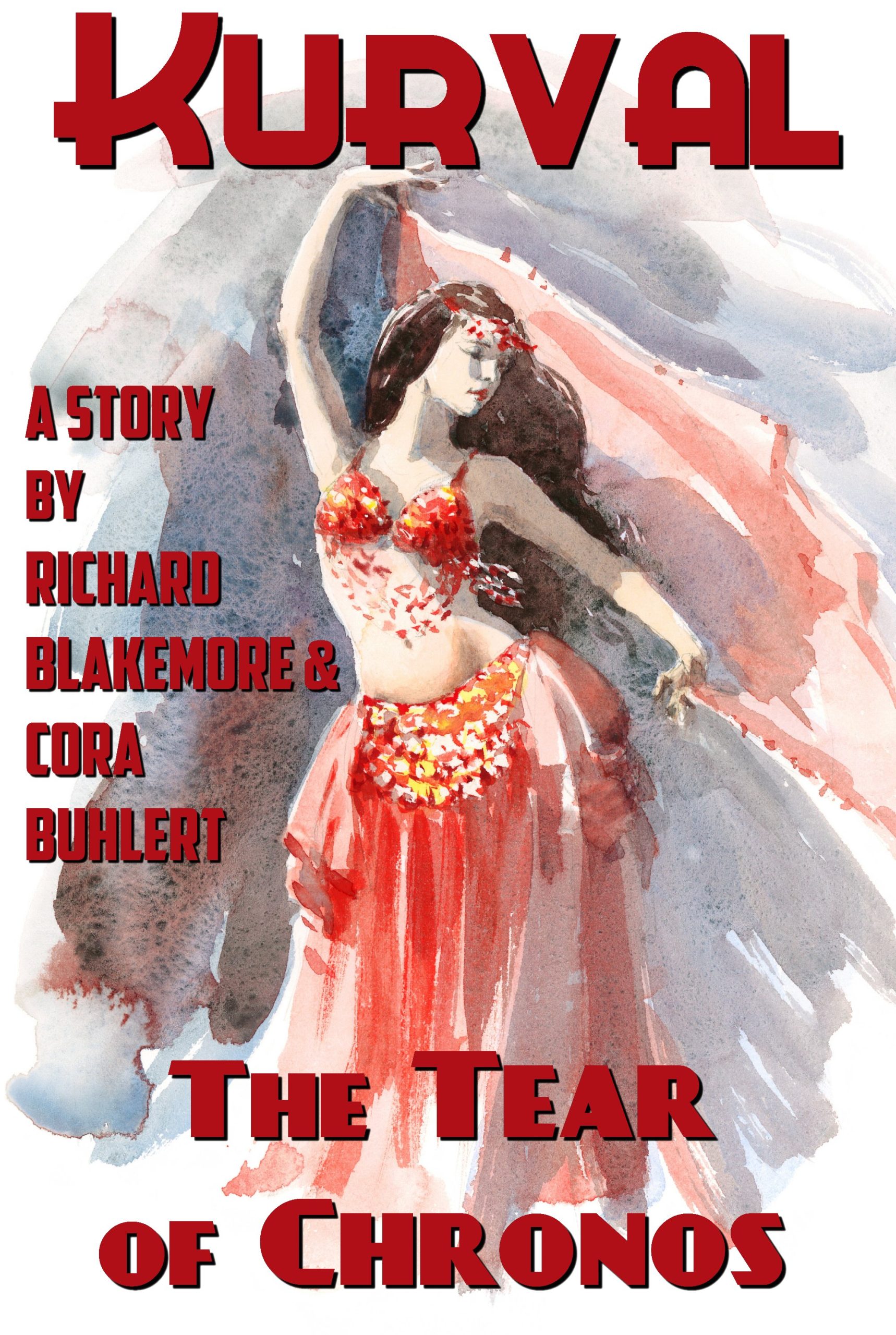
First Monday Free Fiction: “The Tear of Chronos”

The Tear of Chronos by Richard Blakemore and Cora Buhlert

Welcome to the May 2023 edition of First Monday Free Fiction. Though it’s actually the second Monday of the month.

To recap, inspired by Kristine Kathryn Rusch who posts a free short story every week on her blog, I’ll post a free story on the first Monday of every month. At the end of the month, I’ll take the story down and post another.

Unless you’ve been living under a rock, you’ll probably know that the coronation of King Charles III took place on Saturday. Therefore, this month’s free story “The Tear of Chronos” is a story about a coronation, namely that of Kurval, King of Azakoria, who crowned himself after killing his villainous predecessor in true sword and sorcery fashion, but is still required to go through the motions and is about as thrilled about the entire ceremony as King Charles looked at times.

The lengthy coronation ceremony requires Kurval to consult the oracle of the goddess Ashvarya and gain a glimpse of the future by gazing into a magical jewel called the Tear of Chronos. However, he gets far more than he bargained, when he enters the inner sanctum only to find himself not just with a statue of the goddess, but with a woman of flesh and blood who is the spitting image of the goddess and wears the Tear of Chronos around her neck.

So follow Kurval, as he meets a woman who may or may not be a goddess, uncovers a conspiracy and gazes into…

The Tear of Chronos

“When King Kurval took the throne of Azakoria in the Year of the Forked Serpent, he consulted the oracle of Ashvarya, as is custom for the newly crowned kings of Azakoria. Just what precisely the oracle revealed to him is not known, though King Kurval would go on to have a long and glorious reign, bringing peace, justice and prosperity to Azakoria…”

From the Chronicles of Azakoria by Ragur, Count Falgune

I. The Coronation

It was the day of his coronation, but Kurval, King of Azakoria, wanted nothing more than to retire to the royal apartments with a jug of wine and a leg of lamb and be left alone. But instead, he had to spend the entire day either on his feet or in the saddle — and all in full armour, too.

As far as Kurval was concerned, the whole ceremony was superfluous anyway. He had won the crown fair and square — by chopping off the head of the previous King Orkol and placing the bloody crown on his own head. As long as no one challenged him — and no one dared — he was king, ceremony or no ceremony.

However, his vizier Izgomir, whom Kurval had inherited from Orkol along with the crown, had insisted that a formal coronation was absolutely necessary to keep up appearances and pacify the nobles, the people, the priests and the gods. And since Kurval did not actually know a lot about being king, he’d gone along with it.

And so he had gotten up at the crack of dawn and dressed in his rich, but impractical royal robes. He had dropped to his knees in the temple of Odulf, God of the Sun and Lord of all lesser Gods, to receive the crown — the very crown he himself had taken from Orkol’s severed head not quite two weeks before — from the hands of the high priest.

Next, he had overseen a seemingly endless military parade, as every single regiment in the Azakorian forces plus various mercenary companies marched past Kurval to salute him.

First came the elite Blood Guards in their splendid red armour, led by the young Lord Vangenard. Vangenard had been involved in the uprising against Orkol for reasons of his own and had been the first to cry out “All hail King Kurval,” once Kurval had placed the bloody crown on his own head. In return, Kurval had given him command of the Blood Guards after Vangenard had slain his predecessor Vitericus.

Izgomir did not trust Vangenard. He said that a man who had turned first against Orkol and then against his employers would eventually turn against Kurval as well. And who knew, maybe he was right? However, Kurval liked the young Lord and for now Vangenard seemed to be on his side.

Once the Blood Guards had ridden past, came the not quite so elite Silver Sentinels in their shimmering silver armour. Their commander was one Baron Kelgurd. Kurval did not know the man well. However, both Izgomir and Vangenard had recommended him as a dependable man who was no friend of Orkol’s. And since those two almost never agreed on anything, Kurval figured he should heed their advice the one time they did.

Next came the Ruthless Swords, the mercenary company that Kurval had commanded before the crown of Azakoria had landed at his feet. He smiled and waved, this time with genuine enthusiasm. These were his people, after all, and he knew every single man and woman marching past him in the plain, functional armour of the professional mercenary. He might not be certain about the loyalties of Izgomir or Vangenard or Kelgurd, but he was certain about the Ruthless Swords.

Tsabo, commander of the Ruthless Swords, rode ahead, splendid in his gilded armour that gleamed against his dark skin. Tsabo was probably the only true friend Kurval had in the world. The armour had been a gift, together with the offer to become general of the Azakorian army. Kurval had hoped for an enthusiastic acceptance, but so far all that Tsabo had said was that he needed to discuss the matter with his wife.

Kurval decided to take the fact that Tsabo had chosen to wear the splendid plate gilded armour rather than his ordinary plain chainmail as a positive sign. Because he did not want to deal with the intricacies of kinghood, not to mention a palace full of backstabbing nobles who despised him, without his best friend by his side.

More soldiers marched past. Archers, pikemen and the alchemists with their deadly but cumbersome flash powder cannons. Soldier after soldier, a seemingly endless stream of them. All the while, Kurval was in full armour and seated upon his faithful stallion Shadowmane. The day was unpleasantly hot day and he found himself desperately needing to pee, but found that he could not move from his post until after the last infantryman had filed past.

Even after the parade, Kurval barely had time to relieve himself, before he had to sit on the obsidian throne to receive the oaths of fealty of the various nobles, most of whom hated him and half of whom wanted to kill him and sit on the throne themselves. To make matters even worse, the obsidian thrones was infernally uncomfortable and so his back and arse were sore, when he could finally rise.

And still there was no rest for Kurval. For now it was time to ride through the streets of the capital and gracefully receive the cheers and homages of the people of Azakoria who cheered and threw rose petals onto his path, which struck him as very wasteful, though at least Shadowmane appreciated having some petals to nibble on. Though at least the cheers of the people were genuine — unlike the smiles and bows of the nobles — though they were cheering less for Kurval than for the demise of his hated predecessor Orkol.

Once Kurval and his retinue had reached the temple district, there followed a tour of every single temple in Amalgonda to pay his respects to Gods that were not his in rituals that were meaningless to him.

“What am I even doing here?” Kurval asked himself, not for the first time.

Many years ago, in his homeland Temirzhan across the Great Sea, the Dark Gods that dwell on the Plains of Shadow had prophesied that one day, Kurval would be King on the far side of the great sea. So Kurval had travelled across those endless waves, not so much to chase a glorious destiny, but mostly because there was no place in his homeland anymore for a captain of the Royal Guard who had gotten his king killed.

Kurval had spent many years wandering the lands on the far side of the sea, selling his brawn and his sword to whoever needed his services. He’d started out as a lone sellsword and eventually rose to commander of a mercenary company in the employ of the King of Azakoria, the glorious destiny that the Dark Gods had prophesied long forgotten. Most likely, the Dark Gods had lied anyway, cause that’s what they did.

When some of the Azakorian nobles approached Kurval to enlist him and the Ruthless Swords in their uprising against King Orkol, Kurval had accepted without hesitation. After all, Orkol was perpetually late in paying, so Kurval felt he owed him no loyalty. Not to mention that the plotting nobles promised to pay Kurval and his people better than Orkol ever had.

Finally, Kurval had seen what Orkol did to the people of Azakoria, how he abused those he was responsible for. He’d seen how Orkol bled a once wealthy country dry. He’d seen protests and uprisings brutally squashed, citizens randomly arrested, imprisoned, tortured, executed. He’d seen men slaughtered and women ravished, all in Orkol’s name. Worse, Kurval and his people had even been ordered to take part in Orkol’s atrocities.

Unbidden, an image rose in his mind. Bodies swaying in the wind outside the walls of the rebellious city of Fredegond. Young women in plain white gowns with nooses round their necks, gently crying into their execution hoods, bound hands clutched in prayer, as they were led to the gallows.

That had been the last straw. Kurval had walked away in disgust and thrown in his lot with the plotting nobles. After all, Count Walbordo, leader of the plotters, could hardly be a worse king then Orkol. At the very least, he paid better.

He’d had no illusions why Walbordo and the other plotting nobles wanted his support. Their own troops weren’t sufficient to take on Orkol’s, so they needed Kurval and his men. The mercenaries were to be used as shock troops, to break down resistance, to fight and bleed and die, so Walbordo’s own men would be spared.

Kurval knew fully well that he and his people were expected to die fighting Orkol’s troops, that they were never expected to collect the generous payment they’d been promised. He also knew that they were better than that, better fighters, better trained. He knew they would prevail. And they did.

Once Kurval and his people fought their way to the throne room, he’d finally found himself face to face with Orkol himself. Kurval had treated the swine better than he deserved and gave Orkol the chance to draw his sword. But Orkol was not much of a fighter and so Kurval chopped his head off. The crown, still sticky with Orkol’s blood, rolled across the marble floor and landed in front of Kurval’s feet. And suddenly he heard the voice of the Dark Gods in his mind again, heard their prophecy, their mocking words. And he bent down to pick up the crown and put it on his own head.

And now that he was king, now that he had finally fulfilled the glorious destiny that he’d been foretold all those years ago, Kurval realised that he had no idea what came next. The Dark Gods had certainly never said anything about that and Kurval himself knew nothing about being a king.

***

This story was available for free on this blog for one month only, but you can still read it in The Tear of Chronos. And if you click on the First Monday Free Fiction tag, you can read this month’s free story.


Posted in Books, First Monday Free Fiction | Tagged , , , , , , | Leave a comment

The Mandalorian and Baby Grogu Celebrate “The Return”

Welcome to the somewhta belated final instalment of my episode by episode reviews of season three of The Mandalorian. Previous installments may be found here.

Warning! Spoilers behind the cut! Continue reading

Posted in TV | Tagged , , , , , , , , , , | 2 Comments

An Open Letter to the 2023 Hugo Finalists, Whoever They May Be

This is an updated repost of this post from 2021 and this one from last year, which a lot of people found helpful.

ETA: This post is now also available in Chinese on Weibo, thanks to MrOctopus233.

Nominations for the 2023 Hugo Awards closed yesterday and the finalists are expected to be announced sometime in May.

Right now, no one except for possibly the Hugo administrators knows who those finalists will be. And yes, I deliberately posted this so shortly after the Hugo nominations closed that the e-mails won’t have gone out yet and no one knows who the finalists are.

However, sometime in the next two weeks or so, some of you will receive an e-mail from the Chengdu Worldcon, informing you that you are a finalist for the 2023 Hugo Award and asking you whether you want to accept the nomination. Some of you will have received such e-mails before, for others it will be the first time.

But whether it’s your first or your twentieth nomination, congratulations! That’s awesome.

As a first time recipient of such an e-mail in 2020 as well as a Hugo finalist in 2021 and Hugo winner in 2022, here are a few things I’ve learned:

  1. The e-mail may not look like you think it will. When I got the e-mail from CoNZealand in 2020, the subject line was “CoNZealand Hugo Awards Confidential”. I was exhausted that day and waiting for two important e-mails, so I scanned right past that subject line, because I assumed it was the convention newsletter. I only opened the mail, because none of the two important e-mails had come yet, so I thought I might as well check out the CoNZealand e-mail while I was waiting. Good thing that I did.
  2. If you receive an e-mail from the Chengdu Worldcon, please reply as soon as you can whether you accept the nomination or not. If there are questions with regard to eligibility, answer them as soon as possible. The Hugo administrator and their team work very hard, so don’t make their job any harder than it has to be.
  3. The Chengdu team will also ask you to keep quiet about your nomination until the official announcement. Please don’t violate this, because you don’t want to steal Chengdu’s thunder!
  4. The period between the time when the finalists are notified and when the Hugo finalists are officially announced can be weird, because while you know that you’re a finalist, almost nobody else does. I blogged a bit about my experiences in 2020 here. Basically, I kept having the niggling fear that there had been some terrible mistake and that I wasn’t a finalist after all or that I only was a finalist because all twenty people who would have been ahead of me had withdrawn. From talking to other first time finalists, I learned that I wasn’t alone in this. And while I can’t guarantee that terrible mistakes won’t happen, the chance that the wrong person is notified about being a Hugo finalist is extremely small. So relax. You really are a Hugo finalist, even if nobody else knows it yet.
  5. Do something nice for yourself to celebrate. Have an ice cream, a nice box of chocolates, a glass of champagne, a good beer, a bubble bath, whatever it is that makes you happy. You’re a Hugo finalist, so you damn well deserve to celebrate in private.
  6. You can tell a few people you trust about your nomination as long as you know they won’t blab it all over the internet. Before the official announcement, a handful of people knew I was a Hugo finalist. These include my parents (whose reaction was, “That’s nice,” before turning back to watch a rerun of Midsomer Murders), some folks from Galactic Journey and others in the SFF community, who knew not to say anything before the official announcement, as well as my accountant (because I asked her if buying an evening gown for the Hugo ceremony was tax-deductible – it’s not BTW) and the guy who repaired my patio, because he just happened to be there, when I got the e-mail. Neither the accountant nor the patio guy are SFF fans, so chances of a leak were zero. They both also probably thought I was quite mad.
  7. If you are nominated in a fiction category – i.e. short story, novelette, novella, novel, Series, Lodestar or Astounding – or nominated for a non-fiction book or essay in Best Related Work, you should let your editor and/or publisher know that you’re a finalist. They work in the industry and therefore know not to say anything and they may want to prepare some kind of congratulatory tweet, post or other promotion effort. Finally, editors are also thrilled when one of their authors is nominated.
  8. One thing I did not do is tell people about my nomination who might be up in the same category. Because I didn’t know who else was nominated (you don’t before the official announcement) and didn’t want anybody to feel disappointed, because I was a finalist and they were not.
  9. Even if you can’t publicly talk about your Hugo nomination just yet, there are still a few things you can do in the meantime. For example, you can update your bio to mention that you’re a Hugo finalist or write a bio, if you don’t have one yet. Important: Don’t upload your updated bio anywhere until the official announcement has been made! In fact, I spent a chunk of the evening after the Hugo finalists had been announced updating my bio everywhere it appears.
  10. In fact – and this is important – don’t upload anything that mentions your Hugo nomination anywhere on the internet, until the official announcement has been made. Even if you set a Tweet or blogpost to go live after the announcement has been made, don’t upload it yet. Because mistakes happen, you accidentally hit “publish” rather than “schedule” or a post goes live too early. I had my celebratory blogpost ready to go in Word, but I only uploaded it with links and a few comments added once the announcement had been made.
  11. Another thing you can do in the meantime is prepare a media kit, if you haven’t got one already. You can see mine here and there are also plenty of pages around the web that tell you what a media kit is supposed to contain. Important: Get permission to use any photos that you did not take yourself.
  12. Another thing you can do is write a press release about your Hugo nomination. It doesn’t matter which category you’re nominated in, whether it’s Best Novel or a fan category. Write a press release anyway. There are plenty of places around the web which tell you how to write a press release. It varies from country to country, so make sure you get the correct format for your country. My press releases from 2020, 2o21 and 2022 (in German) are here. Then make a list of the contact info for the relevant newspapers, radio stations and other media outlets in your region or country. Once the nominations have been announced, send your press release as well as the link to your media kit to those media outlets. The press release linked above netted me two in-depth profiles and a bonus article in two different newspapers in 2020 and two more in-depth profiles in 2021 as well as an article and an interview in 2022, which is much more than I’d hoped for.
  13. Consider whether you want to attend Worldcon and the ceremony. And yes, I know it’s difficult, because of covid  and because conditions and restrictions are very different in different parts of the world. For Chengdu, high travel costs and difficulties getting a visa may also be a problem for many. Nonetheless, get a Worldcon membership, if you haven’t got one already. Like most recent Worldcons, Chengdu offers a reduced rate for people attending their first ever Worldcon. You can also start looking for flights, hotels, etc…. If you need to apply for a visa, do so now. If money is an issue, as it’s for many of us, think about crowdfunding your Worldcon trip, as several finalists have done in recent years. However, don’t start your crowdfunding campaign, until after the finalists have been announced.
  14. If you want to participate in programming, contact Chengdu, since I can’t find a program participation form on their website. Do this as early as possible, so the programming team doesn’t have to find suitable programming for you at the last minute.
  15. Finally, start thinking about the Hugo voter packet. If you need to get permission to include certain texts or images, contact the relevant people.

Finally, here are a few observations regarding what happens after the Hugo finalists are announced:

  1. A lot of people will congratulate you. These will be people you expect – friends, peers, etc… – but also people you don’t expect. After the newspaper articles mentioned above came out, I suddenly got congratulations from translation customers, various relatives, neighbours, former classmates, my plumber and my Dad’s diabetes doctor among others. Enjoy the experience, thank everybody and don’t forget to congratulate your fellow finalists.
  2. Some people will also not congratulate you and again, some of these will be people you don’t expect. There are several reasons why someone might not congratulate you and most of them are not malicious. For example, some people might simply not have seen the news yet. Or they may not understand the significance, since not everybody is plugged into the SFF community and knows how important the Hugos are. Of course, there will also be a few people who think that you don’t deserve your nomination. Ignore them!
  3. Your fellow Hugo finalists are not your rivals, they are your peers. You’ll probably know some of them already and if not, you’ll quickly get to know them. And yes, only one of you will get to take home the rocket in the end, but all six of you are amazing and in a way, you’re all winners. This also applies across categories. I met a lot of great people in the SFF community and even made new friends, just because we were on the Hugo ballot in the same year.
  4. In general, there is a sense of community to siblinghood among Hugo finalists. Whether you’re a bestselling author or a first-time finalist in a fan category, you’re all in this together. There is usually a private group for Hugo finalists to chat, ask questions, share gripes, post photos of Hugo gowns, tiaras and pets, etc…
  5. If you’re not part of the Worldcon SFF community and don’t know anybody else on the ballot, don’t worry! You’ll get to know the others soon enough and pretty much everybody in this community is lovely and very welcoming. If you’re a repeat finalist, reach out to the first-timers to make them welcome. This year, we will likely see at least some Chinese finalists, so please try to reach out to them as well.
  6. As a Hugo finalist, you will get plenty of e-mails from Chengdu about anything from the Hugo voter packet via the program book to the ceremony itself. Pay attention to those e-mails, send any information requested in time and check your spam folder. You don’t accidentally want to miss something important.
  7. Once the Hugo finalists have been announced, there will be people who have opinions about the ballot. Most will be positive or at least fair – I always try to be fair in my own Hugo and Nebula finalist commentaries, even if I don’t care for some of the finalists – but some will be not. There are always people who think that your category or the entire ballot is too male, not male enough, too white, not white enough, too queer, not queer enough, too American, not American enough, too bestselling, not bestselling enough – you get the idea. There will be people who complain that only people no one knows got nominated or that only the usual suspects got nominated – and multiple bestsellers and Hugo winners can be “people no one knows”, while first or second time finalists can be “the usual suspects”. Some of these people won’t even wait 24 hours after the Hugo finalists have been announced to air their opinions – at least they didn’t in 2021. Some will even tag you, just to make sure you don’t miss their very important opinions. The best thing to do is ignore those people.
  8. A handful of people seem to have made it their life’s mission to mock and harass Hugo finalists. Ignore them and block them on social media and don’t let them get you down. Most of them are just jealous.
  9. There will be drama. So far, I’ve never seen a Worldcon that did not have at least some degree of drama and I have been a Worldcon member since 2014. Often, this drama affects the Hugo finalists in some way. Sometimes, the Hugo finalists even band together and try to resolve this drama. How you engages with whatever this year’s drama will be is up to you. However, don’t let it get you down. Drama is normal. At this point, I would be more surprised at a Worldcon without drama than at one which has some degree of drama. And usually, everybody winds up having a great time anyway.

So what happens, if you win?

  1. Basically more of the same. Lots of people will congratulate you, most of them with genuine enthusiasm, a few very grudgingly (one in my case, not a fellow finalist) and some not at all.
  2. Make sure to have your acceptance speech ready before the ceremony with the names of all the people you want to thank. Check with people how their names are pronounced, if you aren’t sure. Always have a printed paper copy of your speech, because phones can and do break down, run out of juice, fail to have reception or get overloaded with messages at the crucial moment.
  3. After you win a Hugo, you should prepare another press release and send it to all the local, regional and national media you can think of. I actually wrote mine at six AM in the morning after the winners had been announced.
  4. Don’t forget to update your bio wherever it appears. That includes anthologies or magazines where you’ve been accepted, but which aren’t out yet.
  5. Your “market value” (for lack of a better word) does go up with your first nomination, goes up even further with your second and even more, if you win. For example, I got a story acceptance in the mail literally the day after I won. Of course, the story might have been accepted anyway, but the timing was still interesting. I also gained a bunch of new Twitter followers with every nomination and winning a Hugo pushed me over the 3000 follower mark for the first time. You’ll also notice that your name will start to show up on covers of anthologies or magazines, sometimes with “Hugo winner” attached. However, you’ll still get rejections as well, because even Hugo winners get rejected and that’s perfectly normal.
  6. You’ll also find that you have acquired more clout in the SFF community, something which also happens once you get nominated. Use what influence you have in the SFF community for good, to uplift and support others.
  7. One thing I noticed is that I would sometimes find myself thinking, “Wait a minute, I have a Hugo and [insert name of vastly more important genre person here] doesn’t? How on Earth did that happen?”
  8. That said, certain people will still call you a nobody who barely sells any books or a fake fan or whatever. This literally happened to me approx. a month after I won the Hugo, when I got into an argument about a TV show with the adherents of one of those “We hate everything” outrage clickbait YouTube channels. I pointed out that I really enjoyed the object of their rage du jour and so did many others and was called “not a real fan” in response. When I said, “Dude, I’m the 2022 Hugo winner for Best Fan Writer”, I was told that awards didn’t matter, that I was clearly not a real fan, because I didn’t hate the thing. Best just ignore those people and privately think, “Guess who has a shiny rocket? Hint, it’s not you.”

Finally – and this is the most important point – enjoy your experience! You’re a Hugo finalist, i.e. your peers consider you and your work one of the six best in your respective category. That’s amazing, so celebrate!

If anybody wants to translate this into Chinese for the benefit of Chinese Hugo finalists, please feel free to do so.

Posted in Books, General | Tagged , , , , | 7 Comments