
Welcome to my latest episode by episode review of Star Trek Picard, once again a little late. Previous installments may be found here.
Warning: Spoilers behind the cut! Continue reading
Organised by Captain C. Barton
Started on August 4, 2178, 08:48 Category: Accidents and emergencies
My name is Barton and I’m the pilot of an EDS (Emergency Dispatch Ship) currently en route to the frontier world of Woden to deliver some desperately needed medical supplies.
I have a problem, because I just discovered a stowaway aboard my ship, an eighteen-year-old girl named Marilyn Lee Cross. Upon questioning, Marilyn explained that her brother Gerry works on Woden as part of the government survey crew. She wants to visit him and since there is no regular passenger traffic to Woden because of the current medical crisis, she snuck aboard my ship. She did see the big red UNAUTHORIZED PERSONNEL KEEP OUT! sign, but chose to ignore it.
Now anybody who is familiar with the Emergency Dispatch Service will be familiar with Paragraph L, Section 8, of Interstellar Regulations:
“Any stowaway discovered in an EDS shall be jettisoned immediately following discovery.”
So you see my dilemma: The law requires that I throw Marilyn out of the airlock. However, I don’t want to do that. Sure, Marilyn may be a little stupid, but that’s hardly a reason to kill her. Not to mention that our security measures are way too lax, as I’ve pointed out time and again. And, besides I’m just not the killing type. If I were, I’d have joined the Starship Troopers, where the pay is better.
Once I discovered Marilyn, I immediately commed my superior Commander Delhart, who yelled a lot and then demanded that I throw the girl out of the airlock at once.
I asked about emergency refuelling – which is possible, if rare and expensive. Delhart said if I requested an emergency refuel without an emergency (as if this wasn’t an emergency), I’d have to pay for it out of pocket. Oh yes, and I should consider myself fired, if I refuse to follow orders.
So in short, I need twenty thousand solar credits and I need them in the next ten hours or poor Marilyn is doomed.
So save Marilyn! And save me from becoming a murderer!
August 4, 2178, 08:54 by Tom G.:
Don’t do it, Barton! A few years ago, they forced me to do it and I never managed to forget or live it down.
PS: Donated what’s left of my unemployment pay. Because they will fire you anyway.
August 4, 2178, 09:02 by Brett:
Thank you for serving. Donated.
August 4, 2178, 09:15 by JWC:
The cold equations of physics and the laws of space know no mercy. Out of the airlock with her now!
August 4, 2178, 09:18 by Ursula in reply to JWC:
You, sir, are an unempathetic arsehole!
PS: Donated.
August 4, 2178, 09:20 by JWC in reply to Ursula:
Overly emotional and knows nothing of science. How typical of a woman!
August 4, 2178, 09:23 by Ursula in reply to JWC:
Oh, so you’re a misogynist, too. Why am I not surprised?
August 4, 2178, 09:22 by Michael M. in reply to JWC:
Way too soft, Ursula. He’s a fascist arsewipe.
Donated as well.
August 4, 2178, 14:19 by Jeannette in reply to JWC:
Ursula and Mike are right. You’re a fascist, a misogynist and probably an arsewipe, too. Also why do you even bother to comment, if you’re not going to help?
Donated and shared.
August 4, 2178, 09:35 by Gary W.:
I have a question: What idiot designed a spaceship (and an EDS at that) that has zero margin for error? It’s not just a mass increase due to a stowaway that will cause problems. Fuel loss, meteor strikes, system failures, pilot errors could all easily cause an EDS to fail.
Donated, because bad engineering shouldn’t cause deaths.
August 4, 2178, 09:44 by Captain Barton (Organiser) in reply to Gary W:
Tell me about it, Gary. I’ve been complaining about the inadequacy of our ships and security measures for ages now. Maybe now they’ll listen.
August 4, 2178, 09:46 by Tom G. in reply to Gary W.:
Can confirm. EDS ships are crappily engineered and our security measures are a joke. How many more must die before somebody does something?
August 4, 2178, 09:55 by Cory D. in reply to Gary W.:
I agree. The engineering is just plain bad. Also, why just a simple “Keep out” sign with no notice that the penalty for ignoring the sign is death?
Donated as well.
August 4, 2178, 11:09 by Richard H. in reply to Gary W.:
In my opinion, the Emergency Dispatch Service is looking at a lawsuit for criminal negligence here. Captain Barton will probably be on the hook for manslaughter as well (sorry). I advise the family of Marilyn to get a lawyer asap.
Donated and started a legal fund for the Cross family.
August 4, 2178, 11:12 by Captain C. Barton (Organiser) in reply to Richard H:
Dude, I’m just following orders here. I no more like this than you.
August 4, 2178, 11:23 by Richard H. in reply to Captain C. Barton (Organiser):
The “I was just following orders” defence didn’t save Korvakian, the butcher of Telos V, and it won’t save you.
August 4, 2178, 11:25 by Captain C. Barton (Organiser) in reply to Richard H:
Great. Now you’re comparing me to one of the worst war criminals in galactic history. Thanks a lot.
Why do you think I started this GoFundMe? Because I don’t want to do this.
August 4, 2178, 12:45 by JWC in reply to Richard H.:
The laws of physics and the cold equations of space know no mercy.
August 4, 2178, 12:49 by Richard H. in reply to JWC:
Shut up, troll! We’re talking about the laws of man here.
August 4, 2178, 14:56m by Neva of Gelania:
By the Stars of Zod, I fear this may all be my fault. I met Marilyn, whose Gelanese is excellent by the way, aboard the Stardust, where I work as a cleaner. She told me all about her brother and I told her that there would be an EDS leaving for Woden that very day.
I’m so sorry, Marilyn. I honestly didn’t know that they kill stowaways. I thought the penalty was just a fine.
Oh please, Captain Barton, don’t kill Marilyn for something I did. I donated my entire pay and the rest of the Stardust cleaning crew chipped in as well. It’s not much, but I hope it will help.
August 4, 15:15 by SadPuppy3:
Girls don’t belong in space. Out of the airlock with her.
August 4, 15:23 by Jeannette in reply to SadPuppy3:
Shut up, misogynist troll!
August 4, 15:45 by Gerry Cross:
Hi, here’s Gerry, the brother of Marilyn. Me and the boys of the survey crew all donated, of course.
Mari, sweetheart, don’t do something stupid like that ever again, do you hear me? The frontier worlds are not like Earth. It’s the Wild West out here. Also, why aren’t you on Mimir like you promised?
Barton, if you throw my sister out of that airlock, me and the boys of the survey crew will rough you up, understood? And they’ll never find your body.
August 4, 15:52 by Captain C. Barton (Organiser) in reply to Gerry Cross:
Chill out, dude. I don’t want to kill your sister either.
August 4, 15:54 by Marilyn Lee Cross in reply to Gerry Cross:
I’m so sorry, Gerry. I didn’t know. Please help me. I’m so scared. And don’t hurt Captain Barton. It’s not his fault and he’s been very kind.
August 4, 16:01 by Gerry Cross in reply to Marilyn Lee Cross:
It’s all right, Mari. Everything will be all right.
August 4, 16:16 by Harold W. Tannenbaum, director of the Woden colonisation project:
Far be it from me to interrupt this drama, but when can we expect those medical supplies? Cause we’ve run out of kala fever serum here and several members of Group One are sick.
August 4, 16:22 by Gerry Cross in reply to Harold W. Tannebaum:
With all due respect, sir, that’s my sister we’re talking about here. Group One can endure a bit of cosmic diarrhoea.
August 4, 16:25 by Robert Tucker in reply to Gerry Cross:
Hi Gerry, it’s Bob from Group One. I think we met at the rec centre once. Anyway, we can manage for a few more hours without the serum, even if purple and green spotted poop is really, really unpleasant.
PS: The whole ward donated.
August 4, 18:57 by Commander Eberhard Delhart:
Stop stalling, Barton, and jettison the girl now. That’s an order!
August 4, 19:09 by Captain C. Barton (Organiser) in reply to Commander Eberhard Delhart:
With all due respect, sir, fuck you! We’re funded. And I quit.
***
Inspired by this comment thread at Camestros Felapton’s blog and “The Cold Equations” by Tom Godwin.
ETA: If you’d rather have an e-book version of this story, you can get it for free in the format of your choice here.
 Our monthly round-ups of new speculative fiction and new crime fiction releases by indie authors are a perennially popular feature. Therefore, we now offer you a round-up of our favourite St. Patrick’s Day speculative fiction by indie and small press authors.
These St. Patrick’s Day stories cover the broad spectrum of speculative fiction. We have urban fantasy, paranormal romance, paranormal mystery, children’s fantasy, portal fantasy, witches, werewolves, fairies, leprechauns, lion shifters, reindeer shifters, undead demon hunters, superheroes, magic coins, mail order brides, Lady Luck and much more. But one thing unites all of those very different books. They’re all set on or around St. Patrick’s Day.
As always with my round-up posts, this round-up of the best indie holiday speculative fiction is also crossposted to the Speculative Fiction Showcase, a group blog which features new release spotlights, guest posts, interviews and link round-ups regarding all things speculative fiction several times per week.
As always, I know the authors at least vaguely, but I haven’t read all of the books, so Caveat emptor.
And now on to the books without further ado:
 Feeling Lucky by Kathy Bryson:
“Most most people who spend time at a job develop ideas of how they can improve a product or business. They just don’t always get a chance to share. And that’s not counting the thousands of unpublished artists, writers, and musicians out there…”
What would you do if you suddenly got 5 million dollars to spend on your dreams? What it if was a leprechaun’s money?
Megan O’Malley was mortified when she got drunk and pinched the bandleader’s ass at a cousin’s wedding. But she was astonished when he turned out to be a leprechaun! Seems they’re not the little, green men of fairytales after all. They just say that because they like a good joke and what better way to hide the gold? Oh, that bit’s true – as is the part about not sharing!
An award-winning fantasy of money and magic and making the most of your dreams!
 Into the Rainbow by Jessica L. Elliott:
Twins Dierdre and Treasa have gone to Kansas City on their first spring break without parents along with their tagalong sister Darcie. Other than constant rain, everything is going smoothly until a birthday prank gone wrong sends them into the Emerald Glade where leprechauns reign and magic is real. In order to get home, the girls must find out why they were summoned so they can return through the rainbow.
 Away with the Fairies by S.K. Gregory:
Seven years ago, Declan disappeared while out in the woods. A year later, he returned home, with no memory of where he was or what happened to him.
Now Declan works as a barista, trying to get on with his life and forget what happened, but that isn’t easy when he keeps seeing things that aren’t there. Shadows from the corner of his eye, strange lights around people. It gets worse when a new girl starts working at the coffee shop. There is something about her, something different.
With her help, Declan starts to uncover the truth of what happened to him, how the Fae took notice and pulled them into their realm. Now they want him back.
A Luck O’ The Irish Tale. Can be read as a standalone.
 End of the Rainbow by Michelle Ann Hollstein:
It’s St. Patrick’s Day and Aggie, Betty and Roger are celebrating at an Irish pub in Palm Springs when Betty’s leprechaun-love-interest drops dead. Could it be murder? Join Aggie and friends as they embark on a celebration they won’t soon forget.
 The Man from U.N.D.E.A.D.’s St. Patrick’s Day Parade by Darren Humphries:
The United Nations Department for the Enforcement and Apprehension of Demons is the first, last and only line of defence against the supernatural threats trying to break into a world where magic and technology are uneasy bedfellows.
A death brings Agent Ward, the Man From U.N.D.E.A.D., to Ireland and to a secret location where there are dangers without and secrets within.
Can Ward work out the latter before a veritable parade of demonic beings launch a full-scale attack?
The Man From U.N.D.E.A.D.’s St Patrick’s Day Parade is a short story featuring Agent Ward from the Man From U.N.D.E.A.D. series of novels.
Lion shifter Aaron wants to settle down and find his mate. After one of his friends finds his mate online, Aaron decides to give LK Brides a try. He’s surprised to get matched the very day he signs up.
Curvy beauty Emma has been waiting to get matched by LK Brides for months. When it finally happens, she can’t believe the how strong her feelings are for her match after only one meeting.
As their relationships moves forward quickly, Emma begins to doubt how much she can trust Aaron. Will the lion shifter luck out and find love this St. Patrick’s Day? Find out in the second Holiday Mail-Order Mates story.
 Four-Leaf Clover by Amanda M. Lee:
Clove Winchester is feeling lucky at life, and that’s before a mysterious stranger drops into her magic store and gifts her with a special coin. Suddenly things can’t go wrong for Clove, and she’s the center of attention in the Winchesters’ world – especially because Aunt Tillie wants that coin.
When a near-death experience rocks Clove and her boyfriend Sam, Clove takes a closer look at the coin and realizes there’s a lot she can do with her new luck streak. Unfortunately for Aunt Tillie, Clove is determined to keep the benefits to herself.
When a brazen armed robber hits Hemlock Cove and goes after Bay, all of the Winchester witches band together to solve the crime and save the day. Of course, they may need a little luck to do it.
 The Reindeer’s St. Patrick’s Surprise by Elizabeth Ann Price:
Harlan Connors is a reindeer shifter who isn’t ready to settle down. After a disastrous attempted mating, all he wants is to have fun. Mating and marriage are the furthest things from his mind.
Temp is a woman who knows what she wants – a baby. Convinced that Mr. Right is never going to show up, she decides to start a family on her own.
However, a chance meeting and a wild St. Patrick’s Day later, the two of them find themselves married and both unable and unwilling to stay away from one another. But can they weather their own insecurities and Harlan’s ex-fiancée to find their happy ever after?
 St. Patrick’s Alternatives by Lesley L. Smith:
Physicist Chloe Phillipson uses her anti-gravity power to help save St. Patrick’s Day.
 To Catch a Leprechaun by Emily Martha Sorensen:
It’s really tough to catch a leprechaun. Especially when sisters get in the way.
The Greek Goddess of Luck can be found hiding in the most unlikely of places. In an effort to hide from her father, Luck, or so she likes to be called, spends her time tending bar at Lady luck, her own establishment in mid-town Manhattan.St. Patrick’s Day is the busiest day of the year – the annual drinking contest brings hundreds of people to fight the reigning champion, Sosha, for the title.On her way to work, Luck meets two cops at a police checkpoint. She quickly finds herself wondering what it would be like to not be so alone anymore.After their shift, Sullivan, Santina, and Mackenzie hear the call of Lady Luck, and find the sexy temptress behind the bar.Unable to resist her, the pack soon discovers their need to claim her as their own. Now tied to a pack of wolf shifters, the Goddess of Luck has no idea what plans they have unwittingly put into motion.

Our monthly round-ups of new speculative fiction and new crime fiction releases by indie authors are a perennially popular feature. Therefore, we now offer you a round-up of our favourite St. Patrick’s Day mysteries by indie and small press authors.
These holiday mysteries cover the broad spectrum of crime fiction. We have plenty of cozy mysteries, culinary mysteries, animal mysteries, historical mysteries, paranormal mysteries, police procedurals, crime thrillers, noir thrillers, legal thrillers, romantic suspense, amateur sleuths, crime-fighting witches, crime-fighting bakers, crime-fighting ghostwriters, crime-fighting dogs, murders, pranks, missing gold coins, murdered leprechauns, Sherlock Holmes and Doctor Watson and much more. But one thing unites all of those very different books. They’re all set on or around St. Patrick’s Day.
As always with my round-up posts, this round-up of the best indie holiday mysteries is also crossposted to the Indie Crime Scene, a group blog which features new release spotlights, guest posts, interviews and link round-ups regarding all things crime fiction several times per week.
As always, I know the authors at least vaguely, but I haven’t read all of the books, so Caveat emptor.
And now on to the books without further ado:
 Struck by Shillelagh by Amy Alessio:
Struck by Shillelagh: A St. Patrick’s Day novella mystery! When her friend is arrested for attempted murder of the Mayor at the St. Patrick’s Day parade, Alana O’Neill tries to learn who really hit the unpopular politician with the black thorn shillelagh. A new booth owner with a questionable past, a secret author featuring the antiques mall and recipe failures are unable to distract Alana for long on her quest for justice. Vintage recipes include Edible Blarneystones, Refrigerator Cake, Lime Ribbon Delight and more. This story is 11,000 words.
Includes Bonus Story Thankful for Pie: In this Thanksgiving holiday novella, Star tries to learn who is sabotaging her family’s struggling bakery. She also wonders why her new karate instructor drives her so crazy.
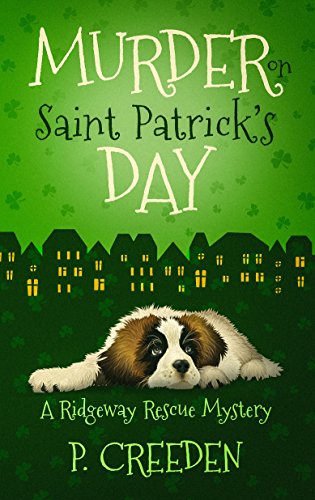 Murder on Saint Patrick’s Day by P. Creeden:
It’s St. Patrick’s Day and 20-year-old Emma Wright is working hard at training five-month-old Molly, her foster puppy, to become a therapy dog. But her training coach and neighbor gets an emergency call, cutting the lesson short, and Emma volunteers to pick up her daughter at a St. Patrick’s Day concert in town.
When Emma arrives, the concert has just finished up, and the teenage girls are visiting with the band. Then the lead singer stumbles and falls to the ground, dead. Emma becomes the only level head in the crowd and calls for help. When the Sheriff and Colby arrive, they investigate it as a potential accident. But Emma finds subtle clues that something more sinister is going on. Did the leader of the band die in an accident, or was it murder?
 Lucky Charmed by Kerry L. Curtis:
Kate is trying to find out who is trying to kill Rhys, while she’s looking for the stolen Cartier necklace and searching for an Irishman’s pot of gold. She gets help from Cap much to Rhys dismay.
 Shamrock Shenangigans by Kathi Daley:
Zak and Zoe travel to Ireland for their first Valentines Day as husband and wife. They have been invited to attend a murder mystery weekend in a real haunted castle. During their first night at the castle, they find one of the guests dead. Really dead. As they delve into the murder they begin to see that not only are things not as they appear, but several of the other attendees are not who they claim to be. During the course of her investigation Zoe discovers a secret about herself that is more than just a little shocking.
 Shamrock Snakes by Tom Dots Doherty:
Set in Dublin during a St. Patrick’s Day Festival, Shamrock Snake is an exciting Irish crime thriller that’s told from a male and female perspective as Doyle tires to find out what is behind a series of gruesome murder-suicides.
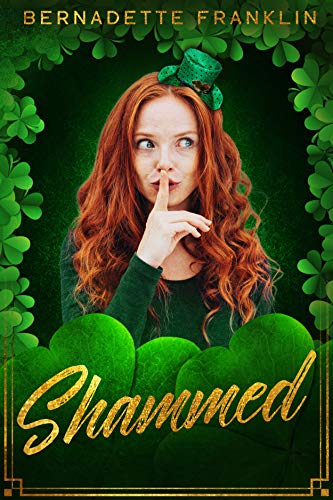 Shammed by Bernadette Franklin:
At R.K. Legal & Associates, office hours are between ten to six, pranks happen after hours, and evidence of all shenanigans are removed before doors open to clients.
When Alice’s boss, Mr. Kenton, starts a prank war with Lance McCarthy, an up-and-coming attorney from a rival firm, she thinks it’s just business as usual.
She’s never been so wrong in her life.
Chosen to be Mr. Kenton’s accomplice, Alice must face off against Lance in what quickly becomes a winner-takes-all game of hearts.
 Paddy Whacked by S. Furlong-Bollinger:
Inspector Helmes and his trusty sidekick, Watkins, know they have their work cut out for them in solving the murder of Paddy O’Toole, the Grand Leprechaun. However, nothing can prepare them for the strange lineup of suspects they encounter at the annual Holiday Icon Convention.
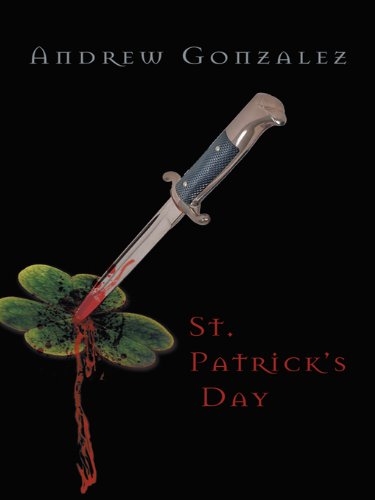 St. Patrick’s Day by Andrew Gonzalez:
St. Patricks Day is a story about two brothers who had a terrible history in the past and takes place in Celina, Ohio. The older brother Jimmy Marsh tries to kill his younger brother Jacob Marsh out of anger and jealousy when they were kids. At the age of ten the older brother Jimmy Marsh did his part in killing his parents. Because of doing so, Jimmy was abused by his parents and Jacob the younger brother was treated like a prince. Jimmy failed to kill his brother Jacob and was sent to a sanitarium for ten years but then he escaped and went after Jacob again. Through the years Jacob had delusions of seeing his brother, and now that Jimmy is free, he has another chance of going after Jacob and his friends. So now its up to Jacob not only to save himself but also the people he loves.
 Sleuthing for the Weekend by Jennifer L. Hart:
It’s St. Patrick’s Day in Beantown, and Mackenzie Elizabeth Taylor needs the Luck of the Irish to solve her latest mystery—namely, who was the mysterious Uncle Al, the man who left her his apartment building as well as his PI business? But that personal investigation has to take a backseat to raising her teenage genius Mac, and dealing with her immature baby-daddy and demanding mother. Not to mention taking on a job that will actually produce some green.
The case is a gnarly dispute by two Irish pub owners who happen to be brothers as well as rivals over a missing inheritance. With the entire city out pub-crawling, Mackenzie goes hunting for a pot of gold…but winds up with a body instead.
With an assist from Mac, Mackenzie must slip into her gumshoes and go toe-to-toe with Detective Hunter Black, her neighbor, protector, and main squeeze, in order to solve her case. this case and claim the reward before someone else. Can the mother daughter team successfully investigate in the middle of a city-wide chaos? Or is their luck about to run out?
End of the Rainbow by Michelle Ann Hollstein:
It’s St. Patrick’s Day and Aggie, Betty and Roger are celebrating at an Irish pub in Palm Springs when Betty’s leprechaun-love-interest drops dead. Could it be murder? Join Aggie and friends as they embark on a celebration they won’t soon forget.
 Duffel Bags and Drownings by Dorothy Howell:
Fashionista and event planner to the stars Haley Randolph is staging a St. Patrick’s Day bash for one of Hollywood’s biggest couples. When she visits the catering company to check on preparations, it looks like the green ice sculptures will be the hit of the party — until Haley finds a server floating face down in the water tank.
Haley becomes the prime suspect in the murder. With a killer — and a giant leprechaun — on the loose, she must do some fast sleuthing to find the pot of gold at the end of this rainbow. Will she kiss the Blarney Stone — or the hot new detective on the case?
Haley will need the luck of the Irish to find the killer — and the hottest handbag of the season!
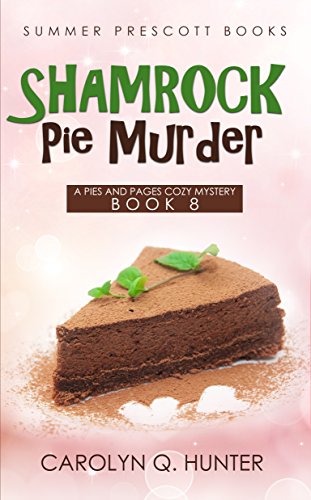 Shamrock Pie Murder by Carolyn Q. Hunter:
Indulge yourself in a sweet slice of murder!
It’s Saint Patrick’s Day in Culver’s Hood and pie shop owner, Bertha Hannah, has been asked to cater the dessert course at a local chiropractic luncheon. Unfortunately, what seems like a fun event is hampered by persistent protestors, professional disagreements, and jealous lovers. The unpleasant situation goes from bad to worse when one of the event’s attendees is murdered, under most unusual circumstances.
Bert has her hands full trying to prove one man’s innocence while hunting down ghosts of the past. Will she be able to “crack” the case, or will she find herself permanently on pins and needles?
 Lucky Strike by Madison Johns:
When Sheriff Peterson is injured during a high-speed chase — Agnes and Eleanor spring into action.
Agnes Barton and Sheriff Peterson’s working relationship is shoddy at best. He’d rather balk at the idea of Agnes and Eleanor independently investigating his cases. That changes though when he’s injured in a high-speed chase. While the good sheriff is laid up at a secret location for his own safety, the girls are on the case.
It’s hard to investigate the true nature of the sheriff’s accident though when Rodney Scott is murdered at the local bowling alley and all they have to rely on is the Interim Sheriff Karl Roberts. Agnes needs to quell her suspicions about Roberts as the girls launch an investigation that has them at their wits end and it will take more than luck to solve this case.
 St. Patrick’s Day Secret by Linda P. Kozar:
When seventeen-year-old Sean visits his eccentric Irish grandfather, he discovers a secret that his Gramps is obsessed with—finding the family’s cache of gold coins, stolen, according to his grandfather, by leprechauns. Though Sean doesn’t believe in elves or leprechaun’s he decides to spend his last summer before college with his grandfather, and joins him in his quest to find a purloined pot of gold.
Four-Leaf Clover by Amanda M. Lee:
Clove Winchester is feeling lucky at life, and that’s before a mysterious stranger drops into her magic store and gifts her with a special coin. Suddenly things can’t go wrong for Clove, and she’s the center of attention in the Winchesters’ world – especially because Aunt Tillie wants that coin.
When a near-death experience rocks Clove and her boyfriend Sam, Clove takes a closer look at the coin and realizes there’s a lot she can do with her new luck streak. Unfortunately for Aunt Tillie, Clove is determined to keep the benefits to herself.
When a brazen armed robber hits Hemlock Cove and goes after Bay, all of the Winchester witches band together to solve the crime and save the day. Of course, they may need a little luck to do it.
SOME KILLERS ARE BORN, SOME ARE CREATED…
After a night of exuberant sex with a college coed on St. Patrick’s Day, club bouncer Declan McGilvery discovers something quite unsettling about himself. What transpires over the next few weeks for this Irish-born Boston native is nothing short of unthinkable. As circumstances grow beyond Declan’s control, his life heads in a direction he could’ve never possibly imagined. Declan comes to realize in an all-too-real way, that one night stands can hold implications beyond lust and risky behavior. Sometimes they can even lead to death.
 Go Bráth (‘Til Doomsday) by Christopher Ryan:
NYPD Detectives Frank Mallory and Alberto “Gunner” Gennaro (from the award-winning debut novel CITY OF WOE and the popular short story collection CITY OF SIN) are just trying to enjoy the St. Patrick’s Day Parade when all Hell breaks loose….
 The Clover Pin by Olive Thomas:
Holmes and Watson are drawn into a case which deals not only with a murder in their own time, but which dredges through the circumstances of one committed some six years earlier.
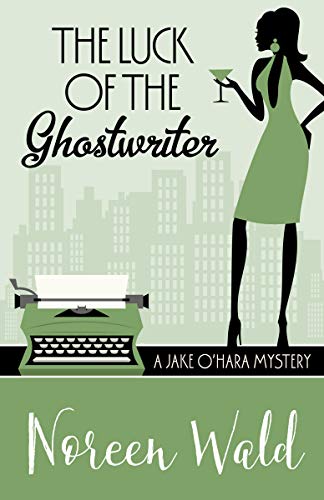 The Luck of the Ghostwriter by Noreen Wald:
Jake O’Hara and her colleagues are looking forward to a complimentary weekend in Manhattan’s swanky Plaza Hotel, the venue for the Greater New York Crime Writers’ Conference. The conference kicks off on St. Patrick’s Day, making the atmosphere a bit more festive—and chaotic—than usual. But things get way out of hand when senator-turned-writer Charlie Fione and actress-turned-writer Holly Halligan partake of some green beer—that leaves them permanently green around the gills.
Now Jake’s Irish eyes are far from smiling as she delves into a mystery and tries to rewrite a murderer’s plot—as only New York City’s finest ghostwriter can.
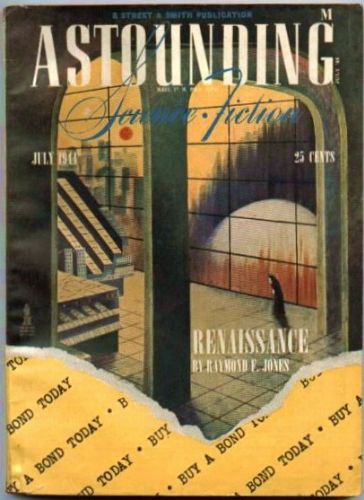
Is it me or are some of the 1944 covers of Astounding Science Fiction really bad?
“The Huddling Place” is a science fiction short story by Clifford D. Simak, which was first published in the July 1944 issue of Astounding Science Fiction and is therefore eligible for the 1945 Retro Hugos. The magazine version may be found online here. “The Huddling Place” is part of Simak’s City cycle and has been widely reprinted.
This review will also be crossposted to Retro Science Fiction Reviews.
Warning: Spoilers beyond this point!
“The Huddling Place” starts off with the funeral of one Nelson F. Webster. It might be a scene in any contemporary set story, if not for the fact that the pallbearers are robots and that Nelson F. Webster died in 2117, aged eighty-three.
Our narrator is Jerome A. Webster, son of the late Nelson F. Webster, and one of only three Websters still left alive. The other two are Jerome’s son Thomas, who will soon be leaving for Mars, and Jerome’s mother, who never gets a name. In the course of the funeral, We also get a brief rundown of the Websters (and a Webster father-in-law, William “Gramp” Stevens who is an important character in the first “City” story published earlier the same year) interred in the family crypt on the Webster estate. Again, only one woman is mentioned, Mary Webster, Jerome’s late wife.
For four generations now, the Websters have lived on a spacious estate with whispering pine trees, meadows, a rocky ridge and a stream full of trouts, ever since John J. Webster, great-great-grandfather of Jerome, moved there after humans abandoned cities in the twentieth century in favour of what the characters consider gracious living on huge lots of land, served by a small army of robots.
The story follows Jerome through his day, as he retreats into his study to mourn his father, not even bothering to say good-bye to the priest who conducted the funeral service. Instead, Jerome leaves the Websters’ faithful robot butler Jenkins to deal with the priest, just as he leaves him to deal with everything else.
We learn that Jerome never leaves his house, even though he spent several years as a doctor on Mars in his younger days. Nowadays, however, Jerome doesn’t see any need to leave his house. After all, modern technology allows him to speak to anybody, virtually visit any place, attend a concert or play, browse a library and conduct any business he might want to conduct, all from the comfort of his home. This short paragraph is probably the most prescient thing published in Astounding in the entire year of 1944, because the Internet allows us to do all of that from the comfort of our own home as well. Though I hope that most of us react to those possibilities a little differently than Jerome.
Jerome’s contemplations are interrupted by a virtual visit from an old friend, the Martian philosopher Juwain whom Jerome met during his time as a doctor on Mars. Juwain has come to pay his respects to the late Nelson F. Webster and also to ask why Jerome never physically returned to Mars for a visit, even though the Martians owe him a great debt, because Jerome wrote the book on Martian medicine. For we learn that the Martians never really had doctors before the humans arrived. Instead, they simply accepted illnesses as fatal. Meanwhile, Martians have come up with orderly and logical philosophy that may be applied as a practical tool, rather than the fumbling human attempts at philosophy. And Juwain is about to make a further breakthrough in philosophy, a breakthrough that will help both humans and Martians. A. Williams’ interior art depicts Juwain as a being with flimsy tentacle-like limbs and a huge domed head, which certainly suggests a species of philosophers.
This is not the first time in Astounding in the 1940s that different races and species are given different specialisations they are inherently suited for. Something similar can be found in the Jay Score stories by Eric Frank Russell, one of which – “Symbiotica” – was a finalist for the 1944 Retro Hugo. Though it’s certainly interesting that the superior Martian philosophy is orderly, logical and practically applicable, i.e. it is a type of philosophy that would have appealed to John W. Campbell. Meanwhile, humanity still gets to be superior, if only because medicine is a much more vital field than philosophy for the survival of any species.
The story picks up again at a spaceport, where Jerome sees his son Thomas off to Mars. Jerome can barely keep himself from begging Thomas to stay on Earth. Once the spaceship carrying Thomas to Mars has lifted off, Jerome suffers the mother of all panic attacks. He barely makes it across the open stretch of concrete back to the terminal building, where he huddles on a chair near the wall, terrified of the noise and the strangers all around him.
Jerome is desperate to return home at once, so he can feel safe again. However, the faithful robot butler Jenkins informs him that they can’t leave just yet, because the Websters’ private helicopter is in need of repair. Jerome freaks out even more. “I understand, sir,” Jenkins says, “Your father had it, too.”
Now Jenkins reveals that crippling agoraphobia apparently runs in the Webster family and usually sets in at around fifty. That’s the true reason why Jerome as well as all the Websters before him never leave their estate. Because they cannot.
Being a doctor, Jerome conducts an experiment and invites some two-hundred and fifty men (Simak’s word choice, not mine) to visit him. Only three of those invited actually show up, which suggests to Jerome that more and more of humanity (well, the male half) is succumbing to the same crippling agoraphobia that has affected him. This is, Jerome assumes, the result of humanity’s lifestyle living far away from each other on huge tracts of land, where they feel so comfortable that they simply cannot bear to leave the familiar surroundings, unless they absolutely have to. And maybe not even then.
Jerome’s theory is tested when he gets a call from a man called Clayborne, an old acquaintance from Mars. Clayborne works for the Martian Medical Commission and has contacted Jerome with an urgent request. After all, Jerome is the leading expert on the Martian brain and Clayborne has a patient who urgently needs a brain operation, an operation only Jerome can carry out. And that patient is none other than Jerome’s good friend Juwain who has been asking for Jerome.
“You’ll bring him here?” Jerome asks, only to be informed that Juwain cannot be moved. Jerome will have to go to Mars to operate him, otherwise Juwain will die.
“But I cannot come,” Jerome tells the increasingly (and understandably) irritated Clayborne. Surely he isn’t really needed, surely someone else can carry out the operation. Clayborne, however, won’t have none of that. He’s sending a spaceship straight to the Webster estate.
Soon thereafter, Jerome receives another call, this time from one Henderson, president of the World Committee, which appears to be the global government in Simak’s future. Henderson also insists that Jerome must go to Mars to save Juwain. Because if Juwain dies, the philosophical breakthrough he was about to achieve, a breakthrough which will advance humanity and Martians by a hundred thousand years, dies with him.
To be fair, Jerome is determined to at last try to go to Mars, even though he is utterly terrified. He also realises that even though humanity may have left the cities behind, they have still psychologically chained themselves to their homes. Finally, he realises that he has to break those chains and leave his comfortable home behind, just as humans left the cities behind some two hundred years before. So Jerome forces himself to pack a bag and promptly suffers yet another panic attack.
His panic attack is interrupted by Jenkins who arrives to tell him about a most extraordinary occurrence. A ship landed at the estate and wanted to take Jerome to Mars.
“They are here?” Jerome asks, “Why didn’t you call me?”
Jenkins declares that he did not want to bother Jerome, because the whole thing was just too preposterous. So Jenkins personally told the men to leave and when they refused, he threw out by force.
Poor Juwain is doomed and humanity will never learn the philosophical revelations he had in store for them. And all because of an overzealous robot butler.
 I enjoyed “Desertion”, the other Clifford D. Simak story I reviewed for the Retro Reviews project, a whole lot and it’s definitely going on my Retro Hugo ballot. I did not like “The Huddling Place” nearly as much. What is more, the story reminded me of what always irritated me about Simak’s stories, when I first read them as a teenager, namely the anti-urbanism.
Now I’m very much a city person and I was even more of a city person, when I was younger. My teenaged self wanted to live in some major international metropolis – London, New York or Paris were my top choices – and literally could not understand that there were people who actually enjoyed living in the countryside or in suburbs or small towns. I always assumed they were forced to live there due to jobs, money issues or families who had the idiotic idea that children should grow up in the countryside. Realising at age fifteen that American suburbs like the ones you always see in horror films were a real thing where real people lived utterly baffled me, because who would choose to live in a horror movie setting?
When I read about city world of Trantor, capital of the Galactic Empire from Isaac Asimov’s stories, I thought Trantor was the coolest place ever and immediately would have moved there, if that had been at all possible. And when I first encountered the City cycle by Clifford D. Simak at around the same time, I thought it was a horrible dystopia where human had abandoned the cities to live on country estates where nothing ever happens and no one ever goes anywhere, because there is nowhere to go. Worse, I strongly suspected that Simak was not aware that he was writing about what to me was a horrible dystopia.
My adult self has a more differentiated view of the City stories. Yes, Clifford D. Simak was clearly not a city person and obviously preferred the countryside. Just as he was obviously a dog person. Indeed, I was stunned that there is no dog anywhere in sight in “The Huddling Place”, because dogs are so prominent in Simak’s fiction, including the City stories.
However, even as early as “The Huddling Place” it is very clear that Simak does not view the cityless world he has created as an unalloyed good (and civilisation does eventually break down in the City cycle and humans die out, while dogs and ants take over the world). After all, Jerome A. Webster is a pitiful person, chained to his home and unable to leave even to save the life of his friend. Furthermore, Jerome is utterly dependent on Jenkins and the other robots. It isn’t Jerome himself who makes the fatal final decision, Jenkins makes it for him.
I vaguely remembered that the way the humans treated their robots as slaves to run their oversized estates was one of the things that annoyed me about the City cycle. However, upon rereading the story, I realised that it’s not so much the humans who are enslaving the robots. Instead, it’s the humans who are slaves to their robots. Furthermore, I also remembered Jenkins as wholly positive figure fully in the “robot as pathos” range, to quote Asimov’s classification of science fictional robots. But upon rereading, I found Jenkins an almost sinister figure. Does he truly have the best interests of Jerome and the other Websters at heart or is he slyly making Jerome even more reliant on him? After all, if not for Jenkins, it’s quite possible that Jerome might have managed to overcome his fears and gone to Mars after all.
 Agoraphobia is another theme that keeps popping up during the golden age, particularly among writers in the orbit of John W. Campbell and Astounding Science Fiction. Isaac Asimov, who suffered from agoraphobia himself, addressed the issue several times, most notably in the Elijah Baley and R. Daneel Olivaw novels. Asimov’s 1953 science fiction murder mystery The Caves of Steel is set on a future Earth that is pretty much the opposite of the world from Simak’s City stories. Here, humanity has retreated to huge domed cities and is terrified of any open space. The 1956 sequel The Naked Sun, meanwhile, is set on a world of suburban sprawl that is even more extreme than that of “The Huddling Place”. Here, too, humans live on huge estates tended by robots. But in The Naked Sun, the Solarians not only refuse to leave their palatial homes, they also cannot bear to be in the physical presence of other humans, even members of their own families. Indeed, the similarities between “The Huddling Place” and The Naked Sun are so pronounced that I wonder whether both stories aren’t the result of one of John W. Campbell’s infamous writing prompts.
It’s also interesting to view both “The Huddling Place” and The Naked Sun in the light of the trend towards suburbification after World War II. Because in the 1950s and 1960s, people all over the western world really did turn their back on cities in favour of suburbs built on what had been fields and meadows only a decade before. Of course, those people were far more likely to end up in a Levittown shoebox or a “garden city” housing estate than on a huge multigenerational estate like the Webster home. On the other hand, the McMansions that were popular in the US from the 1980s into the early 2000s do seem to show a trend towards a scaled down version of the Webster home. And while humans post WWII did not actually succumb crippling agoraphobia, people did stop going to cinemas, theatres, restaurants, bars, etc… for a while, preferring to stay at home and watch TV and have dinner parties in the privacy of their own homes. Suburbification is mainly associated with the postwar era, but now I wonder whether those trends were already noticeable in the 1930s and early 1940s and whether stories like “The Huddling Place” and The Naked Sun were a type of “If this goes on…” speculation.
In the real world, the trend towards suburbification and people retreating into the privacy of their homes eventually reversed, as younger people moved back into the cities, once derelict city neighbourhoods became extremely desirable places to live, while some suburbs withered and became places for old people, families and those who can’t afford to live in the city. Just as people started going out again and cinemas, theatres, restaurants, etc… rebounded. Furthermore, the postwar trend towards suburbification was a purely western phenomenon anyway. Beyond the western world, people continue to flock to the cities, because that’s where the jobs, the opportunities and the facilities are.
Indeed, the world Simak describes in “The Huddling Place” and the other City stories is pretty much unsustainable. It’s simply not possible for people to take up so much space, unless the world population has been drastically reduced. And in fact, I always assumed that only a minority of people, mainly in the US, lived like the Websters, while life and cities go on as normal in the rest of the world. And considering how very few women there are in the City stories, I also wonder whether women didn’t continue as normal, maybe even happy that the men had walled themselves up.
In many ways, “The Huddling Place” is a very American story. Now many of the stories I reviewed for the Retro Reviews project feel very American, but “The Huddling Place” is an extreme example, since the story’s idea of gracious country living is very American phenomenon. “The Huddling Place” is an early example of what Joanna Russ would eventually call galactic suburbia science fiction and one of the comparatively few that was written by a male author.
Since “The Huddling Place” is a Clifford D. Simak story, it is beautifully written. The nature descriptions do their best to make the reader understand just why Jerome loves his plot of land so much. The panic attack scenes are visceral and will bring back unpleasant memories to anybody who ever suffered a panic attack.
In fact, “The Huddling Place” feels more like a work of mid-century literary fiction than like the sort of hard science fiction normally found in the pages of Astounding. Maybe that is why John W. Campbell felt the need to add a blurb announcing that this story is an important extrapolation of social trends. In fact, if Jenkins and the other robots had been replaced by human servants, the spaceport with an airport or train station and if the dying Juwain had resided in a different country rather than on Mars, “The Huddling Place” wouldn’t have felt out of place in a 1940s issue of the Saturday Evening Post or the New Yorker.
A tale about crippling agoraphobia and the dangers of suburbification with rather sinister undertones for such a quiet story.
 “The Free-Lance of Space” by Edmond Hamilton is a space opera short story, which appeared in the May 1944 issue of Amazing Stories and is therefore eligible for the 1945 Retro Hugos. The story may be found here. This review will also be crossposted to Retro Science Fiction Reviews.
Warning: There will be spoilers in the following!
Like so many space operas and noir stories, “The Free-Lance of Space” starts out in a disreputable bar cum cosmic opium den near the Uranus spaceport. In a private room, two men are meeting, the Saturnian agent Brun Abo and the Earthman Rake Allan, the notorious Free-Lance, a broker and fixer who owes no allegiance to Earth or any other world, after he was kicked out of the Earth diplomatic corps, disgraced and outlawed.
Brun Abo has a job for Rake Allan. For it turns out that a Martian biologist named Doctor Su has discovered a drug that can revive people who have died of “spaceshock”, i.e. the sudden exposure to the vacuum of space. Such a drug is invaluable to any power who possesses it and therefore Brun Abo wants to acquire the formula for the Saturnian space navy, because it would give them the edge in case of an interplanetary war. The Saturnians aren’t the only ones interested in the formula, other worlds have made Su an offer as well. However, Doctor Su refused all of them and intends to return to Mars that very night. Abo now offers Rake Allan half a million Earth dollars, if he procures the formula for the Saturnians.
Allan listens to Abo’s story with interest, but he has no intention of selling the formula to the Saturnians. Instead, he’ll sell it to the highest bidder, whoever that might be. And so he overpowers Abo and leaves him in the intergalactic opium parlour, drugged out of his mind. Then Allan heads for the spaceport to catch the Draco, the spaceship that will take Doctor Su back to Mars. He gets lucky, too, for the Draco has been delayed, because half her crew got drunk on Uranus and had to be replaced.
Allan boards the Draco under an assumed name and secures a cabin for himself. Unfortunately, the cabin right next to Doctor Su’s is already taken by a young Earthwoman, so Allan has to improvise. He tries to sneak into the woman’s cabin and when he finds it already occupied, he sprays narcotic gas through the keyhole to knock the woman out.
However, Allan is in for a surprise, because the young woman in the cabin next to Doctor Su’s is also onboard under an assumed name. In truth she is Jean King of the Earth diplomatic service, Allan’s former co-worker and ex-lover. And she’s aboard the Draco for the same reason as Allan.
When Jean comes to again, she tells Allan that she isn’t looking to secure Doctor Su’s formula for Earth. Instead, she wants to keep the agents of other planets from stealing the formula, because Doctor Su is a true humanitarian (Martianitarian?) and wants to give the formula to the entire solar system rather than any one power.
Allan, however, is much more sceptical about the alleged noble motives of Jean and the Earth diplomatic corps. After all, the corps disowned him and left him to rot in a Venusian prison for two years, after a mission went south. Jean begs Allan to reconsider his decision, but he’s not listening. Instead, he gags Jean and continues with his mission.
He drugs Doctor Su with the same narcotic gas he used on Jean earlier and breaks into his cabin. He quickly find a sample of the elixir, but he can’t find the formula. So Allan has to wait for Doctor Su to wake up. He threatens Su with his blaster, even though the Free-Lance does not kill, and tricks him into revealing the whereabouts of the formula. Su begs Allan not to take the formula, because he can never reproduce it from memory. And besides, he really wants to give it to the whole solar system.
“Why didn’t you already publish it already then?” Allan asks, “Why wait?”
Su declares that he doesn’t want to publish the formula until it has been tested on a human being. That’s why he is returning to Mars, because he wants to test the formula. And Su’s chosen test subject is none other than his own son who died in a spaceship accident two years before and whose body being kept refrigerated on Mars. Su also begs Allan to leave him as much of the elixir as Su needs to revive his son and take the rest, if he must.
Su’s plight touches what remains of Allan’s conscience where Jean’s could not. He releases Jean and Su. “You win,” he tells them and advises Su to publish the formula as soon as he has tested it, because there will be other agents after it.
And indeed one of those other agents, a Jovian named Stakan Awl, attacks as soon as Allan has made his decision. Turns out that the Jovian secret service got the crew of the Draco drunk on Uranus to replace them with their own agents. Once safely in space, those agents take over the ship and proceed to procure the formula. However, Stakan Awl wants to test the formula first. And the test subject he picks is none other than Rake Allan.
As Allan is on his way to the nearest airlock (though Hamilton calls them “space-doors”), he manages to trick his guards and escape. He makes his way to the bridge and barricades himself in, intending to turn the Draco around and alert the Uranian space patrol. However, Stakan Awl has disabled the engines. Worse, the Jovians are about to cut their way onto the bridge. Allan cannot deal with them all. And if he is recaptured, the Jovians will kill not only him, but everybody aboard the Draco, because Jovians never leave witnesses.
So Allan decides on a risky gamble. The controls for the airlocks and life support system are on the bridge. So are spacesuits for emergencies. Allan put on one of those spacesuits and opens the airlocks all over the ship, just as the Jovians break down the door. Within seconds, Allan is the only person left alive aboard the Draco.
He closes the airlocks and starts up the life support system again. Then he races back to Doctor Su’s cabin to retrieve the elixir. He revives first Jean and then Doctor Su. Allan informs the stunned Doctor that his elixir works and has been tested on humans and that there are plenty more people to revive, the passengers and non-treacherous crew of the Draco and the Jovian agents, too, once they have been bound and disarmed.
So Doctor Su takes off to revive the rest of the passengers and crew, while Jean and Allan enjoy their reunion and revival some more. Jean asks Allan to return to Earth with her, for surely the diplomatic corps will forgive all his past transgressions after the great service he did to Earth and the entire solar system. Rake Allan confesses that he never forgot Jean and asks her to marry him. Jean accepts and Rake muses that they will probably get wedding presents from police forces of all nine planets now that the Free-Lance is settling down.
 “The Free-Lance of Space” is a neat action-packed spy thriller from one of the pioneers of the space opera subgenre as we know it. I’ve never warmed to E.E. Smith, even though his works are hugely important to the development of the science fiction genre. However, I’ve always liked the works of Edmond Hamilton who started writing space opera only a few years after Smith and whose Interstellar Patrol series is one of the founding texts of the space opera subgenre. But Edmond Hamilton’s work is also important to me personally, because the 1979 anime series based on Hamilton’s Captain Future series (which is eligible for the 1945 Retro Hugo for Best Series – hint, hint) was one of works which made me fall in love with science fiction, along with Star Wars, the original Star Trek, Time Tunnel and Raumpatrouille Orion.
“The Free-Lance of Space” is a fairly obscure Edmond Hamilton story and has been reprinted only once in 1974. Nonetheless, it has all the elements that make for a cracking good space adventure. The science is complete nonsense, of course. For starters, it makes no sense that Allan never even considers using the Draco‘s communication system to call for help. And opening the airlocks would have sucked everybody aboard the Draco into space. Furthermore, knowledge of how the vacuum of space works and how it affects the human body was purely theoretical at the time this story was written, though over in Nazi Germany Dr. Hubertus Strughold was putting those theories into practice via experiments carried out on concentration camp inmates, which did not stop NASA from recruiting him for the US space program.
In my review of “Highwayman of the Void” by Dirk Wylie a.k.a. Frederik Pohl, I noted that many science fiction stories of the golden age seem to be set in the same consensus version of the solar system, a solar system that has very little to do with the one we actually live in, but still influences science fiction to this day. “The Free-Lance of Space” is another story that is set in this pulp science fiction shared universe. However, “The Free-Lance of Space” is more than that. It very much feels like Edmond Hamilton was trying to write a Leigh Brackett story. And no, Brackett did not write this one and publish it under Hamilton’s name – the writing style is different.
Leigh Brackett and Edmond Hamilton would marry two and a half years after this story was published. Unlike the other science fiction power couple of the golden age Henry Kuttner and C.L. Moore, Brackett and Hamilton collaborated only once on “Stark and the Star Kings”, a story intended for Harlan Ellison’s The Last Dangerous Visions. But even though Brackett and Hamilton may not have collaborated very much, they did influence each other.
I first noticed this last year when I reviewed the 1949 Eric John Stark novella “Queen of the Martian Catacombs” a.k.a. The Secret of Sinharat shortly after I had reviewed Edmond Hamilton’s 1948 novel The Valley of Creation for Galactic Journey and realised that even though the settings of both stories were completely different, Himalaya in the late 1940s versus Mars in the far future, there were certain similarities with regard to characters, plot and theme. Reading “The Free-Lance of Space” shortly after reviewing several Leigh Brackett stories from the same year reveals yet more similarities.
Like so many Leigh Brackett protagonists, Rake Allan is an outlaw, a man alienated from his homeworld and embittered because Earth betrayed him. Like Leigh Brackett’s outlaw heroes, Rake Allan does have a personal code. “The Free-Lance does not kill,” he says at one point, ironically while threatening Doctor Su with a gun. And though some of the Jovian agents die in a shootout, Allan later insists that Su revive the Jovians killed when Allan opened the airlocks. Allan is also quickly overcome by his conscience, once he learns why Su developed the elixir. And like Rick Urquart from Leigh Brackett’s Shadow Over Mars and many other Leigh Brackett heroes over the years, Rake Allan realises at the end that love is more important than money and power.
We don’t get many physical descriptions of Rake Allan. We mainly learn that he is tall and rangy, another thing he shares with many Brackett heroes. Another thing we learn about Rake Allan is that he has brown skin. So we have another potential protagonist of colour. And this time around, he even looks dark-skinned in the interior art by Julian S. Krupa. Meanwhile, Jean King is clearly described as blonde, blue-eyed and white, so we likely have an interracial relationship as well.
Edmond Hamilton generally wrote strong female characters and Jean King, diplomat and secret agent, is no exception. In practice, she doesn’t get a whole lot to do and spends most of the story either tied up or frozen to death, but she has potential. The relationship between Rake Allan and Jean King also feels less rushed than some of Leigh Brackett’s romantic couples, but then Hamilton circumvents the insta-love problem by giving Rake and Jean a past romantic history.
Meanwhile, the spaceship with everybody aboard except for the protagonist unconscious and seemingly dead is reminiscent of Leigh Brackett’s novelette “The Veil of Astellar” where the protagonist finds himself in a similar situation, though for a very different reason.
“The Free-Lance of Space” is a highly enjoyable spy thriller in space. It’s a minor Hamilton, but nonetheless a story that deserves to be remembered more than it is.

Margo actually wears a sensible coverall for most of the novel, but the cover artist had to give her a brass bikini.
Shadow Over Mars by Leigh Brackett is a planetary romance novel, which appeared in the fall 1944 issue of Startling Stories and is therefore eligible for the 1945 Retro Hugos. The magazine version of the novel may be found here. This review will also be crossposted to Retro Science Fiction Reviews.
Many people will probably also know this novel under its alternate title The Nemesis from Terra, under which it was reprinted as one half of an Ace Double (the other half was Collision Course by Robert Silverberg) in 1961 and a few times since. Though unlike the Ace Double reprints of two Eric John Stark stories, which I reviewed for Galactic Journey last year, the only difference between Shadow Over Mars and The Nemesis from Terra seems to be the title. The text is otherwise unchanged, including a persistent misspelling of the Mars moon Deimos as “Diemos”.
Warning: There will be spoilers in the following!
Shadow Over Mars starts off in the ancient Martian city of Ruh, a location that I at least don’t remember from any other of Leigh Brackett’s Martian adventures. Protagonist Rick Gunn Urquart is on the run, trying to avoid the press gangs of the charmingly named Terran Exploitations Company (well, at least they’re honest and there’s something to be said for truth in advertising) who are hunting slaves for the mines they operate on Mars. Anybody who doesn’t run fast enough is fair game, because evil capitalists need cheap labour.
Rick is a typical Leigh Brackett outlaw protagonist, someone who ekes out a living on the margins of his society. Rick is a drifter, born in space, “in the hull of a tramp freighter…” he proudly declares at one point, “…and never left it since.” To the native Martians, Rick is an Earthman (and the titular nemesis from Terra), but that’s not how he views himself. And indeed it’s interesting that even though most of Leigh Brackett’s protagonists are nominally Earthpeople, they have little connection or loyalty to Earth and usually view themselves as something else.
Rick ended up stranded on Mars, when he was fired from his latest job on a spaceship crew after slugging a mate (we’re certain he deserved it). He’s dead broke, because he left what little money he had in the brothels of Mars. And so he is fair game for the press gangs of the Terran Exploitations Company, press gangs that consist of apelike Martian beings called anthropoids.
Rick easily kills the first batch of anthropoids with his trusty blaster, but the shots draw others and Rick has gotten trapped in a dead end in the maze-like streets of Ruh. Lucky for him, he spots the crack of light of an open door and forces his way inside.
The house is inhabited by an old Martian woman and her grandson. Rick tells them that he means them no harm, but that he will hide out until the press gangs have gone. The old woman offers to read his fortune. Rick doesn’t really believe in such things, but he humours the old woman anyway. Her pronouncements regarding his origin turn out to be surprisingly accurate. Then she tells Rick that he is the titular shadow that will fall upon Mars and suddenly attacks him with a knife. Ricks shoots her in self-defence and flees, only to promptly run into the arms of a press gang and end up in the very slave mines he tried so hard to avoid.
In the next few chapters, we encounter the rest of the players and the fractions that are fighting for control of Mars. For starters, there is the Terran Exploitations Company with its director Ed Fallon. Fallon’s righthand man is Jaffa Storm, a human telepath from Mercury who is described as tall and dark-skinned. So we have another main character of colour in this novel. But unlike Eric John Stark, Leigh Brackett’s other tall and dark-skinned Earthman from Mercury, Jaffa Storm is an unambiguous villain and a particularly nasty one, too.
On the Martian side, we have the boy king Haral and his general Beudach who are plotting to start a rebellion and kick the Earthpeople off Mars. The grandson of the old woman Rick killed immediately runs to Haral and Beudach to inform them about the prophecy and to demand the head of Rick Gunn Urquart as vengeance for his grandmother. Haral, Beudach and their supporters are only too happy to oblige, because they don’t want any Earthpeople ruling Mars, whether it’s the Terran Exploitations Company or Rick Urquart whose shadow will fall upon Mars. And so the hunt is on for Rick.
The third fraction is the Union Party (I’m sure it’s purely coincidental that the name of the party is reminiscent of the term “trade union), a group headed by Earthman Hugh St. John and Martian Eran Mak. They want to unite Earthpeople and Martians and establish a better society on Mars for everybody. However, that requires getting rid of Ed Fallon and his Terran Exploitations Company first. And so Fallon tries to bribe St. John with large sums of money, which St. John gratefully pockets while trying to find proof that Fallon is using slave labour in his mines, so he can report him to the authorities, because even the imperialist Terran Empire of Leigh Brackett’s stories frowns upon slavery. You’d figure that the press gangs roaming the streets of Martian cities and snatching people would be proof enough, but apparently not. And so St. John has sent a spy into Fallon’s lair, a young Earthwoman named Mayo McCall.
Mayo McCall is a spunky heroine and an all around awesome character. When Jaffa Storm forces a kiss on her, she kicks him in the balls. Nor does she take shit from anybody else. She’s probably my favourite female Leigh Brackett character. Mayo works as a technician for the Terran Exploitations Company and absolutely no one finds anything unusual about a woman working as a testing technician for a mining company. Of course, when Shadow Over Mars was written, plenty of women in the real world were working in factories, building airplanes and tanks, testing military equipment, etc… But in the speculative fiction of the golden age, spaceship crews, lab technicians, miners, etc… are all male and women only appear in a few stereotyped roles such as wife, mother, daughter, girlfriend/love interest, housewife, actress, nurse, etc… In this environment, Mayo McCall is a breath of fresh air.
Mayo just happens to be at work, when Rick stages a slave mutiny, because he’s not going to let himself be worked to death by the Terran Exploitations Company. At first, Rick’s revolt seems to be successful, until Jaffa Storm brings in a Banning Shocker, a weapon that also appears in “Queen of the Martian Catacombs”, the first Eric John Stark story. Eric John Stark is only threatened with the Banning Shocker, but in Shadow Over Mars we see it in action. And so Rick’s fellow mutineers are either killed or surrender one by one. Rick refuses to surrender and is about to be killed by Jaffa Storm and his men, when Mayo intervenes and tries to get Storm and Fallon to confess that they’re using slave labour. Unfortunately, Mayo is unmasked as a spy instead. In the resulting shoot-out, Rick and Mayo flee into the mine tunnels and eventually escape into a maze of fossilised bore tunnels left behind by the long extinct mud-worms of Mars.
If the huge Martian mud-worms seem a tad familiar to you, you’re not alone. Because those mud-worms are very clearly the ancestors of the sandworms from Frank Herbert’s classic novel Dune. And indeed, there is quite a bit of Brackett influence detectable in Dune. I guess Frank Herbert was a fan.
Rick and Mayo eventually escape the tunnels and find themselves in the Martian dessert, where they encounter a group of tiny winged people, a native Martian race that also appears elsewhere in Leigh Brackett’s work such as her 1949 novel Sea-Kings of Mars a.k.a. The Sword of Rhiannon. The winged people are allied with Haral and therefore immediately recognise Rick as the man all Mars is looking for. So he and Mayo are taken prisoner.
The winged people are planning to hand Rick over to Haral, Beudach and the grandson of the prophetess. Only a young woman named Kyra takes a liking to Rick, because he is so alive and she believes he could bring that life to dying Mars. Mayo agrees and thinks that Rick might be an asset to the Union Party. Rick himself isn’t sure what he believes except that he wouldn’t mind ruling Mars with Mayo by his side. Mayo points out that that’s not what she meant. She also tells Rick that she loves him, even though she isn’t sure if he is able to love anybody except himself.
Now I’m a big fan of Leigh Brackett, but one thing that often bothers me about her stories is that her characters tend to fall in love with each other a little too quickly. The most glaring example is Eric John Stark falling in love with the titular character of “Black Amazon of Mars” as soon as he realises that the masked Martian warlord he has been fighting is really an attractive woman, completely forgetting that she had him whipped nearly to death only two days before. The romance between Rick and Mayo does not come quite so out of nowhere – after all, they did survive the ordeal in the worm tunnels together. And to be fair, Rick isn’t entirely sure at this point whether he loves Mayo. He just knows that there is a connection between them and wants to see where it goes.
Nor are Rick and Mayo the only characters affected by insta-love. Kyra also falls in love with Rick at first sight, even though she knows that he doesn’t feel the same. Hugh St. John quietly pines for Mayo and Jaffa Storm also wants to possess her, even though Mayo kicked him in the balls at their first meeting. Maybe, humans from Mercury have a touch of masochism in Leigh Brackett’s version of the solar system.
What is more, believable romantic relationships are fairly rare in golden age science fiction. Leigh Brackett may tend towards insta-love, but at least her characters do get to have feeling at all, which is more than you can say for many other stories of the period. Of all the stories I reviewed for the Retro Reviews project, the most affecting love story not written by Leigh Brackett was that between a man and his spaceship. And I liked Rick and Mayo very much. They definitely have chemistry and I could easily imagine them being played by Humphrey Bogart and Lauren Bacall in a movie. Nonetheless, I would have preferred it if the relationship between Rick and Mayo had developed a little more slowly.
Though Rick and Mayo haven’t got much time, before their captors take them to Haral and his court. Rick won’t beg for his own life, but asks the Martians to let Mayo go. The Martians, however, have no intention of letting anybody go. And so Rick is crucified against the nearest wall, while the Martian chiefs continue to plot the overthrow of the Terran Exploitations Company.
The Martian war council is interrupted by Jaffa Storm and his troops, who kill the Martians, kidnap Mayo and leave Rick for dead. However, Rick is not dead, not yet. Nor is he the only survivor of the massacre. Haral’s general Beudach and the winged girl Kyra survived as well. Together, they free Rick. Beudach, who has been quite impressed by Rick’s courage and strength, clamps the collar of Ruh, symbol of the rulership over Mars, around Rick’s neck before succumbing to his injuries.
Now Rick has the collar and the prophecy to back him up, he and Kyra gather the troops. They persuade Martians and Earthpeople living on Mars to work together to bring down the Terran Exploitations Company. Rick also enlists the help of Hugh St. John and Eran Mak and their Union Party.

The cover of the 1951 edition shows Rick crashing a spaceship into the company headquarters.
Meanwhile, Jaffa Storm hasn’t been idle. He killed his boss Ed Fallon to take his place and is using his telepathic abilities to learn of his enemies’ plans before they can put them into action. To counter Storm’s abilities, Rick decides to do something completely unpredictable and crashes a spaceship into the headquarters of the Terran Exploitations Company. The element of surprise gives Rick the edge and the combined army of Martians and Earthpeople manage to overcome Storm’s forces. However, Storm has fled and taken Mayo with him.
Rick is determined to go after them, but first he has to deal with treachery from his own allies, when Hugh St. John and Eran Mak double-cross him. They knock Rick out, steal the collar of Ruh and tell Earthpeople and Martians that he betrayed them both. Then they put Rick on a spaceship bound for Earth with fifty thousand credits to make him go away. But Rick isn’t someone you can get rid of that easily. He uses the fifty thousand credits to bribe his way off the ship.
He finds Kyra who was mortally wounded in the attack on the Terran Exploitations Company. She dies in Rick’s arms, but not before telling him where Storm has fled with Mayo. I have to admit that I was disappointed that poor Kyra was fridged like that. Yes, obviously there was no future for Rick and her, but couldn’t Brackett have found someone else for her? Or have Kyra remain happily single and working to build a better Mars?
After many more ordeals, Rick finally tracks down Jaffa Storm in the polar cities of Mars, where an ancient non-human race lies in stasis and dreams, while their marvellous technology still lies around, ripe for the taking. Rick has no weapons, but nonetheless he manages to outwit Storm by using his telepathy against him. For while Storm can sense which move Rick is going to make next, he is unaware that Rick is lefthanded and therefore miscalculates his countermoves.
Rick kills Storm and rescues Mayo. Together, they head back to confront the treacherous Hugh St. John and Eran Mak. Rick tells them in no unclear terms that he will not be bought off with fifty thousand credits. After all, Rick tells them, he was the one who suffered, was crucified and almost killed on more than one occasion, while St. John and Mak sat around in their office twiddling their thumbs. Also, Rick knows the secrets of the polar cities with their fantastic weapons and he will use them if he has to.
Luckily, Rick has no interest in ruling Mars. St. John and Mak can have that job, thank you very much. Rick would much rather have Mayo – as well as a spaceship and a crew to explore the asteroid belt and Jupiter plus trading privileges. After all, he was born in space and that’s where he will return.

The 1961 Ace Double cover shows Rick in chains
No one wrote better planetary adventures than Leigh Brackett and Shadow Over Mars perfectly showcases her skills. There are thrills and action aplenty as well as twists and turns and the nigh psychedelic descriptions of alien landscapes that Brackett excelled at.
Shadow Over Mars was Brackett’s first science fiction novel (she also penned a hardboiled crime novel entitled No Good From a Corpse in the same year). In many ways it feels like a prototype for her later work, particularly the Eric John Stark stories as well as her 1949 novel Sea-Kings of Mars a.k.a. The Sword of Rhiannon. A lot of elements from this novel – the prophecy, the slave rebellion, the Banning Shocker, the polar cities of Mars with their mysterious non-human inhabitants, the winged people of Mars and the dark-skinned humans of Mercury – would all show up again in future stories.
But while Eric John Stark may be physically closer to Jaffa Storm, there are also many similarities between his character and Rick Urquart. Both are drifters without a home or a loyalty to any particular planet. Erik John Stark was an orphan raised by a Mercurian natives and refers to himself as N’chaka, the man without a tribe. Meanwhile, Rick was born in space and doesn’t belong on any planet.
Now most of Leigh Brackett’s protagonists are drifters and outlaws, but Rick Urquart is a little more cynical than most of them. Eric John Stark’s involvement with various uprisings against villainous capitalists and colonialists are inevitably motivated by idealism, even if he calls himself a mercenary. Rick, on the other hand, is mainly out for himself. His love for Mayo softens him somewhat, but he still has no qualms about blackmailing St. John and Mak to get what he wants. Though to be fair, St. John and Mak have it coming.
I can’t even blame them for not wanting Rick in charge of Mars, because Rick really isn’t the sort of person you’d want to put in charge of anything larger than a spaceship. Never mind that history has shown again and again that the people who lead the revolution are usually not the ones who end up ruling the country afterwards. Nonetheless, Rick is right. St. John and Mak did let him fight and suffer and bleed for their cause and then promptly turned on him. And even if Rick is plainly unsuited to ruling Mars, I can’t help but wonder how well Mars will do under the control of the backstabbing St. John and Mak. They are marginally better than Fallon and Storm, if only because they don’t enslave anybody (yet). But I can’t really imagine them being good rulers. Most likely, they will become the villainous government that the next outlaw hero has to take down in ten or twenty years’ time. Leigh Brackett obviously had a strong dislike of politicians and government and it often shows through in her fiction.

The cover of the edition I own has nothing to do with the story at all.
The Sad and Rabid Puppies generally seem to like Leigh Brackett, probably because of the 1970s Skaith trilogy with its evil space hippies and evil space socialists bleeding a beleaguered population dry. However, Leigh Brackett’s stories from the 1940s and early 1950s are extremely critical of colonialism, imperialism and capitalism and her heroes are often literal social justice warriors, fighting to liberate a downtrodden native population. These tendencies can be seen in the Eric John Stark stories as well as in the 1944 Retro Hugo finalist “The Citadel of Lost Ships”. Shadow Over Mars is another example of Leigh Brackett in social justice warrior mode. And the Terran Exploitations Company are the most blatantly evil capitalists I’ve ever come across in any Brackett story.
Rick and the kidnapped men slaving away in the mines of the Terran Exploitations Company wear chains and manacles and Rick is often depicted in chains on several of the covers this novel had over the years. Those chains bring to mind not only slavery in the antebellum South – abolished for not quite eighty years when this novel was published and therefore as far removed for 1940s audience as WWII and the Great Depression are for us – but also the chain gangs of convicts that still toiled in fields and built roads in the US South at the time Shadow Over Mars was published. Leigh Brackett often tackled contemporary social issues in her stories, which is why I’m so surprised that those who believe that good science fiction should be apolitical tend to embrace her work. But then, Leigh Brackett also wrote cracking good action, so maybe that makes it easier to overlook the blatantly political messages in her stories.
Like pretty much all stories of the golden age, Shadow Over Mars is dated in places. The apelike anthropoids the Terran Exploitations Company uses as disposable muscle are referred to as “black boys” by those on the receiving end of their fists, which is not a word choice anybody would make today. The smoking, always present in golden age speculative fiction, is also really notable here. Rick, Jaffa Storm and pretty much every other male character smokes. At one point, his trusty pack of cigarettes even save Rick from a pit full of flesh-eating psychedelic killer flowers.
But in spite of the dated aspects, Shadow Over Mars is another great and glorious adventure from the queen of space opera. It would make a great addition to the 1945 Retro Hugo ballot, especially since 1944 wasn’t a strong year for SFF novels.
“I, Rocket” by Ray Bradbury is a military science fiction short story, which appeared in the May 1944 issue of Amazing Stories and is therefore eligible for the 1945 Retro Hugos. The story may be found here. This review will also be crossposted to Retro Science Fiction Reviews.
Warning: There will be spoilers in the following!
As the title implies, “I, Rocket” is a story written from the POV of a spaceship. This isn’t all that unusual in the modern era, see the Imperial Radch trilogy by Ann Leckie or “Damage” by David D. Levine. But while the science fiction and fantasy of the golden age are full of sentient machines, often possessed or otherwise malevolent, I don’t know any other story of this period which has a machine, in this case a spaceship, as a POV character.
Pronouns are always tricky with non-human characters. And since neither the rocket nor Ray Bradbury have expressed a pronoun preference, I have decided to go with “she”, since seagoing ships and spaceships are traditionally referred to by feminine pronouns. Besides, the crew also refers to the rocket as “she”.
At the beginning of the story, the rocket is lying ruined on a barren pebbled plateau with twisted jets and bashed fore-plates. It will, the rocket calculates, take a few hundred years for rust and corrosion to break her down. And since the rocket has a lot of time on its hands, she decides to share her story.
The rocket was created as a warship to serve in the war between Earth and Mars. Her first captain was a man called Lamb, a man who is described as wrinkled brown leather with diamond eyes and uneven white teeth. Does this man that Captain Lamb is a man of colour or merely that he wears brown leather? It’s not entirely clear at this point, though Captain Lamb’s face is described as brown and wrinkled throughout, so I assume that he is indeed a man of colour.
The rocket experiences her first launch and notes that this is the first time she’s outside the hangar and the base to see the world. She is surprised to find that it is round. There are more surprises in store for our rocket. Momentum, zero gravity, the gravitational forces of other celestial bodies and the indescribable tides of space.
During the rocket’s first trip, we learn more about her crew. We learn that Captain Lamb is in love with a Martian dancer whom he hopes to take back to Earth with him after the war. The cook, meanwhile, is eager for revenge, because his parents died in a Martian attack. Two other crewmen, Conrad and Hillary, are in love with the same woman. The young navigator Ayres is experiencing a religious awakening, something which is apparently common among spaceship crews.
And then there are Anton Larion and Leigh Belloc, two crewmen who are planning to sabotage the rocket. The rocket is aware of their plot, but has no way of warning Captain Lamb and the rest of the crew. However, the rocket is resourceful. She deals with the saboteur Belloc and takes him out via a bursting oil pipe. During the confusion that follows, the second saboteur Larion blurts out a confession and tries to escape in a lifeboat. However, our rocket causes the airlock to malfunction, shooting Larion out into space. She likens this to an immune system reaction.
The rocket experiences her first battle and then many others. She also loses two crewmembers to the war. And when the war is finally over, our rocket is converted into a cargo vessel and given a new captain and crew. She transports freight from Venus and Mars to Earth for five years, until she crashes on a asteroid and her crew is killed.
The rocket lies wrecked on the pebbled plateau for four months, until a one-man patrol ship finds her. And the captain of that ship is none other than Captain Lamb, now patrolman, who misses his old ship just as much as she misses him and therefore set out to search for her when she was lost.
Captain Lamb confesses to the rocket that she was the only thing he ever truly loved. Apparently, things didn’t work out with the Martian dancer. It also turns out that Captain Lamb is no happier in peacetime than the rocket. However, the Captain tells the rocket, there is another war brewing, this time with Venus, and good rockets are always needed. And therefore, Captain Lamb will be back with a salvage and repair crew to make the rocket flight ready again and return her to Earth. “I’ll be captain of you again,” he says.
And so the rocket waits in anticipation for her captain to return.
 “I, Rocket” is a beautiful story about the love between a captain and his ship and the difficulties of old soldiers – whether human or metal – to function in peacetime. Ray Bradbury really was on fire in 1944 and I could fill the entire short story category on my Retro Hugo ballot solely with Bradbury stories.
Stories about sentient machinery were a thing during the golden age. “Ride the El to Doom” by Allison V. Harding features a sentient elevated train, “Killdozer!” by Theodore Sturgeon features a murderous bulldozer, “The Twonky” by C.L. Moore and Henry Kuttner features an overbearing radio-phonograph console. However, of all these stories “I, Rocket” is not just the only story actually narrated from the POV of a sentient machine, it’s also the only one where the sentient machine is unambiguously heroic.
Above, I compared “I, Rocket” to modern science fiction stories with spaceship protagonists. However, “I, Rocket” isn’t just a spiritual predecessor to the likes of Ancillary Justice by Ann Leckie or “Damage” by David D. Levine. It is a direct ancestor, because like “I, Rocket” both later stories very much hinge on the love between ships and their captains. And yes, “I, Rocket” is a love story, albeit a rather unconventional one.
Apart from Captain Lamb, the rest of the rocket’s crew are roughly sketched and yet these characters come alive in their brief interactions with the captain and each other, all observed by the rocket. When two of them die, we feel their loss as keenly as the rocket.
Of the conversations aboard the rocket, the one between Captain Lamb and the young pink-faced navigator Ayres, one of the two crewmembers who will die during the war, is interesting, because it suggests that most spacemen board their ships as staunch atheists, but find religion along the way, inspired by the grandeur of the cosmos. Religion is not a theme that frequently shows up in golden age science fiction – in fact, the only other story I reviewed where religion plays a role is “The Veil of Astellar” by Leigh Brackett – and if religion appears at all, it is usually portrayed negatively. Hence, the conversation between Lamb and Ayres and the implication that all spaceship crews are religious is so unusual.
In my review of “Highwayman of the Void” by Dirk Wylie a.k.a. Frederik Pohl, I noted that a lot of golden age science fiction seems to take place in the same consensus version of the solar system. “I, Rocket” is another story that is clearly set in the pulp science fiction shared universe. And so Martian dancers wear silver bells and Venusian spider-silk is a popular export good, just as in Leigh Brackett’s stories of the same period. But then, Ray Bradbury and Leigh Brackett were lifelong friends and critique partners (and even collaborated on one story), so Bradbury probably deliberately inserted those little Easter eggs referring to Brackett’s stories.
Ray Bradbury undoubtedly was one of the best stylists of the golden age and “I, Rocket” once again shows off his writing skills. Bradbury attempts to describe what the world and the universe would look like from the POV of a spaceship and likens the rocket’s mechanical components and processes going on inside her to the functions of the human body. I particularly liked a passage where the rocket lands on a planet for the first time and likens the mass and the gravity well to the libido and sex drive. But then, rockets are very phallic. Though it is depressing that the most erotic scene in all of the stories I reviewed for this project is that of a rocket landing on Mars.
Of the five Ray Bradbury stories I reviewed for the Retro Reviews project, one is directly about World War II and three others are stories about war, albeit war in space rather than on Earth. Bradbury never served in the army; he was declared medically unfit due to his bad eyesight. Yet he wrote a lot about wartime experiences, more than most other SFF writers active during World War II. It’s also notable that the protagonists of Ray Bradbury’s war stories are not soldiers, but a medic retrieving corpses from the battlefield (“Morgue Ship”), a wartime nurse turned murderous mermaid (“Undersea Guardians”), a newsreel photographer (“The Monster Maker”) and a war rocket respectively. Bradbury really seems to have wanted to make the point that civilian personnel and other non-combatants (and military vehicles like our rocket) can be as important and heroic as soldiers.
Unlike some of the other 1944 Ray Bradbury stories I reviewed, “I, Rocket” has been reprinted a couple of times. What is more, in 1961 Cele Goldsmith selected it as one of the seven best stories ever published in Amazing for the 35th anniversary issue alongside such classics as “I, Robot” by Eando Binder or “Armageddon 2419 A.D.” by Philip Francis Nolan, the story which introduced Buck Rogers to the world.
Another winner by Ray Bradbury in what was a very strong year for him.


 sending...